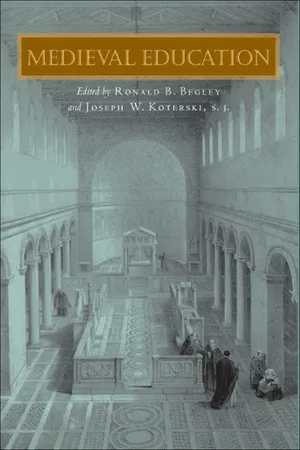
This volume offers original studies on the subject of medieval education, not only in the formal academic
sense typical of schools and universities but also in a broader cultural sense that includes law, liturgy, and the new religious orders of the high Middle Ages. Its essays explore the transmission of knowledge during the middle ages in various kinds of educational communities, including schools, scriptoria, universities, and workshops.
eBook - ePub
Medieval Education
- 234 pages
- English
- ePUB (mobile friendly)
- Available on iOS & Android
eBook - ePub
About this book
Information
Topic
StoriaSubtopic
Storia della didatticaMendicant Education
CHAPTER 8
Educational Communities in German Convents of the Franciscan and Dominican Provinces before 1350
ANDREAS RÜTHER*
This essay will treat, first of all, the mendicant orders at the universities of Europe in the thirteenth century and then turn to some specific examples from Germany in the fourteenth (Rüegg 1996; Pat-schovsky and Rabe 1994; Cobban 1975). Additionally, rather than treating the intellectual history of mendicant learning, I will be focusing primarily on the history of the mendicant movements in medieval society and academic life (Maierù 1994; Hoenen, Schneider, and Wier-land 1995). I am looking at the schools not as institutions but as organized groups of individuals who formed, inhabited, and constituted the convents as educational communities. I will not concentrate on individual scholars or their thinking and writings (Courtenay 1994, 325–50; Brunner and Wolf 1993). I will discuss the characteristics of the system of higher education and illustrate them by reference to certain specific studia in German lands. Therefore, I will cite evidence and statements about the development of regular schools from the rules, constitutions, and decisions of the general chapters; I will also present a short overview of ordinances for studies and curricula of preaching friars and Minorites. Subsequently, I will sketch the origins of colleges of the mendicant orders at the universities and offer a panorama of the provincial and local convent studies.
I would like to start with the Dominican position on the pursuit of knowledge and the evaluation of education (Mulchahey 1998; Renard 1977; Boyle 1978). The Dominican order had created absolutely new and independent institutions for teaching and study, for which Dominic himself had laid the foundation and which were developed further by the general chapters of 1259, 1305, and 1405. At the most basic level within a convent, a lector instructed all his brothers in theology and was supported by a director of students (the magister studentium). In addition to this, each province possessed one or two studia solemnia, which educated the convent lectors; among them the most significant had the title studia generalia—these individuals had the obligation to take two or three advanced students from each province for further education.
After the reform of studies in 1259 in Valenciennes, a differentiation of the system emerged with the creation of a studium solemne as a studium directed particularly at theology and a studium artium in which younger members would receive direction in grammar and dialectic as well as an introduction to philosophy. The lector prepared the younger brothers for the examination that was appropriate to the friars who sought permission to preach outside the convent. Such friars were required to be at least twenty-five years of age (constitution 2, chap. 10, 11–12; constitution 2, chap. 33, 5–6). A prerequisite for the attainment of permission to preach publicly was at least four years of theological studies, and these studies only the most qualified of the brothers were allowed to undertake.
The leadership of the order limited the number of students sent to the studia to three per province; each home province was to equip its scholars with money as well as three theological books that corresponded to the objects of study at the order’s studia (constitution 2, chap. 28, 22–23). The increasing numbers of young students who sought to complete their insufficient education through study of the arts within the order caused the general chapter to set a minimum age of eighteen for acceptance into the cloister; in addition to this, each cloister was supposed to set up a board of three qualified brothers who were to check prospective novices in morals and knowledge (constitution 1, chap. 14, 19–22).
Further prescriptions regarding studies found their way into the constitution later; each public preacher was required to study for three years but might study theology for another four years (constitution 2, chap. 30). The total time of study comprised eight years: the first two were devoted to philosophy; the second two were focused on history of the Church, basic theology, and canon law, and only then did actual theology make its entrance. The spiritual center of this system was Saint-Jacques in Paris, which had two chairs of theology at hand and exclusively educated those masters who had received the licentia ubique docendi (Verger 1995; 1997).
Now I will turn to a brief examination of the educational system and the Franciscan organization of studies (Roest 2000; Società internazionale 1990). The constitutions of Narbonne in 1260 included a separate chapter on the vows of poverty but no provision for access to books for education or rules about the paths of study; nor did the constitution of the order worked out by Bonaventure offer any selection criteria for scholars or urge an obligation to study. In this case as well, entrance to the convent was not to occur before the novice’s eighteenth year, for these beginning clerics had to be educated sufficiently in grammar and logic. Before the year-long novitiate, in which contemplation and the praying of the offices and theological studies stood at the center, an examination as to the content of the faith and knowledge of the sacraments took place. No academic degrees were awarded. After two to three years of attendance at a provincial institution, a study of four years could constitute a finished degree. The provincial chapters appointed the lectorships of the studia particularia.
For the central part of this essay, I will concern myself with the relationship between mendicant studia and the universities. The University of Paris was a union and congregation of magistri and scholars into a corporate education body; the University of Bologna, on the other hand, had an autonomous corporation of students who had charged a collegium doctorum with the task of instruction. The association of teachers and students together constituted the studium generale. Attendance at the studium generale meant at first nothing more than connection to a house in which the masters and students lived and were provided with food and in which academic exercises were conducted under the direction of a regent. In the colleges of masters, on the other hand, a circle of masters of arts lived in a collegial society similar to an endowment; these magistri studied at the superior faculties and gave instruction in philosophy. This principle of structure corresponded to that of the system of schools of the mendicant orders (Elm 1983; Berg 1977). The mendicant studies in these old university cities were created in the context of the universities and borrowed or copied their organization from them (Courtenay 1988; Wagner 1999). The erection of these order-specific schools of lectors in Paris was the framework for later successes in scholarly activities. In Bologna, for example, only the studia generalia of the mendicants offered the opportunity to study theology until the creation of the theological faculty in 1360, which was equipped with three Franciscan, two Augustinian (Gutiérrez 1970; Cendoya 1966), two Carmelite, one Dominican, and one Cluniac Benedictine professorships.
In contrast to the early Dominican studia in Paris, Bologna, and Oxford, the fourth in Cologne became a center of scholasticism long before the city could boast of a university like those other famous ones (Berg 1986; Duchardt 1993). In the biggest city of medieval Germany, Albertus Magnus, the first lector of the Dominican studium generale, had in 1248 an international audience, including the person who shortly afterward became the order’s central theologian (Thomas Aquinas) one hundred fifty years before there was a university there (Frank 1992, 1988). In 1307, as the mystic Meister Eckhart instructed the preachers of Cologne, Duns Scotus established the scholarly tradition of his own order’s schools at the Franciscan studium there. Eighty years later, at the founding of the University of Cologne, mendicant orders controlled five of the seven professorships and were freed from the obligation of enrollment through the statutes of 1392. University activities in Cologne took place in the convents of the orders, and for academic actions the members of the university assembled themselves in the rooms of the mendicant orders.
In Erfurt as well we find quite early on a structure similar to that of the later university. Emperor Charles IV set up a studium generale as early as 1360 because of the presence of the four higher schools of the mendicant orders and the great number of independent masters and scholars, although until then a privileged university had not existed (Schwinges 1996; Keck, Wiersing, and Wittstadt 1996; Fuchs 1995). At the founding of the university, the two great chapter churches and the three mendicant orders had to provide the resources for masters and establish chairs of theology. The three professors of the religious orders were also the leaders of the mendicant studia generalia and took part simultaneously in public disputations. The regent of the Augustinian studium, Angelus von Döbeln, who had received his doctorate in Paris, was the first dean of the university’s theological faculty. Among the colleges of Erfurt were found eight masters from Prague, and each college had a Licencius, a Baccalaureus formatus, a Sententiarius, and a Biblicus. Its most famous student and scholar would be the Augustinian friar Martin Luther.
Yet, their studium generale lagged behind the excellence of that of Magdeburg for a long time, but the elevation to the status of a university was denied to Magdeburg. This relationship could be compared to that between the cathedral school of Chartres and the early universities in the late twelfth century (Boockmann 1999). Before the first university in Central Europe was even established, there existed at twenty-eight places in the Holy Roman Empire such studia, in comparision to three hundred in the whole of Europe, a phenomenon sui generis. In the second half of the fourteenth century this flourishing development stopped, yet was continued in part in the numerous newly founded universities. In Prague, Vienna, Erfurt, and Cologne the former Dominican, Franciscan, Augustinian, and Carmelite schools (Flood 1988; Lickteig 1981; Lansink 1967) were incorporated into the theological faculties, a phenomenon see in Padua and Salamanca. In Heidelberg, Leipzig, Freiburg, Mainz, and Tübingen these studia did not serve as chairs in the later university; in Magdeburg and Strasbourg, despite the massive concentration of higher schools of each mendicant order, universities were not established there during the Middle Ages (Lorenz 1999; Schmidt 1998).
In Germany, mendicant schools provided in many cases the foundations of the later universities (Elm 1999; Barone 1993). The efficient systems of studia were highly developed and rationally organized. They became a fundamental part of the later medieval educational world. A centralized administration selected students and distributed teachers. Twenty-two regional schools with separate disciplines were founded in the Strasbourg Franciscan province, eight in the Cologne Augustinian province, and even four in the Lower German Carmelite province (Andermann and Andermann 2000; Kintzinger, Lorenz, and Walter, 1996; Dickerhof 1994). In general it has been estimated that there were nearly 700 to 800 mendicant schools of varying levels in the early fourteenth century altogether (Barone 1997; Le scuole 1978). The hierarchical system of education provided for cloister schools on the local level, whose task it was to equip the brothers with theological and pastoral knowledge, as well as familiarity with the scriptures. This was a temporary arrangement: regional groups were assembled for the organization of schools of arts and natural philosophy, within which an educational community moved at intervals on a principle of rotation. The studia particularia were intended to impart deeper, more comprehensive knowledge. Prerequisites for admission to these colleges for theology were attendance at all three types of particular studies—arts, logic, natural philosophy.
In this distributed and specialized system, which was similar—in structure, not in geographical unity—to that of the university, each master had a bachelor at his side who read under him. Smaller schools were directed by a principal lector; larger schools, by a qualified instructing body under the supervision of the provincial chapter, which controlled the distribution of the advanced students and teachers. This system was neither monolithic nor restricted to theological pursuits. For example, the Dominican commission of studies decided to add, alongside the system of purely theological schools, institutions for the exclusive instruction of secular knowledge: studia artium and studia philosophiae naturalis. In the vertical direction, studia solemnia were arranged that were attended by those members of the order of each province who did not aspire to any higher theological degrees. The backbone of this system of education remained the flexible exchange of people and ideas throughout Europe, making this network the most developed and advanced of its age.
WORKS CITED
Andermann, Ulrich, and Kurt Andermann, eds. 2000. Regionale Aspekte des frühen Schulwesens. Kraichtaler Kolloquien 2. Epfendorf: Bibliotheca-Academia.
Barone, Giulia. 1993. Les couvents des mendiants, des colleges déguisés? In Vocabulaire des collèges universitaires (XIIIe—XVIe siècles): Actes du colloque Leuven 9–11 avril 1992, edited by Olga Weijers. Turnhout, Belgium: Brepols.
——. 1997. Studi III: Gli ordini mendicanti. In Dizionario degli Istituti di Perfezione, edited by Guerrino Pelliccia and Giancarlo Rocca. Vol. 9. Rome: Edizioni Paolini.
Berg, Dieter. 1977. Armut und Wissenschaft: Beiträge zur Geschichte des Studienwesens der Bettelorden im 13. J...
Table of contents
- Cover Page
- Title Page
- Copyright Page
- Dedication
- Contents
- Introduction
- I. The Transmission of Knowledge
- II. Town and Gown
- III. Mendicant Education
- Contributors
- Appendix: Publications of Louis B. Pascoe, S.J.
- Name Index
- Subject Index
- Footnotes
Trusted by 375,005 students
Access to over 1.5 million titles for a fair monthly price.
Study more efficiently using our study tools.
Frequently asked questions
Yes, you can cancel anytime from the Subscription tab in your account settings on the Perlego website. Your subscription will stay active until the end of your current billing period. Learn how to cancel your subscription
No, books cannot be downloaded as external files, such as PDFs, for use outside of Perlego. However, you can download books within the Perlego app for offline reading on mobile or tablet. Learn how to download books offline
Perlego offers two plans: Essential and Complete
- Essential is ideal for learners and professionals who enjoy exploring a wide range of subjects. Access the Essential Library with 800,000+ trusted titles and best-sellers across business, personal growth, and the humanities. Includes unlimited reading time and Standard Read Aloud voice.
- Complete: Perfect for advanced learners and researchers needing full, unrestricted access. Unlock 1.5M+ books across hundreds of subjects, including academic and specialized titles. The Complete Plan also includes advanced features like Premium Read Aloud and Research Assistant.
We are an online textbook subscription service, where you can get access to an entire online library for less than the price of a single book per month. With over 1.5 million books across 990+ topics, we’ve got you covered! Learn about our mission
Look out for the read-aloud symbol on your next book to see if you can listen to it. The read-aloud tool reads text aloud for you, highlighting the text as it is being read. You can pause it, speed it up and slow it down. Learn more about Read Aloud
Yes! You can use the Perlego app on both iOS and Android devices to read anytime, anywhere — even offline. Perfect for commutes or when you’re on the go.
Please note we cannot support devices running on iOS 13 and Android 7 or earlier. Learn more about using the app
Please note we cannot support devices running on iOS 13 and Android 7 or earlier. Learn more about using the app
Yes, you can access Medieval Education by Ronald B. Begley, Joseph W. Koterski, Ronald B. Begley,Joseph W. Koterski, Ronald B. Begley, Joseph W. Koterski, S.J. in PDF and/or ePUB format, as well as other popular books in Storia & Storia della didattica. We have over 1.5 million books available in our catalogue for you to explore.