A synergy between academia and activism has long been a goal of both scholars and advocacy organizations in communications research. The essays in Communications Research in Action demonstrate, for the first time in one volume, how an effective partnership between the two can contribute to a more democratic public sphere by helping to break down the digital divide to allow greater access to critical technologies, democratizing the corporate ownership of the media industry, and offering myriad opportunities for varied articulation of individuals' ideas.
Essays spanning topics such as the effect of ownership concentration on children's television programming, the media's impact on community building, and the global consequences of communications research will not only be valuable to scholars, activists, and media policy makers but will also be instrumental in serving as a template for further exploration in collaboration.
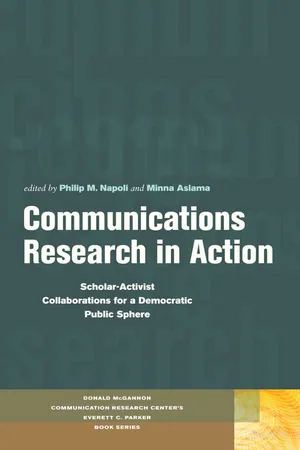
eBook - ePub
Communications Research in Action
Scholar-Activist Collaborations for a Democratic Public Sphere
- 384 pages
- English
- ePUB (mobile friendly)
- Available on iOS & Android
eBook - ePub
Communications Research in Action
Scholar-Activist Collaborations for a Democratic Public Sphere
About this book
Information
Publisher
Fordham University PressYear
2011Print ISBN
9780823233472
9780823233465
eBook ISBN
9780823233489
PART I
Explorations of Movement Actors
Strategies, Impacts, and Needs
This part is devoted to research that has examined the activities, needs, and effectiveness of organizations dedicated to the improvement of our media system. Public interest media advocacy and activism has become an increasingly common focus of research. Scholars are interested in these organizations for a variety of reasons, including trying to enhance our understanding of the policymaking process and social movements (Napoli 2009). And, of course, scholars often become members of these organizations in an effort to affect social change with their scholarship. The media reform/media justice movement is increasingly perceived as a social movement in its own right. Research can contribute not only to our understanding of this social movement and the role that movement actors play in enhancing our media system, but also to the development of strategic and organizational assessments that can serve the movement and efforts to strengthen it.
The chapters in this part reflect this wide range of research imperatives. They examine the nature of public interest media advocacy and activism, the broader political and institutional conditions under which such efforts operate, and the strategic approaches and information needs of individuals and organizations working in this field. Such topics represent a natural point of collaboration between academics and public interest and advocacy communities, as organizations in this area often desire to rigorously assess the fields in which they work and the effectiveness of their efforts; and a growing number of academics are becoming actively engaged as members of these organizations.
Kidd and Lee’s chapter describes a multifaceted action research project dedicated to enhancing digital inclusion, from the perspective of a scholar (Kidd), who has long served as a key member of the initiating organization—the Media Alliance. The authors describe their project as “embedded research,” given the close association between the researchers and the advocacy organization out of which this project emerged. Regan Shade analyzes institutionalized efforts in Canada to incubate collaborative research focused on the diffusion, use, and economic and policy implications of information and communications technologies. In so doing, she assesses the impact of projects dealing with policy issues surrounding information privacy and community networking. Dailey and Powell describe the results of research directed at assessing the information needs and information flows of the individuals and organizations working in the vital area of broadband deployment and diffusion. Their work seeks to enhance our understanding of the ecology of knowledge in which those working on behalf of public interest broadband policies operate.
Together, these chapters highlight three very different points of intersection between scholars and activists. Kidd and Lee’s chapter is representative of a growing body of what might be described as self-reflective research on public interest media advocacy and activism (McChesney 2007) that originates from within movement actors in a way that harkens back to Todd Gitlin’s groundbreaking research on the student antiwar movement in the 1960s and 1970s and how it was covered by the media. Regan Shade’s analysis focuses on the institutionalized efforts within a particular government (in this case, Canada) to foster just the kind of collaborative enterprises that are the focus of Kidd and Lee’s analysis. Regan Shade’s analysis highlights the extent to which policymakers often recognize how the public interest is served by scholar-activist collaborations and are willing to devote resources to fostering them. Dailey and Powell’s chapter focuses on a level of analysis that encompasses both of the previous chapters. Their unique focus on the information environment in which policymakers, scholars, and activists all work provides a rare examination of the information resources and communication processes that serve as the backbone for policy research, policy making, and policy advocacy (Cox and Fominaya 2009). Together, these chapters provide three distinct, interlocking paths of inquiry into better understanding public interest media advocacy and activism as a social movement.
Certainly, the long-term effectiveness of scholar-activist collaborations for a more democratic public sphere depends, at least in part, on enhancing our understanding of the individuals and organizations involved in such efforts, the challenges and opportunities they face, and the dynamics of the environments in which they are working to achieve their goals. The chapters in this section contribute to all of these areas.
REFERENCES
Cox, Laurence, and Cristina F. Fominaya. 2009. “Movement knowledge: What do we know, how do we create knowledge, and what do we do with it?” Interface: a journal for and about social movements 1 (1):1—20.
Gitlin, Todd. 2003. The Whole World Is Watching: Mass Media in the Making and Unmaking of the New Left. 2nd ed. Berkeley: University of California Press.
McChesney, Robert W. 2007. Communications Revolution: Critical Junctures and the Future of Media. New York: The New Press.
Napoli, Philip M. 2009. “Public Interest Media Advocacy and Activism as a Social Movement.” Communication Yearbook 33:385—429.
CHAPTER 1
Digital Inclusion
Working Both Sides of the Equation
DOROTHY KIDD with ELOISE LEE
This action research project examined efforts to enhance digital inclusion in San Antonio, a working-class immigrant neighborhood of East Oakland, California. Part of a longer-term collaboration between the researcher (Department of Media Studies at the University of San Francisco) and an advocacy organization (Media Alliance), it took place during the fall of 2008 and first half of 2009. The research encompassed the design, implementation, and evaluation of three interconnected initiatives: a media training program for women community leaders called Raising Our Voices (ROV); the planning of a local digital media production and distribution site; and municipal and national policy interventions regarding broadband communications.
The study is the latest in a series of academic-activist research collaborations involving Media Alliance, a thirty-three-year-old regional media resource, training, and advocacy organization. The first study analyzed the role of Media Alliance in advocating for the participation of underserved communities in the planning and implementation of municipal broadband, and the resultant widening of the frame of digital inclusion in a campaign in San Francisco (Ganghadaran 2007). The second study incorporated the lessons from the San Francisco municipal broadband campaign in a citizens’ advocacy toolkit (Levy et al. 2007).
The principal investigator, Dorothy Kidd, consulted on the two earlier studies. She has worked with Media Alliance for over ten years in many capacities, and now describes this approach as embedded research.1 Her own research agenda is focused on documenting the changing relations between mediascapes, movements concerning media change, and dominant and counter-public spheres in the San Francisco Bay region. Most recently, she has compared the current movements to democratize broadband and the Internet with the citizens’ telecommunications movements of the progressive era; she has also documented earlier versions of ROV and their contribution to antipoverty counter-public spheres (Kidd and Barker-Plummer 2009).
Building on this earlier body of research, the current study was based on two broad premises. First, efforts to democratize broadband communications (to provide universal service for all) needed to go beyond concepts of digital divide, or of the corporate and government-centered notions of digital inclusion (Gangadharan 2007). Although the provision of Internet access, computer training, and appropriate content for marginalized communities was necessary, Media Alliance argued that the vector of broadband development should be the development of communications capacity for marginalized communities themselves. Broadband planning for marginalized neighborhoods would then start from the community as producers of meaning for the public sphere, rather than as consumers of commercial content or of e-government information.
Second, U.S. citizens’ efforts at media reform in general—and in municipal broadband campaigns in particular—had suffered, in part, from fragmentation and division among activists working to bolster the media representation of marginalized communities seeking economic and racial justice; computer and Internet technology designers and trainers; and government policy reformers.
Action research, a participatory approach that expressly promotes social analysis and citizens’ action for democratic social change, was chosen as the most appropriate methodology. Action research is a form of participatory community-based research, based on generating knowledge for the “express purpose of taking action to promote social analysis and democratic social change” (Hearn et al. 2009, 46). This approach differs from some other social science research methodologies, in the “nature of the enquiry process, which is . . . an attempt to take action or provoke change or improvements of some kind (e.g., to design, implement or evaluate a new media application)” (49). Following from this approach, and consistent with her own skills, the principal investigator participated in all stages of the project, including planning, course design, workshop development and implementation, and evaluation. A methodological pluralism was adopted, employing a mix of methods, including informal in-person interviews, in-class discussions, written commentaries and evaluations, survey instruments, participant observation, and video/multimedia observation.
This chapter reviews the origins of the project, the results, and the specific implications for communications policy and academic-activist research collaborations.
MEDIA ALLIANCE AND THE BACKGROUND TO THE PROJECT
Begun by radical journalists in 1976, Media Alliance is one of the oldest membership-based media activist organizations in the United States. Its original goal was “system change from within the media field—reforming corporate journalism, through defending media workers’ rights, critiquing ‘bad’ journalism and celebrating the ‘good,’ and training aspiring journalists” (Hackett and Carroll 2006, 108). In the late 1990s, Media Alliance shifted in response to major changes in the local and national mediascapes. The commercial and public service media in the Bay Area, like most of the United States, had become increasingly conglomerated, with a much smaller professional work force and a marked shrinking of locally produced news and cultural programming, especially for historically marginalized communities (Kidd 2005; Barker-Plummer and Kidd 2009). A new media sector, directed by social justice organizations, was emerging, in addition to the alternative media sector.2 This development was partly in response to the ballooning “democratic deficit” (Hackett and Carroll 2006, 17); the growing awareness of the strategic value of communications for social change; and the greater availability of cheaper, easy-to-use digital production equipment and Internet distribution (Barker-Plummer and Kidd 2009).
Media Alliance initiated movement in three different vectors. First, they offered more support to the growing alternative media sector. They coordinated, for example, a campaign to democratize the venerable Pacifica Radio station, KPFA-FM, demanding increased representation of youth and communities of color in programming and governance; and another campaign to democratize the local PBS television station, KQED. Second, in 1999, they started Raising Our Voices, a computer and media training program for antipoverty and housing activists to produce journalism for mainstream and alternative media, and to develop their own media platforms. Third, they took on a role as regional hub in the emerging national media reform movement, best exemplified by their mobilization of public support against the further deregulation of media ownership rules by the Federal Communications Commission (FCC) (Chester 2007).
In 2003, Media Alliance saw a political opportunity closer to home in the pending municipal franchise agreement between the City of San Francisco and Comcast, the giant cable incumbent. Jeff Perlstein, the executive director at the time, argued that the local campaign could provide a public forum for addressing community concerns about the impact of big media corporations, for codifying mechanisms of accountability and for building long-haul efforts to win deep changes in the U.S. media system (Perlstein 2004). In the ensuing campaign, Perlstein bridged two of the sectors within the media reform movement; he drew on the expertise of two Washington-based media lobby organizations, as well as Media Alliance’s growing relationships with civil rights and social justice organizations.
THE PREMISE: DIGITAL INCLUSION
AND THE GREAT DIVIDE
Media Alliance and their allies argued that the inferior quality, slower transmission speeds, and greater expense of U.S. broadband, in comparison with most developed countries, was partly due to the failure of public policy. The national government’s deregulation of telecommunications had contributed to market concentration, in which a small number of giant telecommunications companies faced little pressure to lower their prices or upgrade their services, and especially to build digital services into “historically marginalized communities: low income neighborhoods, both urban and rural and . . . communities of color” (Levy et al. 2007, 4). The coalition’s demands included enhanced digital networking for community-based organizations and improved consumer equity in pricing and service quality across rich and poor neighborhoods (Kidd 2009).
The cable franchise campaign suddenly ended in 2004, when the City of San Francisco shut down the public process. By then, Media Alliance had already begun work with a new coalition to pressure the municipality of San Francisco to provide universally accessible broadband communication. Their allies included the do-it-yourself (DIY) computer and Internet technology communities (free/open software geeks, builders of community wireless networks, and refurbished computers), alternative and social justice media producers, civil rights and labor organizations, and city supervisors.
Media Alliance argued that the digital divide frame was inadequate. Instead, their approach combined “communication rights, media justice, and digital inclusion,” which they set out in the toolkit for their Internet4Every-one campaign:
Many countries now consider the ability to share information and communicate on the Internet as part of the basic human right to communicate. In the United States, universal Internet access and usage has become an issue of equity and justice—media justice. Together, the right to communicate and the goal of media justice inform what we call digital inclusion.
Digital inclusion means going beyond basic access to the Internet to ensure that everyone has the hardware, skills, resources, and technical support to make that access meaningful to daily life. It’s this meaningful engagement that allows us to shape the social, economic, and political conditions we require for a just and democratic society (Levy et al. 2007, 3).
The toolkit explained how digital inclusion should guide policy. Priority would be given to programs directed to youth, seniors, disabled people, and low-income households without adequate Internet capacity, as well as to strengthening community capacity (via the provision of hardware, training, and media content) over the technical or proprietary details of design and deployment. Media Alliance underscored six key dimensions of digital inclusion: “universal, affordable, and robust access to the Internet; affordable computers and Internet connections; affordable and culturally appropriate training and technical support; multilingual and culturally appropriate local content; community-based production and Web portals; responsive and accountable ownership; and sustainability, or the financial health to ensure programs’ vitality and longevity” (4).
Ultimately, the efforts to build a universally accessible public broadband system in San Francisco were short-lived. After the controversial awarding of the contract for municipal wireless to Google and Earthlink, the two companies withdrew in August 2007, due to a combination of technical and capital problems; and the City did not continue with a universal broadband plan. Media Alliance and their community advocate partners made some progress. They succeeded in incorporating public input into policy deliberations, especially from working class citizens of color; encouraged a pilot project in one of the most marginalized neighborhoods; and widened the frame of digital inclusion beyond the initial market- and government-based definitions (Gangadharan 2007). However, as Gangadharan points out, continuing public pressure, and th...
Table of contents
- Cover Page
- Title Page
- Copyright Page
- Contents
- Foreword
- Acknowledgments
- Introduction
- Part I: Explorations of Movement Actors: Strategies, Impacts, and Needs
- Part II: Media Ownership: Bridging Research and Regulation
- Part III: Alternative and Community Media: Discovering Needs and Opportunities
- Part IV: Communications Infrastructure: Rethinking Rights
- Part V: Assessment: Creating Support for Scholar-Activist Collaboration
- Conclusion: Bridging Gaps, Crossing Boundaries
- List of Contributors
- Index
Trusted by 375,005 students
Access to over 1.5 million titles for a fair monthly price.
Study more efficiently using our study tools.
Frequently asked questions
Yes, you can cancel anytime from the Subscription tab in your account settings on the Perlego website. Your subscription will stay active until the end of your current billing period. Learn how to cancel your subscription
No, books cannot be downloaded as external files, such as PDFs, for use outside of Perlego. However, you can download books within the Perlego app for offline reading on mobile or tablet. Learn how to download books offline
Perlego offers two plans: Essential and Complete
- Essential is ideal for learners and professionals who enjoy exploring a wide range of subjects. Access the Essential Library with 800,000+ trusted titles and best-sellers across business, personal growth, and the humanities. Includes unlimited reading time and Standard Read Aloud voice.
- Complete: Perfect for advanced learners and researchers needing full, unrestricted access. Unlock 1.5M+ books across hundreds of subjects, including academic and specialized titles. The Complete Plan also includes advanced features like Premium Read Aloud and Research Assistant.
We are an online textbook subscription service, where you can get access to an entire online library for less than the price of a single book per month. With over 1.5 million books across 990+ topics, we’ve got you covered! Learn about our mission
Look out for the read-aloud symbol on your next book to see if you can listen to it. The read-aloud tool reads text aloud for you, highlighting the text as it is being read. You can pause it, speed it up and slow it down. Learn more about Read Aloud
Yes! You can use the Perlego app on both iOS and Android devices to read anytime, anywhere — even offline. Perfect for commutes or when you’re on the go.
Please note we cannot support devices running on iOS 13 and Android 7 or earlier. Learn more about using the app
Please note we cannot support devices running on iOS 13 and Android 7 or earlier. Learn more about using the app
Yes, you can access Communications Research in Action by Philip M. Napoli, Minna Aslama, Philip M. Napoli,Minna Aslama in PDF and/or ePUB format, as well as other popular books in Social Sciences & Public Policy. We have over 1.5 million books available in our catalogue for you to explore.