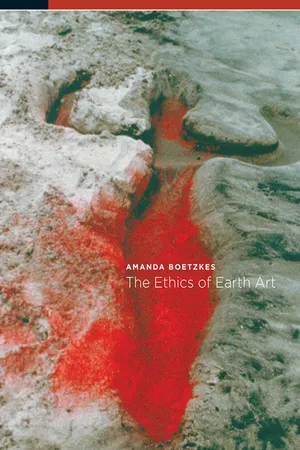
The Ethics of Earth Art
eBook - PDF

The Ethics of Earth Art

  1. 243 pages
  2. English
  3. PDF
  4. Available on iOS & Android
eBook - PDF

The Ethics of Earth Art

About this book

Since its inception in the 1960s, the earth art movement has sought to make visible the elusive presence of nature. Though most often associated with monumental land-based sculptures, earth art encompasses a wide range of media, from sculpture, body art performances, and installations to photographic interventions, public protest art, and community projects.
 
In The Ethics of Earth Art, Amanda Boetzkes analyzes the development of the earth art movement, arguing that such diverse artists as Robert Smithson, Ana Mendieta, James Turrell, Jackie Brookner, Olafur Eliasson, Basia Irland, and Ichi Ikeda are connected through their elucidation of the earth as a domain of ethical concern. Boetzkes contends that in basing their works’ relationship to the natural world on receptivity rather than representation, earth artists take an ethical stance that counters both the instrumental view that seeks to master nature and the Romantic view that posits a return to a mythical state of unencumbered continuity with nature. By incorporating receptive surfaces into their work—film footage of glaring sunlight, an aperture in a chamber that opens to the sky, or a porous armature on which vegetation grows—earth artists articulate the dilemma of representation that nature presents.
 
Revealing the fundamental difference between the human world and the earth, Boetzkes shows that earth art mediates the sensations of nature while allowing nature itself to remain irreducible to human signification.

Frequently asked questions

Yes, you can cancel anytime from the Subscription tab in your account settings on the Perlego website. Your subscription will stay active until the end of your current billing period. Learn how to cancel your subscription.
No, books cannot be downloaded as external files, such as PDFs, for use outside of Perlego. However, you can download books within the Perlego app for offline reading on mobile or tablet. Learn more here.
Perlego offers two plans: Essential and Complete
  • Essential is ideal for learners and professionals who enjoy exploring a wide range of subjects. Access the Essential Library with 800,000+ trusted titles and best-sellers across business, personal growth, and the humanities. Includes unlimited reading time and Standard Read Aloud voice.
  • Complete: Perfect for advanced learners and researchers needing full, unrestricted access. Unlock 1.4M+ books across hundreds of subjects, including academic and specialized titles. The Complete Plan also includes advanced features like Premium Read Aloud and Research Assistant.
Both plans are available with monthly, semester, or annual billing cycles.
We are an online textbook subscription service, where you can get access to an entire online library for less than the price of a single book per month. With over 1 million books across 1000+ topics, we’ve got you covered! Learn more here.
Look out for the read-aloud symbol on your next book to see if you can listen to it. The read-aloud tool reads text aloud for you, highlighting the text as it is being read. You can pause it, speed it up and slow it down. Learn more here.
Yes! You can use the Perlego app on both iOS or Android devices to read anytime, anywhere — even offline. Perfect for commutes or when you’re on the go.
Please note we cannot support devices running on iOS 13 and Android 7 or earlier. Learn more about using the app.
Yes, you can access The Ethics of Earth Art by Amanda Boetzkes in PDF and/or ePUB format, as well as other popular books in Philosophy & Art General. We have over one million books available in our catalogue for you to explore.

Information

Table of contents

  1. CONTENTS
  2. LIST OF ILLUSTRATIONS
  3. ACKNOWLEDGEMENTS
  4. Introduction: At the Limit of Form
  5. 1 Contemporary Art and the Nature of Site
  6. 2 Spiral Jetty: Allegory and the Recovery of the Elemental
  7. 3 Ecotechnology and the Receptive Surface
  8. 4 The Body as Limit
  9. Conclusion: Facing the Earth Ethically
  10. NOTES
  11. INDEX