Understanding the complex nature of international humanitarian action—particularly following natural disasters or armed conflicts—has been the mission of this unique series. This book explores the cutting-edge concerns that will affect how assistance is offered in the future.
Featuring twelve original essays by leading practitioners, policymakers, and scholars, the book is a state of the field report on problems, threats, and opportunities facing relief efforts in today's world.
With contributions from such authorities as Bernard Kouchner, founder of Doctors Without Borders, Charles McCormick, CEO of Save the Children, and physicians, military leaders, field workers, and others, the essays
confront the most critical issues facing the delivery of effective relief.
The issues include military and civilian cooperation in large-scale disasters, with special attention to the growth of private armies. How traditional nongovernmental organizations and faith-based agencies adapt to new
challenges is also explored. Ways to strengthen security for humanitarian workers, refugees, and internally displaced persons and those in transition after wars are also considered.
Bringing together diplomatic, military, medical, legal, political, religious, and ethical perspectives from experiences in Darfur, West Africa, Iraq, Pakistan, and other areas, the essays offer an authoritative inventory of where humanitarian relief has been, and how it must change to save lives and communities in peril.
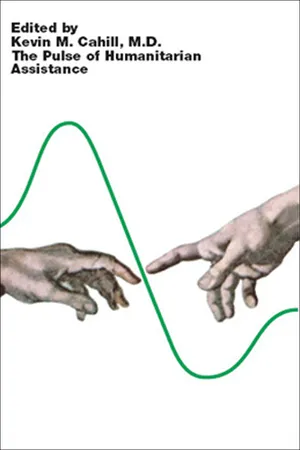
- 256 pages
- English
- ePUB (mobile friendly)
- Available on iOS & Android
eBook - ePub
The Pulse of Humanitarian Assistance
About this book
Information
Publisher
Fordham University PressYear
2013Print ISBN
9780823227167
9780823227150
eBook ISBN
9780823260737
Part 1
Moving Targets
1
Patients Without Borders
THE BIRTH OF A NEW CONCEPT OF HUMANITARIAN ACTION
FOR MANY YEARS I have been involved in fields of work that look different but which in fact converge: humanitarian action, politics, and public health. In all three areas I have promoted a now famous medical concept, very easy to state but difficult to set up: better to prevent than to treat. In many occasions, and in various capacities as volunteer or as a government minister, I have been confronted with the same problem: how to take care of poor people’s health, how to provide them access to prevention and care?
Biafra
In 1968, I was studying medicine, when the May ’68 movement led by students exploded in France. It was a very restless and creative year. But it was also a very selfish one. Few really cared about “remote” people’s misery. Most Westerners were focused on domestic or personal matters, surely worthy of interest, but with no comparison with the difficulties that were assaulting those whose voice was never heard. France had entered into a new long-lasting period of abundance and mass consumption.
That year my personal and decisive shock was the war in Biafra. There, I worked with the International Committees for the Red Cross (ICRC)1 and faced reality. The wounded, the starving children … all of them were denied respect and care because of the supposedly protective Geneva agreements. But we were doctors and we wanted to help different people whose pain and poverty we discovered. The profession had the advantage of being productive across borders and serving a quasi-universal ethical interest. If the sick called on us, we would come, especially if it was forbidden, and sometimes when it was impossible.
The Responsibility of Protection
Nationalism was a permanent threat, and indeed often an enemy. In the 1950s and 1960s, the principle that dominated international law was based essentially on the idea of sovereignty of nations. It was therefore out of the question to interfere into the internal politics of states that depended only on existing governments, even if these did not emanate from the sovereignty of the people.
Any interference generated unanimous criticism from international law specialists from both Western and Eastern countries. But in Biafra we discovered the necessity of free speech, and we became illegal in order to change the law. The other people’s suffering belonged to no one. It is intolerable for governments to consider themselves as the owners of the suffering that they cause. I respect the power, sovereignty, and the legal power of every state, especially since these are supposed to guarantee the well-being of its people.
We only demand that these powers be exercised in a manner that is more humanitarian and, therefore, more human. I believe that a government that has nothing to hide could not pull a victim away from the stethoscope of a doctor, or deprive an ordinary man from the advice of a lawyer. Our methods were based on a principle of subsidiarity. It was only after all national resources have been exhausted that external assistance should be provided. This is what led me, with some of my friends, to create, in 1971, Doctors Without Borders, today known as the “French doctors.” We were taken for fools for a long time before being awarded the Nobel Peace Prize in 1999.
The French doctors are now fifteen thousand worldwide; they operate in forty countries, and, only for France, its yearly budget amounts to 115.2 million.2 Unfortunately, moving from one humanitarian crisis to the other, we had to face problems of leadership—inside our group, which like any other, soon developed power struggles in its own ranks, but also, of course, within the country, with the political and social system that we were suddenly involved with and which, in turn, had to deal with us. We had to face diversity within our organization—doctors and nurses coming from various religious, philosophical, or political obediences. Our challenge was primarily to confront and convince various ethnic groups that did not share our own conception of medicine and health care. In 1981 I founded “Doctors of the World,” which is now present in forty-six countries.
In 1987, at a Law and Humanitarian Morality symposium, I proposed, with my friend Mario Bettati, that the French government should adopt the notion of the right of interference. In 1988, United Nations Resolution 43–131 recognized the right of access to victims of natural disasters or similar emergency situations. It was welcomed in Western countries, and was not opposed by, though it sometimes worried, developing countries that feared colonialism in disguise. Thanks to this new approach, French organizations were able to enter Soviet Armenia in 1988. Six months later, François Mitterrand affirmed: “the obligation of non-interference stops exactly where the risk of non assistance begins.” In his speech of July 14, 1991, he reminded us that: “France took the initiative for this rather extraordinary right in world history, which is a kind of right of interference inside a country when a section of its population is persecuted.” The following year, Pope John Paul II rallied to the right of interference in order to block the aggressor’s hand in Bosnia.
STATE OF AFFAIRS
Health Inequalities
I have spent almost forty years working in nongovernmental organizations (NGOs), not in administrative headquarters, but in the field, on all continents and in almost all the wars and conflicts the earth has suffered since the 1970s. I still refuse to accept that the sick are dying while treatments exist, and I want to explain why this is not enough, why we, all together, have to develop a new idea, to work on “Patients Without Borders.”
The inevitability of suffering and needless death can be eased, perhaps even broken. This is yet to be seen. It will depend on the rich—those of us with wealth and security—on our money and our taste for risk. I tend to be an optimist. It is a race against time. We know what has to be done: a worldwide health insurance system. We can start small but the movement is now taking form for a worldwide tax, a universal income. I am not claiming it will be financially easy, nor would it be simple in terms of infrastructure, but it is a fight we are winning. It is a trend that is catching on.
In poor countries, nearly eight hundred million people do not have enough to eat to stay healthy. Every day, without a guaranteed source of food, they begin their quest; that was their main occupation. Then AIDS arrived, the desert increased, wars multiplied, entire populations were dispersed, and what once was considered worse still is now imaginable. Particularly in Africa, where humanity itself began, the ills of the earth and the sufferance of people are accumulating.
The health of the continent in greatest difficulty requires concrete and urgent action. On top of increasingly lethal infectious diseases, famine or, at the very least, nutritional deficiencies and chronic malnutrition is a problem for many, coupled with the increasing emergence of new and related pathologies. The figures speak for themselves; cases of child mortality, an avoidable problem, can be counted in millions. Diarrhea, pneumonia, measles, tetanus, meningitis, tuberculosis, and malaria subsist when all that is needed is to improve hygiene, to obtain drinking water, and to provide proper vaccinations and some basic medicines.
This is all acquired knowledge, and yet these children continue to die, mainly from indifference. Despite the efforts made by some NGOs, despite the basic treatment and vaccination programs provided by the World Health Organization (WHO) and United Nations Childrens Fund (UNICEF), despite the World Food Program (WFP) and the Food and Agriculture Organization (FAO), children are dying because we provide them with only drops of aid in the desert. We who suffer from plethora and obesity do not know how to share or distribute. We have made the twentieth century one of spectacular growth in inequalities of health, living standards, and knowledge. The relationship of wealth between rich and poor countries has risen from four to eighty in one hundred years (i.e., twenty times greater). But I am not only speaking of statistics.
The WHO reports that:
While a baby born in Japan today can expect to live about 85 years, a girl born at the same moment in Sierra Leone has a life expectancy of 36 years. This Japanese child will receive education, vaccination services and adequate nutrition. If she becomes a mother she will benefit from high quality maternity care. Growing older she will have good treatment services and will receive medication worth about 550 dollars a year. The Sierra Leone girl will be under weight throughout childhood and won’t have any immunizations. She will marry in adolescence and will give birth to six or more children without any assistance. One or more of her babies will die in infancy. If she falls sick she will have an average medication worth about 3 dollars a year. Surviving middle age, she will develop chronic diseases but without any access to treatment. She will die alone.3
Africa is the poorest continent. For example, in rich countries, the total of annual health expenses per inhabitant is $3,100 (11 percent of gross domestic product [GDP]) in 2002,4 whereas it represents only $81 (6 percent GDP) in developing countries.5 In Africa, the situation is even worse with an average of $37 per inhabitant (5.5 percent GDP). The number of hospital beds is 7.5 per 1,000 inhabitants in rich countries while it is 1.2 in Africa. The number of doctors is 1 per 500 inhabitants in rich countries and only 1 per 25,000 in the poorest countries.
Fighting Hunger and Malnutrition in the World
Nutrition in Africa is an ongoing tragedy; malnutrition begins in the womb. It worsens at birth by undernourished breastfeeding women. Calorie insufficiency leads to malnutrition, growth and development problems, measles, diarrhea, and bronchitis. But these are not the only diseases, which we describe as “everyday,” that are killing children. There are many other diseases that thrive on malnutrition and, in turn, contribute to malnutrition.
AIDS an Example of International Cooperation
This epidemic renews today the awakening of the need for an international solidarity. It reveals essential needs. The virus was announced for the first time in 1981 within the American male homosexual community. In 2005, 40.3 million people are living with HIV, 4.9 million are newly infected, and 3.1 million are dead. These figures are underestimations since millions of patients from China and India need to be recorded.
Several recent initiatives have given a new impulse to the fight against AIDS. In particular was the launching, at the end of April 2001, by UN Secretary-General Kofi Annan of a Global Fund devoted to the fight against AIDS, tuberculosis, and malaria. The goal of this fund is to collect $7–10 billion per year in contributions from rich nations; the United States is to give $200 million, while France has committed €150 million over three years. The fund seeks the assistance of the large, transnational corporations, companies, and private foundations.
Some of the private foundations also implement their own programs, with the AIDS Vaccination Initiative (IAVI) launched in 1994 by the Rockefeller Foundation. This program develops vaccines against AIDS and coordinates research. Virologists, immunologists, and vaccinologists work together to study the scientific barriers with the development of the vaccines against AIDS, and in 1998 IAVI published its “Scientific Blueprint for AIDS Vaccine Development,” a strategic plan to coordinate the efforts of world scientists.
At the Abidjan Conference (CISMA) in 1997, France strongly defended equal access to health care for HIV/AIDS treatment. Because of this position and recommendations from the Extraordinary General Meeting of the United Nations on HIV/AIDS of June 25–27, 2001, the French government took the initiative of setting up Esther.6
In order to improve the developing countries’ capacity to provide treatment for people living with HIV/AIDS, the Esther public interest group supports partnerships that coordinate care through hospitals and social networks in a long-term perspective. Its main objectives are implementing high-quality care for people living with HIV/AIDS, encouraging access to existing services, and helping to improve the social and economic environment of persons affected.
Its program is based on five work axes: focus on hospital twinning and the partnership approach, improving health care conditions by enhancing technical platforms and hospital equipment supply, supporting national health care strategies for people living with HIV/AIDS by encouraging national solidarity systems, promoting and supporting the implementation of a continuous care strategy, and taking part in developing joint actions.
As a result of these initiatives, 1,128 health care professionals from the social sector and associations have been trained, equipment setup, conventions signed with 10 countries: Mali, Senegal, Burkina Faso, Ivory Coast, Benin, Cameroon, Gabon, Cambodia, Vietnam, and Morocco. One million seven hundred thousand euros have already been devoted to financing medicine, reagents and consumables in eight countries where Esther intervenes. This sum makes up 40 percent of Esther’s financial commitments on the ground, while waiting for the financing of antiretroviral therapies (ARVs) by the Global Fund, and provides relief in cases where there is a lack of consumables and reagents. There is, however, insufficient antiretroviral therapy in the whole of sub-Saharan Africa despite recent efforts by countries such as Botswana, Cameroon, Nigeria, and Uganda. Another priority for the Esther public interest group is intensifying prevention programs by fighting stigmatization and discrimination.
Finally, let us not forget the third major problem still not under control: malaria. Again, Africa is the worst affected continent, with 90 percent of the world’s cases of malaria. The situation worsened when the parasite developed a resistance to most medicines, in particular to chloroquine. How can we ever really be sure how many die from the disease when they live so far from treatment and medication? Does this data, often gathered empirically, provide us with a benchmark below which the situation becomes unacceptable? As we search in the secure environment of our own countries, our own levels of acceptable risk are so miniscule that even our sophisticated devices cannot measure such a small risk. How can we judge levels of acceptability?
Consider, for example, the complications this lethal disease has for pregnant women: severe anemia, hypoxia for the unborn child, development problems. Pregnancy remains the greatest risk for a woman: giving birth often becomes a question of death. In some African countries, the maternal mortality rate can reach more than 1,000 for 100,000 births, or one woman in every hundred dying during or as a result of her pregnancy. Is this not the most shocking of risks? Has AIDS distorted our ability to look at the dysfunctions of the world?
What can be said of those forgotten and abandoned diseases that no one is taking care of, like sleeping sickness, which still kills thousands, and whose sources of transmission are on the increase due to disorganized health systems? It can only be treated with fifty-year-old medicines that are dangerous and toxic; no other treatments are available because no medical research has been undertaken. Pharmaceutical companies simply are not interested in these sick people, who most often remain untreatable. Less than 10 percent of health research funding is devoted to the 90 percent of diseases that make up the burden of diseases in the world.
CONCLUSION
If we believe that the health of people is a universal good, capable of transcending cultures, religions, and beliefs, if we all aspire to this around the world, we need to define a level of health that is compatible with life, and not merely with survival. Let us not take solace in the naïve concepts of the WHO; for example, their definition of health as “the complete state of physical and mental well-being.” No one aware of the state of the world we live in could accept such a mechanistic definition, except for rare moments of lovemaking ecstasy.
As a distinguished French philosopher7 has pointed out, health is not the absence of disease, but an ability to withstand one’s environment. Withstanding all these ills is to refuse the factors that create them. What are the choices we have? Refusal. Refusal of fatalism, barbarity, and dictatorship, refusal of the confiscation of goods, technology, knowledge, and power. The struggle against illiteracy, and the promotion of the place of women in schools, and in decisive positions, with concrete actions whose positive effects are largely valued and recognized.
These actions are a primary necessity, but this alone is not enough. The world’s organization should be built on respect for the rights of its inhabitants. Then a world in which there is the inevitability of massive and recurrent famine would not exist. Our planet can feed six billion human beings today and ten billion tomorrow. We only need to make a choice: a choice to share and to intervene, a choice to respect the rights of life.
The French health monitoring system analyzes and surveys the various populations of the world and is able to identify the risks and anticipate health and human catastrophes. Warning is, therefore, possible. Must we, and can we, let these hungry people die? The choice of society is a political one, a choice for which we have to accept responsibility. Therein lies the ability to act. All those who share the immense privilege of living in a democracy have the responsibility to become directly involved.
We must fight against our fears, fears that generate useless, disproportionate, harmful withdrawal. Of course every victim has the right to our compassion. And they should be counted one by one. But think how we react to disasters with such a feeling of indifference. The six hundred dead from Severe Acute Respiratory Syndrome (SARS) in ...
Table of contents
- Cover Page
- Title Page
- Copyright Page
- Dedication
- Contents
- Acknowledgments
- Acronyms
- Introduction
- Part 1 Moving Targets
- Part 2 Military-Civilian Cooperation
- Part 3 Post-Conflict Issues
- Part 4 The NGO Perspective
- Notes
- Contributors
- About the Center for International Humanitarian Cooperation and the Institute for International Humanitarian Affairs
Trusted by 375,005 students
Access to over 1.5 million titles for a fair monthly price.
Study more efficiently using our study tools.
Frequently asked questions
Yes, you can cancel anytime from the Subscription tab in your account settings on the Perlego website. Your subscription will stay active until the end of your current billing period. Learn how to cancel your subscription
No, books cannot be downloaded as external files, such as PDFs, for use outside of Perlego. However, you can download books within the Perlego app for offline reading on mobile or tablet. Learn how to download books offline
Perlego offers two plans: Essential and Complete
- Essential is ideal for learners and professionals who enjoy exploring a wide range of subjects. Access the Essential Library with 800,000+ trusted titles and best-sellers across business, personal growth, and the humanities. Includes unlimited reading time and Standard Read Aloud voice.
- Complete: Perfect for advanced learners and researchers needing full, unrestricted access. Unlock 1.5M+ books across hundreds of subjects, including academic and specialized titles. The Complete Plan also includes advanced features like Premium Read Aloud and Research Assistant.
We are an online textbook subscription service, where you can get access to an entire online library for less than the price of a single book per month. With over 1.5 million books across 990+ topics, we’ve got you covered! Learn about our mission
Look out for the read-aloud symbol on your next book to see if you can listen to it. The read-aloud tool reads text aloud for you, highlighting the text as it is being read. You can pause it, speed it up and slow it down. Learn more about Read Aloud
Yes! You can use the Perlego app on both iOS and Android devices to read anytime, anywhere — even offline. Perfect for commutes or when you’re on the go.
Please note we cannot support devices running on iOS 13 and Android 7 or earlier. Learn more about using the app
Please note we cannot support devices running on iOS 13 and Android 7 or earlier. Learn more about using the app
Yes, you can access The Pulse of Humanitarian Assistance by Kevin M. Cahill, Kevin M. Cahill, M.D. in PDF and/or ePUB format, as well as other popular books in Social Sciences & Human Rights. We have over 1.5 million books available in our catalogue for you to explore.