The title of this book translates one of the many ways in which Lucretius names the basic matter from which the world is made in De rerum natura. In Lucretius, and in the strain of thought followed in this study, matter is always in motion, always differing from itself and yet always also made of the same stuff. From the pious Lucy Hutchinson's all but complete translation of the Roman epic poem to Margaret Cavendish's repudiation of atomism (but not of its fundamental problematic of sameness and difference), a central concern of this book is
how a thoroughgoing materialism can be read alongside other strains in the thought of the early modern period, particularly Christianity.
A chapter moves from Milton's monism to his angels and their insistent corporeality. Milton's angels have sex, and, throughout, this study emphasizes the consequences for thinking about sexuality offered by Lucretian materialism. Sameness of matter is not simply a question of same-sex sex, and the relations of atoms in Cavendish and Hutchinson are replicated in the terms in which they imagine marriages of partners who are also their doubles. Likewise, Spenser's knights in the 1590 Faerie Queene pursue the virtues of Holiness, Temperance, and Chastity in quests that take the reader on a path of askesis of the kind that Lucretius
recommends and that Foucault studied in the final volumes of his history of sexuality.
Although English literature is the book's main concern, it first contemplates relations between Lucretian matter and Pauline flesh by way of Tintoretto's painting The Conversion of St. Paul. Theoretical issues raised in the work of Agamben and Badiou, among others, lead to a chapter that takes up the role that Lucretius has played in theory, from Bergson and Marx to Foucault and Deleuze.
This study should be of concern to students of religion, philosophy, gender, and sexuality, especially as they impinge on questions of representation.
eBook - ePub
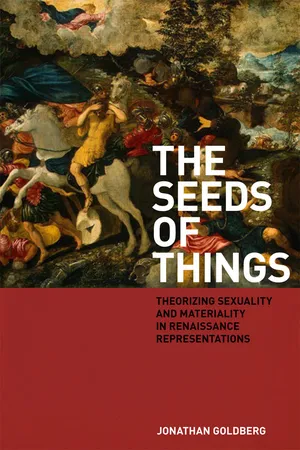
The Seeds of Things
Theorizing Sexuality and Materiality in Renaissance Representations
- 256 pages
- English
- ePUB (mobile friendly)
- Available on iOS & Android
eBook - ePub
The Seeds of Things
Theorizing Sexuality and Materiality in Renaissance Representations
About this book
Information
Publisher
Fordham University PressYear
2009Print ISBN
9780823230679
9780823230662
eBook ISBN
9780823230686
Topic
PhilosophySubtopic
Aesthetics in PhilosophyONE
Conversions: Around Tintoretto
This chapter opens with work of Leo Bersani and Ulysse Dutoit that follows upon Bersani’s turn from a psychoanalytic version of the subject whose desire testifies to a primordial lack to a version of the subject whose attempts at relationality stem from an original relatedness. “Each subject reoccurs differently everywhere” is one succinct version of a thesis that Bersani offers in the service of a claim that “all love is, in a sense, homoerotic,” where the sense invoked by Bersani is the notion of an original sameness that is rediscovered in erotic relations.1 Those claims seem to me to relate to the Lucretian universe, in which everything arises from a basic material substratum that survives the mortality of particular, contingent life forms. I begin with a formulation of the connectedness that Bersani and Dutoit find in a Caravaggio painting as a way of undertaking a similar foray into Tintoretto’s oeuvre, in which I focus on an early, for him small canvas (approximately five feet by eight feet) as pointing to some of the central features of his work. This opening is almost immediately critical, insofar as I find the sexual implications—the homo-ness of an underlying material sameness—disappointingly abandoned in Bersani and Dutoit’s analysis of Caravaggio in favor of an abstracted formal unity; the opening pages of the chapter that follows are devoted to restoring those implications in this initial inquiry into the relationships between sexuality and materiality in Renaissance representations.
***
Writing about Caravaggio’s Conversion of St. Paul in the Cerasi Chapel (Santa Maria del Popolo, Rome; fig. 1), in Caravaggio’s Secrets, Bersani and Dutoit discover the saint—prostrate on his back, knees raised, arms extended—in a “ ‘turn toward’ a new relatedness, but one without transcendence, a relatedness with the natural nonhuman.”2 This is exactly what is displayed in Tintoretto’s depiction of the same subject (in a painting of his in the National Gallery, Washington, D.C.; fig. 2), I would argue, and in the pages that follow I do not seek so much to connect the two paintings (it is doubtful that Caravaggio knew Tintoretto’s painting) as to further the analysis offered by Bersani and Dutoit. Although I subscribe to their phrasing about the kind of “new relatedness” on offer and am therefore prompted to begin an inquiry occasioned by Tintoretto’s painting with their words, I would locate this “new relatedness” in contexts other than the ones that they offer. These critical differences can be related to their provocative translation of conversion as a “turn toward.” What is a conversion? Is it, as the etymology of the word suggests, a turn with? Or is it a turning around? Or back? Does it represent a break? An end? A beginning? In fact, these are questions raised by the conversion of Paul and have been at the center of Pauline scholarship for the last several years.3 This scholarship is but one of the contexts that I will adduce in the discussion that follows.
Bersani and Dutoit read this painting by Caravaggio in the course of an exploration of the secrets of his art. Refusing the almost mandatory coupling of secrecy and sexuality that Foucault argues is central to modern regimes of truth in the introductory volume of his history of sexuality, they deny that the provocations of Caravaggio’s art can be attributed to the painter’s presumptive homosexuality; equally adamantly, they refuse to treat the painting as posing a hermeneutic problem. What they offer instead is a beyond of sex that is also a before. In the conversion that they offer, any determinate sexuality is merely a parenthesis within an encompassing circulation of a before and beyond sex.4 The supine “ecstatic passivity” (Caravaggio’s Secrets, 60) of Caravaggio’s St. Paul, which might call up for readers the emphasis in Bersani’s earlier writing on a primary masochism as fundamental to sexuality—a form of sexuality, he insists in “Is the Rectum a Grave?” most flagrantly displayed by a gay man on his back, legs aloft (almost exactly the pose of Caravaggio’s recumbent, bent-kneed Paul, I would note, although this is not a point that Bersani and Dutoit venture)—is here instead read as “a new receptiveness to the austere sensuality of a universal connectedness of forms” (ibid.). Rather than sex, Bersani and Dutoit venture into a well-established formal analysis. Thus (rather surprisingly, given Bersani’s earlier work), we are invited to note the visual congruence between the raised horseshoe and the bit of curved leather between the saint’s legs rather than ponder as meaningful the replacement at the site of the genital by an empty loop, a space and form doubled in the poised hoof. However, my point is less to emphasize the willfulness of the translation (conversion?) of what Bersani might once have called “sexuality” into an “austere sensuality” than to wonder about the connectedness (“a relatedness with the natural nonhuman”) as well as the version of nature on offer.
Certainly, the refusal of a transcendental meaning to this conversion experience is persuasive; it is even congruent to a degree with more conventional readings of this painting: Walter Friedlaender’s, for example (this is not a casual example, of course, given his standing as a Caravaggist, being, indeed, the one cited most often by Bersani and Dutoit). Friedlaender claims that the formal composition of the painting produces a kind of reality effect—offering a depiction of what he terms “the common world”; he reserves “spirituality” only for the uncanny light in the picture, which has no obvious source, since Caravaggio has dispensed with the visual representation of Jesus that can be found in other depictions of the scene, his own earlier venture included. Tintoretto offers such a representation, as does Michelangelo in his roughly contemporaneous late fresco in the Cappella Paolina (Vatican).5 But whereas Friedlaender takes Caravaggio’s naturalism to be in the service of “a truly human experience” (27), Bersani and Dutoit insist instead on the “relatedness with the natural nonhuman” already noted. As they phrase this elsewhere, Caravaggio is intent on “the incompatibility of existence and being” (Caravaggio’s Secrets, 88), where “existence” means “human existence” and “being” is another word for “nature.” (The distinction is Heideggerian.) This translation of “nature” into “being” draws the analytical terms in the very transcendental direction that the refusal of any spiritual import to the depiction had denied.6 And, indeed, by the end of their study, the connectedness on hand is said to be a mode of rejoining “metaphysical being” (83). This beyond and before the human and the sexual is allied in their analysis to the Lacanian Thing, or so Graham Hammill suggests. His reading of Caravaggio takes off from Bersani and Dutoit but also restores a form of sexuality to his art, albeit also a radically anti-identitarian one; the Thing is the unknowable and yet absolutely determinate situation that subtends each human existence.7 How easily embodied difference can be translated into a transcendental vocabulary is suggested when Slavoj Žižek conjures up “the sacred place of the Thing” in the course of an inquiry into what of the Christian tradition is worth saving.8
Now, it is certainly the case that in Caravaggio’s painting Paul is not related humanly to the other figures in the painting—the horse and the older man attending to it—his link to those figures is, as Bersani and Dutoit claim, a matter of form (and also of color). That the horse’s raised hoof is unthreatening, even as Paul seems to have been thrust down and forward to the edge of the canvas—and yet not by the only force in the painting that could have effected this—certainly suggests that his (non)relationship to the animal figures something of the nonhuman relatedness to whatever that force might be. Indeed, the passivity of Paul is perhaps matched by the docility of the horse (as Friedlaender insisted, it is an ordinary working animal, not a stallion), who hardly seems to need to be restrained by the man adjusting its bridle. Further, as Bersani and Dutoit emphasize, the jungle of arms and legs that fills the space between the horse’s body and the prostrate saint, appendages that do not touch each other and that are all rather confusingly related to upper body parts (in the case of Paul, one further wonders about the location of the lower part of his right leg), is in line with an analysis that has suspended thought as decipherment—hermeneutic analysis—as being what the painting requires. Rather, their claim here and throughout Caravaggio’s Secrets is about submission to something that seems incapable of formulation. What cannot be named is nonetheless called up in a variety of terms; “metaphysical being,” the ultimate clincher, unites Heidegger to the Lacanian Thing. The thing not to be named and yet so designated in this beyond/before of “being” tips the analysis of the natural in the direction of the supernatural. (I phrase the condition of unnamability in this way to recall the well-known formulation about sodomy as the crime not to be named among Christians, and I thereby mean to suggest that Bersani and Dutoit have perhaps not entirely sidestepped the question of sexuality so much as they have displaced/converted it.) By way of this submission to the inhuman, the threat of the “unnamable finality of inorganic matter” (Caravaggio’s Secrets, 5) is mastered—a submission, I would say, to a transcendental, if not humanly comprehensible, force. This passive mastery is the task of aesthetics (this explains why their analysis ultimately is formal), as is made explicit in Bersani and Dutoit’s book on Derek Jarman’s 1986 film Caravaggio, when they write of “the disclosure of Being which perhaps only art brings about.”9 Just as their book on Caravaggio refuses a homosexual key to the secrets of his art, here too Jarman’s assertions of the relation of his film to a militant homosexual politics are dispelled in favor of an analysis that finds it remarkable that “non-desiring connectedness is shown even in homosexual love.” This is, for them, the seemingly counterintuitive truth of Jarman’s encounter with the “plenitude of Being.”
It is from these transcendental and desexualizing gestures that I would seek to save their analysis. For I would note that strictly theological accounts of the conversion of St. Paul have a term that would cover what Bersani and Dutoit describe; the term would be “grace.” This is the point about Paul’s conversion emphasized in the Legenda Aurea, a compendium of lives of the saints that served as a useful repository of information and interpretation from its initial mid-thirteenth-century publication on: its account of Paul is heavily indebted to Augustine.10 That the incomprehensible doings of a deity who turns a persecutor of believers in Jesus into the founder of his church might have a shattering effect on the subject is part of the argument that Leo Steinberg offers in his analysis of Michelangelo’s painting of the scene, where precisely this experience is offered as one that must surpass merely human doing and be the gift of “unmerited grace.”11 This claim is congruent with the approach of Bersani and Dutoit, and equally to be resisted if the inhuman is simply to be another way of saying the divine. Rather, the route to follow has been suggested by Hammill, who, acknowledging the erotic thrust of Caravaggio’s St. Paul, remarks stunningly that it “resuscitates the flesh that Paul relinquishes” (66). Hammill supports his analysis by pointing to Augustine’s considerations of the significance of creation and of historical time. This is clearly a quite different reading of Augustine than that offered in the Legenda Aurea, and I will return to it below.12 Beside these theological contexts, there is another context that I would venture is relevant here as well, Epicurean materialism. This philosophical tradition, I argue, provides terms for the natural (but not human) matrix that Bersani and Dutoit claim for Caravaggio, in a fully serious philosophical manner that has no need of any metaphysical notion of Being to explain the nature of matter.
Bersani and Dutoit claim that Caravaggio’s paintings give access to a oneness of being that is natural. This connectedness would join the human and the nonhuman in what they describe at one point as the “depersonalized resourcefulness of the real” (Caravaggio’s Secrets, 33); this “real” includes human mortality even as it refuses that limit. Caravaggio’s strangely alive-dead Lazarus, or the crucified Jesus in his Deposition, or Mary on her bier, all similarly infused with a life that pervades their corpses, suggests a life beyond mortality that is nonetheless housed in flesh, “an unmappable extensibility of being” (39) beyond mortal limit. Extension, pulsating energy even in “dead” flesh: for Bersani and Dutoit, the only way to describe these beyond/before states is to call up a notion of “Being” that cannot be explained further. Yet the fully materialist vocabulary of Epicurean philosophy does this without having to resort to any figuration of the unspeakable. In De rerum natura, for example, Lucretius makes a similarly unverifiable claim, that underlying all the forms of life that we can see and extending beyond life in human terms there is a form of life that is invisible but nonetheless material—it is housed in the atom, a germinative, ever-moving minimal and irreducible principle of life that nonetheless cannot be said to be alive (since it is not mortal and since its life is seen only in its chance motions, its connections and disconnections, which bring in and out of existence forms of life in which the atoms are never extinguished).13 This form of life is, moreover, not alive precisely because it always is: that is, it is mortal and immortal at the same time.
One reason for conjuring up Lucretius here is that he provides one of several intellectual contexts that make historically plausible aspects of the art of Caravaggio that Bersani and Dutoit seem to produce entirely theoretically. Bersani and Dutoit are not historicists, of course, and it is not my point that they need to be; nor am I endorsing some claim about historical purity in opposition to theory. Rather, I believe that their intervention becomes more forceful and more precise by contextualizations that can further the philosophical purchase of their analysis.
Moreover, in their reading of Jarman’s film about Caravaggio, Bersani and Dutoit concede something that they refuse to Caravaggio’s art (unnecessarily, I believe): that a relatedness to “being” can be seen best in and as a form of homo-relation. I would connect this also to Lucretius, to his notion that at the most elementary level everyone and everything is made up of the same stuff (“element” is in fact one of his terms for the atom—the Greek word is not found in De rerum natura). This sameness does not preclude difference. Indeed, the Lucretian system, being entirely a matter of chance, is better situated to explain difference than it is to understand how certain forms of being replicate themselves (not that any two examples of any kind are in fact identical to each other—this is the Lucretian counterpart to the Lacanian Thing). Writing of Jarman’s film, Bersani and Dutoit insist that it allows one to see that “we are already out there” (Caravaggio, 72), and thereby promotes the discovery of an “other sameness” (80). Part of the thrust of this sense of a connection that exceeds personal identity is ethical. The kind of passive acceptance and ecstatic tameness of the scene of the conversion of St. Paul might relate it to the end of Epicurean philosophy as a way of life: the unperturbedness to which Epicurean practices tend, precisely through the cosmic realization that death is not to be feared because it really is the end—there is no afterlife to worry this one. The continuity of matter, while neither personally consolatory nor threatening, is nonetheless a warrant of the value of material existence, an assurance that the “meaning” of life lies precisely in the persistence of atomic existence, which, at least for Lucretius, is eternal and infinite. It is not Being that goes on but matter. And at every level of connection there is also a disconnection between the aleatory forms of existence that we know and the life that continues in and through and beyond them. The matter which we are does not allow us to know or understand the matter from which we are made in the ways in which we normally understand the material world, among other reasons because the atoms have almost none of the sensible qualities by which we ordinarily apprehend matter.
As I noted, the intervention I wish to make here is not simply theoretical, locating in Lucretius terms that might support the kind of materiality that Bersani and Dutoit describe. A Lucretian analysis of Renaissance painting is also possible historically. So Stephen J. Campbell has argued persuasively in a recent essay on the notoriously mysterious Giorgione Tempest that now hangs in the Accademia in Venice (fig. 3).14 There are aspects of Campbell’s analysis that I will want to question; his account, moreover, does not extend a Lucretian case to the 1540s, when Tintoretto probably painted his Conversion of St. Paul, and certainly not to early-seventeenth-century Rome. I take Campbell to have laid the historical ground for an inquiry that extends well beyond his own rather circumspect historicism, which limits its case to Venetian humanistic contexts of the opening decade or so of the sixteenth century, the same time as Giorgione’s painting (usually dated c. 1510). Campbell attaches the painting to the particulars of Venetian intellectual culture, and likewise would attach each motif and figure in the painting to a prompt in Lucretius—or in contemporary misunderstandings of the Epicurean tradition corrected by way of Lucretian truth. Giorgione’s painting is provocatively described as a “rendering of the natural world in an instantaneous moment of shifting appearances” (305). That is, both the painting itself and its analysis offer an entirely aleatory conjunction that does not signify in any way beyond itself. Everything refers back to Lucretius, but to a Lucretius who not only espouses detachment but whose text is decomposed back into detached atomic units: “All of the crucial...
Table of contents
- Cover Page
- Title Page
- Copyright Page
- Dedication
- Contents
- illustrations
- Acknowledgments
- Introduction
- 1. Conversions: Around Tintoretto
- 2. Turning Toward the World: Lucretius, in Theory
- 3. Spenserian Askesis: The 1590 Faerie Queene
- 4. Margaret Cavendish and Lucy Hutchinson: Writing Matter
- 5. Milton’s Angels
- Notes
- Works Cited
- Index
Trusted by 375,005 students
Access to over 1.5 million titles for a fair monthly price.
Study more efficiently using our study tools.
Frequently asked questions
Yes, you can cancel anytime from the Subscription tab in your account settings on the Perlego website. Your subscription will stay active until the end of your current billing period. Learn how to cancel your subscription
No, books cannot be downloaded as external files, such as PDFs, for use outside of Perlego. However, you can download books within the Perlego app for offline reading on mobile or tablet. Learn how to download books offline
Perlego offers two plans: Essential and Complete
- Essential is ideal for learners and professionals who enjoy exploring a wide range of subjects. Access the Essential Library with 800,000+ trusted titles and best-sellers across business, personal growth, and the humanities. Includes unlimited reading time and Standard Read Aloud voice.
- Complete: Perfect for advanced learners and researchers needing full, unrestricted access. Unlock 1.5M+ books across hundreds of subjects, including academic and specialized titles. The Complete Plan also includes advanced features like Premium Read Aloud and Research Assistant.
We are an online textbook subscription service, where you can get access to an entire online library for less than the price of a single book per month. With over 1.5 million books across 990+ topics, we’ve got you covered! Learn about our mission
Look out for the read-aloud symbol on your next book to see if you can listen to it. The read-aloud tool reads text aloud for you, highlighting the text as it is being read. You can pause it, speed it up and slow it down. Learn more about Read Aloud
Yes! You can use the Perlego app on both iOS and Android devices to read anytime, anywhere — even offline. Perfect for commutes or when you’re on the go.
Please note we cannot support devices running on iOS 13 and Android 7 or earlier. Learn more about using the app
Please note we cannot support devices running on iOS 13 and Android 7 or earlier. Learn more about using the app
Yes, you can access The Seeds of Things by Jonathan Goldberg in PDF and/or ePUB format, as well as other popular books in Philosophy & Aesthetics in Philosophy. We have over 1.5 million books available in our catalogue for you to explore.