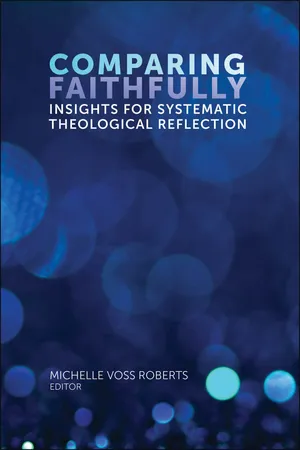
Every generation of theologians must respond to its context by rearticulating the central tenets of the faith. Interreligious comparison has been integral to this process from the start of the Christian tradition and is especially salient today. The emerging field of comparative theology, in which close study of another religious tradition yields new questions and categories for theological reflection in the scholar's home tradition, embodies the ecumenical spirit of this moment. This discipline has the potential to enrich systematic theology and, by extension, theological education, at its foundations.
The essays in Comparing Faithfully demonstrate that engagement with religious diversity need not be an afterthought in the study of Christian systematic theology; rather, it can be a way into systematic theological thinking. Each section invites students to test theological categories, to consider Christian doctrine in relation to specific comparisons, and to take up comparative study in their own contexts.
This resource for pastors and theology students reconsiders five central doctrines of the Christian faith in light of focused interreligious investigations. The dialogical format of the book builds conversation about the doctrine of God, theodicy, humanity, Christology, and soteriology. Its comparative essays span examples from Hindu, Buddhist, Jewish, Muslim, Jain, and Confucian traditions as well as indigenous Aztec theology, and contemporary "spiritual but not religious" thought to offer exciting new perspectives on Christian doctrine.
- 336 pages
- English
- ePUB (mobile friendly)
- Available on iOS & Android
eBook - ePub
About this book
Information
Publisher
Fordham University PressYear
2016Print ISBN
9780823274673
9780823274666
eBook ISBN
9780823274680
Topic
Theology & ReligionSubtopic
TheologyPART I
Divinity
1 The Dance of Emptiness
A CONSTRUCTIVE COMPARATIVE THEOLOGY OF THE SOCIAL TRINITY
Jon Paul Sydnor
Human beings respond to difference, especially religious difference, in varying ways. Some people are repulsed by religious difference and attempt to insulate themselves from it. Others are fascinated by difference and see it as an opportunity to learn more about “the other”—the one who is different from us, the one who is not “the same”—and about themselves. For these people, otherness provides an opportunity to compare, which is a powerful means of insight. For example, democracy is understood in relation to dictatorship, freedom is understood in relation to slavery, and prosperity is understood in relation to poverty. So, too, the “religious other” presents an opportunity to compare and contrast our beliefs, practices, and moods with different beliefs, practices, and moods, and to reform ourselves in the light of difference.1
This type of comparative practice makes us aware of hidden aspects of ourselves. Our environments instill in us many of our habitual thoughts, feelings, and actions, religious and otherwise. Having unconsciously acquired them, we are rarely aware of them. They have been bequeathed to us by our culture, absorbed unknowingly from childhood to adulthood. Because these beliefs and behaviors are often unchosen, they are unfree. We are determined (unfree) whenever our thoughts or actions are instinctive rather than conscious. If we desire freedom, then we must become aware of who we are. We must bring to consciousness that which now lies hidden. Then we can analyze our beliefs and actions and revise them in accordance with consciously chosen values. This process will never be complete, but the more we do it the more free we become.
Fortunately, we can become more aware of our self, our values, our worldview, our family dynamics, and our cultural inheritance through comparison. Indeed, one of the most powerful ways of shedding light on our deepest self is to compare it with a deep self who is “other” to us, different from us. Comparison is the interrogation of the familiar—the obvious, the assumed—by the unfamiliar. Through comparison, otherness sheds light on oneself. The other’s difference provides a contrast to our subconscious beliefs, raising them into consciousness, depriving them of their obviousness, and subjecting them to the vitalizing scrutiny of doubt.
Comparative theology is a new academic discipline that thinks across religious boundaries. For example, this discipline encourages Christians to study Buddhist doctrine, or vice versa. Comparative theology grants us greater awareness of our own faith by encountering a different faith. Once we have encountered this other faith, we have multiple options. We can leave ours the way it was, thankful for the increased awareness. We can revise our faith according to the challenge presented by the other. Or we can borrow aspects of the other faith and incorporate them into our own. We can even attempt to synthesize the two faiths into one, although this is rather difficult. Conversion is the final option, and it must be a real option for comparative theology to be effective. Comparative theology seeks to transform theology, and transformation demands risk.2
In order to gain a place at the table of theological method, comparative theology must become constructive, pastoral theology. In other words, it must produce new (constructive) theology—theology that goes beyond the history of theology or interpretations of theology—and this theology must be helpful to the church—to priests, pastors, and parishioners alike.
Commitment
When discussing Buddhism and Christianity, questions of salvation and the means of salvation soon arise. Buddhism has been characterized as offering a saving knowledge. This characterization was always inadequate, unfaithful to the Buddha’s own teachings as well as to the vast geographic and historical scope of the tradition. As a result of Christianity’s struggles with Gnosticism in the first centuries of the church’s existence, it has developed an allergy to saving knowledge. Salvation is by grace, through faith, in Christ. At times, the allergy to saving knowledge expresses itself as an allergy to any spiritual insight.
Nevertheless, as a Christian, I have found my study of Buddhist doctrine to be spiritually helpful, even transformative. I remain Christian, irresistibly drawn to the grace of Jesus Christ. He is my prophet, rabbi, hero, friend, guru, healer, and savior. For me, divinity shines through him in a peculiarly powerful manner. Yet, the Buddha deepens my experience of Christ, and Buddhism broadens my practice of Christianity. I am now a Christian transformed by encounters with the Buddha and Buddhists and Buddhist practices. Comparison has broadened and deepened my faith.
NAGARJUNA’S DOCTRINE OF EMPTINESS
This essay compares the Protestant theologian Jürgen Moltmann’s doctrine of the social Trinity with the Mahayana Buddhist writer Nagarjuna’s doctrine of emptiness. It utilizes Nagarjuna’s doctrine to develop Moltmann’s social Trinity—not to synthesize the two into one, but to borrow from Nagarjuna to amplify Moltmann.
The Buddhist doctrine of emptiness (sunyata) develops from two preceding concepts ascribed to the Buddha himself—no-self (anatman) and dependent co-origination (pratitya-samutpada).3 The Buddha sought to overcome the suffering associated with sickness, old age, and death. Like many other spiritual seekers in his age, he practiced a renunciant lifestyle through which he sought to transcend the material circumstances, which, for most of us, determine our happiness or unhappiness. One aspect of this endeavor was an interior search for his self (atman), his eternal, unchanging, indestructible interior being.4 After six years of austerities, he had not found permanent transcendence or a permanent self, and he concluded that his cravings were one important cause of his suffering. In response, he preached the doctrine of anatman, or no-self, in order to free his followers from their own craving for self.
Then, in the interpretation of Nagarjuna, the Buddha extended this concept of no-self to all of reality. Just as humans have no eternal, unchanging self that can provide permanent happiness, so all existents lack an eternal, unchanging substance that can provide permanent happiness. Release from suffering cannot come through discovering the permanent self and residing there, or from discovering permanent happiness in any feeling, object, or thought. Release from suffering can only come through giving up all craving for permanence.5
The Buddha’s doctrine of no-self is closely related to his doctrine of dependent co-origination (pratitya-samutpada).6 This doctrine asserts that everything—all feelings, objects, thoughts—arises causally by means of all other feelings, objects, and thoughts. Everything is causing everything else and being caused by everything else, all the time, in one churning nexus of intercausality within which cause and effect are inseparable.7 Here there is no permanence, solidity, or stasis. There is only insubstantial motion, a dynamic, shifting web of synergies in which the one thing that can provide bliss is the paradoxical realization that there is no thing that can provide bliss.8
Around 100 BCE, the Mahayana Buddhist Perfection of Wisdom (Prajna Paramita) literature began to appear. This literature furthered reflection on no-self and dependent co-origination by introducing the doctrine of emptiness (sunyata). Nagarjuna probably lived in the second century CE, two or three centuries after the Perfection of Wisdom first began to appear. He pushes the doctrine of emptiness to its radical limit. In his most famous work, the Fundamental Verses of the Middle Way (Mulamadhyamakakarika), he utilizes logical analysis to establish the radical impermanence, interrelatedness, and hence emptiness of all things. In so doing, he explicitly rejects the two extremes of eternalism and nihilism. That is, he denies that there is a substantive, eternal self that can achieve a substantive, eternal state of bliss.9 At the same time, he denies that there is nothing, that all is illusion, and that everything is unreal. Between these two poles he seeks the way of the “middle,” an English word etymologically related to the Sanskrit term “madhya” in Nagarjuna’s Mulamadhyamakakarika.10
Nagarjuna seeks to expound the Perfection of Wisdom so thoroughly as to free practitioners from any potential for cognitive, emotional, or physical clinging. He does so by asserting that everything—all selves, all beings, all feelings, all concepts, all gods, all matter—is empty of self-sufficiency (svabhava).11 Svabhava can be translated as own-being, self-existence, self-sustenance, independence, enduring solidity, inherent nature, abiding essence, or isolated substance. Because no one, no thought, and no thing has own-being (svabhava), everything is empty.12 And because everything is empty, everything is non-dual—samsara (the unending flux into which we are repeatedly reincarnated) and nirvana (release from the endless cycle of dissatisfaction) are ultimately indistinguishable, ignorance and truth are ultimately indistinguishable, and even craving and emptiness are ultimately indistinguishable. There are no distinctions, hence nothing to grasp after, hence nothing to suffer. Freedom is here already; it only requires recognition.13
Unfortunately, instead of realizing this pre-existing freedom, we thirst for abiding satisfaction from every thing, and we project the potential to provide abiding satisfaction onto every thing. But in truth, every thing is empty of the capacity to provide abiding satisfaction, so our pursuit is fruitless.14 Our demand of static fullness from dynamic emptiness causes our turmoil. Only the recognition of emptiness as the nature of reality, and the experiential realization of that recognition, can free us from our suffering.15
MOLTMANN’S DOCTRINE OF THE SOCIAL TRINITY
The Christian doctrine of the social Trinity is enormously complicated, misunderstood, and controversial. An investigation of the social Trinitarian theology of Jürgen Moltmann will focus this conver...
Table of contents
- Cover
- Half Title
- Series Announcement Page
- Title Page
- Copyright
- Contents
- Half Title
- Introduction: A Place for Comparative Theology in Christian Systematic Reflection
- Part I: Divinity
- Part II: Theodicy
- Part III: Humanity
- Part IV: Christology
- Part V: Soteriology
- List of Contributors
- Index
- Series Page
Trusted by 375,005 students
Access to over 1.5 million titles for a fair monthly price.
Study more efficiently using our study tools.
Frequently asked questions
Yes, you can cancel anytime from the Subscription tab in your account settings on the Perlego website. Your subscription will stay active until the end of your current billing period. Learn how to cancel your subscription
No, books cannot be downloaded as external files, such as PDFs, for use outside of Perlego. However, you can download books within the Perlego app for offline reading on mobile or tablet. Learn how to download books offline
We are an online textbook subscription service, where you can get access to an entire online library for less than the price of a single book per month. With over 1.5 million books across 990+ topics, we’ve got you covered! Learn about our mission
Look out for the read-aloud symbol on your next book to see if you can listen to it. The read-aloud tool reads text aloud for you, highlighting the text as it is being read. You can pause it, speed it up and slow it down. Learn more about Read Aloud
Yes! You can use the Perlego app on both iOS and Android devices to read anytime, anywhere — even offline. Perfect for commutes or when you’re on the go.
Please note we cannot support devices running on iOS 13 and Android 7 or earlier. Learn more about using the app
Please note we cannot support devices running on iOS 13 and Android 7 or earlier. Learn more about using the app
Yes, you can access Comparing Faithfully by Michelle Voss in PDF and/or ePUB format, as well as other popular books in Theology & Religion & Theology. We have over 1.5 million books available in our catalogue for you to explore.