This book brings together an international roster of renowned scholars from disciplines including philosophy, political theory, intellectual history, and literary studies to address the conceptual foundations of the humanities and the question of their future. What notions of the future, of the human, and of finitude underlie recurring anxieties about the humanities in our current geopolitical situation? How can we think about the unpredictable and unthought dimensions of praxis implicit in the very notion of futurity?
The essays here argue that the uncertainty of the future represents both an opportunity for critical engagement and a matrix for invention. Broadly conceived, the notion of invention, or cultural poiesis, questions the key assumptions and tasks of a whole range of practices in the humanities, beginning with critique, artistic practices, and intellectual inquiry, and ending with technology, emancipatory politics, and ethics. The essays discuss a wide range of key figures (e.g., Deleuze, Freud, Lacan, Foucault, Kristeva, Irigaray), problems (e.g., becoming, kinship and the foreign, "disposable populations" within a global political economy, queerness and the death drive, the parapoetic, electronic textuality, invention and accountability, political and social reform in Latin America), disciplines and methodologies (philosophy, art and art history, visuality, political theory, criticism and critique, psychoanalysis, gender analysis, architecture, literature, art).
The volume should be required reading for all who feel a deep commitment to the humanities, its practices, and its future.
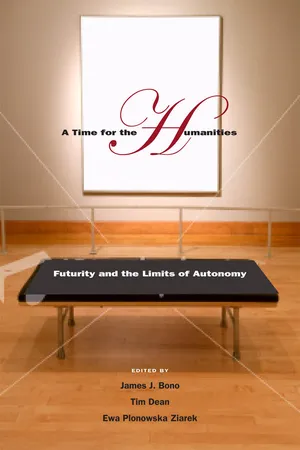
eBook - ePub
A Time for the Humanities
Futurity and the Limits of Autonomy
- 283 pages
- English
- ePUB (mobile friendly)
- Available on iOS & Android
eBook - ePub
A Time for the Humanities
Futurity and the Limits of Autonomy
About this book
Information
Publisher
Fordham University PressYear
2009Print ISBN
9780823229208
9780823229192
eBook ISBN
9780823229215
Topic
EducationSubtopic
Educational PolicyPART I
The New and Its Risks
CHAPTER 1
Life and Event: Deleuze on Newness
Whether cinema, as Deleuze claims, is Bergsonian, remains an open question; that Deleuze himself was a Bergsonian, however, is beyond doubt. Still, we should ask ourselves: What, exactly, does the Bergsonian inspiration to be found across Deleuze’s oeuvre consist of? There are, to be sure, several ways to take on this question, but there is one that, to my mind, is decisive: the problem of the new. In Cinema 1: The Movement-Image, Deleuze writes, “Bergson transformed philosophy by asking the question of the new in the making instead of the question of eternity.”1
This claim, for all its clarity, is no less enigmatic. What transformation of philosophy are we dealing with, according to Deleuze? Or, which amounts to the same, what does “asking the question of the new in the making” mean? What is the problem of the new, of newness, or novelty? Not only did Deleuze intimately know the history of philosophy and thus knew very well that the questions of time, of becoming, of history did not wait for Bergson to be asked—and that therefore it would appear paradoxical to speak of philosophy as having to wait for Bergson to stop asking the question of eternity—Deleuze was also fully aware of what was going on around him when he published these lines in 1983, that is to say, at a moment when, in France and elsewhere, philosophical—and political—debates were centered around the concept of postmodernity. Jean-François Lyotard had published his famous book The Postmodern Condition in 1979.) This was not a time, therefore, in which the question of the new was “hot” in any possible sense; on the contrary, speaking about newness seemed to evoke an optimism, a confidence in progress and a happy tomorrow, that one had rather forgo, shelve next to the memories of a belle époque definitely gone by.
But if all of this is true, what could be the sense, and the implications, of Deleuze’s claim? In what follows I would like to develop a hypothesis about what Deleuze understands by “new” and about the significance of such a concept for our contemporary politics and ethics.
1
Let me remark, first of all, that the question of the new in the making is situated at the intersection of three major themes in Bergson’s philosophy, all of which are crucial for Deleuze’s own thought: the themes of difference, of time (duration), and of life.
In Deleuze’s interpretation, Bergson’s thought is a philosophy of difference because it is not content with a description of differences between things as they are once they have been produced; rather, it aims at capturing the constitutive difference, which Deleuze calls “internal” difference, that distinguishes a thing in itself, that makes a thing what it is in its own singular being. Such a difference is a process of production, of creation, of invention of the new. That is why, in Bergson, as read by Deleuze, difference and time, duration, necessarily coincide. Let me quote from the very first essay published by Deleuze on Bergson in 1956, “Bergson, 1859-1941,” though analogous passages can be found in many later texts, and namely in Cinema 1 and 2:
Bergson tells us, moreover, that his work consisted of reflecting on the fact that all is not given. But what does such a reality signify? Simultaneously that the given presupposes a movement that invents it or creates it, and that this movement must not be conceived in the image of the given. What Bergson critiques in the idea of the possible is that it presents us a simple copy of the product, projected or rather retrojected onto the movement of production, onto invention. But the virtual is not the same thing as the possible: the reality of time is finally the affirmation of a virtuality that is actualized, and for which to be actualized is to invent.2
Indeed, the opposition between the possible and the virtual, which Deleuze was to systematize in Difference and Repetition, is decisive if we want to understand the reality of time and its more than intimate link with a productive difference.
According to Bergson, assuming that the possibility of a thing precedes its existence is a way of denying the reality of time, a denial that is all the more powerful for its not being explicit. In this regard, it is of little importance whether one thinks the possible, with Kant, as the set of transcendental conditions of experience; with Leibniz, as the worlds that God contemplates; or, with the Wittgenstein of the Tractatus, as a logical space—to give but a few examples. In all these cases, time is reduced to an exterior frame within which events take place, but this frame has no bearing on the events themselves since their possibility, be it logical or transcendental, precedes them. To put it into Bergson’s terms: When we deny time a true power of invention, we take away all of its ontological reality, we name it without thinking it, and thereby assume that “all is given”—once and for all.
But in order not to fall prey to yet another form of the illusion of the possible, more is needed than just affirming an ontological agency of time. It is necessary to think the creative power of time as a process of differentiation. The possible and the real are made one in the image of the other; no conceptual difference separates them—for the simple reason, according to Bergson, that the possible is “a mirage of the present in the past”; it is constituted retrospectively by an act of the mind that projects backwards in time the possibility of an event that has already taken place. The power of time, however, its reality, what Deleuze calls the virtual, deploys itself in a completely different way. The actualization of a virtuality does not entail any resemblance whatsoever: On the contrary, it implies the creation of lines of differentiation that neither existed—in a logical or transcendental form—nor could be foreseen in advance.
It is at this point that the third of Bergson’s themes comes in: the theme of life or, more precisely, the concept of the élan vital. The conjunction of time and difference, of the creative power of time and processes of differentiation, is made possible by the concept of life. In Creative Evolution, Bergson, after a series of analyses too long to be recalled here, defines the “essence” of life, the unity of its élan, as a tendency towards change and differentiation. What makes life what it is would then be nothing but this tendency towards movement, change, the creation of new and unforeseeable forms of life. It is for this reason that Deleuze can write, in “Bergson’s Conception of Difference”: “When virtuality realizes itself, which is to say differentiates itself, it is through life and in a vital form; in this sense it is true that difference is vital,” and, at the end of the same text, “Bergsonism is a philosophy of difference, and of difference’s realization; there we find difference in itself, and it realizes itself as novelty.”3 What time does is create, bring about novelty and newness. This can be done only by processes of differentiation, the paradigm of which is the evolution of life. The notions of time, difference, and life cannot be separated. Deleuze’s Bergsonian inspiration lies in this conceptual frame. One could speak of “vitalism,” but we have to keep in mind that this is a vitalism of time and difference, and that “life” is both organic and inorganic.4
We can now understand why Bergson, according to Deleuze, so profoundly transformed philosophy. Only when we begin with the question of the new in the making can we think the reality of time, since a universe in which nothing new comes about is a universe in which “all is given”—which is what, implicitly or explicitly, all sorts of otherwise very different philosophies as well as certain scientistic dreams assume.
But even if we now better understand the importance of the transformation of philosophy brought about by Bergson, the most pressing question remains: What, exactly, is the new? And why is it decisive to ask this question today? And why is it relevant for ethics and politics?
2
To try to understand why we are still concerned with the problem of the new, we must first emphasize that the new, for Bergson as much as for Deleuze, does not in any way coincide with the future. If that were the case, we would be dealing not with a transformation of philosophy but with some version of the idea of progress, be it in an Enlightenment manner or in the manner of a philosophy of history (and it would matter very little, in this regard, whether it would be of the Hegelian type, or the Marxist, or the phenomenological, as in the late Husserl). Now, while it is certain that the new in Bergson and Deleuze always has a positive connotation—I will return to this point—it is just as certain that, for the one as for the other, not everything that will happen in a near or faraway future will be new. The future and the new do not necessarily overlap, and this for essential reasons.
The idea of progress or, for that matter, any version of a teleology of history, dialectic or not, is not only an illusion, but it is, to say it once more, an illusion whose function it is to make us believe that “all is given.” To think that history follows laws that govern its course or, at least, that its movement despite halts and detours is oriented by a sense or towards an end, comes down to assuming that the time of human events does nothing but realize a possibility, an idea, a plan that preceded it. In a text that is entirely dedicated to the critique of the category of the possible, Bergson writes:
How can we fail to see that if the event can always be explained afterward by an arbitrary choice of antecedent events, a completely different event could have been equally well explained in the same circumstances by another choice of antecedent—nay, by the same antecedents otherwise cut out, otherwise distributed, otherwise perceived by our retrospective attention?5
And in the most political of his books, The Two Sources of Morality and Religion, he maintains that if one would like, one may call “progress” the moments of history in which something new opens up, and one may believe that these moments all go in the same direction.6 But that would be just another retrospective illusion of the possible since, in reality, there is no direction established in advance. It would also mean that there is no need for creating and producing moral and political renewals given that they preexist in some ideal form anyway, that they are always already given as possibilities that just wait for the right moment to come into being.
The new, on the contrary, anticipates neither the happy unfolding of history nor, for that matter, the certainty of a future apocalypse. Optimism and pessimism, in this regard, are equally inappropriate, since the new functions as a criterion of evaluation, not of foresight. It is not surprising to see Deleuze bring in, next to Bergson, another major reference of his oeuvre: Nietzsche. Let me quote from Difference and Repetition:
Nietzsche’s distinction between the creation of new values and the recognition of established values should not be understood in a historically relative manner, as though the established values were new in their time and the new values simply needed time to be established. In fact it concerns a difference which is both formal and in kind. The new, with its power of beginning and beginning again, remains forever new, just as the established was always established from the outset, even if a certain amount of empirical time was necessary for this to be recognized.7
What needs to be stressed in this quote is that the power of the new as the power of time is radically distinct from history. In other words, be it in his reading of Bergson or of Nietzsche, the question of the new, for Deleuze, takes the place of the question of history. The new, to be sure, is a category of time, but precisely not of history. To say the same thing otherwise, time takes the place of history. This does not imply, however, that Deleuze subscribes to any discourse on the “end of history” whatsoever: He never did, and for good reasons. Any discourse about the end—of history, of modernity, of metaphysics, of philosophy, etc.— for him implies a teleology or a dialectics that is unable to think the reality of time (or the reality of the virtual, if you prefer a properly “Deleuzian” idiom).
This in turn, however, implies that the task of philosophy, as well as of ethics and politics, is to grasp the new in the making, the constitutive difference that makes something come into being, the singularity of any event, on the one hand, and, on the other, to discern the “old” and the “new” in what is given. And such a task is precisely what the philosophies of history, according to Deleuze, are incapable of achieving.
3
To maintain that the problem of the new comes up in the place of the problem of history is not a self-evident claim (not even for readers of Deleuze) and needs to be backed up. Let us begin by trying to understand its implications in the field of the political. Revolutionary or emancipatory politics, so often associated with the very idea of modernity, are inseparable from the belief in progress (let us think of American Revolution, or French Revolution, of Rousseau or Marx). The denunciation of injustice and the very form of any political action to be taken in order to put an end to injustice are predicated on a confidence in the future of humanity. Yet the politics of progress not only falls prey to the retrospective illusion of the possible, as we have seen, it also introduces a form of transcendence that, to Deleuze’s mind, is unacceptable. The future of the revolution or of a radical democracy as the horizon of political action and as a belief assumes the function of a doubling of the world. The present conditions of life may be intolerable, but the judgment of history, like the judgment of God, justifies them in the promise of a redemption to come. The future, taken in this sense, makes acceptable that which is not acceptable in the name of another world that, though not present, surely won’t fail to come. When Deleuze repeats—as he does so often—that the question is not one of “the future of the revolution,” or of the taking over of power, but one of becoming-revolutionary, he does not merely respond to the easy and widespread discourses that condemn any revolution in principle on the basis that revolutions always “go wrong”; it is also, and more profoundly, to stress that the ethical or political value of what is or what makes itself, in politics and elsewhere, is immanent to it.
But there is yet another aspect of the question that is, to my mind at least, even more decisive: It concerns the model of action, of human agency, political or otherwise. The forms of political action sustained, explicitly or implicitly, by a thinking of history, by a belief in history, bring into play specific conceptions of the subject, community, human agency, and their relation to the natural and historical world. This model—in all its strengths and in its crisis, a crisis that, according to Deleuze, is irreversible—is described with precision in Cinema 1 and Cinema 2. This is why these books, dedicated entirely to cinema, also contain an essential part of Deleuze’s political philosophy—much like, if not more so than, the more explicitly political books such as Anti-Oedipus or A Thousand Plateaus.
The “politics of history” (if you will grant me the expression) correspond exactly to what Deleuze analyzes as the cinematographic model of the action-image that dominated cinema before the First World War, whose exemplary figures are Griffith and Eisenstein. But what does Deleuze mean by “action-image”? Without being able to enter into the details of Deleuze’s analyses, let me recall that it is a film-form in which the composition of images is thought of as the composition of an organic unity. The greatness of Griffith is to have been the first to provide a powerful and coherent conception of editing, in which the parts of an organism, while differentiating themselves, stand in relation with one another. (This, according to Deleuze, is the function of parallel editing where shots of the different elements of the organism—whites and blacks, men and women, rich and poor, city and countryside, etc.—alternate according to a certain rhythm.) This is the first aspect. The second aspect concerns the life of the organism, the laws that govern the relation between its elements. In Griffith, the actions that get started always take the form of a duel that opposes the villain to the good man, good to evil, since the unity of the organism is always threatened and its equilibrium must constantly be re-established. Confronted by danger, the other parts of the whole unite to bring aid to the good, the actions converge towards the place of the duel in order to reverse its result, to restore the compromised harmony. This aspect of the organism’s life is brought out by convergent and accelerated editing. (The insertion of close-ups, in turn, shows the relation between a part and the whole, as is the case, for example, in the famous close-ups of soldiers that alternate with the shots of the battle in Birth of a Nation.) This conception of the composition of images constitutes, in Deleuze’s words, “a powerful organic representation” and would become the paradigm for Hollywood movies:
The American cinema draws from it its most solid form; from the general situation to the re-established or transformed situation through the intermediary of a duel, of a convergence of actions. American montage is organico-active.8
But organic editing is just as important for the Soviet school, and notably for Eisenstein. In his films as well as in his theoretical writings, Eisenstein places himself within Griffith’s heritage; what he puts into question is not the organic conception of editing, but the id...
Table of contents
- Cover Page
- Title Page
- Copyright Page
- CONTENTS
- ACKNOWLEDGMENTS
- INTRODUCTION Future, Heteronomy, Invention
- PART I The New and Its Risks
- PART II Rhetoric and the Future of the Political
- PART III Heteronomy and Futurity in Psychoanalysis
- PART IV Inventions
- NOTES
- CONTRIBUTORS
- INDEX
Trusted by 375,005 students
Access to over 1.5 million titles for a fair monthly price.
Study more efficiently using our study tools.
Frequently asked questions
Yes, you can cancel anytime from the Subscription tab in your account settings on the Perlego website. Your subscription will stay active until the end of your current billing period. Learn how to cancel your subscription
No, books cannot be downloaded as external files, such as PDFs, for use outside of Perlego. However, you can download books within the Perlego app for offline reading on mobile or tablet. Learn how to download books offline
We are an online textbook subscription service, where you can get access to an entire online library for less than the price of a single book per month. With over 1.5 million books across 990+ topics, we’ve got you covered! Learn about our mission
Look out for the read-aloud symbol on your next book to see if you can listen to it. The read-aloud tool reads text aloud for you, highlighting the text as it is being read. You can pause it, speed it up and slow it down. Learn more about Read Aloud
Yes! You can use the Perlego app on both iOS and Android devices to read anytime, anywhere — even offline. Perfect for commutes or when you’re on the go.
Please note we cannot support devices running on iOS 13 and Android 7 or earlier. Learn more about using the app
Please note we cannot support devices running on iOS 13 and Android 7 or earlier. Learn more about using the app
Yes, you can access A Time for the Humanities by Tim Dean,Ewa Plonowska Ziarek, James J. Bono in PDF and/or ePUB format, as well as other popular books in Education & Educational Policy. We have over 1.5 million books available in our catalogue for you to explore.