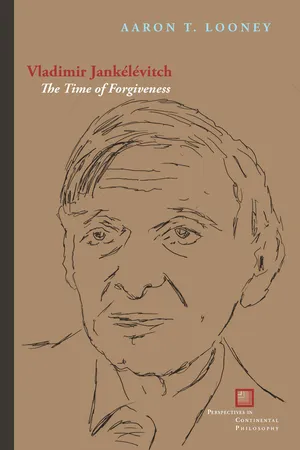
Vladimir Jankélévitch: The Time of Forgiveness traces the reflections of the French philosopher and musicologist Vladimir Jankelevitch on the conditions and temporality of forgiveness in relation to creation, history, and memory. The author demonstrates the influence of Jewish and Christian thought on Jankelevitch's philosophy and compares his ideas about the gift character of forgiveness, the role of retributive emotions in conceptions of justice, and the limits of reason with those of Aristotle, Butler, Kant, Kierkegaard, Nietzsche, Scheler, Arendt, Derrida, Levinas, and Ricoeur.
The Shoah was the pivotal historical event in Jankelevitch's life. As this book shows, Jankelevitch's question "Is forgiveness possible as a response to evil?" remains a potent philosophical conundrum today. Paradoxically, for Jankelevitch, evil is both the impetus and the obstacle to forgiveness.
- 400 pages
- English
- ePUB (mobile friendly)
- Available on iOS & Android
eBook - ePub
About this book
Information
Topic
PhilosophySubtopic
Ethics & Moral Philosophy1
First Philosophy
The title of Vladimir Jankélévitch’s first major work is Philosophie première. Traditionally, a first philosophy provides the cornerstone on which the rest of a thinker’s philosophy is constructed either upward in the architectonics of systematic structures or outward in concentric circles extending from the initial pulse of inspiration at the epicenter. Jankélévitch is fond of citing Henri Bergson, who wrote that a philosopher of value has said only one thing and the rest of his life and work is dedicated to that single point.1 Or more poignantly, Jankélévitch’s philosophy follows Bergson’s insight that there is “something simple, infinitely simple, so extraordinarily simple that the philosopher has never succeeded in saying it. And that is why he has spoken his entire life.”2 Jankélévitch’s first philosophy is an introduction to a philosophy of the “almost [presque]” and is dedicated to the idea of creation. The “almost” forms a third category between being and nothingness. It is, therefore, not ontology that constitutes first philosophy or epistemology, because that which is almost is almost-not. As Jankélévitch observes, it is almost something and almost nothing; it is not a datum or an object of consciousness. Instead, it puts the primacy of consciousness into question because the “almost” cannot be thoroughly grasped and, consequently, is not conducive to the order, definitions, conceptual constructions, and categories of systems. All of these depend on being.
In this sense, Jankélévitch exhibits a parallel to Heidegger. Both criticize the history of philosophy as a history of metaphysics or ontotheology, and both seek to explicate the origin of being that ontologically differs from all beings.3 But whereas Heidegger believes that the history of philosophy has neglected the question of being, Jankélévitch believes that philosophy has lost sight of the notion of creation. As his friend and student Lucien Jerphagnon comments, Jankélévitch is one of the few philosophers who has observed the Jewish contribution to metaphysics, namely Beresit bara Elohim (In the beginning God created) (Gen. 1:1).4 First philosophy, according to Jankélévitch, is thus metaphysics, but it is a philosophy of effectivity, of setting (poser), of action, and of doing. It is a philosophy of creation and re-creation. It is also, therefore, a metaphysics that serves as a guide for morals, not in the sense of a mimesis of the ideas inscribed ideally in the nature of reality but in the sense of a mimesis of decision and action itself. And since it is difficult—even impossible—to adequately comprehend and speak about that which is pure act and not substance and which, moreover, provides the condition of comprehension and speech, Jankélévitch’s first philosophy is largely a negative philosophy—a philosophy that speaks of one thing only but in many ways and from various approaches because it is that which cannot be wholly said.
Wholly Other: Creation
Jankélévitch divides his metaphysics into the metaempirical and metalogical. He is critical of Aristotle’s metaphysics not because it follows physics but because it represents a discourse of definition, which, in Jankélévitch’s eyes, testifies to its inherently secondary character: It simply announces and explicates the essence of what already is. Aristotle’s metaphysics exemplarily represents a hypothetical metaphysics in Jankélévitch’s eyes because Aristotle does not deal with the fact of being but proceeds from being. His unconcern with the einai allows him to focus on the universal predicate of the on and the ousia of this being, the essential being (ens) of this being.5 Although Aristotle establishes the unmoved mover as the source and beginning of all movement, Jankélévitch detects in this originary being the same characteristics as the attributes of a triangle, for example. There is not an absolute beginning or an absolute end but grounds of reason, which are eternal: eternal grounds of reason. One arrives through such hypothetical metaphysics at the order of rationality and intellection—the order of the universal, eternal, and necessary. Although Jankélévitch recognizes the distinction between the intellectual order and the empirical order of individual existents, he misses a metaphysical earnestness that posits a wholly other order to the intellectual order. Moreover, he refuses to reduce the wholly other to a mere difference in degree to the already known order or the order of knowability itself. In this respect, his language of a “wholly other order” is misleading, first of all, because it insinuates an “order” that as such is always already an order of intelligibility and, second, because its wholly otherness seems to indicate what Hegel would call “bad infinity” or a contingent reversal of what is finite, knowable, and so on. What Jankélévitch misses in the history of metaphysics and what he intends to express in the wholly other is a notion of radical transcendence and the beyond (epekeina).
Jankélévitch witnesses certain traces of transcendence within the philosophical tradition, however, particularly in Plato’s good beyond being and beyond essences pronounced in the sixth book of the Republic. Like Levinas, Jankélévitch takes this passage to be decisive for an ethics that is not ontologically grounded but is oriented by the desire for the good.6 Jankélévitch, however, is much more inclined than Levinas to embrace the suprarationality and even irrationality of this move. Both of them sketch an ethics that can be described as hyperbolic. The good beyond being is hyperbole! Indeed, on hearing Socrates tell of the good beyond being and beyond essence, his dialogue partner Glaucon exclaims that it is daimonic hyperbole—an exaggeration, a supernatural excess.7 It is toward the wonderful and supernatural that Jankélévitch looks to orient his ethical vision, but it is a vision that for this very reason is filled with absence. It is composed of desire (Eros) and could be said to be daimonic in the sense of the daimonic conscience of Socrates, on the one hand, and, the daimon herself of the Symposium, Diotima, on the other hand. The former allows Socrates to sacrifice himself, and the latter narrates the restless, godlike, daimonic character of love. It is consequently no wonder that Jankélévitch takes as the hallmark of his ethics a pure love that is willing to sacrifice itself for the other—an ethics that is hyperbolic and inexhaustible.
Jankélévitch doubts, however, that the idea of the good according to Plato is really of a wholly other order. Plato takes a much more guarded stance toward daimonic hyperbole and does not seem convinced of such hyperontic majesty or the infinite transcendence of the epekeina. Already in book 7 of the Republic, Socrates says that the good is the brightest and best of being.8 And even in the context of the good beyond being, Socrates identifies the absolute good and the absolute beautiful with the idea of essence and as that which is.9 For Plato that which most truly is is the idea of all of the things that can be subsumed under it. The single idea of the many things that are considered beautiful or good is the essence of those things, and the essence is that which most truly is. The world of the many participates in that of ideas and essences. Therefore, Plato’s doctrine of participation entails that the philosopher, the lover of wisdom, is distinguished from the philodoxer, the lover of opinion, only by degree, just as the appearances in the world of images and shadows are less real and have less being than the ideas.10 Platonism, according to Jankélévitch, is, therefore, too wary and simultaneously too optimistic. It is too wary of appearance because it does not allow for a trustworthy appearance, and it is too optimistic because the appearance only requires essentialization. It acts as if the intelligible is somehow written with invisible ink onto the sensible, which then only requires the dialectic to read through it. It is clear that appearance is not the essence, but, for Plato, it is partitively something of the essence; there is the essential in it. It is known that the appearance does not appear without deforming essence, or inversely, that it does not deform without allusion to the essence of which it is the appearance, which, through a manner of irony, leads us on the path of truth. In short, Plato holds to the truth in appearance although it is not the truth.11 For the image refers to the idea and the sensible to the intelligible as two absolutely different orders, but these two orders read like the same text in two different languages—the one apparent and the other hidden.12
Instead of then turning to the pre-Socratic philosophers as Heidegger does, Jankélévitch finds in Plotinus, in Neoplatonism in general, and in the mystics advocates of radical transcendence. Plotinus degrades the ousia, the essence, to the level of the second hypostasis, thereby positing the One, the first hypostasis, as an absolute beyond—beyond knowledge, beyond the intelligible, beyond essences and being.13 In fact, Plotinus claims that the good does not even have the predicate of being good. It is beyond being identical with itself in the idea of the good and beyond the reification of adjectives and predication. The good, for Plotinus, is more than good, more than beautiful: “hyperontological, hypernoetic …, hyper down the whole line!” Jankélévitch exclaims.14 He thus contends that Alexandrian philosophy was the first to integrally exhibit the metaphysical earnestness of positing a wholly other order. Its refusal to reduce the wholly other to a mere difference in degree to the known order bestows the epekeina its true eschatological sense.15
But how, if at all, can it be known that there is such a transcendence as the wholly other? Jankélévitch recognizes three different forms of knowledge: perception, intellection, and intuition.16 Perception corresponds to the empirical and pertains to appearance; intellection corresponds to the metaempirical and pertains to essences and necessary principles; and intuition corresponds to the metalogical and pertains to position or creation. Each order is separated qualitatively and categorically, not gradually, and yet each is in relation to the others. The metaempirical plane, he claims, is wholly other than the empirical, and the wholly other order of the metalogical is heterogeneous to both the empirical and the metaempirical. He posits, in other words, two different kinds of transcendence or two forms of epekeina.17 Against Platonic and Neoplatonic tendencies, Jankélévitch makes it clear that since these three orders are distinct, the finite empirical being does not and cannot ascend to the eternal, the necessary, or the universal or, what is more, arrive at the wholly other order through reason. Whoever proceeds from the hic et nunc, or the here and now, of empirical existence does not by mere extension arrive at the other order of essences, and whoever remains in the realm of the intellect never attains to the wholly other order of creation.18 The metaempirical plane begins with itself; it is self-evident to thought, Jankélévitch claims, and the metalogical cannot be thought.
For Jankélévitch, the objective is thus not to ascend out of the cave of appearances into the intelligible world of ideas and essences because there is no other world than the concrete world we live in. Consequently, he does not doubt that Kant has cured us of all transcendental illusions, for experience, he states, is always finite and perception necessarily partial and partitive. Perception is composed of differentiation; it is a mixture of negative and positive. The difference is that which one can perceive.19 The empirical does not thus lead to the beyond; it leads only to other relations, relativity, and finitude. At the same time, he claims that that which is given to the senses does not signify something other than what it is. Against the allegorical readings of the essential in and from the sensible, Jankélévitch demonstrates the tautological positivity of appearances. This rehabilitation of appearances should not be confused with the optimistic stance that the appearance is always that which it appears to be as if appearance announced immediately and incorruptibly its being, but it does put a stop to making of nature a system of ciphers. The empirical world is not a shadowy double of the more real intelligible world. Jankélévitch consequently deems the potential illusion of appearances a scientific problem, for it is a matter of interpreting precisely that which one perceives, not of deciphering its hidden meaning.20
Jankélévitch’s distinction between the metaempirical and the metalogical planes can be understood in part through Kant’s distinction between the transcendental (a priori) and the transcendent.21 Whereas the transcendental concerns that which enables us to experience objects and which plays a role in the way our mind constitutes objects as the conditions of the possibility of knowledge in general, the transcendent is that which is beyond the categories of reason. The metaempirical, according to Jankélévitch, involves the plane of essences, ideas, and ideals—the plane of the logos. It includes eternal truths, the principle of identity, and the ideas of universality and necessity. This intelligible plane renders understandable and knowable the empirical. The empirical world as underintelligible is thus made intelligible.22 Although the intelligible gives meaning to that which alone as mere inchoate sense experience cannot have meaning, it does not give being to existents. The intelligible plane has to do with thought only, not being. Jankélévitch thus establishes two planes of truth: the truth of pe...
Table of contents
- Cover
- Half Title
- Series Announcement Page
- Title Page
- Copyright
- Dedication
- Contents
- Acknowledgments
- Introduction: In the Margins
- 1. First Philosophy
- 2. Apophatic Approaches
- 3. The Temporality of Human Existence and Action
- 4. Translating Resentment
- 5. The Inexcusable and the Unforgivable
- 6. Love and Justice
- 7. Repentance: Concerning Unconditionality
- 8. What Remains
- Notes
- Bibliography
- Index
- Series Page
Trusted by 375,005 students
Access to over 1.5 million titles for a fair monthly price.
Study more efficiently using our study tools.
Frequently asked questions
Yes, you can cancel anytime from the Subscription tab in your account settings on the Perlego website. Your subscription will stay active until the end of your current billing period. Learn how to cancel your subscription
No, books cannot be downloaded as external files, such as PDFs, for use outside of Perlego. However, you can download books within the Perlego app for offline reading on mobile or tablet. Learn how to download books offline
Perlego offers two plans: Essential and Complete
- Essential is ideal for learners and professionals who enjoy exploring a wide range of subjects. Access the Essential Library with 800,000+ trusted titles and best-sellers across business, personal growth, and the humanities. Includes unlimited reading time and Standard Read Aloud voice.
- Complete: Perfect for advanced learners and researchers needing full, unrestricted access. Unlock 1.5M+ books across hundreds of subjects, including academic and specialized titles. The Complete Plan also includes advanced features like Premium Read Aloud and Research Assistant.
We are an online textbook subscription service, where you can get access to an entire online library for less than the price of a single book per month. With over 1.5 million books across 990+ topics, we’ve got you covered! Learn about our mission
Look out for the read-aloud symbol on your next book to see if you can listen to it. The read-aloud tool reads text aloud for you, highlighting the text as it is being read. You can pause it, speed it up and slow it down. Learn more about Read Aloud
Yes! You can use the Perlego app on both iOS and Android devices to read anytime, anywhere — even offline. Perfect for commutes or when you’re on the go.
Please note we cannot support devices running on iOS 13 and Android 7 or earlier. Learn more about using the app
Please note we cannot support devices running on iOS 13 and Android 7 or earlier. Learn more about using the app
Yes, you can access Vladimir Jankélévitch by Aaron T. Looney in PDF and/or ePUB format, as well as other popular books in Philosophy & Ethics & Moral Philosophy. We have over 1.5 million books available in our catalogue for you to explore.