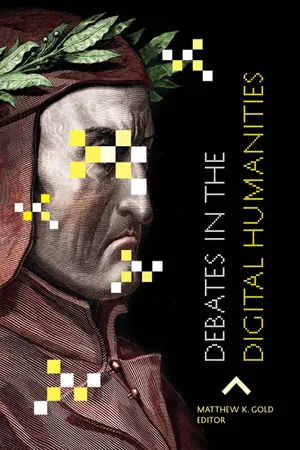
Encompassing new technologies, research methods, and opportunities for collaborative scholarship and open-source peer review, as well as innovative ways of sharing knowledge and teaching, the digital humanities promises to transform the liberal arts—and perhaps the university itself. Indeed, at a time when many academic institutions are facing austerity budgets, digital humanities programs have been able to hire new faculty, establish new centers and initiatives, and attract multimillion-dollar grants.
Clearly the digital humanities has reached a significant moment in its brief history. But what sort of moment is it? Debates in the Digital Humanities brings together leading figures in the field to explore its theories, methods, and practices and to clarify its multiple possibilities and tensions. From defining what a digital humanist is and determining whether the field has (or needs) theoretical grounding, to discussions of coding as scholarship and trends in data-driven research, this cutting-edge volume delineates the current state of the digital humanities and envisions potential futures and challenges. At the same time, several essays aim pointed critiques at the field for its lack of attention to race, gender, class, and sexuality; the inadequate level of diversity among its practitioners; its absence of political commitment; and its preference for research over teaching.
Together, the essays in Debates in the Digital Humanities—which will be published both as a printed book and later as an ongoing, open-access website—suggest that the digital humanities is uniquely positioned to contribute to the revival of the humanities and academic life.
Contributors: Bryan Alexander, National Institute for Technology in Liberal Education; Rafael Alvarado, U of Virginia; Jamie “Skye” Bianco, U of Pittsburgh; Ian Bogost, Georgia Institute of Technology; Stephen Brier, CUNY Graduate Center; Daniel J. Cohen, George Mason U; Cathy N. Davidson, Duke U; Rebecca Frost Davis, National Institute for Technology in Liberal Education; Johanna Drucker, U of California, Los Angeles; Amy E. Earhart, Texas A&M U; Charlie Edwards; Kathleen Fitzpatrick, Pomona College; Julia Flanders, Brown U; Neil Fraistat, U of Maryland; Paul Fyfe, Florida State U; Michael Gavin, Rice U; David Greetham, CUNY Graduate Center; Jim Groom, U of Mary Washington; Gary Hall, Coventry U, UK; Mills Kelly, George Mason U; Matthew Kirschenbaum, U of Maryland; Alan Liu, U of California, Santa Barbara; Elizabeth Losh, U of California, San Diego; Lev Manovich, U of California, San Diego; Willard McCarty, King’s College London; Tara McPherson, U of Southern California; Bethany Nowviskie, U of Virginia; Trevor Owens, Library of Congress; William Pannapacker, Hope College; Dave Parry, U of Texas at Dallas; Stephen Ramsay, U of Nebraska, Lincoln; Alexander Reid, SUNY at Buffalo; Geoffrey Rockwell, Canadian Institute for Research Computing in the Arts; Mark L. Sample, George Mason U; Tom Scheinfeldt, George Mason U; Kathleen Marie Smith; Lisa Spiro, National Institute for Technology in Liberal Education; Patrik Svensson, Umeå U; Luke Waltzer, Baruch College; Matthew Wilkens, U of Notre Dame; George H. Williams, U of South Carolina Upstate; Michael Witmore, Folger Shakespeare Library.