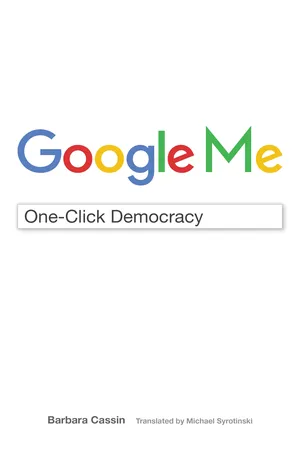
"Google is a champion of cultural democracy, but without culture and without democracy." In this witty and polemical critique the philosopher Barbara Cassin takes aim at Google and our culture of big data. Enlisting her formidable knowledge of the rhetorical tradition, Cassin demolishes the Google myth of a "good" tech company and its "democracy of clicks," laying bare the philosophical poverty and political naiveté that underwrites its founding slogans: "Organize the world's information," and "Don't be evil." For Cassin, this conjunction of globalizing knowledge and moral imperative is frighteningly similar to the way American demagogues justify their own universalizing mission before the world.
While sensitive to the possibilities of technology and to Google's playful appeal, Cassin shows what is lost when a narrow worship of information becomes dogma, such that research comes to mean data mining and other languages become provincial "flavors" folded into an impoverished Globish, or global English.
- 172 pages
- English
- ePUB (mobile friendly)
- Available on iOS & Android
eBook - ePub
About this book
Information
Publisher
Fordham University PressYear
2017Print ISBN
9780823278077
9780823278060
eBook ISBN
9780823278084
1
THE INTERNET REVEALED THROUGH GOOGLE
NOT SINCE GUTENBERG
“Not since Gutenberg.” These words sound like the opening lines of a modern encyclical: “Not since Gutenberg . . . has any invention empowered individuals and transformed access to information as profoundly as Google.”1 Fair enough to say this of the Internet, but of Google? It is one search engine among others, run by a private company of the same name. But it leads us to think that Google is precisely not “one among others.” It is, says David Vise, our global favorite, and for millions of users it ends up being the same as the Internet. But it is the Internet, not Google, that produces effects. Google’s practice (both in the objective sense—to practice Google—and in the subjective sense of the way Google does things, how it proceeds) is simply an excellent means by which the Internet is made apparent. This is why I would like first of all to explain what the Internet represents for someone of my generation, an intermediate generation for whom the screen and the keyboard came after books—a generation that understands that one might call a mouse a mulot [fieldmouse], as Jacques Chirac did in Les Guignols.2 A generation that grew up with handwritten letters, with their instinctive graphology and their polite phrases that were a kind of sociological norm, before email with its informal modes of address. A generation, finally, that spent, or supposedly spent, a long time in libraries, and so marveled at CD-ROMs and electronic corpora in the days before we had broadband.
Google is not the Internet, and neither is it a web browser like Safari or Internet Explorer, even if more and more users set their browser’s homepage to Google (“Google became my default right away!”).3 It is a search engine, like Yahoo! and MSN, whose primary mission is to carry out searches on the Internet. The difference of which Google boasts with respect to other search engines is precisely that it has no portal strategy. It does not try to hold your attention as long as possible, with “sticky” content, such as advertising that jumps out at you in pop-up windows; it sends you as quickly as possible somewhere else, toward the pages that you are searching for without knowing them. If a “portal strategy tries to own all of the information,” Page says, Google is “happy to send you to the other sites. In fact, that’s the point.”4 This is, moreover, one of Google’s angelic arguments in its legal battles. When Agence France Presse (AFP) attacked it for making the commercial property of its photographs freely available, Google replied that it directed more customers toward them than it took away from them, and that Reuters, unlike AFP, had the good grace to be pleased about it. This was how the notion was born that Google coincides with the Internet.5
So the Internet is something relatively recent, younger than me, and I witnessed its birth.
Box A
What I Always Wanted to Know but Was Afraid to Ask: A Brief Immediate History of the Internet and the Web
The Internet, which is an abbreviation of “Interconnected Networks,” is the worldwide network connecting all networks, which all the computers in the world can connect to. Its ancestor is the Arpanet, created in 1969 by the US Department of Defense. The starting point was wholly pragmatic: How can a single terminal communicate with several computing centers? The result, however, is that communication is no longer reliant on a single, strategically vulnerable center; with a network there are multiple heterogeneous layers, each with its own communications protocol, language, and channel (telephone line, fiber optic cable, or satellite), and multiple centers (50 percent of the world’s Internet traffic still passes through the state of Virginia). The Internet enables the whole world to be interconnected, and France has been connected to it since 1988.1
Its other is the intranet (or rather intranets), networks that are not worldwide, but each one confined, intra, to a business or a university, for example. An intranet can, of course, be connected to the Internet, and one can also erect barriers inside the Internet. The new Wall of China that the government is building at the heart of the Internet in China, censoring opposition websites or information and images it disapproves of, reduces the Chinese Internet to a vast, politically correct intranet. Google, after Yahoo!, has just given in to censorship as a condition of the market.2 Like any successful censorship (following the age-old principle according to which supreme art is a matter of hiding its artfulness), it covers its tracks so that the user is not aware there is any censorship. From the moment it began operating in China, Google decided, as if obeying the command of a Chinese “Patriot Act,” that prohibited addresses would not even generate an error message.
The Internet is based on the TCP/IP (Transmission Control Protocol/Internet Protocol), a worldwide system of addresses of communication protocols. These addresses are now assigned and managed by ICANN (Internet Corporation for Assigned Names and Numbers), a nonprofit organization with a hybrid status, half-private and half-public, and neither truly international nor truly American. Founded in 1998 following international pressure, ICANN took over the functions of the IANA (International Assigned Numbers Authority), which was accountable only to its effective creator, the American government, and it signed a protocol agreement with the US Department of Commerce that is still in force, even though it was initially intended to be for a period of five years, or until 2003. This organization is responsible in particular for domain names (DNS, or Domain Name System), like .org, .com, .net, but also .fr, and more recently .eu,3 and so on, and of course invents new ones, following a strict ratio (seven in the year 2000, including .biz, .info, and .museum). Its power was felt recently when it refused to assign a domain name to “adult only” sites and create a “red light district” on the Web. It could (could it?) decide to wipe out a whole section of the Internet, to virtually “unrealize” a country. In any event, decisions are made in and around Washington, where Google also has an office. It is worth noting, moreover, that a search engine such as Google makes the work of ICANN less meaningful, since it allows one to find an address without going through a domain name.
Each computer in its turn is identified by an IP address, which is its identity card. This is how one can trace a search back to a computer, and a computer back to its buyer, even an email back to its user, author, or addressee. Whence the perfectly justifiable fear that a Big Brother could know “everything” if it wanted to, that is, provided it sees an interest, and gives itself the means to do so.
The Internet makes services such as the network time protocol, email, file sharing and transfer, phone networks, and the World Wide Web, the global spider web, accessible to the public. The WWW (are we allowed to hear this as World Wild Web, suggesting a certain wildness in its wideness?) is not itself synonymous with the Internet. The original idea, which was conceived in 1989 by Tim Berners-Lee, who at the time was an IT engineer at the European Organization for Nuclear Research (CERN) in Geneva, was to link together all of the servers in the whole world, by creating a server for these servers, a kind of metaserver, which was indeed organized into a worldwide network in 1992. It has three main functions: to serve as a multimedia platform, to integrate preexisting services, and, most important, to navigate using hypertext. Access to the network’s resources effectively happens through documents formatted in HTML (Hypertext Markup Language). What is significant about HTML code is that it enables hypertext links, or “pointers” which you simply need to click in order to connect to other servers, or to access specific information. These pointers, linked for example to keywords, contain three pieces of information: the type of protocol to use, the name of the server, and the name of the file in that server. This is how a Web address is interpreted, for example: http (hypertext transfer protocol) [= the protocol]; www (World Wide Web) [= the server]; .google [= the file within that server]. Navigation software then provides a number of different entry portals (or browsers, such as Netscape or Internet Explorer), which allow one to consult documents.
The network as a whole is made up materially of analog or digital telephone lines, of fiber optic cables a micron in diameter, of larger cables, and of satellites. Yes, the immaterial network is material, concrete, made of things, which lie on the seabed or cross the sky. Units of bits circulate along these materials, as they do via satellite. The term “bit” is a contraction of “binary digit,” but by chance it also in natural language means “fragment, small amount, piece.”4 It is the unit of measure in information technology, and refers to the basic quantity of information: 0 or 1 in digital code (“open” or “closed” in electronics, “false” or “true” in logic). All information is coded in bits, and philosophers are in rhapsodies at the idea that Leibniz, the inventor of infinitesimal calculus, could have simultaneously thought of the universal characteristic (an attempt to write algebraically the essence of each individual or particular), the principle of indiscernibles (no particular differs from another solo numero, and if two particulars have the same formula, they become one), and the principle of reason (there has to be a reason why something is the way it is rather than any other way, in order for there to be something rather than nothing), and that Boole proved him right with his binary code of 0 and 1.
None of this can really be understood if we ignore the fact that it is historically American, that the United States was its inventor and architect, and it is one of the effects of the network that it has been shared. One can build using locks and dams, as many providers in fact have. As Huitema says, “For a network provider to be able to offer an Internet service, it really only has to be connected, or directed through the intermediary of a partner, at the main point of interconnection, which is in the United States, in a suburb of Washington.”5 It truly is the image of a self-regulating market, one compelled by a principle of virtue, in which “it is in everyone’s interest to cooperate, and to maintain global connectivity.” Huitema is merciless on this score: “Just a few years ago [he is writing in 1995] the Internet was perceived as being entirely under American control. Even though the American army no longer played any part in their adoption, in France the standards of the Internet were called ‘DoD standards.’ There is of course no longer any need nowadays to fear control by the American government” (84). “The majority of members of the IAB (Internet Architecture Board) and of the IESG (Internet Engineering Steering Group, which pilots the IETF, Internet Engineering Ta...
Table of contents
- Contents
- Translator’s Preface
- Preface to the English- Language Edition
- Introduction: Why Be Interested in Google?
- 1. The Internet Revealed through Google
- 2. Google Inc.: From Search to Global Capital
- 3. Our Mission Is to Organize the World’s Information
- 4. Don’t Be Evil
- 5. On Cultural Democracy
- Notes
- Index
Trusted by 375,005 students
Access to over 1.5 million titles for a fair monthly price.
Study more efficiently using our study tools.
Frequently asked questions
Yes, you can cancel anytime from the Subscription tab in your account settings on the Perlego website. Your subscription will stay active until the end of your current billing period. Learn how to cancel your subscription
No, books cannot be downloaded as external files, such as PDFs, for use outside of Perlego. However, you can download books within the Perlego app for offline reading on mobile or tablet. Learn how to download books offline
Perlego offers two plans: Essential and Complete
- Essential is ideal for learners and professionals who enjoy exploring a wide range of subjects. Access the Essential Library with 800,000+ trusted titles and best-sellers across business, personal growth, and the humanities. Includes unlimited reading time and Standard Read Aloud voice.
- Complete: Perfect for advanced learners and researchers needing full, unrestricted access. Unlock 1.5M+ books across hundreds of subjects, including academic and specialized titles. The Complete Plan also includes advanced features like Premium Read Aloud and Research Assistant.
We are an online textbook subscription service, where you can get access to an entire online library for less than the price of a single book per month. With over 1.5 million books across 990+ topics, we’ve got you covered! Learn about our mission
Look out for the read-aloud symbol on your next book to see if you can listen to it. The read-aloud tool reads text aloud for you, highlighting the text as it is being read. You can pause it, speed it up and slow it down. Learn more about Read Aloud
Yes! You can use the Perlego app on both iOS and Android devices to read anytime, anywhere — even offline. Perfect for commutes or when you’re on the go.
Please note we cannot support devices running on iOS 13 and Android 7 or earlier. Learn more about using the app
Please note we cannot support devices running on iOS 13 and Android 7 or earlier. Learn more about using the app
Yes, you can access Google Me by Barbara Cassin, Michael Syrotinski in PDF and/or ePUB format, as well as other popular books in Politics & International Relations & Literary Criticism Theory. We have over 1.5 million books available in our catalogue for you to explore.