Since the publication of her first book, Emmanuel Levinas: The Problem of Ethical Metaphysics, in 1974-the first book about Levinas published in English-Edith Wyschogrod has been at the forefront of the fields of Continental philosophy and philosophy of religion. Her work has crossed many disciplinary boundaries, making peregrinations from phenomenology and moral philosophy to historiography, the history of religions (both Western and non-Western), aesthetics, and the philosophy of biology. In all of these discourses, she has sought to cultivate an awareness of how the self is situated and influenced, as well as the ways in which a self can influence others.
In this volume, twelve scholars examine and display the influence of Wyschogrod's work in essays that take up the thematics of influence in a variety of contexts: Christian theology, the saintly behavior of the villagers of Le Chambon sur Lignon, the texts of the medieval Jewish mystic Abraham Abulafia, the philosophies of Levinas, Derrida, and Benjamin, the practice of intellectual history, the cultural memory of the New Testament, and pedagogy.
In response, Wyschogrod shows how her interlocutors have brought to light her multiple authorial personae and have thus marked the ambiguity of selfhood, its position at the nexus of being influenced by and influencing others.
eBook - ePub
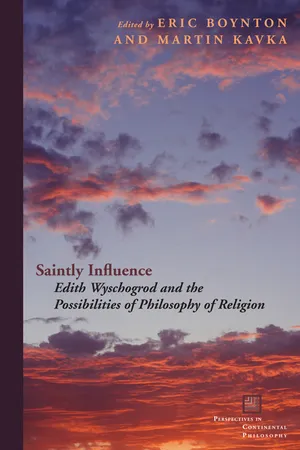
Saintly Influence
Edith Wyschogrod and the Possibilities of Philosophy of Religion
- 228 pages
- English
- ePUB (mobile friendly)
- Available on iOS & Android
eBook - ePub
Saintly Influence
Edith Wyschogrod and the Possibilities of Philosophy of Religion
About this book
Information
Publisher
Fordham University PressYear
2009Print ISBN
9780823230884
9780823230877
eBook ISBN
9780823230891
Topic
PhilosophySubtopic
Philosophy History & TheoryThe Ethical and Transcendence
The Impossible Possibility of Ethics
Edith Wyschogrod is perhaps our deepest and most serious contemporary ethical thinker, the one who has most comprehensively explored our ethical crisis today, and explored it with such decisive finality as to foreclose seemingly all possibility of a real and actual ethics for us. Although most deeply inspired by Levinas, she nevertheless has not succumbed to his absolute and absolutely primordial or pre-primordial ethics; she could not so succumb, if only because she will not abandon the actuality of our world. That actuality is most powerful for her in a uniquely contemporary “death-world,” a death-world ending everything that we have known as ethics. This ending ends history itself, thereby realizing a unique apocalypse, one finally promising life as well as death. This is the supreme challenge which Wyschogrod has chosen, calling forth life out of the depths of death, a life inseparable from the ultimacy and finality of death, but likewise inseparable from a uniquely contemporary nihil, a nihil exposed by mass extermination, a void that cannot be named but which constitutes a unique moment: the entry of the nihil into time. Never before has such a nihil been actually manifest, and never previously has nihilism been so pervasive. Nihilism is most apparent in postmodernism, a primary arena of Wyschogrod’s critical investigation, and one inseparable from a uniquely modern history and consciousness. It is in this investigation that she most conclusively demonstrates the impossibility of ethics for us—but that is the impossibility that she has chosen as possibility, a possibility which theologically can only be named as an absolutely free and an absolutely unconditioned grace.
Wyschogrod is perhaps our most ecumenical or most comprehensive thinker, as demonstrated by her ethical investigations, which are not only phenomenological and analytic at once, but occur within a truly universal perspective, one comprehending Judaism, Christianity, Buddhism, and a uniquely modern atheism. While Wyschogrod’s own theological identity is veiled in her ethical investigations, it is nevertheless a genuine theological identity, one perhaps offering a decisive clue to her deepest quest. One arena that she never explicitly enters is theological ethics, perhaps because she knows how banal and shallow theological ethics has become in our time, but perhaps more deeply because at bottom she is tacitly creating a theological ethics, one unnameable as such in terms of our established categories: an ethics which she can trace our great saints, where holiness is inseparable from a total self-giving, a self-giving that is a model for her of an ethical life. Her book Saints and Postmodernism: Revisioning Moral Philosophy 1 investigates saints in the very context of our nihilism, thereby bringing a unique illumination to each of these opposites. Provocatively, perhaps holiness is possible for us only by way of a reversal of nihilism, just as a nihilistic realization of absolute emptiness or absolute nothingness could be a parallel to an absolute self-emptying, thus offering the possibility of an ultimate coincidentia oppositorum.
Even though Wyschogrod is a genuine theological thinker, nothing is more absent from her discourse than the word God, except insofar as she speaks forcefully of the death of God, a death which she understands theologically, an understanding made manifest in her critical investigations of Hegel. Nor does she divorce the death of God from her own quest for a new ethics, and it is here that she differs most deeply from Levinas. While she has absorbed Levinas’s discovery of the il y a, an il y a that Levinas defines as Being in the absence of beings, Wyschogrod can apprehend an ethical role of the il y a, which is to denucleate the self as a complex of mental acts and render the self receptive to alterity. Alterity seemingly vanishes in postmodernity, and this is a fundamental ground of our ethical crisis, but this is an emptying which is the very opposite of self-emptying, and one inseparable from the modern realization of the death of God. Now if this is a realization which Levinas totally refuses, Wyschogrod herself refuses such a refusal. She does so to open herself to our deepest contemporary actuality, and while this is indeed a nihilistic actuality, it is nevertheless essential to a contemporary as opposed to a primordial or pre-primordial ethics. While Wyschogrod retains a primordial ground in her ethics, one preceding all historical judgment, she balances it by accepting an apocalyptic ground as well, thereby not only differing from Levinas, but opening herself to our new apocalyptic actuality.
While apocalypse has become a pervasive category in contemporary literary theory, just as it is in Heidegger and Derrida, it has been refused by our theological orthodoxies, and nowhere are Jewish, Christian, and Islamic orthodoxies more united than they are on this fundamental point. Yet already in Spirit in Ashes: Hegel, Heidegger, and Man-made Mass Death,2 Wyschogrod can know that the religious roots of the death-world lie in Jewish and Christian apocalypticism, and just as the philosophers whom she focuses upon in that book, Hegel and Heidegger, are apocalyptic philosophers, it is precisely apocalyptic thinking which most deeply unveils the death-world. Of course, an apocalyptic imagination goes beyond all such thinking, especially a uniquely modern apocalyptic imagination, as decisively manifest not only by Blake or Joyce, but even more purely by Kafka or Beckett. While Wyschogrod’s focus is more philosophical than imaginative, she follows Hegel, Nietzsche, and Heidegger in incorporating the imagination into thinking, thereby not only decisively differing from her ethical compeers, but from the whole world of analytic thinking, and her continual critique of that thinking is sustained by an imaginative ground. While that ground for Wyschogrod cannot be separated from the death-world, our uniquely modern imagination, from Dante through Joyce and beyond, is grounded in the ultimacy of death, an ultimacy inseparable from everything that can be envisioned as life itself, and even inseparable from the ultimacy of eternal life.
This ultimate conjunction, this coincidentia oppositorum of eternal life and eternal death, could be a paradigm directing Wyschogrod’s quest, on which only an eternal death makes possible an apocalyptic eternal life, or only the deepest darkness makes possible the deepest light. Hence only an ultimate crisis of our ethics could make possible a truly new ethics, and an ethics that could be real in our nihilistic world. If the bulk of Wyschogrod’s ethical investigations are a fundamentally negative critique, that is essential to her project, for light can come forth only out of the shadows of our darkness. A primary challenge is calling forth a genuine ethical possibility in Wyschogrod’s work out of our darkness. Such a possibility is inseparable from what Levinas knows as the Infinite, an infinite that is the radical, the absolutely other, one that cannot be contained in thought, and which disempowers all selfhood. This is that infinite which is the ultimate ground of alterity, an alterity veiled in our world, if only as a consequence of the death of God, with the result that there is no longer a primordial ground of alterity or otherness, and no longer an absolute “before” at all. True, that absolute “before” may be only veiled, not absent, may be only eclipsed or silent in our abyss, but its eclipse is a primal if not the primal source of the crisis of ethics, a crisis in which no actual ethics appears to be possible for us.
Now it is not insignificant that Levinas, among the greatest ethical thinkers of the twentieth century, should have called forth a primordial or pre-primordial ethics that ends every possible ethics, nor insignificant that the thinking of Levinas is so deeply Neoplatonic, initiating a new and deeply Neoplatonic philosophical movement in France. While Wyschogrod is drawn to Plotinus, she nevertheless resists Neoplatonism, and therein inevitably resists Levinas as well, perhaps most clearly in opening herself to a genuinely apocalyptic horizon. It is not commonly realized that the ultimate struggle in early Christianity was between the absolutely primordial and the absolutely apocalyptic, for Christianity was born with an absolute apocalypse, but it almost immediately gave birth to Gnosticism, the most absolutely primordial of all ultimate ways. We can see a war between the primordial and the apocalyptic most clearly in Paul, that Paul who was the creator of Christian theology, and whom we now know to have been a deeply apocalyptic theologian, perhaps most profoundly so in his struggle with a primitive Christian Gnosticism. This is most clearly recorded in his Corinthian correspondence, a correspondence that cannot possibly be understood as a coherent whole. If here as elsewhere Paul’s deepest ground is the crucified Christ, that ground is absent in Paul’s ecstatic celebration of eternal life in 1 Corinthians 15, and it is precisely here that Paul’s own language is most pagan or Gnostic. This is the Pauline language that most deeply influenced Christian orthodoxy, and despite that orthodoxy’s apparent victory over Gnosticism, Christian orthodoxy has never succeeded in negating or transcending a Gnostic horizon, a purely pagan horizon that has never been more powerful than it is today.
The prophetic revolution of Israel created the ultimate goal of an absolute future, an absolute future which is finally apocalypse itself, and this revolutionary movement towards an absolute future is an inversion or reversal of the archaic movement of eternal return. Nothing is more characteristic of a genuine paganism than is the movement of eternal return, and while this movement was reborn in Judaism, Christianity, and Islam, its most powerful expression occurs in Christian orthodoxy itself, which at this crucial point truly parallels all forms of Gnosticism. But genuine Gnosticism is inseparable from a Judeo-Christian-Islamic horizon, it is never found as such in the East where a truly backward movement is impossible, if only because in the East all ultimate distinctions between past and future disappear. Indeed, if it was Christianity that created Gnosticism, this could be understood as a reversal of an absolutely apocalyptic movement, one only possible for a Christianity that was born as an absolute apocalypse. That apocalypse is in deep continuity with the prophetic revolution, most clearly in reversing every distinction between high and low, a reversal which Nietzsche outlined as the slave revolt of morality, and which he knew to be most profoundly embodied in Christianity. Hence Nietzsche could know the uniquely Christian God as the deification of nothingness, “the will to nothingness pronounced holy.”3
In this perspective, only the uniquely Christian God is an absolute No-saying, and only a uniquely Christian ethics is a true and pure ethics of ressentiment. If Nietzsche only discovered ressentiment after he had discovered the death of God, that is because he discovered the death of a uniquely Christian God, hence one unknown apart from a Christian horizon. Already Paul could know the death of God in the Crucifixion, a death apart from which no absolute sacrifice is possible. A renewal of that death is at the very center of a uniquely Pauline ethics, an ethics revolving about a continual sacrifice of one’s innermost “I” or selfhood: an ethics that can be understood as a purely apocalyptic ethics. Here, a new Adam can only be understood as a consequence of the death of the old Adam, but if that death releases an absolutely new imperative which is an absolutely new indicative, then every distinction between the imperative and the indicative disappears, but only as the consequence of an actual ending of an old world or old creation.
Remarkably enough, there is a realism in Pauline ethics which soon disappears from the great body of Christianity, a realism inseparable from an apocalyptic horizon, a horizon which itself all but disappears from Christianity, except insofar as it is recovered by truly revolutionary movements. Alone among the great religions of the world, Christianity almost wholly transformed itself in the first three generations of its existence—but Christianity alone was born with a profound conflict at its very center, a conflict between its apocalyptic and its non-apocalyptic or primordial poles, a conflict fully manifest in the New Testament.
No tradition has so profoundly transformed itself in the course of its history as has Christianity, but no other tradition embodies such deep dichotomies within itself as does Christianity. These dichotomies manifest fully within the ethical realm in a Christianity that has been profoundly conservative, even reactionary, and profoundly revolutionary at once, a Christianity which has been simultaneously destructive and creative. Of course, the scale of these dichotomies continues to diminish within modern Christianity, as does the life and power of Christianity, but with the ending of Christendom such dichotomies pass into the greater body of humanity, and uniquely and profoundly Christian heterodoxies have become embodied in our new world. This is clearest in philosophy and the imagination, as in Hegel and Nietzsche, and in Blake and Joyce, but it is also manifest in our uniquely modern political and social revolutions, and perhaps even in modern science and technology. Certainly forward movement is manifest throughout modernity, beginning with the prophetic revolution of Israel, and ultimately embodied in Christianity. If forward movement has apparently now ended in all manifest or established Christianity, this itself is a deep transformation of Christianity, one that perhaps makes possible its transmutation into a fundamental ground of modernity.
Nothing is clearer in Wyschogrod’s work than that she calls out not simply the groundlessness of all established ethics, but the very vacuity of our given ethical categories, thus placing in question all of our ethical language, and inevitably raising the question of whether any ethical language at all is possible for us. This issue, regarding the very possibility of ethical language, can be concretely observed in many of our common presumptions. It is commonly assumed, for instance, that Heidegger is not a genuinely ethical thinker, despite his profound impact upon Levinas, and despite the apparent truth that Being and Time embodies the deepest and most powerful ethical language of any twentieth century philosophical work, and is unique in Western philosophical literature in the very primacy and centrality of this language. Is it because Heidegger writes with a deep and extraordinarily difficult language that it is presumed that his could not possibly be an ethical language? Can only a simple language be an ethical language? And despite the dominant presumption that modern ethics transcends theology, is there a lingering, if unconscious, doubt that a non-theological language could be a genuine ethical language? Being and Time is bereft of all explicitly theological language; perhaps the category of God is more wanting here than in any other philosophical work. Yet recent analysis draws forth the profound theological ground of Being and Time, and it is now apparent that Heidegger is a deeply Pauline thinker, most clearly so in his primary focus upon an absolute death, and an absolute death that is an apocalyptic death.
Just as Paul’s ethical thinking is now alien to virtually everyone, the same could be said of Heidegger, and of Nietzsche, too, and it has even become true of Spinoza. Is this not a sign of our profound alienation from a genuine ethical thinking? Now it is true that Heidegger, in withdrawing from the language of Dasein in his later work, withdrew from all manifest ethical thinking, but this can be understood as a reflection of an ultimate or apocalyptic crisis, one central to Heidegger throughout his major thinking, but only all-consuming in his final thinking. So, too, the death of God is more primal for Heidegger than for any other twentieth century philosopher, yet the death of God in modern thinking and vision is an apocalyptic death, and it ushers in an absolute apocalypse. Certainly Heidegger knows that apocalypse, even if he is reticent in speaking of it, yet he gives us a profound witness to it in his critical investigations of modern Germa...
Table of contents
- Cover Page
- Title Page
- Copyright Page
- Dedication
- Contents
- Preface
- Introduction
- The Uncertainty Principle
- PART I The Ethical and Transcendence
- PART II Practices of Influence
- PART III Channeling History
- PART IV Response
- Notes
- Contributors
- Index
- Perspectives
- Footnote
Trusted by 375,005 students
Access to over 1.5 million titles for a fair monthly price.
Study more efficiently using our study tools.
Frequently asked questions
Yes, you can cancel anytime from the Subscription tab in your account settings on the Perlego website. Your subscription will stay active until the end of your current billing period. Learn how to cancel your subscription
No, books cannot be downloaded as external files, such as PDFs, for use outside of Perlego. However, you can download books within the Perlego app for offline reading on mobile or tablet. Learn how to download books offline
We are an online textbook subscription service, where you can get access to an entire online library for less than the price of a single book per month. With over 1.5 million books across 990+ topics, we’ve got you covered! Learn about our mission
Look out for the read-aloud symbol on your next book to see if you can listen to it. The read-aloud tool reads text aloud for you, highlighting the text as it is being read. You can pause it, speed it up and slow it down. Learn more about Read Aloud
Yes! You can use the Perlego app on both iOS and Android devices to read anytime, anywhere — even offline. Perfect for commutes or when you’re on the go.
Please note we cannot support devices running on iOS 13 and Android 7 or earlier. Learn more about using the app
Please note we cannot support devices running on iOS 13 and Android 7 or earlier. Learn more about using the app
Yes, you can access Saintly Influence by Eric Boynton, Martin Kavka, Eric Boynton,Martin Kavka in PDF and/or ePUB format, as well as other popular books in Philosophy & Philosophy History & Theory. We have over 1.5 million books available in our catalogue for you to explore.