Contemplative or "noetic" knowledge has traditionally been seen as the highest mode of understanding, a view that persists both in many non-Western cultures and in Eastern Christianity, where "theoria physike," or the illumined understanding of creation that follows the purification of the heart, is seen to provide deeper insights into nature than the discursive rationality modernity has used to dominate and conquer it.
Working from texts in Eastern Orthodox philosophy and theology not widely known in the West, as well as a variety of sources including mystics such as the Sufi Ibn 'Arabi, poets such as Basho, Traherne, Blake, Hölderlin, and Hopkins, and nature writers such as Muir, Thoreau, and Dillard, The Noetics of Nature challenges both the primacy of the natural sciences in environmental thought and the conventional view, first advanced by Lynn White, Jr., that Christian theology is somehow responsible for the environmental crisis.
Instead, Foltz concludes that the ancient Christian view of creation as iconic—its "holy beauty" manifesting the divine energies and constituting a primal mode of divine revelation—offers the best prospect for the radical reversal that is needed in our relation to the natural environment.
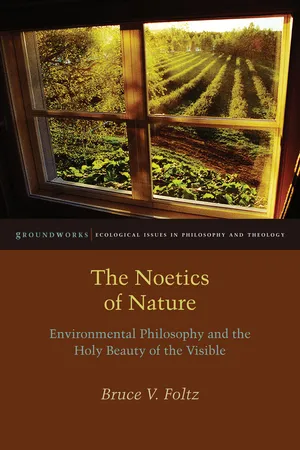
eBook - ePub
The Noetics of Nature
Environmental Philosophy and the Holy Beauty of the Visible
- 320 pages
- English
- ePUB (mobile friendly)
- Available on iOS & Android
eBook - ePub
About this book
Information
Publisher
Fordham University PressYear
2013Print ISBN
9780823254651
9780823254644
eBook ISBN
9780823254668
Topic
Theology & ReligionSubtopic
Christian DenominationsCHAPTER
1
Whence the Depth of Deep Ecology?
Natural Beauty and the Eclipse of the Holy
I
From a deep dream I woke and swear
The world is deep,
Deeper than day had been aware
Friedrich Nietzsche, “The Other Dancing Song,”
Thus Spoke Zarathustra
Despite their pretensions to depth, dreams are affairs of the surface. Which surface? The dreaming consciousness enjoys a constant motion, but always a lateral rather than a vertical movement, one that never arrives at its own denouement since the advent of finality is inevitably the moment the dreamer awakes—to the deeper breathing of relief or of longing, but awakes outside the dream even as it is shed off, just as the swimmer emerges dripping-wet from the surface of the water, plunging only now upon awaking into the truer depths of what transcends the self. The motion of the dream, however relentless it may appear to the dreamer, is unreal, goes nowhere, is a motion of Tantalus, always a movement in place. And as often as not, the lateral character of the dream is perfectly evident, sometimes even evident within the dream itself, as if it were hyper-text displayed on the screen of a computer monitor, where the links patently lead no place but to more links and these to yet further links, flashing one after the other across the surface but arriving nowhere. The dark spots on a banana peel become markings on the shell of a beetle that turn into a person who once stood behind me on a bus in some other time and who now appears at my door. But what, again, constitutes the surface of the dream? Surely nothing other than the dreaming consciousness itself. The dream logic tolerates no unobstructed apertures to anything outside itself, exterior to itself, deeper than itself. The dream is, as Descartes saw with nightmarish clarity, a solipsistic event, even (and most impressively) when some other event outside the dream (a noise or a change in ambient temperature) gets incorporated seamlessly into the self-driven logic of the dream-life, one that can never admit of an outside.
In “Helen’s Exile,” an essay originally dedicated to René Char, poet of nature and its stern beauty, Albert Camus maintains that Western humanity has exiled nature and beauty and the sense for limits that arises from contact with them, while encapsulating itself within the dark dreams of history:
“Only the modern city,” Hegel dares to write, “offers the mind the grounds on which it can achieve awareness of itself.” We live in the time of great cities. The world has been deliberately cut off from what gives it permanence: nature, the sea, hills, evening meditations. There is no consciousness any more except in the streets because there is history only in the streets, so runs the decree … History explains neither the natural universe which came before it, nor beauty which stands above it. Consequently it has chosen to ignore them.1
Cities and history. And now beyond these partitions, texts and signs—enclaves that can be even more stubborn in their resistance to anything outside them, anything exterior to them, anything “deeper than day had been aware.” After Camus, postmodern culture generates its own endless hyper-text, yet with the innovation that it wishes not simply to ignore, but to refuse outright anything outside the text as a proper matter for thought or experience. For the postmodern condition, the word “deep” is at best an emblem of naïveté, and more likely an indication of disloyalty and hostility to the culture of post-modernity, a token of ill-will and treachery—or perhaps even, worse yet, a symptom of “essentialism.” “Culture,” now defined less historically than semiotically, becomes in turn the preferred term for reality itself. This is, indeed, still a humanism, but a lonely humanism in which even a shared humanity is disdained, in favor of an archipelago of cultural gulags, various overlapping “cultures” within which we are each, and collectively, expected to find our proper residence. And from which we can only dream of waking.
In the last quarter of the twentieth century, then, deep ecology stood as one of the few intellectual movements to withstand the sophisticated humanism of post-modernity, to resist the socio-cultural constructivism that is now creeping even into environmental philosophy, and to insist that nature was real, and that “shallow” and “deep” had legitimate referents.
II
The Heideggerean literature at step x=+2 will be characterized by some of us as murky rather than deep, or at least both murky and deep.
Arne Naess2
What makes deep ecology deep? What is the dimension of depth for deep ecology that will keep it from being shallow? In an article called “Deepness of Questions and the Deep Ecology Movement,” Arne Naess reflects on this question of the “depth” of deep ecology. He begins by acknowledging one sense of depth, according to which it is the deepness of the questions it poses that constitutes the depth dimension. Deep questioning is one that progressively, step by step, questions answers—showing at every step that each answer can in turn be seen as provisional and shallow relative to another, deeper question: “Persistent questioning leads to deeper questions.”3 But there is more to this than just the propositional sense in which a premise is deeper than a conclusion, for as we proceed in uncovering and questioning presuppositions, we attain an overall net depth—i.e., our questioning becomes not just deeper in the relative sense, but becomes as such more “profound.” This sense of “profound,” in contrast to the “deepness” of “premise/conclusion relations,” Naess lets “refer to nearness to philosophical and religious matters,” yet surprisingly adds: “the latter term [i.e., ‘profound,’ so characterized] I leave unanalyzed.”4
But if this profundity that is more important than propositional depth is left undefined, how can we avoid the danger of becoming shallow in our very questioning, especially given the danger, at least suggested by Naess, that continued questioning may lead not to greater “profundity” at all, but to “certain kinds of diversionary steps or side-tracking maneuvers,” i.e., into questions of professional philosophy that, if taken up as an end in themselves, lead not to greater overall depth but into conceptual shallowness and sophistry. Perhaps one answer can be found in Naess’s claim that “‘deepness’ must include not only systematic philosophical deepness, but also the ‘deepness’ of proposed social changes.”5 The depth of questioning that would be “profound,” then, would lead to social change that—in the words of point six of his deep ecology platform, to which Naess refers us as an index of deep social change—“would affect basic economic, technological, and ideological structures. The resulting state of affairs would be deeply different from the present.”6
But should we not question more deeply here, too, in hopes of arriving at an element that is itself more “profound”? What kind of difference would constitute a “deep” difference from the current state of affairs? And in what direction should these changes move? How do we know that the differences at which we are aiming will not turn out to be shallow, that the specific changes for which we are struggling will not be discovered to make no deep difference at all? How do we know, for example, that our attempts to bring about a deeper respect for nature by establishing carefully protected parks will not end up transforming the protected areas themselves into specimens and mere objects of curiosity, vanquishing the very wildness we aimed to protect? How do we avoid the self-deception of the dreamer, whose belief in waking is just another part of the dream, a sophisticated gambit that allows us to linger in the shallows? Can we dispense with a philosophical elucidation of this depth dimension that would be substantive, and that would provide us with some criterion for knowing when the questioning of deep ecology, or of environmental philosophy as such, is getting deeper into what Husserl called die Sache selbst, the very “thing itself,” and this must surely mean nature itself? And for knowing when it is merely superficial and self-enclosed? What is the depth of nature—and so too, what is the ground in which deep ecology is properly rooted? As Heidegger observed of Descartes’s project of radical questioning, there is always a special danger that, as we seek the roots or fundamentals, we will overlook the very ground that nourishes those roots—a ground that just because of its axiomatic—that is, its sustaining and ultimately earthly character—will necessarily appear murky to propositional analysis.
This chapter, then, will investigate a certain depth of nature itself, a depth that is hardly unknown, yet which remains largely unarticulated philosophically. This will be defined first by means of an aesthetics that is proper to nature, and which will lead to the conclusion that natural aesthetics is philosophically prior to the aesthetics of art. These considerations will, in turn, lead to the phenomenon of a kind of integrity or “holiness” in nature, without which this depth of nature cannot be understood. Finally, this holiness of nature will serve as a basis for unifying some of the central issues of environmental philosophy, as well as showing why additional issues should be seen as more central. It will, then, try to pursue a perhaps “deep and murky” path through some of those very “philosophical and religious matters” that can help elucidate that ground in nature itself within which environmental philosophy needs to be rooted, if it is not to end up being shallow and merely academic—i.e., if it is not to digress into a series of “diversionary steps or side-tracking maneuvers,” which are not only unhelpful but lead in the wrong direction altogether.
III
Our longing for the beautiful seems to shine from it, situating us within its disclosed world that has its own new and surprising urges. This longing is not in our possession, but conveys an inexhaustible depth of object that belongs to it while exceeding it. The depth is a signal within the form of the object whose intention embraces us. Given this simultaneous objectivity and subjectivity of the experience of the beautiful, we can say that to see … the beautiful is to see the invisible in the visible.
John Milbank7
The strange and dreamy history of aesthetics has resulted in several anomalies and perplexities that have important bearings on the depth, the interiority, and that alluring radiance of nature that has traditionally been called beauty. Of these, two are striking and immediate, while two more are best understood as derivative from them.
Most perplexing of all is that reflections on beauty in aesthetics have themselves been so few in number. “To say of beauty that it is relatively unexplored,” observes Mary Mothersill, “is just to observe that many great philosophers treat it in a perfunctory manner or not at all…. The popular conception—that there is a vast [philosophical] literature [on beauty], many theories, as many as there are theorists—is false.”8 Why this longstanding neglect?
A second, striking perplexity is that even when beauty does get discussed, what is itself less puzzling (the beauty of art) is taken as the central problematic, while what is more puzzling, and indeed most wonderful (the beauty of nature), is ignored altogether or taken as marginal. That is, it is the beauty of art that is the customary locus and norm of the discussion, even though the occurrence of beauty in nature is far more remarkable philosophically. For it seems no more exceptional or puzzling that works of art could be beautiful than that propositions could be true or that human actions could be good: In each case, it seems relatively unproblematic that each could be respectively beautiful, true, or good simply because they were each intended to be that way, made to possess those characteristics. But that a sunset or a tree or a bird can be found to be beautiful should appear to us just as remarkable as someone claiming, without making any qualifications, that one of these was good or that it was true. Surely it is just as exceptional to say that a given tree is beautiful as to say that it is good or true—that it exhibits of its own accord one of the sorts of things which, more than being profoundly human, are what is profoundly constitutive of our humanity itself—the sorts of things that Plato maintains are prerequisites for our having turned out to be human in the first place.
Art is made to be beautiful, while it is hardly self-evident to philosophy that the intentionality of an artisan lies behind the beauty of nature.9 Nevertheless, our modern ordinary ways of speaking and thinking easily accommodate something’s being beautiful just on its own, and in its own right, whereas to say of a cliff-face or a wildflower that it was simply good, and even less so that it was true, would puzzle most listeners. And accordingly, philosophical theories have found this easy to accommodate as well. As is so often the case, it is puzzling how often what is truly puzzling is not taken to be puzzling at all. The perplexity, and wonder, of natural beauty—that it should be at all—has hardly been addressed by philosophers.
IV
In the first place, here [upon this very twig laden with orange blossoms] is a prodigality of beauty; and what harm do they do by existing? And is man not a being capable of Beauty even as of Hunger and Thirst? And if the latter be fit objects of a final cause, why then not the former?
Samuel Taylor Coleridge, Anima Poetae10
Leo Tolstoy, who in the end reduces aesthetics to morality, nonetheless usefully distinguishes between two philosophical conceptions of beauty. “The first,” he explains, “is that beauty is something having an independent existence (existing in itself), that it is one of the manifestations of the absolutely Perfect, of the Idea, of the Spirit, of Will, or of God; the other is that beauty is a kind of pleasure received by us not having personal advantage for its object.” The first, the “objective-mystical definition,” Tolstoy finds characteristic of German Idealism with the second, “subjective” definition, characteristic of British aesthetics. In the first, beauty is “something mystical or metaphysical,” what Muir called “beauty beyond thought,” while in the second it is simply “a special kind of pleasure.”11 At the risk of oversimplification, we could add that the first view traces its lineage to Plato and sees the locus of beauty in what is extraordinary, exceptional, transcendent, perhaps sublime. Its exemplars are natural beauty rather than art, moral beauty (especially when usual human limits are transcended, as with heroes and saints), and the visionary beauty described by mystics. The second finds its predecessor not in Plato but in Aristotle, seeing the locus of beauty in human affectivity and imagination, and taking art as its exemplar. When it does consider nature, it valorizes the harmonious, the balanced and proportional (i.e., the pastoral).
It is, then, the predominance (especially in modernity) of the second kind of aesthetic—the kind that sees beauty as subjective, as mental, as a kind of pleasure—that helps account for the two earlier perplexities. For if beauty is simply the pleasure we get from certain impressions, then it is something quite unremarkable, either in art or in nature, a matter of no more than our psycho-physical constitution.
But is beauty thus described really the beauty we seek and encounter, either in nature or in art? Or is it instead a tamed and bloodless remnant of the rich, dynamic beauty that, in our most fortunate moments, addresses us? Is the sublimity of a thunderstorm, or a mountain range, or indeed of “starry skies above” really nothing more than my cozy sentiment of moral autonomy, as Kant believed? Beauty itself is not just puzzling, but wonderful, something transcendent and theophanous. And most wonderful of all is that in the natural world, we discover a beauty that we did not create and that does not inhere in our own minds. What Tolstoy calls subjective theories of beauty, rather than helping us understand these mysteries, cover them up instead. Moreover, the predominance of such views accounts for the second set of anomalies as well, those that are specific to environmental philosophy proper.
The third perplexity can be stated as follows: given the predominant role of natural beauty in understanding and articulating why nature is important—both in native, uninstructed sensibilities and in our finest nature writers—it is strange that aesthetic considerations have played such a marginal role in environmental philosophy. For the guiding vision of American nature writing is already familiar to the simplest camper or hiker or hunter: We should protect and preserve nature because it is splendid, singular, beautiful. If the writer finds a missionary task, it is either to enlarge and expand our native aesthetic sensibilities (to include reptiles or arctic tundra or inhospitable swamplands) or else to revive and refresh our encrusted or sedimented memory of nature’s beauty—to recall us to our own best perceptions and our own best selves, to help us see better, farther, more clearly that which all of us have already surveyed. It is never aimed at generating this sensibility in the first place, for as Plato insists, it could not be imparted if it were not present already.
Why, then, do aesthetic considerations get overlooked in environmental philosophy? At one level, it is probably because in postmodern, pluralistic societies it is widely believed that aesthetics is utterly ...
Table of contents
- Cover
- Half title
- Series Page
- Title
- Copyright
- Contents
- Preface
- Acknowledgments
- Introduction: The Noetics of Nature
- 1: Whence the Depth of Deep Ecology? Natural Beauty and the Eclipse of the Holy
- 2: Nature’s Other Side: The Demise of Nature and the Phenomenology of Givenness
- 3: Layers of Nature in Thomas Traherne and John Muir: Numinous Beauty, Onto-theology, and the Polyphony of Tradition
- 4: Sailing to Byzantium: Nature and City in the Greek East
- 5: The Resurrection of Nature: Environmental Metaphysics in Sergei Bulgakov’s Philosophy of Economy
- 6: The Iconic Earth: Nature Godly and Beautiful
- 7: Seeing Nature: Theōria Physikē in the Thought of St. Maximos the Confessor
- 8: Seeing God in All Things: Nature and Divinity in Maximos, Florensky, and Ibn ‘Arabi
- 9: The Glory of God Hidden in Creation: Eastern Views of Nature in Fyodor Dostoevsky and St. Isaac the Syrian
- 10: Between Heaven and Earth: Did Christianity Cause Global Warming?
- 11: Nature and Other Modern Idolatries: Kosmos, Ktisis, and Chaos in Environmental Philosophy
- 12: Traces of Divine Fragrance, Droplets of Divine Love: The Beauty of Visible Creation in Byzantine Thought and Spirituality
- Notes
- Index of Terms in Greek, German, and Latin
- Index of Names and Places
- Series List
Trusted by 375,005 students
Access to over 1.5 million titles for a fair monthly price.
Study more efficiently using our study tools.
Frequently asked questions
Yes, you can cancel anytime from the Subscription tab in your account settings on the Perlego website. Your subscription will stay active until the end of your current billing period. Learn how to cancel your subscription
No, books cannot be downloaded as external files, such as PDFs, for use outside of Perlego. However, you can download books within the Perlego app for offline reading on mobile or tablet. Learn how to download books offline
We are an online textbook subscription service, where you can get access to an entire online library for less than the price of a single book per month. With over 1.5 million books across 990+ topics, we’ve got you covered! Learn about our mission
Look out for the read-aloud symbol on your next book to see if you can listen to it. The read-aloud tool reads text aloud for you, highlighting the text as it is being read. You can pause it, speed it up and slow it down. Learn more about Read Aloud
Yes! You can use the Perlego app on both iOS and Android devices to read anytime, anywhere — even offline. Perfect for commutes or when you’re on the go.
Please note we cannot support devices running on iOS 13 and Android 7 or earlier. Learn more about using the app
Please note we cannot support devices running on iOS 13 and Android 7 or earlier. Learn more about using the app
Yes, you can access The Noetics of Nature by Bruce V. Foltz in PDF and/or ePUB format, as well as other popular books in Theology & Religion & Christian Denominations. We have over 1.5 million books available in our catalogue for you to explore.