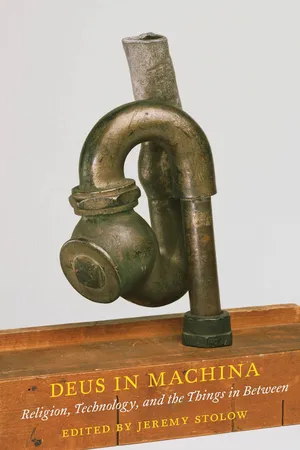
The essays in this volume explore how two domains of human experience and action—religion and technology—are implicated in each other. Contrary to commonsense understandings of both religion (as an "otherworldly" orientation) and technology (as the name for tools, techniques, and expert knowledges oriented to "this" world), the contributors to this volume challenge the grounds on which this division has been erected in the first place.
What sorts of things come to light when one allows religion and technology to mingle freely? In an effort to answer that question, Deus in Machina embarks upon an interdisciplinary voyage across diverse traditions and contexts where religion and technology meet: from the design of clocks in medieval Christian Europe, to the healing power of prayer in premodern Buddhist Japan, to 19th-century Spiritualist devices for communicating with the dead, to Islamic debates about kidney dialysis in contemporary Egypt, to the work of disability activists using documentary film to reimagine Jewish kinship, to the representation of Haitian Vodou on the Internet, among other case studies.
Combining rich historical and ethnographic detail with extended theoretical reflection, Deus in Machina outlines new directions for the study of religion and/as technology that will resonate across the human sciences, including religious studies, science and technology studies, communication studies, history, anthropology, and philosophy.
INTRODUCTION: RELIGION, TECHNOLOGY, AND THE THINGS IN BETWEEN
Jeremy Stolow
1. See Donald J. Mastronarde, “Actors on High: The Skene Roof, the Crane, and the Gods in Attic Drama,” Classical Antiquity 9, no. 2 (October 1990): 247–94; Rush Rehm, Tragic Greek Theatre (New York and London: Routledge, 1994), 69–71.
2. See, for instance, Aristotle, Poetics 1454a–b.
3. Whereas in ancient Greek the term m
chanê still reverberated with the connotations of its root word, mekhos (literally a “means” or an “expedient,” etymologically connected to the proto-Indo-European word magh-, “to be able,” whence also comes the term “magic”), by Roman times the word machina already had expanded its semantic terrain to include “device,” “frame,” “contrivance,” and “trick.”
4. David Hume, Dialogues and Natural History of Religion, ed. J. C. A. Gaskin (1757–1779; Oxford: Oxford University Press, 1993); Ludwig Feuerbach, Lectures on the Essence of Religion, trans. Ralph Manheim (1851; New York: Harper and Row, 1967); Emile Durkheim, The Elementary Forms of Religious Life, trans. Karen E. Fields (1912; New York: Free Press, 1995).
5. Bruno Latour, On the Modern Cult of the Factish Gods (Durham, N.C.: Duke University Press, 2010), 43; see also Latour, “What Is Iconoclash? Or Is There a World Beyond the Image Wars?” in Iconoclash: Beyond the Image Wars in Science, Religion, and Art, ed. Latour and Peter Weibel (Cambridge, Mass.: MIT Press, 2002), 14–37; Latour, Pandora’s Hope: Essays on the Reality of Science Studies (Cambridge, Mass.: Harvard University Press, 1999), 266–92.
6. Matthew Engelke, “Religion and the Media Turn: A Review Essay,” American Ethnologist 37, no. 2 (2010): 371–79.
7. A landmark text in the generation of this “media turn” in the study of religion is Hent de Vries and Samuel Weber, eds., Religion and Media (Stanford: Stanford University Press, 2001). For overviews of religion and media as a field of research, see David Morgan, ed., Key Words in Religion, Media and Culture (New York: Routledge, 2008); and Jeremy Stolow, “Religion and/as Media,” Theory, Culture & Society 22, no. 2 (2005): 119–45; see also the many contributions to the journal Material Religion: The Journal of Objects, Art, and Belief, which began publishing in 2005.
8. As Hent de Vries argues in his agenda-setting introduction to the volume Religion and Media, “We should no longer reflect exclusively on the meaning, historically and in the present, of religion—of faith and belief and their supposed opposites such as knowledge and technology—but concentrate on the significance of the processes of mediation and mediatization without and outside of which no religion would be able to manifest or reveal itself in the first place”; de Vries, “In Media Res: Global Religion, Public Spheres, and the Task of Contemporary Comparative Religious Studies,” in Religion and Media, ed. de Vries and Weber, 28.
9. On the (mediated) production of immediacy, see Rosalind Morris, “Modernity’s Media and the End of Mediumship? On the Aesthetic Economy of Transparency in Thailand,” Public Culture 12, no. 2 (2000): 457–75; Birgit Meyer, “Mediation and Immediacy: Sensational Forms, Semiotic Ideologies and the Question of the Medium,” Social Anthropology 19, no. 1 (2010): 23–39; and Mattijs van de Port, “(Not) Made by the Human Hand: Media Consciousness and Immediacy in the Cultural Production of the Real,” Social Anthropology 19, no. 1 (2010): 74–89.
10. The “conflict thesis” is usually traced back to John William Draper, History of the Conflict between Religion and Science (New York: Appleton, 1878). For recent critiques, see John Hedley Brooke, Science and Religion: Some Historical Perspectives (Cambridge: Cambridge University Press, 1991); Thomas Dixon, Geoffrey Cantor, and Stephen Pumfrey, eds., Science and Religion: New Historical Perspectives (Cambridge: Cambridge University Press, 2010); and Ronald L. Numbers, ed., Galileo Goes to Jail, and Other Myths about Science and Religion (Cambridge, Mass.: Harvard University Press, 2009). On “scientific wonders” and the culture of public scientific spectacle, see Bernadette Bensaude-Vincent and Christine Blondel, eds., Science and Spectacle in the European Enlightenment (Aldershot, UK: Ashgate, 2008); Lorraine Daston and Katharine Park, Wonders and the Order of Nature, 1150–1750 (New York: Zone Books, 1998); James Delbourgo, A Most Amazing Scene of Wonders: Electricity and Enlightenment in Early America (Cambridge, Mass.: Harvard University Press, 2006); Fred Nadis, Wonder Shows: Performing Science, Magic, and Religion in America (New Brunswick, N.J.: Rutgers University Press, 2005); and Simon Schaffer, “Natural Philosophy and Public Spectacle in the Eighteenth Century,” History of Science 21 (March 1983): 1–43.
11. Jacques Derrida, “Faith and Knowledge: The Two Sources of ‘Religion’ at the Limits of Reason Alone,” in Religion, edited by Jacques Derrida and Gianni Vattimo, 56–57 passim (Stanford: Stanford University Press, 1998).
12. On “cybergnosticism,” see Stef Aupers, Dick Houtman, and Peter Pels, “Cybergnosticism: Technology, Religion, and the Secular,” in Religion: Beyond a Concept, ed. Hent de Vries (New York: Fordham University Press, 2008), 687–703. On the “disembodiment” of information and the dismantling of the humanist subject in cybernetic discourse, see N. Katherine Hayles, How We Became Posthuman: Virtual Bodies in Cybernetics, Literature, and Informatics (Chicago: University of Chicago Press, 1999). On the creation of “hybrids,” see Ann Balsamo, Technologies of the Gendered Body: Reading Cyborg Women (Durham, N.C.: Duke University Press, 1999); Elaine Graham, Representations of the Post/Human: Monsters, Aliens and Others in Popular Culture (Manchester, UK: Manchester University Press, 2002); and Donna Haraway, Simians, Cyborgs and Women: The Reinvention of Nature (New York: Routledge, 1991).
13. On visual phantasmagoria, especially in the history of photography and early cine...
Table of contents
Cover
Title Page
Copyright
Contents
List of Illustrations
Acknowledgments
Introduction: Religion, Technology, and the Things in Between
EQUIPMENT
BIO-POWER
(RE)LOCATING RELIGION IN A TECHNOLOGICAL AGE
Notes
List of Contributors
Trusted by 375,005 students
Access to over 1.5 million titles for a fair monthly price.
Study more efficiently using our study tools.
Frequently asked questions
Yes, you can cancel anytime from the Subscription tab in your account settings on the Perlego website. Your subscription will stay active until the end of your current billing period. Learn how to cancel your subscription
No, books cannot be downloaded as external files, such as PDFs, for use outside of Perlego. However, you can download books within the Perlego app for offline reading on mobile or tablet. Learn how to download books offline
Perlego offers two plans: Essential and Complete
Essential is ideal for learners and professionals who enjoy exploring a wide range of subjects. Access the Essential Library with 800,000+ trusted titles and best-sellers across business, personal growth, and the humanities. Includes unlimited reading time and Standard Read Aloud voice.
Complete: Perfect for advanced learners and researchers needing full, unrestricted access. Unlock 1.5M+ books across hundreds of subjects, including academic and specialized titles. The Complete Plan also includes advanced features like Premium Read Aloud and Research Assistant.
Both plans are available with monthly, semester, or annual billing cycles.
We are an online textbook subscription service, where you can get access to an entire online library for less than the price of a single book per month. With over 1.5 million books across 990+ topics, we’ve got you covered! Learn about our mission
Look out for the read-aloud symbol on your next book to see if you can listen to it. The read-aloud tool reads text aloud for you, highlighting the text as it is being read. You can pause it, speed it up and slow it down. Learn more about Read Aloud
Yes! You can use the Perlego app on both iOS and Android devices to read anytime, anywhere — even offline. Perfect for commutes or when you’re on the go. Please note we cannot support devices running on iOS 13 and Android 7 or earlier. Learn more about using the app
Yes, you can access Deus in Machina by Jeremy Stolow in PDF and/or ePUB format, as well as other popular books in Theology & Religion & Religion. We have over 1.5 million books available in our catalogue for you to explore.