Philosophers have largely ignored sleep, treating it as a useless negativity, mere repose for the body or at best a source for the production of unconscious signs out of the night of the soul.
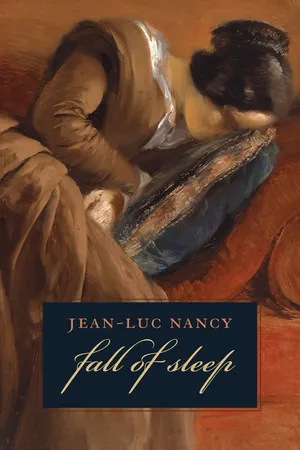
In an extraordinary theoretical investigation written with lyric intensity, The Fall of Sleep puts an end to this neglect by providing a deft yet rigorous philosophy of sleep. What does it mean to "fall" asleep? Might there exist something like a "reason" of sleep, a reason at work in its own form or modality, a modality of being in oneself, of return to oneself, without the waking "self" that distinguishes "I" from "you" and from the world? What reason might exist in that absence of ego, appearance, and intention, in an abandon thanks to which one is emptied out into a non-place shared by everyone?
Sleep attests to something like an equality of all that exists in the rhythm of the world. With sleep, victory is constantly renewed over the fear of night, an a confidence that we will wake with the return of day, in a return to self, to us--though to a self, an us, that is each day different, unforeseen, without any warning given in advance.
To seek anew the meaning stirring in the supposed loss of meaning, of consciousness, and of control that occurs in sleep is not to reclaim some meaning already familiar in philosophy, religion, progressivism, or any other -ism. It is instead to open anew a source that is not the source of a meaning but that makes up the nature proper to meaning, its truth: opening, gushing forth, infinity.
This beautiful, profound meditation on sleep is a unique work in the history of phenomenology--a lyrical phenomenology of what can have no phenomenology, since sleep shows itself to the waking observer, the subject of phenomenology, only as disappearance and concealment.
- 88 pages
- English
- ePUB (mobile friendly)
- Available on iOS & Android
eBook - ePub
The Fall of Sleep
About this book
Information
Publisher
Fordham University PressYear
2009Print ISBN
9780823231188
9780823231171
eBook ISBN
9780823231195
Topic
PhilosophySubtopic
Literary Essays4
Equal World
Everything is equal to itself and to the rest of the world. Everything reverts to the general equivalence in which one sleeper is worth as much as any other sleeper and every sleep is worth all the others, however it may appear. For sleeping “well” or “badly” comes down merely to sleeping more or less, in a more or less continuous, or more or less perturbed fashion. Interruptions and perturbations, including those that arise sometimes from within sleep itself, like those nightmares that wake us up in anxiety and sweat—these accidents of sleep do not belong to it.
Sleep itself knows only equality, the measure common to all, which allows no differences or disparities. All sleepers fall into the same, identical and uniform sleep. This consists precisely in not differentiating. That is why night suits it, along with darkness, and especially silence. Likewise, too, a necessary apathy—passions, sorrows, and joys must be asleep, desire must rest too, and even contact, or the smell of the bed, of its sheets, and of the companion, if there is one, with whom one sleeps.
Everyone sleeps in the equality of the same sleep—all the living—and that is why it might seem strange to assert that sleeping together is such a high-risk undertaking. But we are well aware of this, and for us, at least, whose culture has forgotten the way our ancestors slept together collectively, sleeping together evokes nothing less than what we call in the crudest way (but why crude? except because we have thus twisted the sense of words, at least in the French language) “going to bed together.”
Sleeping together opens up nothing less than the possibility of penetrating into the most intimate part of the other, namely, precisely into his or her sleep. The happy, languid sleep of lovers who sink down together prolongs their loving spasm into a long suspense, into a pause held at the limits of the dissolution and disappearance of their very harmony: intermingled, their bodies insidiously disentangle, however intertwined they can sometimes remain until the end of sleep, until the instant joy returns to them as renewed for having been forgotten, eclipsed during the time of their sleep, where their agile bodies surface again after having been drowned at the bottom of the waters they themselves poured out.
The separation, comma [virgule], between l’émoi, et moi, excitement, and I, on waking [au reveil], is equal to decollating [décoller] (detachment of the neck [cou] and of glue [la colle]), and decollation to a sublimating idealization that relieves what is detached. Indecision, oscillation, the trembling vibration where ideality is announced, these are always called shuddering, quivering, and so on. “That kind of shudder also exalted my happiness, for it made our trembling kiss seem to take wing [décoller], to be idealized. . . . that he had been on the alert all the time and that, during the embrace, he had not been roused [ému], for on hearing the noise he would have had slight [légère] difficulty, despite his quick reflexes, in shaking off the excitement, and I [l‘émoi, et moi], who was glued to him, would have detected that slight twinge, that decollation of a subtle glue [glu]” (Miracle of the Rose).6
But this forgetting itself pertains to the rapture [jouissance] in which there is nothing to take or keep, nothing to win or save: everything, on the contrary, to let go. Sleep enjoys prolonging the pleasure whose evaporation and exhaustion it consumes. It grants full rights to the power of extinction that ardor bears within it: it provides it, not with the easing that is supposed to follow tension, but with the very subtle conversion of tension into the intensity of relaxation that physics calls inertia and that keeps a body in momentum so long as no friction of surrounding matter comes to oppose the pursuit of its trajectory.
Sleeping together comes down to sharing an inertia, an equal force that maintains the two bodies together, drifting like two narrow boats moving off to the same open sea, toward the same horizon always concealed afresh in mists whose indistinctness does not let dawn be distinguished from dusk, or sunset from sunrise.
* * *
For it is in effect the great equal sleep of the whole Earth that those who sleep together share. In their “together” is refracted the entirety of all sleepers: animals, plants, rivers, seas, sands, stars set in their crystalline spheres of ether, and ether itself, which has fallen asleep. But the truth of ether—whether it exists or whether it doesn‘t exist, as we have known it since Michelson and Morley—is that it falls asleep and that it puts to sleep our planetary system with it. It is the great sleep, the great night of the world that surrounds us, toward which we drift irresistibly in an infinite expansion.
For there to be night, though, there must be day. Day introduces night as its own difference and as the alternation by which alone there can be day: meaning both daylight and a period of time. Twofold scansion, twofold alternation, of light and darkness, of the unity of time that succeeds itself. Twofold rhythm, solar and lunar, waking and sleeping. Fiat lux—and there is the first day, wholly made up of its sole brilliance of day, but there at the same time is time itself, the rhythmic balance of days and nights. The first day of the world, the first night, the first difference. Equal to itself, this beat turns every day and all the days that God makes—as we used to say back in the days of God—into succession itself, the successiveness of time, which passes equal to itself in its obstinate cadence.
This equality to itself is distributed according to the rhythmic distinction between the inequality of day and the equality of night. Day by itself is unequal, singular, just as the primal lux was and is always nothing other than difference itself, the division of the primeval indistinctness of a chaos, a khōra, a magma, an upwelling watertable. Day is always another day, it is, in general, the other of the same. Tomorrow is another day, that is to say, again a day and a different day. The passage to this other is created by the equality of night. All nights are equal. All equally suspend the time of difference, the time of differentiations of all kinds, like that of speech, of food, of combat, of travel, of thought.
Nights can indeed differ among themselves—contrast a night of insomnia to a night sealed under leaden sleep. Nights can offer the contrasts of lamps lit and fires extinguished, of nighttime celebrations and dozing households: but it is night nonetheless, night always begun anew. Days can indeed, for their part, resemble each other in the most repetitive monoton...
Table of contents
- Cover Page
- Title Page
- Copyright Page
- Contents
- Translator
- Chapter 01
- Chapter 02
- Chapter 03
- Chapter 04
- Chapter 05
- Chapter 06
- Chapter 07
- Chapter 08
- Chapter 09
- Note
Trusted by 375,005 students
Access to over 1.5 million titles for a fair monthly price.
Study more efficiently using our study tools.
Frequently asked questions
Yes, you can cancel anytime from the Subscription tab in your account settings on the Perlego website. Your subscription will stay active until the end of your current billing period. Learn how to cancel your subscription
No, books cannot be downloaded as external files, such as PDFs, for use outside of Perlego. However, you can download books within the Perlego app for offline reading on mobile or tablet. Learn how to download books offline
Perlego offers two plans: Essential and Complete
- Essential is ideal for learners and professionals who enjoy exploring a wide range of subjects. Access the Essential Library with 800,000+ trusted titles and best-sellers across business, personal growth, and the humanities. Includes unlimited reading time and Standard Read Aloud voice.
- Complete: Perfect for advanced learners and researchers needing full, unrestricted access. Unlock 1.5M+ books across hundreds of subjects, including academic and specialized titles. The Complete Plan also includes advanced features like Premium Read Aloud and Research Assistant.
We are an online textbook subscription service, where you can get access to an entire online library for less than the price of a single book per month. With over 1.5 million books across 990+ topics, we’ve got you covered! Learn about our mission
Look out for the read-aloud symbol on your next book to see if you can listen to it. The read-aloud tool reads text aloud for you, highlighting the text as it is being read. You can pause it, speed it up and slow it down. Learn more about Read Aloud
Yes! You can use the Perlego app on both iOS and Android devices to read anytime, anywhere — even offline. Perfect for commutes or when you’re on the go.
Please note we cannot support devices running on iOS 13 and Android 7 or earlier. Learn more about using the app
Please note we cannot support devices running on iOS 13 and Android 7 or earlier. Learn more about using the app
Yes, you can access The Fall of Sleep by Jean-Luc Nancy, Charlotte Mandell in PDF and/or ePUB format, as well as other popular books in Philosophy & Literary Essays. We have over 1.5 million books available in our catalogue for you to explore.