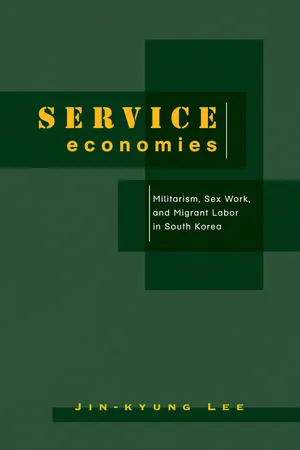
Service Economies
eBook - PDF

Service Economies

Militarism, Sex Work, and Migrant Labor in South Korea

  1. 316 pages
  2. English
  3. PDF
  4. Available on iOS & Android
eBook - PDF

Service Economies

Militarism, Sex Work, and Migrant Labor in South Korea

About this book

Service Economies presents an alternative narrative of South Korean modernity by examining how working-class labor occupies a central space in linking the United States and Asia to South Korea's changing global position from a U.S. neocolony to a subempire.

Making surprising and revelatory connections, Jin-kyung Lee analyzes South Korean military labor in the Vietnam War, domestic female sex workers, South Korean prostitution for U.S. troops, and immigrant/migrant labor from Asia in contemporary South Korea. Foregrounding gender, sexuality, and race, Lee reimagines the South Korean economic "miracle" as a global and regional articulation of industrial, military, and sexual proletarianization.

Lee not only addresses these under-studied labors individually but also integrates and unites them to reveal an alternative narrative of a changing South Korean working class whose heterogeneity is manifested in its objectification. Delving into literary and popular cultural sources as well as sociological work, Lee locates South Korean development in its military and economic interactions with the United States and other Asian nation-states, offering a unique perspective on how these practices have shaped and impacted U.S.-South Korea relations.

Frequently asked questions

Yes, you can cancel anytime from the Subscription tab in your account settings on the Perlego website. Your subscription will stay active until the end of your current billing period. Learn how to cancel your subscription.
No, books cannot be downloaded as external files, such as PDFs, for use outside of Perlego. However, you can download books within the Perlego app for offline reading on mobile or tablet. Learn more here.
Perlego offers two plans: Essential and Complete
  • Essential is ideal for learners and professionals who enjoy exploring a wide range of subjects. Access the Essential Library with 800,000+ trusted titles and best-sellers across business, personal growth, and the humanities. Includes unlimited reading time and Standard Read Aloud voice.
  • Complete: Perfect for advanced learners and researchers needing full, unrestricted access. Unlock 1.4M+ books across hundreds of subjects, including academic and specialized titles. The Complete Plan also includes advanced features like Premium Read Aloud and Research Assistant.
Both plans are available with monthly, semester, or annual billing cycles.
We are an online textbook subscription service, where you can get access to an entire online library for less than the price of a single book per month. With over 1 million books across 1000+ topics, we’ve got you covered! Learn more here.
Look out for the read-aloud symbol on your next book to see if you can listen to it. The read-aloud tool reads text aloud for you, highlighting the text as it is being read. You can pause it, speed it up and slow it down. Learn more here.
Yes! You can use the Perlego app on both iOS or Android devices to read anytime, anywhere — even offline. Perfect for commutes or when you’re on the go.
Please note we cannot support devices running on iOS 13 and Android 7 or earlier. Learn more about using the app.
Yes, you can access Service Economies by Jin-kyung Lee in PDF and/or ePUB format, as well as other popular books in Literature & Korean History. We have over one million books available in our catalogue for you to explore.

Information

Table of contents

  1. Contents
  2. Acknowledgments
  3. Introduction: Proletarianizing Sexuality and Race
  4. 1 Surrogate Military, Subempire, and Masculinity: South Korea in the Vietnam War
  5. 2 Domestic Prostitution: From Necropolitics to Prosthetic Labor
  6. 3 Military Prostitution: Gynocentrism, Racial Hybridity, and Diaspora
  7. 4 Migrant and Immigrant Labor: Redefining Korean Identity
  8. Postscript: The Exceptional and the Normative in South Korean Modernization
  9. Notes
  10. Select Bibliography
  11. Index