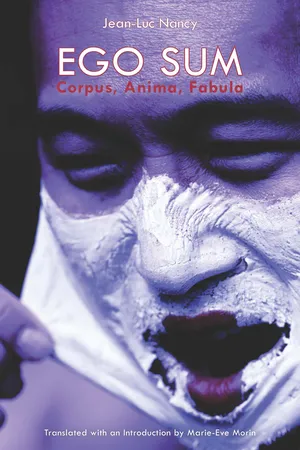
First published in 1979 but never available in English until now, Ego Sum challenges, through a careful and unprecedented reading of Descartes's writings, the picture of Descartes as the father of modern philosophy: the thinker who founded the edifice of knowledge on the absolute self-certainty of a Subject fully transparent to itself. While other theoretical discourses, such as psychoanalysis, have also attempted to subvert this Subject, Nancy shows how they always inadvertently reconstituted the Subject they were trying to leave behind.
Nancy's wager is that, at the moment of modern subjectivity's founding, a foundation that always already included all the possibilities of its own exhaustion, another thought of "the subject" is possible. By paying attention to the mode of presentation of Descartes's subject, to the masks, portraits, feints, and fables that
populate his writings, Jean-Luc Nancy shows how Descartes's ego is not the Subject of metaphysics but a mouth that spaces itself out and distinguishes itself.
- 168 pages
- English
- ePUB (mobile friendly)
- Available on iOS & Android
eBook - ePub
About this book
Information
Publisher
Fordham University PressYear
2016Print ISBN
9780823270620
9780823270613
eBook ISBN
9780823270637
NOTES
PREFACE TO THE ENGLISH EDITION
1. Heidegger, Contributions to Philosophy: Of the Event (GA 65), trans. Richard Rojcewicz and Daniela Vallega-Neu (Bloomington: Indiana University Press, 2012), §259, 336.
2. [Usually rendered in English as “the ego.” See, for example, Freud’s famous paper “Das Ich und das Es,” which is translated in French as “Le moi et le ça” but in English as “The Ego and the Id.” (All translator’s notes or additions made to existing notes by the translator appear in square brackets.)]
3. [In English in the text followed by the French word “embrayeur”.]
4. [See AT IXa 27.]
5. See Martin Heidegger, Being and Time, trans. John Macquarrie and Edward Robinson (Oxford: Blackwell, 1962), 89, H. 62.
TRANSLATOR’S INTRODUCTION
1. As Nancy and Lacoue-Labarthe write: “even the gap of the shifter operates almost as a sort of confirmation of the subject adhering to its own certainty through the certainty of its noncoincidence to itself.” Philippe Lacoue-Labarthe and Jean-Luc Nancy, The Title of the Letter: A Reading of Lacan, trans. François Raffoul and David Pettigrew (Albany: SUNY Press, 1992), 121.
2. Jacques Derrida, Writing and Difference, trans. Alan Bass (Chicago: University of Chicago Press, 1978), 33–34.
3. See The Inoperative Community, ed. Peter Connor (Minneapolis: University of Minnesota Press, 1991), 20.
4. About contact/separation, see Being Singular Plural, trans. Robert D. Richardson and Anne E. O’Byrne (Stanford: Stanford University Press, 2000), 5, 91, 97. About entanglement/disentanglement, see Nancy’s discussion of ipseity in “Eulogy for the Mêlée,” in ibid., 145–158.
5. See The Ground of the Image, trans. Jeff Fort (New York: Fordham University Press, 2005); “The Look of the Portrait” in Multiple Arts: The Muses II, ed. Simon Sparks (Stanford: Stanford University Press, 2006); and, more recently, L’autre portrait (Paris: Galilée, 2014).
6. See Identity: Fragments, Frankness, trans. François Raffoul (New York: Fordham University Press, 2014), 14 (translation modified).
7. See Ian James, “The Persistence of the Subject: Jean-Luc Nancy,” Paragraph 25, no. 1 (2002): 125–141. This article is slightly reworked in Chapter 1 of The Fragmentary Demand: An Introduction to the Philosophy of Jean-Luc Nancy (Stanford: Stanford University Press, 2006), 49–63.
8. See Marie-Eve Morin, Jean-Luc Nancy (Cambridge: Polity, 2012), chapter 5.
9. Jacques Derrida, On Touching—Jean-Luc Nancy, trans. Christine Irizarry (Stanford: Stanford University Press, 2005).
10. Corpus, trans. Richard A. Rand (New York: Fordham University Press).
11. See “Mundus est fabula,” 651–653.
12. See Oxford English Dictionary, 2nd ed., ed. John Simpson and Edmund Weiner (Oxford: Clarendon Press, 1989).
13. “Dum Scribo,” trans. Ian McLeod, Oxford Literary Review 3, no. 2 (1978): 6–21; “Larvatus pro Deo,” trans. Daniel E. Brewer, Glyph II (1977): 14–36; “Mundus Est Fabula,” trans. Daniel E. Brewer, Modern Language Notes 93, no. 4 (1978): 635–653.
EGO SUM: OPENING
1. See The Discourse of the Syncope: Logodaedalus, trans. Saul Anton (Stanford: Stanford University Press, 2008), 1–4, “A Digression on Fashion.”
2. Michel Foucault, who invented the concept, provides in his works the best representation of what an epistēmē is: it is the anthropological concept of general anthropology. In other words, whatever its operative force and precision, it is not a philosophical concept.
3. Martin Heidegger, Kant and the Problem of Metaphysics, trans. Richard Taft, 5th enlarged edition (Bloomington: Indiana University Press, 1997), §43, 164.
4. Because it was philosophical, Bataille’s anthropology has not remained fashionable, beyond a short explosion of curiosity …
5. Philippe Lacoue-Labarthe, The Subject of Philosophy, ed. and trans. Thomas Trezise (Minneapolis: University of Minnesota Press, 1993). About this reference and the others that will follow, current practices (including the so-called return of favors) necessitate an inopportune comment (that will without a doubt be taken for a denegation): It is not friendship or collaboration to a collective work that dictates the reference, but rather the reverse.
6. See Discourse of the Syncope, 15 and 138.
7. The Correspondence of Walter Benjamin, 1910–1940, ed. Gershom Scholem and Theodor W. Adorno (Chicago: University of Chicago Press, 1994), Letter to Hugo von Hofmannsthal, 13 January 1924, 229 [translation modified].
8. Gérard Granel, “Préface” to Edmund Husserl, La crise des sciences européennes et la phénoménologie transcendantale (Paris: Gallimard, 1976), vii [my translation].
9. Since 1936, year of the first conference on the “mirror stage.” See Jacques Lacan, Écrits: The First Complete Edition in English, trans. Bruce Fink in collaboration with Héloïse Fink and Russell Grigg (New York: Norton, 2006), 52 and n. 4 on 57.
10. See Jean-Claude Milner, De la syntaxe à l’interprétation (Paris: Seuil, 1978) and For The Love of Language, trans. Ann Banfield (Basingstoke: Palgrave-Macmillan, 1990), as well as André Green, “Psychanalyse, langage: l’ancien et le nouveau,” Critique 381 (1979), or earlier, Nicolas Abraham, “The Shell and the Kernel: The Scope and Originality of Freudian Psychoanalysis,” originally published in Critique 249 (1968) and reprinted in Nicolas Abraham and Marie Torok, The Shell and the Kernel: Renewals of Psychoanalysis, trans. Nicholas T. Rand (Chicago: University of Chicago Press, 1994).
11. Jean Petitot-Cocorda, “Sur ce qui revient à la psychose,” in Folle vérité: Vérité et vraisemblance du texte psychotique, ed. Julia Kristeva and Jean-Michel Ribelles (Paris: Seuil, 1979), 223–269. All the quotations are from 267–268.
12. See, for example, Jean-Michel Ribettes, “Le Phalsus,” in Folle vérité, 135, or Daniel Sibony, Le nom et le corps (Paris: Seuil, 1974), 160 et al.
13. It is for this reason, incidentally, that I take the liberty to make these somewhat repetitive comments, the principle of which appears to me to have been established for many years already.
14. This would then also be related to the general problematic of the remainder as it is articulated in several of Jacques Derrida’s works, a question which is none other than that of the beginning or first incision [l’entame] of discourse, that is, the question of a certain writing, as the psychoanalytical discourse does not fail to come to recognize (see for example Daniel Sibony, Le nom, 12, passim). We will not take up for itself the interrogation which is opened by these questions, and which would have to do with a psychoanalysis that would be written. Let us only add this other precision: if, in certain of its aspects, what we are saying here about psychoanalysis bears certain analogies with the way in which Cornelius Castoriadis attempts to take the critical measure of psychoanalysis, our attempts diverge radically when the question is sharpened to the point of its furthest implication. See Cornelius Castoriadis, “Psyche,” in Crossroads in the Labyrinth, trans. Kate Soper and Martin H. Ryle (Cambridge, Mass.: MIT Press, 1984), 1–115. Castoriadis’s demand remains, despite the distrust he shows toward the philosophical critique of psychoanalysis (197), dependent upon the aim of a discourse more powerful, more “capable,” or more unitary, than analytical discourse. It is something completely different that must be at stake here, if analysis has already opened, cut into, and hence started to undermine [entamé, en tous les sens] such a discourse.
15. I am extending, here again, the analysis of “the undecidable” that was begun in The Discourse of the Syncope.
16. Maurice Blanchot, “Le discours philosophique,” L’Arc 46 “Merleau-Ponty” (1971), reprinted in La Condition critique: Articles 1945–1998 (Paris: Gallimard, 2010), 332–337, at 332.
17. Ibid., 333.
18. Ibid., 334.
19. Ibid., 336.
20. Theodor W. Adorno, Negative Dialetics, trans. E. B. Ashton (London: Routledge, 2004), 15. It must be pointed out that this does not contradict the motif of the literarity or textuality of philosophy; it is rather a matter of sharpening this motif to the point of exhaustion.
21. See François Récanati, La transparence et l’énonciation (Paris: Seuil, 1979), 198–199, which testifies to the necessity of inventing a linguistic treatment sui generis for the “cogito.”
22. Blanchot, “Le discours philosophique,” 337.
23. Admittedly, Lacan was saying, in 1954: “The core of our being does not coincide with the ego. That is the point of the analytic experience, and it is around this that our experience is organized, and around this that these strata of knowledge which are now being taught have been deposited. But do you think that we should be content with that, and say—the I of the unconscious subject is not me [moi]? That is not good enough because nothing, for those of you who think spontaneously, if one can say that, implies the inverse. And normally you start thinking that the I is the real ego.… In this way, you have accomplished the decentring essential to the Freudian discovery, but you have immediately reduced it.” The Seminar of Jacques Lacan, Book II: The ...
Table of contents
- Cover
- Half Title
- Title Page
- Copyright
- Contents
- Preface to the English Edition
- Translator’s Introduction
- Epigraph
- Ego Sum: Opening
- Dum Scribo
- Larvatus pro Deo
- Mundus Est Fabula
- Unum Quid
- Notes
Trusted by 375,005 students
Access to over 1.5 million titles for a fair monthly price.
Study more efficiently using our study tools.
Frequently asked questions
Yes, you can cancel anytime from the Subscription tab in your account settings on the Perlego website. Your subscription will stay active until the end of your current billing period. Learn how to cancel your subscription
No, books cannot be downloaded as external files, such as PDFs, for use outside of Perlego. However, you can download books within the Perlego app for offline reading on mobile or tablet. Learn how to download books offline
Perlego offers two plans: Essential and Complete
- Essential is ideal for learners and professionals who enjoy exploring a wide range of subjects. Access the Essential Library with 800,000+ trusted titles and best-sellers across business, personal growth, and the humanities. Includes unlimited reading time and Standard Read Aloud voice.
- Complete: Perfect for advanced learners and researchers needing full, unrestricted access. Unlock 1.5M+ books across hundreds of subjects, including academic and specialized titles. The Complete Plan also includes advanced features like Premium Read Aloud and Research Assistant.
We are an online textbook subscription service, where you can get access to an entire online library for less than the price of a single book per month. With over 1.5 million books across 990+ topics, we’ve got you covered! Learn about our mission
Look out for the read-aloud symbol on your next book to see if you can listen to it. The read-aloud tool reads text aloud for you, highlighting the text as it is being read. You can pause it, speed it up and slow it down. Learn more about Read Aloud
Yes! You can use the Perlego app on both iOS and Android devices to read anytime, anywhere — even offline. Perfect for commutes or when you’re on the go.
Please note we cannot support devices running on iOS 13 and Android 7 or earlier. Learn more about using the app
Please note we cannot support devices running on iOS 13 and Android 7 or earlier. Learn more about using the app
Yes, you can access Ego Sum by Jean-Luc Nancy, Marie-Eve Morin in PDF and/or ePUB format, as well as other popular books in Literature & Literary Criticism Theory. We have over 1.5 million books available in our catalogue for you to explore.