Winner of the 2017 Alpha Sigma Nu Award
The collapse of communism in eastern Europe has forced traditionally Eastern Orthodox countries to consider the relationship between Christianity and liberal democracy. Contributors examine the influence of Constantinianism in both the post-communist Orthodox world and in Western political theology. Constructive theological essays feature Catholic and Protestant theologians reflecting on the relationship between Christianity and democracy, as well as Orthodox theologians reflecting on their tradition's relationship to liberal democracy. The essays explore prospects of a distinctively Christian politics in a post-communist, post-Constantinian age.
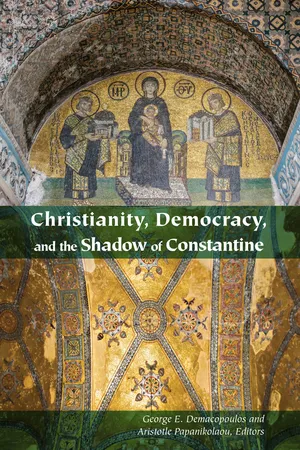
eBook - ePub
Christianity, Democracy, and the Shadow of Constantine
- 304 pages
- English
- ePUB (mobile friendly)
- Available on iOS & Android
eBook - ePub
Christianity, Democracy, and the Shadow of Constantine
About this book
Information
Publisher
Fordham University PressYear
2016Print ISBN
9780823274208
9780823274192
eBook ISBN
9780823274215
Topic
Theology & ReligionSubtopic
Religion, Politics & StatePOLITICAL THEOLOGIES: PROTESTANT-CATHOLIC-ORTHODOX CONVERSATIONS
POWER TO THE PEOPLE
ORTHODOXY, CONSOCIATIONAL DEMOCRACY, AND THE MOVE BEYOND PHYLETISM
Luke Bretherton
Introduction
I had the privilege a few summers ago of going on retreat to Vatopedi Monastery on Mount Athos, the ancient spiritual center of Orthodoxy.1 Up some stairs from where the church and refectory were located, in a passageway the monks constantly traversed, were two clocks. One was marked “worldly”/cosmic time, keeping Greenwich Mean Time—a chronological order universalized as a result of contingent historical procedures developed mainly to serve the interests of industrial and imperial expansion and efficiency.2 The other clock marked the time that determines the practices and life of the monastery and that was changed regularly according to a combination of the rhythms of nature (notably, the movement of the sun) and the liturgical calendar. This monastic, liturgical time is referred to on Athos as “Byzantine” time—revealing both its local and traditional character. To catch the ferry or arrange to meet someone, one has to operate on worldly time; to eat or worship (two dimensions of the same event at the monastery), one has to know the time set within your monastery, which, as St. Benedict tells us, is a school for the Lord’s service. Such was my schooling that, for all the contingency and abstraction of worldly time, it still felt more “real” than the local time, despite the materiality, sociality, and concreteness of the latter.
As well as the problem of how to live faithfully at the intersection of two time zones—one eschatological and the other earthly—Vatopedi illustrates the problem of how to live in overlapping and intersecting political spaces. Mount Athos is an anomaly that incorporates and disrupts key aspects of political order as it emerged in Europe since the tenth century. Each monastery is a self-governing polity, and governance of the mountain as a whole is overseen by a council of representatives of the twenty monasteries whose jurisdiction overlaps and must be negotiated with both its titular ecclesiastical ruler, the ecumenical patriarch of Constantinople, and the modern sovereign power responsible for Mount Athos within the post-Westphalian international order, the Greek nation state. In its national administrative structures, Greece locates responsibility for Mount Athos within the Foreign Ministry. The three different forms of monastic life practiced on the island (in the monasteries, the scetes, and the cells) add further differentiation and variation. Most of the monasteries are “Greek”—although they welcome monks and guests of all nationalities—but there are also the “foreign” monasteries of Russia, Serbia, and Bulgaria, at which, nevertheless, “Greek” monks may also reside (even if this is far less common today). Mount Athos can thus be said to represent an ongoing form of what John Milbank calls “complex space”: That is, in contrast to the bounded nation state with a single law and indivisible source of rule, which at the same time is unbounded in the exercise of its sovereign will within its own borders, complex space entails overlapping jurisdictions in which the sovereign authorities of the pope, parliaments, kings, dukes, doges, and various forms of self-governing corporation are interwoven with each other and span disjunctive spaces.
In this essay I will reflect on the twin problematics Mount Athos presents us with—that is, how to live faithfully at the intersection of two time zones and how to live in overlapping and intersecting political spaces—in the context of thinking about the relationship between Christianity and democracy.3 These reflections will serve as a prelude to some constructive suggestions for ways in which Orthodoxy might faithfully conceptualize its relationship to democratic politics in liberal states characterized by religious and moral plurality. But first let me say a word about democracy.
Defining Democracy
Democracy means collective self-rule by the people for the people, rather than rule by the one, the few, or the mob. This definition raises the question of who and what constitutes the people and thence what is the nature and form of this self-rule. Many accounts of democracy conceive of self-rule as an extension of individual autonomy. Popular sovereignty is derived from the sovereignty of the individual and is considered indivisible and singular. Legitimacy is premised on each individual having an equal say in the decisions that affect everyone. This “say” can be organized in a variety of ways; hence, there are debates about different ways of organizing collective self-rule. The adjectives “representative,” “deliberative,” and “direct” placed before the term “democracy” denote different forms of organizing collective self-rule and constituting individuals into a people. However, by conceiving of collective self-rule as an extension of individual autonomy, what is lost from view is the intrinsic relationship between collective self-rule and the forms of association in which the art of ruling and being ruled is learnt and performed. And thence the ways in which the people as a whole is constituted through different forms of association coming into relationship with each other and the negotiation of their different interests and visions of the good in the formation of a common life—this common life being what constitutes the people qua people.
We can begin to see that there is a paradox in the conceptualization of democracy in modern political thought: Democratic citizenship is seen as an expression of individual autonomy but its performance and defense are in great measure dependent on participation in a group. Without being embedded in some form of association, the individual citizen is naked before the power of either the market or the state and lacks a, if not the, vital means for his or her own self-cultivation. The relationship between Christianity and democracy encapsulates the triadic tension between market, state, and community within which the individual is located. State and market processes are seen to limit, challenge, and provide alternatives to those derived from religious obligations and identities, yet in an increasingly deinstitutionalized and atomized society religions provide one of the few corporate forms of life available for mobilizing and sustaining the ability of individuals to act together in defense of their common interests and in pursuit of their common objects of love.
An alternative approach to the relationship of democratic thought to individual autonomy—one that helps us address the paradox just outlined—begins with the relationships between individuals. If democracy is the rule of the people by the people, then at its most basic level it demands relationships between people. Without some kind of meaningful relationships between people there are just individuals, and an atomized and disaggregated crowd, whether at a local, national, or transnational level. If one is to begin with relationships, then one has to take seriously the arenas or forms of social life through which individuals develop and sustain relationships over time and in which they learn the arts of ruling and being ruled. This starting point for thinking about democracy is not in opposition to individual liberty but in recognition that individual liberty depends on and is mediated by multiple forms of association.4 Much political theory has moved beyond the sterile dichotomies between “liberals” and “communitarians” to take seriously the symbiosis between individual freedom and communal formation in democratic politics.
The dark side of thinking about democracy by beginning with relationships, the side that rightly worries liberals, is the way in which such a beginning can lead to an emphasis on the collective taking precedence over and oppressing the individual. At a minimal level, the emphasis on relationships, and the necessary particularity of such a beginning point, is felt by some to threaten universalistic and egalitarian conceptions of citizenship.5 Beyond this normative concern, and as Tocqueville and Montesquieu observed, there can be despotism of the people as well as that of a despot. Beyond even the problem of democratic despotism are those forms of political order that inherently subordinate the individual to a collective vision of peoplehood, as is the case with nationalist, fascist, state socialist, and state communist regimes. Polities characterized by one or another of these regimes may include democratic elements, but the constitution of the demos as a political community is substituted for some other, supposedly prepolitical species of peoplehood such as the ethnos or Volk. However, beginning with relationships between individuals can challenge collectivist, homogenous, and monistic conceptions of peoplehood and popular sovereignty. In these accounts a different set of adjectives come to the fore as ways of describing the organization of rule by the people for the people. The adjectives used foreground how relationships between individuals take multiple forms and the complex rather than simple nature of social and political space.
Sovereignty, Christianity, and Consociational Democracy
One conception that begins with relationships and allows us to make sense of the kind of complex space Vatopedi represents can be called “consociationalist.” Consociation is a term derived from the work of the early seventeenth-century Dutch Protestant political thinker Johannes Althusius.6 While literally meaning “the art of living together,” the broader meaning of consociationalism denotes the mutual fellowship between distinct institutions or groups that are federated for a common purpose. In contrast to the likes of Hobbes, Rousseau, and Hegel, Althusius allows for the pluralization of political order so as to accommodate and coordinate the diversity of associational life, whether economic, familial, or religious. In his account, to be a political animal is not to be a citizen of a unitary, hierarchically determined political society. Nor is it to participate in a polity in which all authority is derived from a single point of sovereignty (whether of the general will or the Leviathan). Rather, it is to be a participant in a plurality of interdependent, self-organized associations that together constitute a consociational polity. Mount Athos is a clear example of such a polity. The singularity of each is constitutive of the commonwealth of all. In such a compound commonwealth, federalism is societal and political rather than simply administrative. In contrast to constitutional federalism as a way in which to limit sovereignty, as exemplified in the dominant interpretations of the US Constitution, which leaves undisturbed the indivisibility of political sovereignty, consociationalism envisages a full-orbed confederalism whereby sovereignty is distributed across distinct corporate entities. For Althusius, sovereignty is an assemblage that emerges through a process of mutual communication between consociations and their reciprocal pursuit of common ends. Unity is premised on the quality of cooperation and relationship building and is not secured through either legislative procedure, the singular nature of sovereign authority, or the formation of a unitary public sphere premised on a homogeneous rational discourse.
The consociational approach is not as alien as may first appear. The theories of Hobbes, Carl Schmitt, and Giorgio Agamben are one thing; historical practice is quite another. As Mount Athos illustrates, the medieval Gothic order did not wholly disappear with the advent of the “Westphalian” order of nation states. Rather, it was displaced and redescribed so that forms of political community became relocated and renamed as “economic” or “social.” For example, the joint stock trading company—the early modern archetype of the contemporary capitalist firm—was an explicitly political community based on the concept of the corpus politicum et corporatum or communitas perpetua that went back to Roman law. The paradigmatic example of the early modern mercantile republic was the East India Trading Company, which, as a colonial proprietor,
did what early modern governments did: erect and administer law; ...
Table of contents
- Cover
- Half Title
- Series Announcement Page
- Title Page
- Copyright
- Dedication
- Contents
- Half Title
- Outrunning Constantine’s Shadow
- The Post-Communist Situation
- Political Theologies: Protestant-Catholic-Orthodox Conversations
- Constantine’s Shadow: Historical Perspectives
- An Apophatic Approach
- List of Contributors
- Index
- Series Page
Trusted by 375,005 students
Access to over 1.5 million titles for a fair monthly price.
Study more efficiently using our study tools.
Frequently asked questions
Yes, you can cancel anytime from the Subscription tab in your account settings on the Perlego website. Your subscription will stay active until the end of your current billing period. Learn how to cancel your subscription
No, books cannot be downloaded as external files, such as PDFs, for use outside of Perlego. However, you can download books within the Perlego app for offline reading on mobile or tablet. Learn how to download books offline
Perlego offers two plans: Essential and Complete
- Essential is ideal for learners and professionals who enjoy exploring a wide range of subjects. Access the Essential Library with 800,000+ trusted titles and best-sellers across business, personal growth, and the humanities. Includes unlimited reading time and Standard Read Aloud voice.
- Complete: Perfect for advanced learners and researchers needing full, unrestricted access. Unlock 1.5M+ books across hundreds of subjects, including academic and specialized titles. The Complete Plan also includes advanced features like Premium Read Aloud and Research Assistant.
We are an online textbook subscription service, where you can get access to an entire online library for less than the price of a single book per month. With over 1.5 million books across 990+ topics, we’ve got you covered! Learn about our mission
Look out for the read-aloud symbol on your next book to see if you can listen to it. The read-aloud tool reads text aloud for you, highlighting the text as it is being read. You can pause it, speed it up and slow it down. Learn more about Read Aloud
Yes! You can use the Perlego app on both iOS and Android devices to read anytime, anywhere — even offline. Perfect for commutes or when you’re on the go.
Please note we cannot support devices running on iOS 13 and Android 7 or earlier. Learn more about using the app
Please note we cannot support devices running on iOS 13 and Android 7 or earlier. Learn more about using the app
Yes, you can access Christianity, Democracy, and the Shadow of Constantine by George E. Demacopoulos, Aristotle Papanikolaou, George E. Demacopoulos,Aristotle Papanikolaou in PDF and/or ePUB format, as well as other popular books in Theology & Religion & Religion, Politics & State. We have over 1.5 million books available in our catalogue for you to explore.