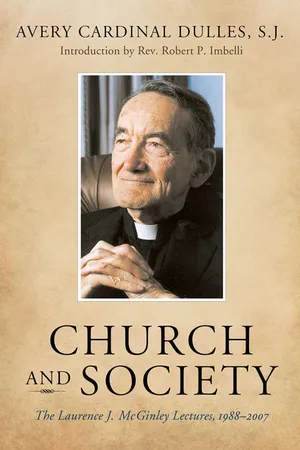
One of the leading theologians of our time, Avery Cardinal Dulles, S.J., has written and lectured on a wide range of topics across his distinguished career, and for a wide range of audiences. Integrating faith and scholarship, he has created a rich body of work that, in the words of one observer, is "both faithful to Catholic tradition and fresh in its engagement with the contemporary world."
Here, brought together for the first time in one volume, are the talks Cardinal Dulles has given twice each year since the Laurence J. McGinley Lectures were initiated in 1988, conceived broadly as a forum on Church and society. The result is a diverse collection that reflects the breadth of his thinking and engages with many of the most important—and difficult—religious issues of our day.
Organized chronologically, the lectures are often responses to timely issues, such as the relationship between religion and politics, a topic he treated in the last weeks of the presidential campaign of 1992. Other lectures take up questions surrounding human rights, faith and evolution, forgiveness, the death penalty, the doctrine of religious freedom, the population of hell, and a whole array of theological subjects, many of which intersect with culture and politics.
The life of the Church is a major and welcome focus of the lectures, whether they be a reflection on Cardinal Newman or an exploration of the difficulties of interfaith dialogue. Dulles responds frequently to initiatives of the Holy See, discussing gender and priesthood in the context of church teaching, and Pope Benedict's interpretation of Vatican II.
Writing with clarity and conviction, Cardinal Dulles seeks to "render the wisdom of past ages applicable to the world in which we live." For those seeking to share in this wisdom, this book will be a consistently rewarding guide to what it means to be Catholic—indeed, to be a person of any faith—in a world of rapid, relentless change.
- 546 pages
- English
- ePUB (mobile friendly)
- Available on iOS & Android
eBook - ePub
About this book
Information
Topic
Theology & ReligionSubtopic
Christian Denominations1
University Theology as a
Service to the Church
December 6–7, 1988
The title of this lecture could be an occasion for some surprise. University theology is not always considered a benefit to the Church. In the light of certain well-publicized cases of recent memory some might be inclined to repeat the proposition: “Universities, with their programs of study, their colleges, their degrees, and their professorships, are products of vain heathenism; they are as much good to the Church as the devil is.”1 This proposition, taken from the writings of John Wycliffe, was condemned by the Council of Constance in 1415. The condemnation, approved by Pope Martin V in 1418, may be taken as evidence, at least indirect, for the Church’s appreciation of universities and their theological faculties.
DIFFERING STYLES OF THEOLOGY
The concept of university theology is necessarily somewhat vague. No sharp opposition can be drawn between theology done at the university and that done in other forums, but theology does tend to take on different hues depending on the environment in which it is practiced. Patristic theology, for instance, had a particularly pastoral character since it was closely linked with the preaching of the bishops to their flocks. In the early Middle Ages theology, chiefly practiced in monasteries, became more contemplative; it was closely bound up with the pursuit of holiness and with prayerful reading of sacred texts, both biblical and patristic. In the high Middle Ages the universities emerged as the chief centers of theological productivity. Theology became more academic and scientific. Then, in early modern times, when the universities became secularized and nationalized, theology moved by preference to the seminaries, and there it remained for the most part until about a generation ago. Seminary theology has usually been somewhat clerical and doctrinaire. Since the mid-1960s there has been a notable shift back to the university but in a situation quite unlike the Middle Ages. As yet few theologians have reflected seriously on what should be expected from university theology as a service to the Church in our day. The answer to this question will depend in part on how one appraises the changing character of the university itself.
CONTRIBUTION OF MEDIEVAL UNIVERSITIES
The golden age of university theology was no doubt the high Middle Ages.2 The earliest medieval universities grew up spontaneously as expansions of preexisting schools and were subsequently recognized by papal or royal charters. Later medieval universities were founded directly by popes or, in some cases, by kings and emperors. The university faculties of theology, especially at Paris and Oxford, produced the greatest speculative theology of the age, and perhaps of any age. Bonaventure, Albert the Great, Thomas Aquinas, and Duns Scotus composed philosophically sophisticated articulations of Christian doctrine that still remain vital elements in the heritage of Catholicism. When new problems have arisen in later centuries, Catholics have found light and guidance in the work of the medieval masters.
It is not easy to summarize the manifold contributions of medieval universities to the life of the Church. Most obviously, they provided Europe with some learned clergy. Many of the popes, cardinals, and bishops were former students or even professors of theology or canon law. Viewed in historical perspective, the intellectual probings of the medieval Scholastics have given the Church of later ages an invaluable doctrinal resource. The theology of Thomas Aquinas guided the Council of Florence in its teaching on the Trinity and on the sacraments; it was used by the Council of Trent for its teaching on justification and the Eucharist, and again by Vatican Council I for its decrees on faith and reason and on papal primacy. Modern developments in Mariology, and notably the doctrine of the Immaculate Conception, gained impetus from the speculations of Duns Scotus at Oxford and Pierre d’Ailly at the University of Paris. The theology of grace and of salvation history, as developed by many modern authors, is indebted to Bonaventure.
The medieval universities, especially from the fourteenth century on, cooperated with popes and bishops in the formulation of doctrine and maintenance of orthodoxy. The university theologians were considered to have quasi-hierarchical status as members of what was called the ordo doctorum. The Decrees of the Council of Vienne (1311–12), by order of Pope Clement V, were not promulgated until they had been reviewed by the universities.3 The university theologians attended councils such as those of Constance and Basel and were entitled to a deliberative vote within their “nation” or “deputation”—a right of some importance because the doctores frequently outnumbered the bishops themselves. At Paris in the fourteenth century, the theological faculty had an acknowledged privilege to pass judgment on its own members before any ecclesiastical authority could censure them for doctrinal deviations. When controversies arose, the theological faculties pronounced on questions of orthodoxy and heresy. Thus the University of Oxford condemned the eucharistic teaching of Wycliffe and the University of Prague censured certain errors of Jan Hus. The theological faculties of Cologne, Louvain, and Paris drew up lists of errors culled from Luther’s writings, so that Rome had little more to do than to ratify what the universities had previously done.
In certain crises the university faculties of theology were of direct assistance in matters of church governance. Robert N. Swanson in his 1979 book Universities, Academics, and the Great Schism has shown in some detail how the eyes of Europe turned to the universities, especially Paris, to provide a remedy for the constitutional problem created by the rivalry of two, and eventually three, claimants to the see of Peter.4
THEOLOGY IN MODERN UNIVERSITIES
The contribution of the medieval universities was in some ways unique because of the dominance of the Catholic faith throughout Western Europe and because they antedated the rise of the modern national state. Later the subjection of Oxford and Cambridge to the British crown, and that of Paris to the king and Parlement, severely damaged the value of the universities to the Catholic Church. But even after the Reformation and the rise of nationalism, Catholic universities continued to serve the cause of Catholic orthodoxy in regions known to us as Belgium, Spain, Portugal, Germany, Austria, and Italy. These universities, staffed principally by Dominicans, Jesuits, and Carmelites, produced updated syntheses of theology and philosophy, modeled on the great summas of the Middle Ages, and laid the groundwork for a vigorous proliferation of controversial literature, catechetical literature, and seminary handbooks. Besides responding to the new challenges of the Protestant Reformation, rationalism, and skepticism, the university theologians of the sixteenth and seventeenth centuries attempted to deal with social and moral problems arising from the modern nation-state and the colonial expansion. Spanish and Portuguese authors such as Francisco de Vitoria, Francisco Suárez, Juan de Lugo, and John of St. Thomas added luster to their age.
Crushed by the secular spirit of the Enlightenment and the oppressive tactics of absolutist monarchs, Catholic university theology suffered a severe decline in the eighteenth century, but it revived by the middle of the nineteenth. The Gregorian University, in close alliance with the papacy, promoted a new vintage of Scholasticism, which survived down to Vatican Council II. This theology, heavily apologetical in tone, became the basis of seminary textbooks and controversial literature throughout the Catholic world. The German universities developed several creative strains of theology. The professors of Tübingen and Munich entered into fruitful dialogue with German idealism and with German historical scholarship, thus paving the way for major developments in the twentieth century.
It seems fair to include under the caption of university theology the work of John Henry Newman, who developed the main principles of his thought during his years as a tutor at Oriel College, Oxford. Later Newman served briefly as the first rector of the Catholic University at Dublin and in that capacity published his eloquent and balanced proposals for the pursuit of theology in a Catholic university. In other works Newman drew richly from patristic sources and from the Anglican divines in order to respond to the challenges posed by agnosticism and secularity.
The mention of Newman’s work at Oxford serves as a reminder that the Catholic Church, as well as other confessions and communions, owes a great debt to the university research not conducted under Catholic auspices. As I have already suggested, the philosophical, philological, and historical scholarship of German universities in the nineteenth century, especially at centers such as Göttingen and Berlin, was destined to have an enormous impact on all Christian theology. Biblical studies at Cambridge and patristic studies at Oxford were likewise of momentous import. The biblical and patristic ressourcement that took place in the Catholic Church between World War II and the Second Vatican Council relied heavily on the pioneering work of these non-Catholic scholars.
With a few notable exceptions, such as Tübingen and Rome, Catholic higher education in the nineteenth century was relatively weak. In many parts of Europe it labored under laws that discriminated against Catholicism or even against all religion in higher education. In laicist France, no Catholic university faculties survived, but some of the functions of university theology were performed by Catholic institutes of higher studies and by houses of formation in which religious orders educated their own members.
In the United States it became possible for Catholics to erect their own colleges and universities, but until after World War II these institutions were small and poorly endowed. Graduate programs in theology, where they existed at all, were designed for clergy and religious. In the late 1940s a women’s college, St. Mary’s in Indiana, opened a school of theology for sisters and laywomen. In the 1960s, doctoral programs in theology, offering civilly recognized degrees, came into existence at a number of Catholic universities, including Notre Dame (1961), Marquette (1963), Fordham (1967), and St. Louis (1969).5 Catholic institutions also entered into joint theological programs such as the Graduate Theological Union at Berkeley, California. Today, therefore, there exist many doctoral programs in Catholic theology, some of them having a serious research component. A glance at the membership lists of theological associations, at publishers’ catalogues, and at the tables of contents of learned journals strongly suggests that Catholic theological leadership has in recent years passed from the freestanding seminaries to the universities and graduate schools. A similar shift would seem to have taken place in many European countries. The Catholic university faculties of Germany, Belgium, and Holland have produced much of the most creative theology of the past few decades. The fact that a former university professor has been elected pope (John Paul II) may be of more than symbolic significance.
THE CONTRIBUTION OF UNIVERSITY THEOLOGY
In view of the contemporary preeminence of university theology, it becomes important to inquire what kind of benefits such theology can be expected to confer on the Church in our day. The question can be approached by considering the typical characteristics of university theology as contrasted with seminary theology. The two would appear to be mutually complementary. The seminary, generally speaking, is oriented toward the formation of future clergy. For this reason it puts the accent on teaching rather than on pure research. The seminary professor can normally assume that the students are already convinced believers and, in Catholic seminaries, accept the doctrines of the Church. Seminary theology is specifically aimed to equip the students for the tasks of the ordained priesthood—especially preaching, counseling, and the ministry of the sacraments. Seminaries generally operate in comparative isolation, feeling little need to expose their students to intellectual challenges coming from other disciplines. The intent is to transmit safe and established doctrine. Proof frequently takes the form of an appeal to authoritative texts—Scripture, councils, papal utterances.
University theology, by contrast, is oriented more heavily toward research. In order to make new advances it maintains, or should maintain, close contact with other disciplines, such as history, literary criticism, sociology, psychology, and philosophy. It makes use of reason not only deductively but also critically. It may address a widely diversified audience, including persons who are adherents of different religious traditions, or even of no particular religion. It concentrates on open and unsolved questions that cannot be settled by a simple appeal to authority. For all these reasons university theology can become the seedbed of new and exciting developments.
The reentry of Catholic theology into the universities is no doubt providential. Since the Council of Trent theology had become too far removed from the modern world with its ebullient secularity. Skillfully as the traditional Scholastic questions continued to be pursued, the vibrant movements of the day were not addressed with sympathy and understanding. The Church confronted the secular world too much as a judge, too little as a participant. The kind of careful attention that Thomas Aquinas gave to Aristotle, Maimonides, and Averroes was rarely given to modern thinkers such as Newton, Kant, Hegel, and Heisenberg, mentioned as adversaries but scarcely read in Catholic seminaries. The products of the seminary system, staffing the Roman congregations and other sensitive positions, maintained and defended the Catholic tradition but seemed ill at ease in the modern world. The new shift back to the university corresponds to the call of Vatican II for openness and dialogue. Reminding Catholic Christians of their involvement in the problems common to all humanity, the council strongly endorsed the teaching of theology in Catholic universities. It called for research in the sacred sciences so that the Church might make its presence felt in the enterprise of advancing higher culture and might form citizens capable of witnessing to their faith and shouldering social responsibilities in the world of our day.6
The revival of university theology cannot make its expected contribution unless lessons are drawn from the past. Precisely because it encourages independent thinking, such theology can easily be a source of error. Nearly all the major heresies since the twelfth century have been associated with university theology. One thinks in this connection of Wycliffe, Hus, and Luther, of Averroism, Conciliarism, Gallicanism, Jansenism, and various forms of rationalism.
Even when it escapes the trap of heresy, university theology exhibits certain weaknesses as compared with the typical seminary theology. It tends to become rather detached from the Church and from pastoral concerns. It easily ad...
Table of contents
- Cover Page
- Title Page
- Copyright Page
- CONTENTS
- FOREWORD
- PREFACE
- ABBREVIATIONS
- 1. University Theology as a Service to the Church Fall 1988
- 2. Teaching Authority in the Church Spring 1989
- 3. Catholicism and American Culture: The Uneasy Dialogue Fall 1989
- 4. Faith and Experience: Strangers? Rivals? Partners? Spring 1990
- 5. Newman, Conversion, and Ecumenism Fall 1990
- 6. The Uses of Scripture in Theology Spring 1991
- 7. John Paul II and the New Evangelization Fall 1991
- 8. Historical Method and the Reality of Christ Spring 1992
- 9. Religion and the Transformation of Politics Fall 1992
- 10. The Church as Communion Spring 1993
- 11. The Prophetic Humanism of John Paul II Fall 1993
- 12. The Challenge of the Catechism Fall 1994
- 13. Crucified for Our Sake: Love, Violence, and Sacrifice Spring 1995
- 14. John Paul II and the Advent of the New Millennium Fall 1995
- 15. Priesthood and Gender Spring 1996
- 16. The Travails of Dialogue Fall 1996
- 17. The Ignatian Tradition and Contemporary Theology Spring 1997
- 18. Mary at the Dawn of the New Millennium Fall 1997
- 19. Should the Church Repent? Spring 1998
- 20. Human Rights: The United Nations and Papal Teaching Fall 1998
- 21. Can Philosophy Be Christian? The New State of the Question Spring 1999
- 22. Justification Today: A New Ecumenical Breakthrough Fall 1999
- 23. The Papacy for a Global Church Spring 2000
- 24. The Death Penalty: A Right-to-Life Issue? Fall 2000
- 25. Religious Freedom: A Developing Doctrine Spring 2001
- 26. Christ Among the Religions Fall 2001
- 27. When to Forgive Spring 2002
- 28. The Population of Hell Fall 2002
- 29. True and False Reform in the Church Spring 2003
- 30. John Paul II and the Mystery of the Human Person Fall 2003
- 31. The Rebirth of Apologetics Spring 2004
- 32. A Eucharistic Church: The Vision of John Paul II Fall 2004
- 33. How Real Is the Real Presence? Spring 2005
- 34. Benedict XVI: Interpreter of Vatican II Fall 2005
- 35. The Mission of the Laity Spring 2006
- 36. The Ignatian Charism at the Dawn of the Twenty-First Century Fall 2006
- 37. Evolution, Atheism, and Religious Belief Spring 2007
- 38. Who Can Be Saved? Fall 2007
- MCGINLEY LECTURES PREVIOUSLY PUBLISHED
- INDEX
Trusted by 375,005 students
Access to over 1.5 million titles for a fair monthly price.
Study more efficiently using our study tools.
Frequently asked questions
Yes, you can cancel anytime from the Subscription tab in your account settings on the Perlego website. Your subscription will stay active until the end of your current billing period. Learn how to cancel your subscription
No, books cannot be downloaded as external files, such as PDFs, for use outside of Perlego. However, you can download books within the Perlego app for offline reading on mobile or tablet. Learn how to download books offline
Perlego offers two plans: Essential and Complete
- Essential is ideal for learners and professionals who enjoy exploring a wide range of subjects. Access the Essential Library with 800,000+ trusted titles and best-sellers across business, personal growth, and the humanities. Includes unlimited reading time and Standard Read Aloud voice.
- Complete: Perfect for advanced learners and researchers needing full, unrestricted access. Unlock 1.5M+ books across hundreds of subjects, including academic and specialized titles. The Complete Plan also includes advanced features like Premium Read Aloud and Research Assistant.
We are an online textbook subscription service, where you can get access to an entire online library for less than the price of a single book per month. With over 1.5 million books across 990+ topics, we’ve got you covered! Learn about our mission
Look out for the read-aloud symbol on your next book to see if you can listen to it. The read-aloud tool reads text aloud for you, highlighting the text as it is being read. You can pause it, speed it up and slow it down. Learn more about Read Aloud
Yes! You can use the Perlego app on both iOS and Android devices to read anytime, anywhere — even offline. Perfect for commutes or when you’re on the go.
Please note we cannot support devices running on iOS 13 and Android 7 or earlier. Learn more about using the app
Please note we cannot support devices running on iOS 13 and Android 7 or earlier. Learn more about using the app
Yes, you can access Church and Society by Avery Cardinal Dulles in PDF and/or ePUB format, as well as other popular books in Theology & Religion & Christian Denominations. We have over 1.5 million books available in our catalogue for you to explore.