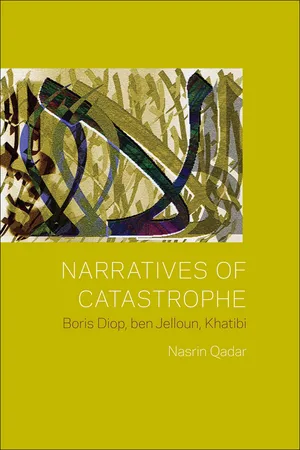
Narratives of Catastrophe tells the story of the relationship between catastrophe, in the senses of "down turn" and "break," and narration as "recounting" in the senses suggested by the French term récit in selected texts by three leading writers from Africa.
Qader's book begins by exploring the political implications of narrating catastrophic historical events. Through careful readings of singular literary texts on the genocide in Rwanda and on Tazmamart, a secret prison in Morocco under the reign of Hassan II, Qader shows how historical catastrophes enter language and how this language is marked by the catastrophe it recounts. Not satisfied with the extra-literary characterizations of catastrophe in terms of numbers, laws, and naming, she investigates the catastrophic in catastrophe, arguing that catastrophe is always an effect of language andthought,. The récit becomes a privileged site because the difficulties of thinking and speaking about catastrophe unfold through the very movements of storytelling.
This book intervenes in important ways in the current scholarship in the field of African literatures. It shows the contributions of African literatures in elucidating theoretical problems for literary studies in general, such as storytelling's relationship to temporality, subjectivity, and thought. Moreover, it addresses the issue of storytelling, which is of central concern in the context of African literatures but still remains limited mostly to the distinction between the oral and the written. The notion of récit breaks with this duality by foregrounding the inaugural temporality of telling and of writing as repetition.
The final chapters examine catastrophic turns within the philosophical traditions of the West and in Islamic thought, highlighting their interconnections and differences.
- 238 pages
- English
- ePUB (mobile friendly)
- Available on iOS & Android
eBook - ePub
About this book
Information
1. Becoming-Survivor
Boubacar Boris Diop is one of Senegal’s most prominent contemporary writers. His literary production spans the period from 1981 to the present. In addition to being an author, he has been a journalist, a teacher of philosophy and literature, and an activist. He has written several political texts and has become an important voice in debates on the politics of la francophonie.1 After the completion of his novel in 2000 on the genocide of the Tutsi in Rwanda, he turned to Senegal’s other national language, Wolof, in Doomi Golo and returned to French with his powerful 2006 novel, Kaveena.2 Today Diop writes in both languages and is in the forefront of debates about the place of national languages in the literary landscape of Senegal.3 Unfortunately, my own linguistic shortcomings limit me to the works written in French, two of which I include in this book.
Much of Diop’s work is written on the traces of catastrophic events, literary, historical, political, or mythical. In 1998, he was among a group of African writers who participated in a project funded by the Fondation de France in collaboration with the Rwandan government. The project was part of Fest’ Africa and entitled “Rwanda: Ecrire par devoir de mémoire.” The group spent two months in Rwanda, listening to survivors and visiting the preserved sites of massacres such as Nyamata, Ntarama, and Murambi. The participants produced a series of texts that reflected on the genocide and its aftermath through various modalities of writing (poetry, testimony, fiction).4 The results of these reflections bear more on the question of the aftermath and survival than on the event of the genocide per se. Several of these texts reflect on not only surviving genocide but also the ethical implications of constructing out of the traces of such an event a project of memory and remembering. This chapter engages with Boubacar Boris Diop’s Murambi, le livre des ossements (Murambi, the Book of Bones), the writing of which disrupted, in two ways, Diop’s own relationship with language and writing. In addition, to the change in language of expression—French to Wolof—a discernible shift in writing style distinguishes this book from his previous works, as he himself has pointed out repeatedly. This shift has profoundly affected his writing, aesthetically and politically. The disruptive effects on language mark the text of Murambi throughout, culminating in the final scene of the novel that announces a turn in speech and language.
In reading Murambi we are prompted to think about the complexities of the relationship between surviving, time, and language. We are pushed to think of survival beyond the commonly held notion of “not having died when one should have” and toward an experience of a turning in the subject’s relationship with language and with temporality. My reading focuses primarily on the central story of the return of Cornelius Uvimana to Rwanda and the vicissitudes of this homecoming. I show how his every encounter with people and events marks a moment of turning in his relationship with his own story and with language. These relationships are marked by a temporal singularity that belongs to the time of surviving and to the experience of the aftermath. I argue that the impulse toward historiography to explicate the causes and effects of the genocide displaces the issue of surviving. Similarly, the ideal of reconciliation and regained national unity, as if the genocide were an abhorrent moment of history that can be overcome and healed, turns attention away from the question of surviving, which has little to do with understanding the reasons for the event or with the ideal of recovering unity. By closely following the itinerary of Cornelius, I show that survival is a singular experience of a turn within the subject’s time and speech and that this experience is born in solitude. The turn offers the possibility of a future, necessary for surviving, but without a specific content or project.
A catastrophe, a genocide, has taken place. It is an event in history. The effect of this event disperses itself across the narration in temporal modes of “before” and “after,” but the narration cannot recount the event.5 The narration registers the event obliquely as the relation between too early and too late, as we shall shortly see in the verb tenses and the narrative voices of the text. This impossibility of narration, at the heart of the narration, makes us consider the question of the relation between history and the event. While the genocide is a historical—that is, temporal—event, it does not offer itself to historiography, in that one cannot explain its causation or its origin with a reasoned speech. The time of history and the time of historiography diverge incommensurably in the event. This divergence is most poignantly registered when Cornelius comes into contact with the sites of the disaster. The narration follows the dynamic of this radical incommensurability and proposes the necessity for another kind of speech and another relation with time. As the end of the novel reveals, this other time and this other speech, the time and speech of survival, are both catastrophic and the promise of survival. They are catastrophic because they do not allow for a clear distinction between life and death but rather point to a life that continues but is always carried away by death.
Because Murambi thematizes the problem of the artistic project, we are called upon to think about the question of a project as a work and as a time in the sense of projection, of future determined from the standpoint of the present. Despite the well-deserved reception of the works generated by the project of “Rwanda: Ecrire par devoir de mémoire,” the very notion of “project” in this case has been the subject of debate and critique among scholars. Not only may “project” impart a teleological structure to the endeavor of writing, it also suggests coherence and unity, a program with a projected end. However, the project is marked by incompleteness, as indicated by the unpublished status of the text by one of Kenya’s renowned writers, Meja Mwangi, entitled The Great Sadness. I insist on this detail not in order to show up the “failure” of a writer, but only to point out how a project may resist its own end. This failure is the effect of catastrophe that cannot allow for projection. The temporal fissure that the turn toward such an event registers is so radical that the future cannot be the work of a projection, because in this turn futurity itself is at stake. Murambi inscribes this radical temporal turning.
Moreover, Murambi tells the story of the writer, who visits there or returns there after all is done, in order to write about or around the event. This story is told in the contiguity between the figure of the writer who undertakes such a project and the figure of Cornelius. I say contiguity and not similarity because the two figures are fundamentally different in their relationship to the event, and, for ethical reasons, this difference must be maintained. The contiguity between the inside and the outside of the novel implicates the writer in particular ways. It reveals how ethics after a genocide cannot include an uncontaminated zone but must implicate everyone, including the writer. The emphasis the novel places on Opération Turquoise and France’s involvement in the genocide implicates the project in this ambiguous ethical zone because so much of the project’s funding came from France, while at the same time it insists that there is no zone of innocence into which one can retreat.6 In other words, the point of the critique and self-reflection is not to determine whether the project is good or bad, legitimate or illegitimate, but rather to draw out the ethical complexities of speaking and writing after such an event. Certainly, “Rwanda: Ecrire par devoir de mémoire” is ethically, politically, and artistically necessary; it is a debt and an obligation, in all the senses of devoir. It is so because Rwanda has not just happened but has happened to us, to all of us, in radically and incommensurably different ways. To be silent about Rwanda is therefore not an ethical, political, or artistic choice. Our implication in this catastrophe imposes on us a debt from which we cannot absolve ourselves. Furthermore, as Kenneth Harrow has argued, this obligation also requires that we be vigilant about the violences that are being committed in the post-genocide era, in the name of the genocide, justice, or vengeance, both within and without the borders of Rwanda.7
Murambi engages with all these questions in many ways, beginning with the structure of the novel. While it struggles to sustain the flow of the narration with the story, récit, of Cornelius Uvimana, this is not where the novel begins; and when the novel finally reaches this story, it remains haunted by others that fall to the side along the way in order to accommodate the story. Every narration is ethically implicated because in order to tell a story, it pushes aside multiple others that nonetheless haunt it. The novel is constructed in four parts. Part 1, titled “La peur et la colère” (Fear and Anger) tells in short, interrupted chapters and in the first-person narrative voice the stories of perpetrators and their victims at the beginning of the genocide. It tells the stories of preparations and the fearful anticipation of something unknown. Part 2, “Le retour de Cornelius” (The Return of Cornelius), tells of Cornelius Uvimana’s return to Kigali, four years after the end of the genocide, ending twenty-five years of exile in Djibuti. This part is told in one uninterrupted chapter, in the third person. This story is then in turn interrupted by part 3, “Le Génocide” (The Genocide), which takes up once again the stories of the perpetrators and their targets. Part 4, “Murambi,” returns to Cornelius’s story that ends the novel. Murambi is thus the scene of multiple interruptions and multiple returns, which together create the network of relations between figures and places. Cornelius’s return to Rwanda provides the focal point of the dynamic of return that gives momentum to the narration. Within this general dynamic there are those who return in various ways and those who do not. Jessica, Cornelius’s friend and a survivor of the genocide, appears in part 1 and then again in part 2. She returns haunted by not only her experiences of the genocide but also the figure of her friend, Theresa, who appears alive in Jessica’s story in part 1 then as a cadaver in Nyamata in part 2. Gérard or “le Matelot” (the sailor) appears in part 2 in Kigali and then returns in part 4 in Murambi, as a limit figure. Those who return “alive” (let us say so provisionally, for this survival, as we shall see, raises precisely the question of how to separate life from death), such as Jessica, Gérard, or the keepers of the bones on the preserved sites of the genocide, return as Cornelius’s guides toward the experience of survival. In the proximity of these returning figures a path toward survival opens for Cornelius, a path with troubling and difficult vicissitudes. He becomes a survivor through a complex relationship with the remnants of the genocide, the bones of the perished victims, and the ghostly presence of those who are still alive, just barely. The repetitive movements of appearing, reappearing, and disappearing endow the text with a haunting and ghostly quality that tells of survival.
The novel foregrounds the struggle of narration to stabilize itself with the narrative voices “I” and “he.” This struggle prompts us to think that perhaps the only way in which this story can continue is in the anonymous third person: the one who cannot or does not write himself in the story but speaks only through the other as other; the one who writes herself as distance and at a distance from himself; the one who speaks obliquely. The voice that speaks in the first person cannot sustain the narration but shares its place with others, with other “I”s, by allowing itself to break off and then get resurrected as the voice of another.8 The novel thus foregrounds in its shifting points of view the fragmented condition of subjectivity. There is a subject, an “I,” but fragmented, and shared out. The direct testimonial mode is unbearable for the narration, as if the project of giving testimony cannot bear the weight of this task and shatters under its exigency. Only when testimony becomes haunted, in the sense that it becomes the voice of another, can it allow for narration. The third-person narration does not occupy the position of the unimplicated observer, the model of the “beautiful soul,” but is the mark of a ghostly space.
The haunted quality of the text leaves a temporal imprint on the narration. The victims speak in the future tense, anticipating death or hoping to survive in spite of everything. Rosa Karemera is among those hoping to survive: “I hope to survive this business [histoire]. Just to see Valérie Rumiya’s expression when she runs into me in the neighborhood” (119; 99).9 Valérie is the woman who betrayed Rosa to the soldiers. However, Rosa does not return and this leaves her status suspended and unknown. Is she among the bones or among the ghostly living? This suspended state of nonreturn also haunts the narration, for the haunting is not limited to those who do return but also includes those whose absence haunts. The beautiful anonymous woman, whose story is told by Jessica in part 3, has no hope of surviving except as the voice speaking from the other side of death, urging Rwandans to unify after the atrocities. Her only hope for surviving the atrocities is transcendental: “I will be the sun. From up there, I’ll have my eye on you, you the Rwandans. Join together. Aren’t you ashamed, children of Rwanda? Whether someone is Hutu, Tutsi, or Twa, what is it to you? Then, after this awful business is over, behave yourself and be united, won’t you? In reality, she was already speaking to us from another world” (115; 95). She takes Jessica by surprise one day and insists on telling her the story of the violence committed by the priest against her and other young women hiding in his church. She insists on telling her the story because she knows she is going to die. Jessica becomes the bearer of this story and can never free herself from the effect of this woman’s absent presence, as if possessed by a ghost that cannot be exorcised. Jessica herself is physically on the verge of disappearance and filled with unending disquietude punctuated at multiple places in the text. Upon his return, Cornelius is struck by his childhood friend’s frailty: “She was very thin and seemed to be in bad health under her determined forehead and her deep and slightly sad eyes” (46; 36).
While the victims speak in or of the future, the perpetrators speak about the event in the past and so do the survivors. By victim, I mean the absolute victim, the one who cannot bear witness to his own suffering, who is absolutely devoid of future as well as of past in relation to the event because he is annihilated. While the narration insists on the ghostly figures of survivors and victims, the difference between these two is registered temporally. For victims, future is an impossible future, perhaps a pure future that cannot turn into a past. Only the perpetrator and the survivor can speak about a past with regards to the event and turn toward a future as a possibility. But here too, the relation with the past and with the future is not the same thing for survivors and perpetrators. For the perpetrators in the story, the project of genocide was that of constructing a future, a projected future that justified the means. This future was well defined and had clear contours: a future purified from the contamination of the Tutsi, a future of a pure identity. But this project, despite massive destruction and violence, failed. The survivor, on the other hand, experiences an aporia that relates him intimately to a past out of which a fragile futurity may perhaps be offered. This future can neither be projected nor become a certainty. The survivor lives in attention toward the past and toward the dead, living and breathing in their proximity. The ghostly dynamic of this relation opens perhaps toward a future, as Cornelius’s itinerary slowly suggests.
Cornelius returns to Rwanda, four years after the end of the genocide, in 1998—the year of the Rwanda project—with the aim of finding how his family was massacred in Murambi and settling into his own history: “To come back to one’s country—to be happy there or to suffer—was a rebirth, but he didn’t want to become someone without a past. He was the sum of everything he had experienced. His faults. His cowardliness. His hopes. He wanted to know, down to the very last detail how his family had been massacred. In Murambi, Siméon Habineza would tell him everything. He had to” (55; 44). Cornelius’s goal at this point is to recuperate a history that he could call his own, a “rebirth” that would allow him to reappropriate his past. Through this rebirth, he aims to recuperate subjectivity and a place from which he can declare himself an “I.” He arrives in Rwanda as a survivor—in the common sense—of the genocide, for even though he was not there during the events of the summer of 1994, his exile came about as a result of violence unleashed on the Tutsi prior to this fateful date. Even his birth is marked by survival, for, according to his uncle Siméon Habineza, his Tutsi mother gave birth to him on the run during one of the violent episodes preceding this genocide. However, his birth and exile do not suffice to inscribe him in the dynamic of survival as I shall elaborate here, a dynamic that Jean-François Lyotard has defined in the following terms: “The word ‘survivor’ implies that an entity who is dead or should be dead is still alive. With the thought of this ‘still,’ of a reprieve or a death sentence, a problematic of time is introduced, but not just any time. A problematic of time in its relationship with the question of being and not-being of what is” (Lectures d’enfance 59; my translation). This particular temporality of survival has at least two implications.
First, “an entity who is dead” but “still alive” directs our attention toward the narration, where the voices of victims, always already without voice because they are victims, come to register themselves. Therefore what “is,” the presence of the narration, comes about in the relation between being and nonbeing. In other words, even if the narration comes about in the present and registers the voice of an “I,” it does not indicate presence. The present of the narration marks the effect of the fracture between the future and the past. In the relationality between the future and the past rises a ghostly present. Ghostliness thus becomes the general condition for the possibility of narration and all the voices in it.
Second, this condition of narration reveals the problems that Cornelius’s project poses in terms of subjectivity and historicity. As a survivor he must come to terms with this “still alive” condition of the survivor, a condition that reveals itself to be singular and solitary. As his quest for a historical subjectivity progresses, he faces the impossibility of recuperating an identity either on the national or on the personal level.
Cornelius’s plan to recover this identity has a two-fold dimension. On the one hand, he wants to regain a personal story through the recovery of the story of his family and, on the other hand, he seeks a national and community belonging by staging a historical play about the genocide. The main character of this play is General Perrichon—a strong believer in human rights—whose cat has disappeared. His Ethiopian gardener, who has also disappeared, is the primary suspect for the crime. This is no ordinary cat as it is the bearer of classified information. The general seeks the assistance of Pierre Intera and Jacques Hamwe in finding the Ethiopian and the cat.10 The name Perrichon echoes of Perrin, the French colonel of Opération Turquoise who appears at the end of the novel.11 The figure of the Ethiopian gardener resonates with the theory that the Tutsi came from Ethiopia. The genocidal rhetoric of the Hutu hardliners included returning the Tutsi back to Ethiopia via the river Nyaborongo. Gesturing toward this return, the perpetrators dumped thousands of bodies in the river during the genocide. Cornelius’s project of recuperating his past includes and indeed seems to necessitate a recuperation of a common national history. What he is consists of the personal history of his family and the general history of his nation, and he must find a way of representing them both to himself. While he hopes that Siméon Habineza, his paternal uncle and the only other surviving member of his family, will help him with the first, the play will accomplish the second. In other words, Cornelius seeks the experience of a community through the theatrical presentation, a public event to share with others and share in the history of others. Cornelius’s desire is not only to give voice to the history of victimization, but also to share in this history through the representation of the events in the play. He thus wants to find a place for himself in a nation from whose experience he has felt excluded since the age of twelve, when his uncle Siméon smuggled him into Burundi to protect him from the violence perpetrated against the Tutsi. A stranger both abroad and now in his own country, Cornelius wishes to find a place for himself within a community. The uncle, the agent of this estrangement, is now held responsible for bridging the gaps.
In Djibuti, Cornelius played the role of the historian who explained the origin and the causes of the genocide. It was important to him that this genocide have a historical beginning, that it not remain the ambiguous and immemorial story of a violence without discernible origin. He consistently sought to explain its origin in terms of cause and effect. Cornelius located this origin in the 1959 r...
Table of contents
- Cover Page
- Title Page
- Copyright Page
- Dedication
- Contents
- Acknowledgments
- Introduction
- Chapter 1 Becoming-Survivor
- Chapter 2 Suffering Time
- Chapter 3 Shadowing the Storyteller
- Chapter 4 Un-limiting Thought
- Chapter 5 Figuring the Wine-Bearer
- Conclusion Engendering Catastrophes
- Notes
- Works Cited
- Index
Trusted by 375,005 students
Access to over 1.5 million titles for a fair monthly price.
Study more efficiently using our study tools.
Frequently asked questions
Yes, you can cancel anytime from the Subscription tab in your account settings on the Perlego website. Your subscription will stay active until the end of your current billing period. Learn how to cancel your subscription
No, books cannot be downloaded as external files, such as PDFs, for use outside of Perlego. However, you can download books within the Perlego app for offline reading on mobile or tablet. Learn how to download books offline
Perlego offers two plans: Essential and Complete
- Essential is ideal for learners and professionals who enjoy exploring a wide range of subjects. Access the Essential Library with 800,000+ trusted titles and best-sellers across business, personal growth, and the humanities. Includes unlimited reading time and Standard Read Aloud voice.
- Complete: Perfect for advanced learners and researchers needing full, unrestricted access. Unlock 1.5M+ books across hundreds of subjects, including academic and specialized titles. The Complete Plan also includes advanced features like Premium Read Aloud and Research Assistant.
We are an online textbook subscription service, where you can get access to an entire online library for less than the price of a single book per month. With over 1.5 million books across 990+ topics, we’ve got you covered! Learn about our mission
Look out for the read-aloud symbol on your next book to see if you can listen to it. The read-aloud tool reads text aloud for you, highlighting the text as it is being read. You can pause it, speed it up and slow it down. Learn more about Read Aloud
Yes! You can use the Perlego app on both iOS and Android devices to read anytime, anywhere — even offline. Perfect for commutes or when you’re on the go.
Please note we cannot support devices running on iOS 13 and Android 7 or earlier. Learn more about using the app
Please note we cannot support devices running on iOS 13 and Android 7 or earlier. Learn more about using the app
Yes, you can access Narratives of Catastrophe by Nasrin Qader in PDF and/or ePUB format, as well as other popular books in Literature & African Literary Criticism. We have over 1.5 million books available in our catalogue for you to explore.