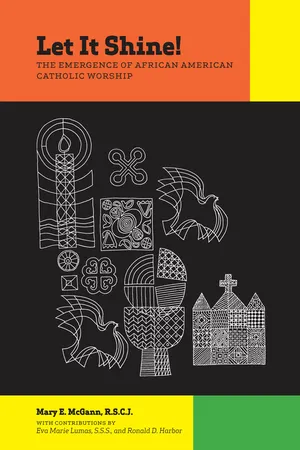
Let It Shine! probes the distinctive contribution of black Catholics to the life of the American church, and to the unfolding of lived Christianity in the United States. This important book explores the powerful spiritual renaissance that has marked African American life and selfunderstanding over the last several decades by examining one critical dimension: the forging of new expressions of Catholic worship rooted in the larger Catholic tradition, yet shaped in unique ways by African American religious culture.
Starting with the 1960s, the book traces the dynamic interplay of social change, cultural awakening, and charismatic leadership that have sparked the emergence of distinctive styles of black Catholic worship. In their historical overview, McGann and Eva Marie Lumas chronicle the liturgical and pastoral issues of a black Catholic liturgical movement that has transformed the larger American church. McGann then examines the foundational vision of Rev. Clarence R. J. Rivers, who promoted forms of black worship, music, preaching, and prayer that have enabled African American Catholics to reclaim the fullness of their religious identity.
Finally, Harbor constructs a black Catholic aesthetic based on the theological, ethical, and liturgical insights of four African American scholars, expressed through twenty-three performative values. This liturgical aesthetic illuminates the distinctive gift of black Catholics to the multicultural tapestry of lived faith in the American church and can also serve as a pastoral model for other cultural communities.
Blending history, theology, and liturgy, Let It Shine! is a valuable resource for scholars, teachers, and students and a practical pastoral guide to bringing African American spirituality more firmly into the sacramental life of American parishes.
- 181 pages
- English
- ePUB (mobile friendly)
- Available on iOS & Android
eBook - ePub
About this book
Information
Publisher
Fordham University PressYear
2009Print ISBN
9780823229925
9780823229918
eBook ISBN
9780823229932
Topic
Theology & ReligionSubtopic
Christian DenominationsThe Emergence of African American Catholic Worship
Mary E. McGann, R.S.C.J., and Eva Marie Lumas, S.S.S.
The religious and social ferment created in the 1960s by Vatican II and the African American Civil Rights movement set the stage for momentous change for Black Catholics in the United States. In the years following these events, the American Church has witnessed the emergence of distinctively African American patterns of celebrating Catholic worship. This chapter will trace the process by which these new expressions of Catholic liturgy have been forged over the past four and a half decades. It will identify the historical forces that served as catalysts; the leadership that has guided the process; the issues, both liturgical and contextual, that have given it direction; the cultural self-redefinition among African American Catholics that has shaped and fostered a reclaiming of a distinct “ethno-religious patrimony” within the larger Church; and the present and future challenges to this process.
Historian Father Cyprian Davis, O.S.B., has brilliantly traced the long history of African American Catholics in the United States.1 He notes that the earliest baptismal records from St. Augustine, Florida, dating from the second half of the sixteenth century, attest to the presence of Catholics of African descent. Likewise, their presence is evident in Spanish-, French-, and English-speaking territories during the American colonial period.2 Throughout the ensuing centuries of American history, African Americans were drawn to the Catholic Church for many reasons. Some found within this tradition a sense of stability and order. Others valued Catholic education, which empowered numerous Black children with skills, self-esteem, and moral principles. Still others were drawn by Catholic sacramental practice—the honoring of saints and “holy ancestors,” and the rhythms of a liturgical year that appealed to an African cosmology of seasons, times, and creation’s impact on worship and daily living.
Yet despite these attractions, the history of Black Catholics in the United States has been marked by frustration and marginalization. Despite their committed engagement in the life of the Church, Black Catholics were systematically excluded from clerical leadership. It was not until 1886 that Augustus Tolton, son of slave parents, became the first recognizable and self-identified Black priest ordained for ministry in the United States.
As early as 1889, African American lay Catholics gave birth to an indigenous tradition of struggle for social justice.3 Through a series of national Black Catholic lay congresses, held between 1889 and 1924, Catholics of African descent worked “to enjoy the [full] heritage of their faith; to win for themselves, their progeny, and their people, the attention, care and respect of the Church; and to help secure the rights of citizenship for their race.”4
Black involvement in Catholic liturgical life was likewise marked by both commitment and disappointment. While valuing the sacramental character of Catholic worship, many Black members suffered from liturgies that were dry, uninspired, staid, and lacking in the deep religious feeling that could nourish and express their spiritual longings. In the words of Father Glenn Jean-Marie, “when our people embraced the Catholic faith, they rejected their past in order to become a ‘new creation.’ … [They] left behind Blackness and became pure, White, and Catholic.”5 Brother Cyprian Rowe, S.M. points out that
Catholics of African descent have suffered intensely from the sterility of liturgical rites, because they have somewhere in their bones a tradition of worship in which the sung and spoken word have been fused into celebrations of joy. Afro-Americans are therefore among the first to realize that it is a certain cultural ignorance, and even cultural imperialism, that have resulted in their almost total exclusion from worship, except as spectators.6
Two Religious-Liturgical Patrimonies
As faithful and loyal participants in the Catholic tradition, Black Catholics shared another cultural-religious legacy, a tradition well described as “African-American Christianity.”7 This indigenous form of Christian life and worship exceeds the boundaries of any church body, penetrating the fabric of life within the Black community in the United States.8 African American Christianity was born of Black struggle for liberation, freedom, health, and wholeness in situations of oppression. In pursuing liberation, Black Americans had found “a great Savior, Jesus Christ, the Emancipator.”9 Within the crucible of non-Catholic Christian Churches, African Americans forged a distinctive style of Christian worship, rooted in the expressive patterns of African ritual and expressed through music, preaching, prayer, and testimony.10 Black Catholics, while participating in Catholic parish life, shared and were nourished by this larger Black religious heritage. Yet this “patrimony” was systematically excluded from their expression of Catholic worship.11
The 1960s: A Kairos Moment for Black Catholics
The convergence of the American Civil Rights movement and Vatican II in the 1960s set Black Catholics and the entire American Church on a new course. Theologian M. Shawn Copeland identifies the intersection of these two events as a kairos 12 moment for African American Catholics. “Change in the social mood without change in the ecclesial mood might have forced Black Catholics in the United States to abandon their centuries-old religious tradition; change in the ecclesial mood without change in the social mood might have compelled them to barter their racial-cultural heritage for silver. There was a propitiousness to these times. This was God’s time: this was kairos.”13
On the one hand, the Civil Rights movement challenged the structures of social and economic segregation of Blacks in the United States. It gave birth to a new cultural consciousness, a pride in their God-given worth, that challenged the negative Black identity that had been reinforced in American culture and in the Church itself.14 It had awakened in Black Catholics a renewed sense of their religious and ritual heritage that had yet to find expression in Catholic life and worship and called into question the persistent racism that denied them full participation and leadership in the Church. In the late 1960s, the first National Black Catholic Clergy Caucus (NBCCC) gathered to address the American bishops on urgent issues that faced the Black community.15 This initial act of national solidarity among Black clergy was quickly followed by other initiatives to foster Black leadership—clerical, religious, episcopal, and lay.16 In turn, the new leadership that emerged in the 1960s became highly significant for the unfolding of African American Catholic liturgy.
Within the same decade, the Second Vatican Council challenged the historical cultural, intellectual, and theological insularity of the Catholic Church. The council modeled in an historic way a Church that desires to embrace all cultures, and articulated a vision of a worldwide Church that “respects and fosters the genius and talents of various races and peoples.”17 In embracing a new ecclesial vision, one in which no single culture can be normative for Catholic life and worship, council leaders set a far-reaching course for liturgical inculturation:
Even in the liturgy the Church has no wish to impose a rigid uniformity … rather, the Church respects and fosters the genius and talents of various races and peoples. The Church … preserves intact the elements of these people’s way of life … and admits such elements into the liturgy itself, provided they are in keeping with the true and authentic spirit of the liturgy. … Provisions should be made … for legitimate variations and adaptations to different groups regions, and peoples. … In some places and circumstances … an even more radical adaptation of the liturgy is needed.18
Following the council, two pontiffs gave specific invitations to Catholics in Africa and of African descent to share their religious-cultural heritage with the Church. Pope Paul VI, in his 1969 address in Kampala, invited the churches of Africa to bring “to the Catholic Church the precious and original contribution of ‘Blackness’ which she particularly needs in this historic hour.”19 His call was taken to refer to Blacks throughout the African diaspora and was often quoted to assert the cause of the Black Catholic movement in the United States. Several years later, John Paul II addressed representatives of the African American Catholic community in New Orleans: “your Black cultural heritage enriches the Church and makes her witness of universality more complete.”20
Father Clarence R. J. Rivers and the Beginnings of a “Black Renaissance” in Catholic Church Liturgy
Coinciding with the council’s welcome of diverse cultural expressions, Father Clarence R. Joseph Rivers was launching what would become a “Black Renaissance” in American Catholic liturgy.21 Rivers, a musician, dramatist, author, scholar, liturgist, composer, and priest of the diocese of Cincinnati, was convinced that the treasury of African American art, culture, and religious expression could revitalize Catholic worship. Several years before Vatican II, Rivers began composing liturgical music in a Black idiom, producing his American Mass Program in 1963. In his compositions, Rivers drew on the spirituals, jazz, and gospel, thus introducing American Catholics to the rhythms, melodies, and harmonies of the Black musical idiom. Other composers, notably Eddie Bonnemere and Mary Lou Williams, joined Rivers in the attempt to bring the full range of Black music to Catholic worship. However, their use of jazz, calypso, and gospel in liturgical music was not always well accepted and at times openly resisted.22
Through workshops and lectures, Rivers worked “to bring greater cultural coherence to the liturgy” by “critically reexamine[ing] the relation of the various elements of the Mass to the Black idiom.”23 In so doing, he began to articulate a specifically African American Catholic liturgical aesthetic, an aesthetic that required (1) the use of drums, highly rhythmic music, musical improvisation, and dance; (2) a ritualized but spontaneous participation of the worshiping community, free of rubrical rigidity; and (3) rich poetic preaching and prayer that draw on participatory drama. This aesthetic is rooted in a theology that knows God to be both transcendent and immanent and flows from a spirituality that acknowledges that “to be spiritual is to be alive, to be capable of moving and of responding to movement.”24 In 1968, Rivers founded Stimuli, Inc.—a center for liturgical arts, design, and publication—to foster a greater synthesis between Black cultural expression and European American worship traditions.25 He noted that this synthesis would require that Black Catholics come to know and cherish their cultural tradition. Only then could they recognize that its vitality and dynamism can “enrich Christian and other forms of worship not only for Blacks but for all religionists.”26
The 1970s: Flowering of the Black Catholic Liturgical Movement
The aftermath of the Civil Rights movement left many of the one million Black Catholics in the United States eager for change. The organization of Black Catholic leadership, begun during the 1960s, culminated in the founding of a National Office for Black Catholics (NOBC) in 1970.27 The same year, the First National Black Lay Congress was held, focusing the lay leadership of Black Catholics on a national level once again. The 1970s saw the naming of four Black bishops in key cities who began to shape an episcopal presence that would take eloquent leadership in the 1980s.28 Theologians began to formulate a Black Catholic theology, adding their voices to the significant work on Black theology already written by their Protestant brothers and sisters. Historians retraced the historical evolution of Black Catholics, providing first access to the strong if often invisible presence of African Americans in Catholic life in the United States. Together, these leaders precipitated what has aptly been called the “Black Catholic Movement” of the 1970s.29
In this context, the American Church saw a flowering of the Black Catholic liturgical movement launched by Father Clarence Rivers in the 1960s. In 1970, Rivers became the first director of the NOBC’s Department of Culture and Worship. Through workshops, conferences, and publications, this department began to create a platform for a true indigenization of Black Catholic worship.30 Under its auspices, the journal Freeing the Spirit was launched as a forum for exploring issues pertinent to Black worship, and as a means of providing liturgical resources, images of African art, and newly composed music to pastoral leaders. Black liturgists, composers, and musicians were enlisted to offer workshops on Catholic liturgy around the country. The primary goal of these workshops was to educate and “liberate” Black Catholics to reclaim the fullness of their religious and ritual heritage, and to train ministers for the tasks of leadership. These gatherings enabled composers and musicians to explore various styles of Black sacred music and to collaborate in the creation of new musical settings. Composers Grayson Brown, Robert Ray, Ronald Harbor, and others took up the work of blending the idioms of jazz, gospel, and soul with European musical styles to create a new synthesis: the beginnings of a Black Catholic liturgical repertoire. In the process, Rivers encouraged composers and pastoral musicians to “be free to use traditional ‘Catholic’ musics and allow them free interplay with our Afro-American musics. … Like our forefathers who combined African and white Protestant music to produce the rich musics of Black America, musically liberated Black Catholics … [will bring a] still greater enrichment to the Afro-American [musical] styles, [a] further originality.”31
As leadership articulated the path of liturgical indigenization, Black Catholic renewal began to flourish in pockets around the country. Beginning in the late 1960s, some predominantly Black parishes had taken first initiatives to incorporate African American music, artistic expression, and modes of pa...
Table of contents
- Cover Page
- Title Page
- Copyright Page
- Dedication
- CONTENTS
- INTRODUCTION
- PART ONE AN HISTORICAL OVERVIEW
- PART TWO THE FOUNDATIONAL VISION
- PART THREE AESTHETIC PRINCIPLES
- A FINAL TRIBUTE
- NOTES
- SELECT BIBLIOGRAPHY
- CONTRIBUTORS
- INDEX
Trusted by 375,005 students
Access to over 1.5 million titles for a fair monthly price.
Study more efficiently using our study tools.
Frequently asked questions
Yes, you can cancel anytime from the Subscription tab in your account settings on the Perlego website. Your subscription will stay active until the end of your current billing period. Learn how to cancel your subscription
No, books cannot be downloaded as external files, such as PDFs, for use outside of Perlego. However, you can download books within the Perlego app for offline reading on mobile or tablet. Learn how to download books offline
Perlego offers two plans: Essential and Complete
- Essential is ideal for learners and professionals who enjoy exploring a wide range of subjects. Access the Essential Library with 800,000+ trusted titles and best-sellers across business, personal growth, and the humanities. Includes unlimited reading time and Standard Read Aloud voice.
- Complete: Perfect for advanced learners and researchers needing full, unrestricted access. Unlock 1.5M+ books across hundreds of subjects, including academic and specialized titles. The Complete Plan also includes advanced features like Premium Read Aloud and Research Assistant.
We are an online textbook subscription service, where you can get access to an entire online library for less than the price of a single book per month. With over 1.5 million books across 990+ topics, we’ve got you covered! Learn about our mission
Look out for the read-aloud symbol on your next book to see if you can listen to it. The read-aloud tool reads text aloud for you, highlighting the text as it is being read. You can pause it, speed it up and slow it down. Learn more about Read Aloud
Yes! You can use the Perlego app on both iOS and Android devices to read anytime, anywhere — even offline. Perfect for commutes or when you’re on the go.
Please note we cannot support devices running on iOS 13 and Android 7 or earlier. Learn more about using the app
Please note we cannot support devices running on iOS 13 and Android 7 or earlier. Learn more about using the app
Yes, you can access Let It Shine! by Mary E. McGann in PDF and/or ePUB format, as well as other popular books in Theology & Religion & Christian Denominations. We have over 1.5 million books available in our catalogue for you to explore.