eBook - ePub
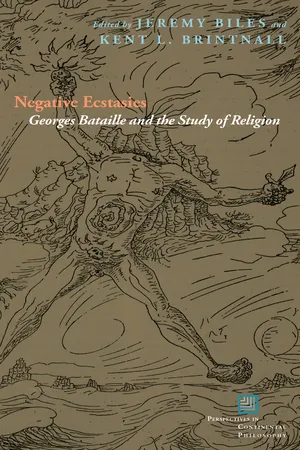
Negative Ecstasies
Georges Bataille and the Study of Religion
- 336 pages
- English
- ePUB (mobile friendly)
- Available on iOS & Android
eBook - ePub
Negative Ecstasies
Georges Bataille and the Study of Religion
About this book
Despite Georges Bataille's acknowledged influence on major poststructuralist thinkers—including Foucault, Derrida, Kristeva, Lacan, Baudrillard, and Barthes—and his prominence in literary, cultural, and social theory, rarely has he been taken up by scholars of religion, even as issues of the sacred were central to his thinking. Bringing together established scholars and emerging voices, Negative Ecstasies engages Bataille from the perspective of religious studies and theology, forging links with feminist and queer theory, economics, secularism, psychoanalysis, fat studies, and ethics. As these essays demonstrate, Bataille's work bears significance to contemporary questions in the academy and vital issues in the world. We continue to ignore him at our peril.
Information
Publisher
Fordham University PressYear
2015Print ISBN
9780823265206
9780823265190
eBook ISBN
9780823265213
Topic
Theology & ReligionSubtopic
Ethics & Moral PhilosophyNotes
Introduction: Sacred with a Vengeance
Jeremy Biles and Kent L. Brintnall
1. Gill, “Introduction” to Bataille: Writing the Sacred, xv. For a detailed study of Story of the Eye, see ffrench, The Cut: Reading Bataille’s Histoire de l’oeil. For divergent readings of the gender politics of the novel, see Hollywood, Sensible Ecstasy, 39–54; and Brintnall, Ecce Homo, 188–197.
2. Bataille’s older brother, Martial, disputes this characterization of their parents. For a detailed biographical account, see Surya, Georges Bataille: An Intellectual Biography, 3–13. It is tempting to see the parents—Joseph-Aristide and Marie-Antoinette—as the mad, perverse counterparts of the biblical Joseph and Mary and their son Georges as a sinister reiteration of Christ; Bataille indeed identified with the incarnate word, the carnal god, crucified and crying out.
3. Much of the present biographical account is drawn from Bataille, “Autobiographical Note,” collected in My Mother, Madame Edwarda, The Dead Man, 215–222.
4. See “Coincidences” in Story of the Eye, 94. For a discussion of Bataille’s reliability as a narrator of his own life, see Hollywood, Sensible Ecstasy, 44–45.
5. Bataille, “Autobiographical Note,” 217.
6. See Bataille, Story of the Eye, 58–64; see also Leiris, Mirror of Tauromachy. Bataille credited Leiris’s Mirror as central to his own endeavors to unravel the problems of eroticism and its connections to religion. See Bataille, Erotism, 9.
7. Bataille, “Autobiographical Note,” 218.
8. Bataille speaks of “the open wound that my life is” in a letter to Alexandre Kojève collected in Guilty, 123.
9. On Bataille’s repetition of Nietzsche, see Abel, “Georges Bataille and the Repetition of Nietzsche.” See also Biles, Ecce Monstrum, 36–71.
10. Stuart Kendall uses this phrase to describe Bataille’s Nietzschean undertakings in the publication Acéphale, addressed further below. Kendall, “Editor’s Introduction: Unlimited Assemblage,” xx.
11. Bataille, Theory of Religion, 109.
12. Bataille, The Tears of Eros, 206–207. The significance of Bataille’s meditations on this photo are testified to by the frequency with which scholars use it as an entry point to their consideration of Bataille. See, for example, Biles, Ecce Monstrum, 9–12; Brintnall, Ecce Homo, 1–8, 20–24; Buch, The Pathos of the Real, 27–39; Connor, Georges Bataille and the Mysticism of Sin, 1–7; Hollywood, Sensible Ecstasy, 79–94. For critical assessments of Bataille’s use of these torture images, see Brook, Bourgon, and Blue, Death by a Thousand Cuts, 222–242; and Elkins, “The Very Theory of Transgression: Bataille, Lingchi, and Transgression,” 5–19.
13. Denis Hollier cites Raymond Queneau’s quoting of Bataille in “The Dualist Materialism of Georges Bataille.”
14. Bataille, “Autobiographical Note,” 218.
15. See André Breton, Manifestoes of Surrealism, 119–194.
16. Leiris, “Dela Bataille impossible à l’impossible ‘Documents,’” 689.
17. For further discussion of Documents, see Ades and Baker, Undercover Surrealism; Falasca-Zamponi, Rethinking the Political, 95–103.
18. Bataille, “The Use Value of D. A. F. De Sade,” in Visions of Excess, 94.
19. Bataille, On Nietzsche, 19. On Bataille’s understanding of communication and community, see the exchange between Maurice Blanchot and Jean-Luc Nancy: Blanchot, “The Negative Community,” in The Unavowable Community, 1–26; and Nancy, The Inoperative Community, 1–42; see also the essays collected in Mitchell and Winfree, eds., The Obsessions of Georges Bataille: Community and Communication.
20. Bataille, “Autobiographical Note,” 220.
21. Bataille, “The Sacred Conspiracy,” in Visions of Excess, 179. Uppercase in the original.
22. Bataille, “The Sacred,” in Visions of Excess, 242.
23. For the Collège’s lectures, see Hollier, ed., The College of Sociology, 1937–1939. For intellectual histories of the Collège, see Falasca-Zamponi, Rethinking the Political; and Richman, Sacred Revolutions.
24. For a discussion of Bataille’s sacred politics, see Irwin, Saints of the Impossible. See also Surya, Georges Bataille, for a detailed account of Bataille’s political involvements.
25. Bataille, “Autobiographical Note,” 219–220.
26. Bataille himself claims that the secret society “[turned] its back on politics”—a statement that must be read in the context of his wider thought and activity. As Hollywood has argued, the gesture of turning away from politics is, for Bataille, itself a political gesture. See Hollywood, Sensible Ecstasy, 60–87.
27. A complete survey of Bataille’s religious development would have to take full account of the profound influence exercised upon Bataille’s concept of the sacred by Laure. Mostly overlooked or underappreciated in the critical literature on Bataille, Laure was a key interlocutor for Bataille and a compelling, incisive, and impassioned thinker in her own right. For a detailed treatment of Laure’s role in the thought of Bataille and Michel Leiris, see Sweedler, The Dismembered Community; see also the notes collected in Stuart Kendall’s recent translation of Guilty. For Laure’s writings, see Laure: The Collected Writings.
28. Bataille, “Autobiographical Note,” 221.
29. Gemerchak, The Sunday of the Negative, 171.
30. On the complex compositional and publication history of La somme, see Kendall, “Editor’s Introduction.”
31. For recent investigations of Bataille’s emphasis on consumption over production and the general economy perspective of The Accursed Share, see Stoekl, Bataille’s Peak; Winnubst, ed., Reading Bataille Now.
32. Bataille, “Joy in the Face of Death,” in The College of Sociology, 1937–1939, 325.
33. Bataille, Erotism, 16.
34. Bataille, “Autobiographica...
Table of contents
- Cover
- Series Page
- Series Editor
- Title Page
- Copyright
- Dedication
- Contents
- Acknowledgments
- Introduction: Sacred with a Vengeance
- Movements of Luxurious Exuberance: Georges Bataille and Fat Politics
- Sovereignty and Cruelty: Self-Affirmation, Self-Dissolution, and the Bataillean Subject
- Erotic Ruination: Embracing the “Savage Spirituality” of Barebacking
- Desire, Blood, and Power: Georges Bataille and the Study of Hindu Tantra in Northeastern India
- The Religion of Football: Sacrifice, Festival, and Sovereignty at the 2010 FIFA World Cup in South Africa
- Violent Silence: Noise and Bataille’s “Method of Meditation”
- Georges Bataille and the Religion of Capitalism
- Sacrifice as Ethics: The Strange Religiosity of Neoliberalism
- Bataille’s Contestation of Interpretive Anthropology and the Sociology of Religion
- The Traumatic Secret: Bataille and the Comparative Erotics of Mystical Literature
- Foucault’s Sacred Sociology
- Bataille and Kristeva on Religion
- Bataille, Teilhard de Chardin, and the Death of God
- Does the Acéphale Dream of Headless Sheep?
- Afterword
- Notes
- Works Cited
- List of Contributors
- Index
- Perspectives in Continental Philosophy
Trusted by 375,005 students
Access to over 1.5 million titles for a fair monthly price.
Study more efficiently using our study tools.
Frequently asked questions
Yes, you can cancel anytime from the Subscription tab in your account settings on the Perlego website. Your subscription will stay active until the end of your current billing period. Learn how to cancel your subscription
No, books cannot be downloaded as external files, such as PDFs, for use outside of Perlego. However, you can download books within the Perlego app for offline reading on mobile or tablet. Learn how to download books offline
Perlego offers two plans: Essential and Complete
- Essential is ideal for learners and professionals who enjoy exploring a wide range of subjects. Access the Essential Library with 800,000+ trusted titles and best-sellers across business, personal growth, and the humanities. Includes unlimited reading time and Standard Read Aloud voice.
- Complete: Perfect for advanced learners and researchers needing full, unrestricted access. Unlock 1.5M+ books across hundreds of subjects, including academic and specialized titles. The Complete Plan also includes advanced features like Premium Read Aloud and Research Assistant.
We are an online textbook subscription service, where you can get access to an entire online library for less than the price of a single book per month. With over 1.5 million books across 990+ topics, we’ve got you covered! Learn about our mission
Look out for the read-aloud symbol on your next book to see if you can listen to it. The read-aloud tool reads text aloud for you, highlighting the text as it is being read. You can pause it, speed it up and slow it down. Learn more about Read Aloud
Yes! You can use the Perlego app on both iOS and Android devices to read anytime, anywhere — even offline. Perfect for commutes or when you’re on the go.
Please note we cannot support devices running on iOS 13 and Android 7 or earlier. Learn more about using the app
Please note we cannot support devices running on iOS 13 and Android 7 or earlier. Learn more about using the app
Yes, you can access Negative Ecstasies by Jeremy Biles, Kent L. Brintnall, Jeremy Biles,Kent L. Brintnall in PDF and/or ePUB format, as well as other popular books in Theology & Religion & Ethics & Moral Philosophy. We have over 1.5 million books available in our catalogue for you to explore.