eBook - ePub
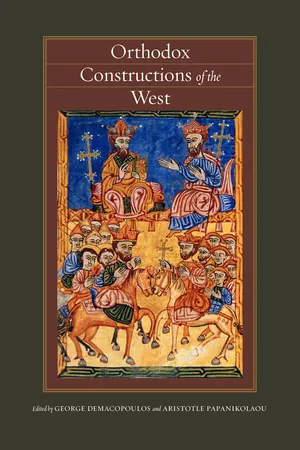
Orthodox Constructions of the West
- 380 pages
- English
- ePUB (mobile friendly)
- Available on iOS & Android
eBook - ePub
Orthodox Constructions of the West
About this book
The category of the "West" has played a particularly significant role in the modern Eastern Orthodox imagination. It has functioned as an absolute marker of difference from what is considered to be the essence of Orthodoxy and, thus, ironically has become a constitutive aspect of the modern Orthodox self. The essays collected in this volume examine the many factors that contributed to the "Eastern" construction of the "West" in order to understand why the "West" is so important to the Eastern Christian's sense of self.
Information
Publisher
Fordham University PressYear
2013Print ISBN
9780823251933
9780823251926
eBook ISBN
9780823252091
Topic
Theology & ReligionSubtopic
Christian DenominationsNOTES
Orthodox Naming of the Other: A Postcolonial Approach / George E. Demacopoulos and Aristotle Papanikolaou
We thank Ben Dunning and Paul Gavrilyuk for their many helpful suggestions to an earlier version of this essay.
1. As is well known, Constantinopolitan missionaries to the Balkans helped to develop and encouraged the use of Slavonic in the Balkans, whereas Frankish missionaries insisted on Latin. The debate came to a head when the Byzantine missionaries Cyril and Methodius were arrested by the Franks and sent to Rome for trial where they were ultimately vindicated.
2. So many Greek have emigrated to Australia that it is commonly believed that Melbourne has the highest Greek population of any city outside of Athens.
3. By “imagined” we do not mean that they are fictional or deliberately untrue, but that they are comprised of presumptions and assumptions that are not based upon empirical encounters with the other.
4. There is no textual evidence to indicate that Christians in the first millennium identified themselves as Eastern or Western in order to differentiate themselves from one another. It is true, of course, that in the documents surrounding the Council of Ephesus (431), the language of “Easterners” is applied to the “heretical” supporters of John of Antioch in order to differentiate their theology from that of the See of Alexandria and Rome, even though neither of the latter are ever referred to in the same documents as “Westerners.”
5. As numerous scholars have shown, the Roman Empire was not converted to Christianity overnight simply because Constantine legalized the religion. Some of the most important studies of the past generation include Ramsey McMullen’s The Christianizing of the Roman Empire (New Haven, Conn.: Yale University Press, 1984), Robin Lane Fox, Pagans and Christians (New York: Knopf, 1987), and Averil Cameron’s Christianity and the Rhetoric of Empire (Berkeley: University of California Press, 1994).
6. Of course, the experience of Eastern Christians living under Muslim rule in these regions was decidedly different.
7. John Chrysostom’s appeal to Innocent of Rome at the time of his exile provides a famous example.
8. While it is true that Gregory’s Eastern correspondence was larger than anyone else of his day, it is also true that he has the largest surviving correspondence of anyone from the ancient world.
9. For the many problems of the Augustine-versus-the-East narrative that all too frequently haunts theological and historical scholarship, see Demacopoulos and Papanikolaou, Orthodox Readings of Augustine.
10. In particular, this was true for Basil of Caesarea and Cyril of Alexandria.
11. For this history, see the excellent work of A. Edward Sieciensky, The Filioque: History of a Doctrinal Controversy (Oxford: Oxford University Press, 2010), especially 51–71.
12. Ibid., 69.
13. Ibid.
14. Ibid., 98.
15. Tia Kolbaba, Inventing Latin Heretics: Byzantines and the Filioque in the Ninth Century (Kalamazoo: Medieval Institute Publications, 2008).
16. In 1339, Barlaam of Calabira informed the papal court: “That which separates the Greeks from you is not so much a difference in dogma as the hatred of the Greeks for the Latins provoked by the wrongs they have suffered” (Barlaam of Calabira, MPG 151.1332. Translated by D. Geanakoplos in his Byzantine East and Latin West [New York: Barnes and Noble, 1966], 91). Concerning Barlaam’s career, see Tia Kolbaba, “Barlaam the Calabrian: Three Treatises on Papal Primacy, Introduction, Edition and Translation,” Revue des études byzantines 53 (1995): 41–115, especially 50–63.
17. Constantine Stilbes was the first to publish a series of grievances against the crusaders. Writing from exile in 1213, Stilbes produced a catalogue of criticisms, ranging from theological errors of the clergy to criminal actions by crusaders. His criticisms were comprehensible by a wide audience. Stilbes’s text is important because it serves as a point of demarcation—prior to 1213 there had been several Byzantine critiques of Latin doctrine (filioque, Papal primacy, etc.), but Stilbes’s criticisms, and many that followed, took a much more aggressive approach to Roman theology and Latin abuses in the East. See Jean Darrouzès, “Le mémoire de Constantin Stilbès contre les Latins,” Revue des Études byzantines 21 (1965): 50–100. See, also, Michael Angold, “Greeks and Latins after 1204: The Perspective of Exile,” in Latins and Greeks in the Eastern Mediterranean after 1204, ed. B. Arbel et al. (London: Frank Cass, 1989), 63–86.
18. Demetrios Chomatenos, the bishop of Ochrid, Serbia (ca. 1216–36) became the leading proponent of clerical opposition to the Latins on the Greek mainland. Of course, the fact that he was so insistent suggests two important things. First, we can assume that the interaction he so frequently critiqued must have been quite common. Second, that he came to have a personal investment (theological, political, or otherwise) in perpetuating a radical distinction between Orthodox and Latin teaching. For a critical edition of his letters and canonical judgments, see Gunter Prinzing, ed., Demetrii Chomateni: Ponomata Diaphora (Berlin: Walter de Gruyter, 2002).
19. An analysis of the Frankish experience in both the Peloponnesus of Greece, as well as the regions around Thessaloniki, in fact, demonstrates that the Franks enjoyed a good relationship with their Greek laborers, possibly even better than that of the Byzantine lords who had preceded them. See Angold, The Fourth Crusade: Event and Context (London: Longman, 2003), 139f.
20. In this regard, Homi Bhabha’s interest in the work of Franz Fanon could prove to be especially rewarding as Bhabha explores the extent to which the colonized can actually disrupt (through mimicry and mockery) the sensibilities of the colonizer. See, especially, Bhabha, “Interrogating identity: Frantz Fanon and the Postcolonial Prerogative” and “Of Mimicry and Man: The Ambivalence of Colonial Discourse,” in his The Location of Culture (London: Routledge, 1994), 57–93 and 121–31.
21. Gennadios Scholarios probably serves as the best example here. In contrast to the apologetic narrative that posits Scholarios as having abandoned his fascination with Thomas Aquinas at roughly the same time that he came under the influence of Mark of Ephesus (i.e., in the 1440s), we note that Scholarios actually published an epitome for Thomas’s Summa contra gentiles and Summa theologica in 1464, more than fifteen years after he began his vociferous condemnation of the Council of Florence.
22. Gregory Palamas’s critique, however brief, of syllogistic reasoning surely had more to do with his condemnation of Barlaam’s reliance on pre-Christian authors than it was a critique of Western-styled Scholasticism. See, for example, his Triads in the section on apophaticism.
23. Angold, The Fourth Crusade, 202–3. It is noteworthy that many of the Greek landowners in the Peloponnesus were able to come to a peaceful solution with their Frankish overlords, in large part Frankish settlers in the Peloponnesus were the most tolerant of Eastern Christian religious traditions.
24. On the links between Orthodox and Hellenistic identity that emerged, for the first time, in the wake of the Fourth Crusade, see James Skedros, “Hellenism and Byzantium,” St. Vladimir’s Theological Quarterly 54 (2010): 345–63.
25. See Angold, The Fourth Crusade: Event and Context (Harlow, U.K.: Pearson Longman, 2003), especially 202–3.
26. The widely divergent interpretations of the quintessential “Western” theologian, Augustine of Hippo, provides an excellent case in point. See Demacopoulos and Papanikolaou, “Augustine and the Orthodox: The ‘West’ in the East,” in Demacopoulos and Papanikolaou, Orthodox Readings of Augustine, 11–40.
27. The Ottoman millet system allowed different religious sects to self-govern according to their confessional inclinations (Muslims, Orthodox Christians, Armenian Christians, Jews, etc.). During the sixteenth and seventh centuries, a patriarchate of S...
Table of contents
- Cover
- Half Title
- Series Page
- Title Page
- Copyright
- Contents
- Acknowledgments
- Half Title
- Orthodox Naming of the Other: A Postcolonial Approach / George E. Demacopoulos and Aristotle Papanikolaou
- Perceptions and Realities in Orthodox-Catholic Relations Today: Reflections on the Past, Prospects for the Future / Robert F. Taft, S.J.
- Byzantines, Armenians, and Latins: Unleavened Bread and Heresy in the Tenth Century / Tia Kolbaba
- “Light from the West”: Byzantine Readings of Aquinas / Marcus Plested
- From the “Shield of Orthodoxy” to the “Tome of Joy”: The Anti-Western Stance of Dositheos II of Jerusalem (1641–1707) / Norman Russell
- The Burdens of Tradition: Orthodox Constructions of the West in Russia (late 19th–early 20th cc.) / Vera Shevzov
- Florovsky’s Neopatristic Synthesis and the Future Ways of Orthodox Theology / Paul L. Gavrilyuk
- Eastern “Mystical Theology” or Western “Nouvelle Théologie”?: On the Comparative Reception of Dionysius the Areopagite in Lossky and de Lubac / Sarah Coakley
- The Image of the West in Contemporary Greek Theology / Pantelis Kalaitzidis
- Christos Yannaras and the Idea of “Dysis” / Basilio Petrà
- Religion in the Greek Public Sphere: Debating Europe’s Influence / Effie Fokas
- Shaking the Comfortable Conceits of Otherness: Political Science and the Study of “Orthodox Constructions of the West” / Elizabeth H. Prodromou
- Eastern Orthodox Constructions of “the West” in the Post-Communist Political Discourse: The Cases of the Romanian and Russian Orthodox Churches / Lucian Turcescu
- Primacy and Ecclesiology: The State of the Question / John Panteleimon Manoussakis
- (In)Voluntary Ecumenism: Dumitru Staniloae’s Interaction with the West as Open Sobornicity / Radu Bordeianu
- Notes
- List of Contributors
- Index
- Series List
Trusted by 375,005 students
Access to over 1.5 million titles for a fair monthly price.
Study more efficiently using our study tools.
Frequently asked questions
Yes, you can cancel anytime from the Subscription tab in your account settings on the Perlego website. Your subscription will stay active until the end of your current billing period. Learn how to cancel your subscription
No, books cannot be downloaded as external files, such as PDFs, for use outside of Perlego. However, you can download books within the Perlego app for offline reading on mobile or tablet. Learn how to download books offline
Perlego offers two plans: Essential and Complete
- Essential is ideal for learners and professionals who enjoy exploring a wide range of subjects. Access the Essential Library with 800,000+ trusted titles and best-sellers across business, personal growth, and the humanities. Includes unlimited reading time and Standard Read Aloud voice.
- Complete: Perfect for advanced learners and researchers needing full, unrestricted access. Unlock 1.5M+ books across hundreds of subjects, including academic and specialized titles. The Complete Plan also includes advanced features like Premium Read Aloud and Research Assistant.
We are an online textbook subscription service, where you can get access to an entire online library for less than the price of a single book per month. With over 1.5 million books across 990+ topics, we’ve got you covered! Learn about our mission
Look out for the read-aloud symbol on your next book to see if you can listen to it. The read-aloud tool reads text aloud for you, highlighting the text as it is being read. You can pause it, speed it up and slow it down. Learn more about Read Aloud
Yes! You can use the Perlego app on both iOS and Android devices to read anytime, anywhere — even offline. Perfect for commutes or when you’re on the go.
Please note we cannot support devices running on iOS 13 and Android 7 or earlier. Learn more about using the app
Please note we cannot support devices running on iOS 13 and Android 7 or earlier. Learn more about using the app
Yes, you can access Orthodox Constructions of the West by George E. Demacopoulos, Aristotle Papanikolaou, George E. Demacopoulos,Aristotle Papanikolaou in PDF and/or ePUB format, as well as other popular books in Theology & Religion & Christian Denominations. We have over 1.5 million books available in our catalogue for you to explore.