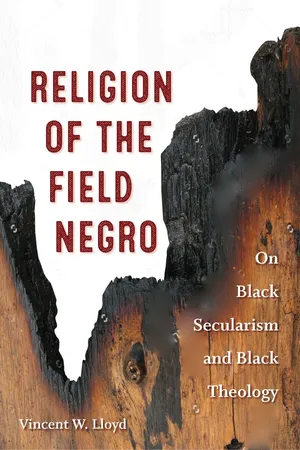
Black theology has lost its direction. To reclaim its original power and to advance racial justice struggles today black theology must fully embrace blackness and theology. But multiculturalism and religious pluralism have boxed in black theology, forcing it to speak in terms dictated by a power structure founded on white supremacy. In Religion of the Field Negro, Vincent W. Lloyd advances and develops black theology immodestly, privileging the perspective of African Americans and employing a distinctively theological analysis.
As Lloyd argues, secularism is entangled with the disciplining impulses of modernity, with neoliberal economics, and with Western imperialism – but it also contaminates and castrates black theology. Inspired by critics of secularism in other fields, Religion of the Field Negro probes the subtle ways in which religion is excluded and managed in black culture. Using Barack Obama, Huey Newton, and Steve Biko as case studies, it shows how the criticism of secularism is the prerequisite of all criticism, and it shows how criticism and grassroots organizing must go hand in hand. But scholars of secularism too often ignore race, and scholars of race too often ignore secularism. Scholars of black theology too often ignore the theoretical insights of secular black studies scholars, and race theorists too often ignore the critical insights of religious thinkers.
Religion of the Field Negro brings together vibrant scholarly conversations that have remained at a distance from each other until now. Weaving theological sources, critical theory, and cultural analysis, this book offers new answers to pressing questions about race and justice, love and hope, theorizing and organizing, and the role of whites in black struggle. The insights of James Cone are developed together with those of James Baldwin, Sylvia Wynter, and Achille Mbembe, all in the service of developing a political-theological vision that motivates us to challenge the racist paradigms of white supremacy.
- 304 pages
- English
- ePUB (mobile friendly)
- Available on iOS & Android
eBook - ePub
About this book
Information
Publisher
Fordham University PressYear
2017Print ISBN
9780823277643
9780823277636
eBook ISBN
9780823277650
Topic
PhilosophySubtopic
Political PhilosophyPART I
Cornerstones
CHAPTER 1
Cone
Black theology, it often seems, consists of movement in two directions, one political and one cultural. Black theology is the religion of black power, and black theology is the religion of the black community. The task of the black theologian is to explain how these two directions complement each other and to join them into a unified project. What sutures them, somehow, is theology. Secular reason alone is not up to the task. It is only when secular reason is supplemented by the language (or concepts, or beliefs) of faith, God, Christ, and Spirit that radical black politics and black culture no longer seem independent of, or even at odds with, each other. When God is aligned with the poor and oppressed and God’s work is to free the poor and oppressed, God is to be found in the language and practices of the black community—the community systematically oppressed. God’s work is to free this community from oppression—work that is necessarily political.
When black theology is presented in this way, a worry quickly presents itself. Black theology would offer a solution to a problem defined in secular terms. Radical politics and black culture in this picture are, at their root, understood in the same way in both secular and black theological discussions—the black theologian just adds something on top of the secular understanding. Black culture not only is X, it also is where God is at work in the world. Recent critics, both from the secular and theological academy, have pointed to the contingency of such a position: our “secular age” is relatively recent and brings deep, highly specific assumptions.1 Theology may appear autonomous as a supplement to the secular, but in fact its autonomy is lost; the secular sets the terms for the theological. What would it mean for black theology to start from a commitment to the genuine autonomy of the theological?
It is my contention that a compelling response to this question is implicit in the early work of James Cone. My interest here is in making those implicit commitments to the autonomy of the theological explicit by emphasizing the role of paradox and tradition in Cone’s work and in the project of black theology more generally. This pair of terms presents a means of affirming the primacy of the theological while at the same time articulating core commitments of black theology. Moreover, the language of paradox and tradition returns black theology to its radical roots. Not only does the theological come before the secular, but black theology emerges as the only orthodox theology; white (and ostensibly colorblind) theology emerges as crypto-secular heresy.
Critiques of Black Theology
Two critiques of the current state of black theology, from quite different directions, have underscored the aporias that result when a theological project starts from secular foundations. First, reformulations of liberation theology have argued that the purported focus on the poor and oppressed that once motivated liberation theology has been lost.2 In some cases, this loss is due to an aspiration for middle-class status that overshadows a commitment to the struggles of the oppressed. In other cases, this loss is due to a celebration of specific communities or cultures—for example, Asian American, or African, or Latina, or queer—that overshadows the reason that these groups were originally of interest to liberation theologians—namely, their oppression or poverty. Yet oppression and poverty have not gone away, nor has the need for concrete projects to address them diminished. In the face of neoliberalism and the unchecked power of international financial institutions and multinational corporations, these critics contend that what is needed is to bring together all those reduced to dire poverty by these policies and institutions. For such a project cultural issues may be used pragmatically, for mobilization, but they are ultimately of secondary concern.
Advocates of this new approach to liberation theology offer a powerful challenge to black theology. When the emphasis of black theology becomes a celebration of black culture, when de jure racial oppression becomes de facto, and when a black middle class develops in whose interest it is to celebrate black culture while ignoring de facto racial oppression, black theology easily strays from its seminal commitment to the struggle of the poor and oppressed. This critique naturally leads to a condemnation of “black” as a name for the poor and oppressed, where the critic objects by pointing out that (a) there are poor and oppressed people who are not black, and (b) there are black people who are neither poor nor oppressed. I will argue that abandoning black theology is not the necessary result of this critique.
This first critique of the current state of black theology is immanent criticism rather than a theological critique, arguing that black theology does not live up to its own commitments to the poor and oppressed. The critic proceeds through secular reason, using empirical data to identify who qualifies as poor and oppressed, and in doing so appears to expose inconsistency in the black theologian’s own position. In contrast, the second critique is thoroughly theological. These critics charge that black theology, in its current state, overlooks the deep connections between Christianity and racism. They assert that a careful genealogy of race reveals that race is a theological problem, arising because of Christian heresy.3 White theology is not a recent problem; it names the theological heresy of supersessionism. White theology refuses to grapple with the theological significance of Jesus’s Jewish flesh, instead imagining a radical break between Judaism and Christianity. The old law of the flesh overturned, white theology sees Jesus as inaugurating the age of the spirit. In the process race is invented as that by which Christians are not marked, quickly slipping into that by which Europeans are not marked. In other words, black theology must be reframed as a defense of theological orthodoxy that offers the only avenue for addressing the (ostensibly secular but actually theological) problem of racism in society.
This second group of critics laments the thin theology that has become characteristic of black theological reflection—too little talk about pneumatology, about the economy of the Trinity, about the Christian tradition.4 In order to combat problematic theology, it is necessary to offer better theology: for example, to explain how white theology differs from the Christology found in Irenaeus, Gregory of Nyssa, and Maximus the Confessor. According to these critics, the early work of black theologians offered some promise when it emphasized the similarities between God’s identification with the Jewish people and God’s identification with blacks, restraining inclinations toward supersessionism. But early work in black theology also tended to rely on the theological concepts of white theologians like Karl Barth and Paul Tillich, who, like many mid-twentieth-century white Protestants, sometimes evince a commitment to supersessionist positions.
If the first critique of black theology takes theology to be implicit in its political point, the second critique takes politics to be implicit in its theological point. For the former, focusing on the most marginalized has the effect of advancing the Christian imperative to identify with the poor. For the latter, once the theological problem is resolved, the intellectual apparatus that authorizes racism will be crippled, with the consequence that racism itself will crumble. Each critique is compelling, but the two are at odds. Each builds on the flaw targeted by the other. The first critique builds on the sort of thin theology targeted by the second, while the second critique ignores the centrality of the poor and oppressed recalled by the first.
Rather than forcing an artificial resolution to such a tangle—and just pulling the knot tighter—perhaps the concerns raised by both sides can be alleviated when the terms of the debate are altered. To show how this might work, the foundational scholarship of James Cone is enormously useful. A story is often told about Cone’s work, sometimes by Cone himself, that divides his writings into two stages. In the first stage, which includes Black Theology and Black Power (1969) and Black Theology of Liberation (1970), he was heavily influenced by white theologians, particularly Barth and Tillich, and white philosophers, particularly existentialists. After being criticized for simultaneously proclaiming his independence from white theology and relying on white theological categories, Cone turned to resources within the African American tradition to undergird his theological position.5 He proceeded to write The Spirituals and the Blues (1972), and he relied on these black musical traditions in God of the Oppressed (1975). In contrast to this story about Cone’s development, I argue that Cone’s first works offer a novel account of Christian paradox. In a sense, my task is to translate the secular existential idiom of Cone’s early work into a theological idiom of paradox, where the human encounter with paradox indicates participation in the ultimate paradox, that of Jesus Christ. With this translation, we are able to address questions such as, What does it mean when Cone writes, “The logic of liberation is always incomprehensible to slave masters”?6 Might it mean something deeper than an accusation of willful ignorance or false consciousness? Might it suggest that there is a fundamental link between the incomprehensible, the black, and the theological? And might this incomprehensibility be linked with the essential character of black life, which Cone describes as filled with contradictions?7
Paradox and Tradition
Before turning to Cone’s writings, I will sketch what I mean by paradox and tradition. These are both concepts irreducible to a vocabulary authorized by secularism. From the secularist’s perspective, there can be no genuine paradox. Moments of perplexity or incongruity can be explained through secular reason, with the tools of the natural sciences, social sciences, and even humanities.8 It might seem as though things don’t fit together, but from the secularist’s perspective ultimately they must—even chaos has a theory to explain it, even anomie has a sociological explanation. And from the secularist’s perspective, tradition is obsolete. Just because something has been done before is no reason to do it again. Tradition is better described as the sum of a community and its history, stripping away the normative connotations. For the secularist, tradition is something to be rationally studied or romantically embraced; either option is taken by the autonomous agent.
Paradox and tradition might not be part of a secular vocabulary, but are they thickly theological? Are they uniquely Christian? Cornel West, following Kierkegaard and others, suggests that at least paradox is: “The paradox of the Christian tradition is that it precludes its own descriptions from grasping the truth; that is, the Christian notion of the fallenness of human creatures does not permit even Christian descriptions to be true. This is so because, for Christians, Jesus Christ is the Truth and the reality of Jesus Christ always already rests outside any particular Christian description.”9 This might sound like a trendy morsel of Eastern wisdom—the Truth cannot be spoken—except West goes on to assert that there is a very specific test for this ineffable truth. The test involves comparison to the person of Jesus Christ. Certainly, every description of Jesus gets Jesus wrong, but all descriptions are not equally wrong. The paradox doubles: not only does Christian discourse claim to speak truthfully and claim that all speech is untruthful; it also claims that there is an embodied criterion for truthfulness, but that embodied criterion itself can only be spoken of untruthfully. Unlike Beckett’s dreary tragi-comedy—“Ever tried. Ever failed. No matter. Try again. Fail again. Fail better”—West presents this Christian tragicomedy with the glass half full, paradox as joyfully difficult. From a secular perspective paradox brings frustration; from a Christian perspective, with an existential commitment to its embrace, paradox brings salvation.
By paradox, then, I simply mean moments of irresolution, without the possibility of resolution through secular means. Paradox without tradition is blind; tradition without paradox is empty. Theologians too often forget this, either wallowing in the fallenness of the world, in paradox, or triumphantly proclaiming the Christian story absent even a hint of genuine humility. A commitment to paradox means a commitment to trying as hard as possible to understand the ultimate paradox, Jesus Christ, knowing that one’s efforts will always fall short. There is no quick and direct access, no shortcut. It is a difficult task, working through the accumulated tryings and failings of the centuries and of one’s contemporaries, of visible churches’ stammering as they seek to speak in one voice with the church invisible. In other words, a commitment to paradox means immersion in thick tradition. But immersion in thick tradition all too often leads paradox to be forgotten. It starts to seem as though one’s descriptions are right, that one’s feelings are true, that one is indeed participating in the Body of Christ. That is when paradox humbles. Paradox reminds that as soon as one feels comfortable with one’s commitments—one’s descriptions, one’s feelings, one’s participation—those commitments are misdirected. Christian commitment is ultimately to paradox, to the One who is Paradox, the God-Man, and to nothing else.
The Theology of James Cone
The challenge of writing theology, like the challenge of writing good fiction, is at once to tell a compelling story and to tell a story that is fundamentally equivocal. Doing one or the other is sometimes manageable; to do both is nearly impossible. The theologian’s prayer is to fail better. It is the aspiration to do both that I find in Cone’s theology. It is not that Cone locates one paradox (other than Christ) at the heart of his theological project. It is that in articulating the Christian logos, Cone weaves together multiple irreducible paradoxes. Sometimes Cone hesitates, does not fully embrace the moments of paradox. (Even more often, his readers and critics hesitate for him.) These hesitations can give his theology the appearance of excessive alignment with radical politics or African American culture—that is, the appearance of conceding its heart to the secular. Yet Cone’s theological writings, even his early work, grow out of an immersion in African American religious life. In other words, Cone is immersed in the Christian tradition; such immersion always is located in a specific time and place. In his early works, Cone prevents that specific location from crippling his theological imagination through his use of paradox. The pillars that hold together Cone’s descriptions of African American religion are each paradoxical, either underdefined or defined multiply with each definition in tension with each other. I will analyze these pillars, including blackness, liberation, freedom, and humanity, showing how each of them, in Cone’s account, is ultimately paradoxical. We must not forget, however, that these concepts are each pillars of Cone’s explication of the Christian tradition. Cone is explicating tradition equivocally: he is employing what might be called an aesthetics of paradox.
First among the paradoxes woven together by Cone is the paradox of blackness. Cone describes it as both “ontological symbol” and “visible reality.”10 Does this mean that sometimes Cone writes about blackness in the symbolic sense and other times he writes about it in the literal sense? Certainly not: throughout his writings, and most prominently in his early writings, the word “black” refers to both senses at once. This usage stymies the desire to dismiss Cone’s terminology as merely metaphorical or as absurdly ethnocentric. At a deeper level, it stymies the desire for theological certainty, for everything to fit together comfortably. Theological certainty is achieved by abandoning theology, by endorsing secularism in the guise of theology. Cone is clear that blackness is an idea of God, not humans, and so it is not comprehensible in exclusively human terms: “Blackness or salvation (the two are synonymous) is the work of God, not a human work. It is not something we accomplish; it is a gift.”11 Further, “blackness and divinity are dialectically bound together as one reality.”12
Cone writes autobiographically that his “turn to blackness was an even deeper conversion-experience than the turn to Jesus.”13 At times, Cone writes of this turn as a change from understanding himself as a “Negro”—that is, understanding himself in white terms—to understanding himself as “black,” in autonomous (and Christian) terms. To be black is not simply to have a certain skin color, but it is also not detachable from a specific community. Indeed, to be black, to be converted to blackness, means a commitment to a specific racial community and to the struggles of that community. In a sense, Cone means by a turn to Jesus an embrace of community: seeing oneself as a participant in the tradition of Jesus-worshippers. To turn to blackness means to turn to an impossible position, to confidently claim an identity foreclosed by the world.14 To turn to blackness is to turn to paradox. Cone’s juxtaposition of his two conversions should not be read as coincidental: they are complementary. It is from within the tradition of Jesus-worshippers that Cone can claim his blackness; his blackness is precarious unless it is rooted in (or hovers above) the tradition of Jesus-worshippers.
The black church thus has a privileged position, politically and theologically. This is the black church invisible, not the black churches occasionally maligned by Cone and recently declared dead.15 Black churches in the world are repositories of tradition, conveyers of the words and rhythms and performances of dark-skinned worshipers of Jesus Christ. But that does not make black churches black. Blackness is the paradoxical claim to an impossible position—and so necessarily an identification with struggle (occupying a space that does not yet exist can only take place by force). The black church is invisible because it conjoins the paradox of blackness with the Christian tradition. It is an impossible mixture, as tradition and paradox are incapable of binding with each...
Table of contents
- Cover
- Title Page
- Copyright
- Contents
- Introduction
- I. Cornerstones
- II. Questions
- III. Exempla
- Coda: The Birth of the Black Church
- Notes
- Bibliography
- Index
Trusted by 375,005 students
Access to over 1.5 million titles for a fair monthly price.
Study more efficiently using our study tools.
Frequently asked questions
Yes, you can cancel anytime from the Subscription tab in your account settings on the Perlego website. Your subscription will stay active until the end of your current billing period. Learn how to cancel your subscription
No, books cannot be downloaded as external files, such as PDFs, for use outside of Perlego. However, you can download books within the Perlego app for offline reading on mobile or tablet. Learn how to download books offline
Perlego offers two plans: Essential and Complete
- Essential is ideal for learners and professionals who enjoy exploring a wide range of subjects. Access the Essential Library with 800,000+ trusted titles and best-sellers across business, personal growth, and the humanities. Includes unlimited reading time and Standard Read Aloud voice.
- Complete: Perfect for advanced learners and researchers needing full, unrestricted access. Unlock 1.5M+ books across hundreds of subjects, including academic and specialized titles. The Complete Plan also includes advanced features like Premium Read Aloud and Research Assistant.
We are an online textbook subscription service, where you can get access to an entire online library for less than the price of a single book per month. With over 1.5 million books across 990+ topics, we’ve got you covered! Learn about our mission
Look out for the read-aloud symbol on your next book to see if you can listen to it. The read-aloud tool reads text aloud for you, highlighting the text as it is being read. You can pause it, speed it up and slow it down. Learn more about Read Aloud
Yes! You can use the Perlego app on both iOS and Android devices to read anytime, anywhere — even offline. Perfect for commutes or when you’re on the go.
Please note we cannot support devices running on iOS 13 and Android 7 or earlier. Learn more about using the app
Please note we cannot support devices running on iOS 13 and Android 7 or earlier. Learn more about using the app
Yes, you can access Religion of the Field Negro by Vincent W. Lloyd in PDF and/or ePUB format, as well as other popular books in Philosophy & Political Philosophy. We have over 1.5 million books available in our catalogue for you to explore.