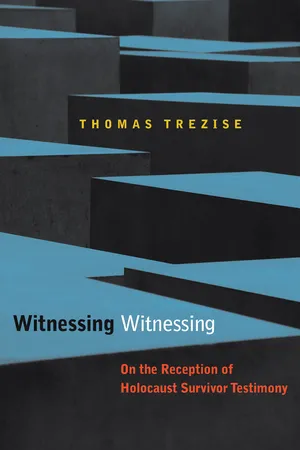
Witnessing Witnessing focuses critical attention on those who receive the testimony of Holocaust survivors. Questioning the notion that traumatic experience is intrinsically unspeakable and that the Holocaust thus lies in a quasi-sacred realm beyond history, the book asks whether much current theory does not have the effect of silencing the voices of real historical victims. It thereby challenges widely accepted theoretical views about the representation of trauma in general and the Holocaust in particular as set forth by Giorgio Agamben, Cathy Caruth, Berel Lang, and Dori Laub. It also reconsiders, in the work of Theodor Adorno and Emmanuel Levinas, reflections on ethics and aesthetics after Auschwitz as these pertain to the reception of testimony.
Referring at length to videotaped testimony and to texts by Charlotte Delbo, Primo Levi, and Jorge Semprun, the book aims to make these voices heard. In doing so, it clarifies the problems that anyone receiving testimony may encounter and emphasizes the degree to which listening to survivors depends on listening to ourselves and to one another.
Witnessing Witnessing seeks to show how, in the situation of address in which Holocaust survivors call upon us, we discover our own tacit assumptions about the nature of community and the very manner in which we practice it.
- 336 pages
- English
- ePUB (mobile friendly)
- Available on iOS & Android
eBook - ePub
About this book
Information
Publisher
Fordham University PressYear
2014Print ISBN
9780823244492
9780823244485
eBook ISBN
9780823264049
Topic
PhilosophySubtopic
Holocaust HistoryONE
Frames of Reception
One of the more noteworthy contributions to our understanding of the reception of Holocaust survivor testimony has been made by Dori Laub, a psychiatrist and cofounder of the Fortunoff Video Archive for Holocaust Testimonies at Yale University. In two influential essays, “Bearing Witness, or the Vicissitudes of Listening” and “An Event Without a Witness: Truth, Testimony and Survival,”1 Laub, who is also a survivor and has served as an interviewer for the Archive, draws attention to the relational nature of testimony by insisting that the listener, as witness to the witness, plays a crucial role in the elaboration of testimonial narrative. Specifically, he makes it clear that listeners enable witnesses to listen to themselves and hence to become survivors in more than the biological sense of the term by speaking of themselves as formerly silenced victims, to create for themselves a present and a future through the distancing act of narrating their past. At the same time, Laub points out that the ability of listeners to play this role depends to some extent on whether they, too, can listen to themselves. That is, even as they focus on what witnesses say (or do not say) and on how it is said (or not), listeners should be alert to the character as well as to the possible causes and effects of their own responses. They must bear witness at once to witnesses and to themselves. Finally, Laub’s work suggests that the reception of Holocaust survivor testimony requires not only attending to the voices of witnesses while remaining aware of one’s own but also attending, with equal self-awareness, to the voices of other listeners. Witnessing witnessing assumes a community of respondents no less than of testifying survivors.2
Of course, not everyone has the opportunity to listen in person to Holocaust survivors, much less to record interviews with them and thus to collaborate in both the production and the reception of testimony. But none of what I have just conveyed from Laub’s work loses any of its pertinence when transposed to the reception of testimony already recorded in one form or another: whether survivors’ voices continue to be heard will still depend on whether we enable their testimony to speak, and this in turn will still depend in some measure on how well we listen to ourselves and to other listeners. To be convinced of this, one need look no further than Laub’s own account, in “Bearing Witness,” of the videotaped testimony of an Auschwitz survivor and of the debate provoked by its viewing at an interdisciplinary conference on education and the Holocaust. This portion of his essay has become familiar to many for its anecdotal illustration of an interpretive conflict between history and psychoanalysis. Yet the very succinctness and simplicity that lend it the aura of a fable may also have discouraged any sustained consideration of Laub’s account as a case study in the impairment of listening, not only to other listeners but to oneself and to survivors.3 If I propose such a consideration here, it is certainly in part because, just as psychoanalysis has always learned more from pathology than from health, so perhaps shortcomings in the reception of Holocaust survivor testimony will prove more instructive than successes. But it is also because only close examination of Laub’s text and of the videotaped testimony to which it refers can afford an idea of the extent to which and the ways in which the reception of testimony is a question of framing. The analysis that follows will therefore focus primarily on frames of reception, in the expectation that studying a single but noteworthy instance of witnessing witnessing will warrant, in the last section of the chapter, certain general inferences in the name of a reception at once more attentive and more inclusive.

I turn, then, to “Bearing Witness,” where the author recounts how “a woman in her late sixties was narrating her Auschwitz experience to interviewers from the Video Archive for Holocaust Testimonies at Yale.” Laub notes that the woman was “slight, self-effacing, almost talking in whispers, mostly to herself. Her presence was indeed barely noteworthy in spite of the overwhelming magnitude of the catastrophe she was addressing. She tread lightly, leaving hardly a trace” (BW, 59). This only heightens, by contrast, the subsequent drama of Laub’s account:
She was relating her memories as an eyewitness of the Auschwitz uprising; a sudden intensity, passion and color were infused into the narrative. She was fully there. “All of a sudden,” she said, “we saw four chimneys going up in flames, exploding. The flames shot into the sky, people were running. It was unbelievable.” There was a silence in the room, a fixed silence against which the woman’s words reverberated loudly, as though carrying along an echo of the jubilant sounds exploding from behind barbed wires, a stampede of people breaking loose, screams, shots, battle cries, explosions. It was no longer the deadly timelessness of Auschwitz. A dazzling, brilliant moment from the past swept through the frozen stillness of the muted, grave-like landscape with dashing meteoric speed, exploding it into a shower of sights and sounds. Yet the meteor from the past kept moving on. The woman fell silent and the tumults of the moment faded. She became subdued again and her voice resumed the uneventful, almost monotonous and lamenting tone. The gates of Auschwitz closed and the veil of obliteration and of silence, at once oppressive and repressive, descended once again. The comet of intensity and of aliveness, the explosion of vitality and of resistance faded and receded into the distance. (BW, 59)4
As we shall see, it is the first of the three short sentences in quotation marks that allegedly triggered the debate on which this portion of Laub’s essay is focused. But the effort he devotes to staging and imaginatively expanding upon what little the woman is quoted as saying should not escape our attention. For although setting the scene of the interview as the context in which her witnessing took place provides information essential to understanding Laub’s text, his use of the past progressive tense (as in “a woman in her late sixties was narrating” or “she was relating”) creates a suspense that can only pertain to the narrative re-presentation of this witnessing, while his evocation of her voice before, during, and after her brief account of the Auschwitz uprising is clearly calculated to accentuate ex post facto the contrast he senses between a moment of vitality and the numbness that surrounds it, between a fleeting presence of passionate intensity and the deathly self-effacement by which it is framed. More remarkable yet, the woman is no sooner said to have fallen silent than Laub begins to speak, in a manner that could hardly be confused with the straightforwardness of her own statement, of “a fixed silence against which the woman’s words reverberated loudly, as though carrying along an echo of the jubilant sounds exploding from behind barbed wires, a stampede of people breaking loose, screams, shots, battle cries, explosions,” emphasizing that “a dazzling, brilliant moment from the past swept through the frozen stillness of the muted, grave-like landscape with dashing meteoric speed, exploding it into a shower of sights and sounds.” At first glance, of course, the transition from quoting to commenting may appear so smooth as to suggest that this passage merely prolongs the “reverberation” of the woman’s words. But if the phrase “as though” does not already send a sufficient signal, then the rather inflated and overly insistent prose it introduces should certainly alert us to the fact that the witness’s silence has here been superseded by Laub’s own highly imaginative and appropriative response to her testimony. To put it simply, what we witness in this case is the witnessing of Dori Laub and not of the woman in question. Taking note of Laub’s response is also important, finally, because Laub himself does not explicitly acknowledge it as his own. That is, the generalizing third-person grammar in which he formulates it leaves no room to ask how the other interviewer reacted,5 even as it imparts to the response itself the function of a prompt to Laub’s readers—as though anyone in his position would have responded in precisely the same way.
I will eventually return to Laub’s description of the Auschwitz uprising in order to evaluate it in historical terms. My point for now is that the perspective from which he will present the controversy concerning this woman’s testimony has already been heavily inflected by his own reception of it. And it is especially important that his readers remain aware of this inflection since, as will gradually become clear, the witness to whom he refers as a single individual is arguably a composite figure based on the videotaped testimonies of at least three different women, certain of whose features are exaggerated, transformed, or largely invented.6
With all of that in mind, let us consider his summary of the debate, which reads as follows:
Many months later, a conference of historians, psychoanalysts, and artists, gathered to reflect on the relation of education to the Holocaust, watched the videotaped testimony of the woman, in an attempt to better understand the era. A lively debate ensued. The testimony was not accurate, historians claimed. The number of chimneys was misrepresented. Historically, only one chimney was blown up, not all four. Since the memory of the testifying woman turned out to be, in this way, fallible, one could not accept—nor give credence to—her whole account of the events. It was utterly important to remain accurate, lest the revisionists in history discredit everything.
A psychoanalyst who had been one of the interviewers of this woman, profoundly disagreed. “The woman was testifying,” he insisted, “not to the number of the chimneys blown up, but to something else, more radical, more crucial: the reality of an unimaginable occurrence. One chimney blown up in Auschwitz was as incredible as four. The number mattered less than the fact of the occurrence. The event itself was almost inconceivable. The woman testified to an event that broke the all compelling frame of Auschwitz, where Jewish armed revolts just did not happen, and had no place. She testified to the breakage of a framework. That was historical truth.” (BW, 59–60)
From the perspective discussed just a moment ago, whose dramatic quality will inevitably affect the perception of even the most critical reader, the historians as Laub portrays them are bound to appear insensitive, if not obtuse, and their concerns quite trivial. Ignoring all that matters to the psychoanalyst (subsequently identified as Laub himself), they focus exclusively on the number of chimneys destroyed, as though one’s first response to an earthquake victim should be to ask what this quake measured on the Richter scale. Moreover, Laub compounds the poor impression they make by having them speak, like the positivistic or objectivistic historiography they are alleged to advocate, in a single voice, or rather, in no real voice at all.7 For unlike the psychoanalyst, whose speech is quoted, theirs is only reported, as would befit a group none of whose members is capable of thinking independently of the others. To make matters still worse, they claim, according to Laub, that the fallibility of the woman’s memory concerning the number of chimneys destroyed during the Auschwitz uprising justifies dismissing her testimony as a whole,8 and thus they appear to abuse the historical method in a way that is typical of the revisionists or Holocaust deniers themselves.9 In light of all this, one cannot help but suspect that these anonymous historians collectively constitute, for Laub, little more than a convenient straw man. And since nothing in his essay so much as suggests that they might not be representative of historians in general, it is just as difficult to avoid the suspicion that their portrayal is mainly informed by Laub’s own questionable assumptions about history as a discipline.10
It is worth remarking as well that, in his rebuttal, the psychoanalyst makes a mistake quite similar to that of his adversaries, despite the attempt to distinguish his argument from theirs by speaking in his own voice and as a solitary defender of the otherwise defenseless woman and by emphasizing another, supposedly more fundamental consideration in terms of which her testimony, regardless of its factual inaccuracy, becomes historically intelligible. Just as the historians find in its single flaw sufficient reason to reject her testimony as a whole, so the psychoanalyst finds in the preoccupation with factual accuracy sufficient reason to reject in its entirety their response to that testimony—and this in the name of an interpretive conclusion of which he states, in a fashion no less dogmatic than their own: “That was historical truth.” Thus, we need to recognize not only that Laub introduces this debate in a manner deeply colored by his own response to the woman’s testimony but that he conveys the competing claims prompted by her testimony through a rather exaggerated rhetoric of persuasion, a rhetoric that must be taken into account if these claims are to be reliably adjudicated.
At this point, though, I would like to enter into the real substance of the debate, beginning with what I take to be the three main components of Laub’s position. My presentation of this position is meant to emphasize its strengths, or at least its critical implications, more fully than I believe is done by the essay itself. The same will hold when I present the position of the historians.
In the first place, then, by insisting that the woman testified to “an event that broke the all compelling frame of Auschwitz,” that she testified to “the breakage of a framework,” Laub clearly highlights the failure or refusal of the historians to take note of this breakage. And by claiming that “one chimney blown up in Auschwitz was as incredible as four,” he no less clearly relates this failure or refusal to their own insistence on factual accuracy. Yet whether they do so knowingly or not, the historians also rely on a rhetoric of persuasion, and in particular on a stratagem that consists essentially in conflating a factual issue with an issue of interpretation. Thus, they begin by rejecting the woman’s testimony because of a factual error in her account of the Auschwitz uprising: she alleges that four chimneys were blown up, when in fact only one was destroyed. Moreover, it appears also to be a matter of “the facts” when one of them, having asserted that her account is “hopelessly misleading in its incompleteness” and even that “she had no idea what was going on,” notes that “the revolt [was] put down and all the inmates [were] executed,” that “they flung themselves into their death, alone and in desperation” (BW, 61)—as though the witness had not already observed that “of course these men knew that this would probably be the end for them” and that the SS “killed out every man.” It is apparently still a question of “the facts,” and of an account “hopelessly misleading in its incompleteness” due to the witness’s having “no idea what was going on,” when the same speaker points out that “the Jewish underground was … betrayed by the Polish resistance” (BW, 61)—as though the witness had not already demonstrated an awareness of this in her reference to possible but unforthcoming assistance from “the outside, the others.”11 The factual basis on which the historians reject the woman’s testimony thus proves to be rather precarious, both because she actually knows much of what they claim she does not and because, in the case of the chimneys, she makes a mistake not only unexceptional in the annals of eyewitness testimony but against which the discipline of history has at its disposal well-known and reasonably adequate methodological or procedural safeguards (such as the comparison of testimonies, the consideration of the personal history of witnesses, and the evaluation of testimony in the light of other forms of evidence).
We might feel justified, therefore, in suspecting that the objections raised by the historians do not primarily concern “the facts,” indeed that, again in the case of the chimneys, the wholesale rejection of the woman’s testimony seems almost comically dogmatic precisely because at this point a lone fact has been asked to bear the full weight of an unstated interpretive prejudice. Our suspicion is scarcely allayed, moreover, when from the midst of these objections emerges a statement whose predicate is of a clearly interpretive tenor, namely: “She ascribes importance to an attempt that, historically, made no difference” (BW, 61, my emphasis). Granted, to describe the rebellion in this way is, on the face of it, simply to express a view according to which it did not, in the end, seriously disable the machinery of extermination at Auschwitz and hence did not alter the course of genocide. In other words, we do not really know enough about the historians to determine whether this view reflects a particular position regarding, for instance, the Jewish response to persecution in general. What we can say for sure, however, by considering their assessment of this particular event, is that for the historians only a general point of view, that is, a position external and posterior to the Holocaust and encompassing the Holocaust in its “completeness,” can insure a correct judgment of what, “historically,” is “important,” and in so doing provide a foundation for the Right Story. As such, the very framework assumed by the historians, in which an act of resistance to genocide is judged “an attempt that, historically, made no difference,” can only beg the question: For whom, for whose history, did it make no difference? And if we now recall that what Laub here considers to be the real point of the woman’s testimony, what he refers to as “the breakage of a framework,” is precisely this resistance, this act whereby participants in the uprising violated the norms of Auschwitz, it almost seems as though the historians, having left unexamined their own most basic assumption, could not help but miss or dismiss the point. At the same time, the peremptory dismissiveness exhibited by these self-appointed arbiters of what counts in the grand sweep of history can help us to understand why, as a survivor, Laub so “profoundly disagreed” with them, why, indeed, he may have felt bound to marshal his own resistance by staking a claim to historical truth for those courageous inmates who knew only too well that the odds were against both the success of their rebellion and the possibility of their story ever being told or appreciated.12
But this leads directly to a second point, or rather to something like a consideration of the first point from a second perspective. For Laub’s disagreement with the historians does not revolve exclusively around the significance of the Auschwitz uprising. What he calls “the breakage of a framework” has to do, in his eyes, not only with the act of resistance to which the woman testifies but at least as much with the testifying itself as just such an act. As he puts it, the woman “is...
Table of contents
- Cover Page
- Title Page
- Copyright Page
- Dedication
- Contents
- Preface
- Acknowledgments
- Abbreviations
- Introduction
- 1. Frames of Reception
- 2. Trauma and Theory
- 3. Art after Auschwitz, Again
- 4. Theory and Testimony
- 5. The Survivor as Other
- Conclusion
- Notes
- Bibliography
- Index
Trusted by 375,005 students
Access to over 1.5 million titles for a fair monthly price.
Study more efficiently using our study tools.
Frequently asked questions
Yes, you can cancel anytime from the Subscription tab in your account settings on the Perlego website. Your subscription will stay active until the end of your current billing period. Learn how to cancel your subscription
No, books cannot be downloaded as external files, such as PDFs, for use outside of Perlego. However, you can download books within the Perlego app for offline reading on mobile or tablet. Learn how to download books offline
Perlego offers two plans: Essential and Complete
- Essential is ideal for learners and professionals who enjoy exploring a wide range of subjects. Access the Essential Library with 800,000+ trusted titles and best-sellers across business, personal growth, and the humanities. Includes unlimited reading time and Standard Read Aloud voice.
- Complete: Perfect for advanced learners and researchers needing full, unrestricted access. Unlock 1.5M+ books across hundreds of subjects, including academic and specialized titles. The Complete Plan also includes advanced features like Premium Read Aloud and Research Assistant.
We are an online textbook subscription service, where you can get access to an entire online library for less than the price of a single book per month. With over 1.5 million books across 990+ topics, we’ve got you covered! Learn about our mission
Look out for the read-aloud symbol on your next book to see if you can listen to it. The read-aloud tool reads text aloud for you, highlighting the text as it is being read. You can pause it, speed it up and slow it down. Learn more about Read Aloud
Yes! You can use the Perlego app on both iOS and Android devices to read anytime, anywhere — even offline. Perfect for commutes or when you’re on the go.
Please note we cannot support devices running on iOS 13 and Android 7 or earlier. Learn more about using the app
Please note we cannot support devices running on iOS 13 and Android 7 or earlier. Learn more about using the app
Yes, you can access Witnessing Witnessing by Thomas Trezise in PDF and/or ePUB format, as well as other popular books in Philosophy & Holocaust History. We have over 1.5 million books available in our catalogue for you to explore.