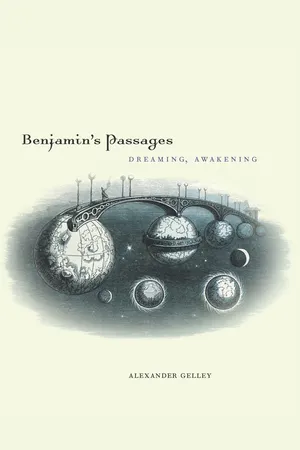
In transposing the Freudian dream work from the individual subject to the collective, Walter Benjamin projected a "macroscosmic journey" of the individual sleeper to "the dreaming collective, which, through the arcades, communes with its own insides." Benjamin's effort to transpose the dream phenomenon to the history of a collective remained fragmentary, though it underlies the principle of retrograde temporality, which, it is argued, is central to his idea of history.
The "passages" are not just the Paris arcades: They refer also to Benjamin's effort to negotiate the labyrinth of his work and thought. Gelley works through many of Benjamin's later works and examines important critical questions: the interplay of aesthetics and politics, the genre of The Arcades Project, citation, language, messianism, aura, and the motifs of memory, the crowd, and awakening.
For Benjamin, memory is not only antiquarian; it functions as a solicitation, a call to a collectivity to come. Gelley reads this call in the motif of awakening, which conveys a qualified but crucial performative intention of Benjamin's undertaking.
- 232 pages
- English
- ePUB (mobile friendly)
- Available on iOS & Android
eBook - ePub
About this book
Information
Publisher
Fordham University PressYear
2014Print ISBN
9780823262571
9780823262564
eBook ISBN
9780823262588
ONE
Contexts of the Aesthetic
How to talk about the aesthetic today? In many circles the term meets with either suspicion or lack of interest. Discussions of the aesthetic are viewed as a diversion from cultural-political considerations in favor of merely formalist or antiquarian preoccupations. Aesthetics has been displaced on all sides—by cultural and media studies, by sociology of the arts, by psychology and biography of artists, by audience response, by various “anti-aesthetics” (including the postmodern). And the sponsorship that conceptual thought had provided for aesthetics at least up to Hegel is now seen as one of its principal liabilities.
One difficulty, of course, is the diversity of meanings attached to the term. The modern origin of the problematic lies in the mid and later eighteenth century, the period from Baumgarten to Hegel, a moment when the “aesthetic” was integrated within a comprehensive philosophical system, and in fact, when it assumed a key function therein. In the wake of the English empiricists and of the French philosophes, the turn to aesthetics in German Romantic and Idealist thought may be seen as an effort to rehabilitate a sense of wonder, of divinity in nature in a time of skepticism and disbelief. The effort of philosophy in this period was directed to awakening the “moribund language of nature” (Hamann) and giving it a place of honor in the system of philosophy.1 It is in this sense that aesthetic thought in this period—and preeminently Kant’s Critique of Judgment—came to view art and nature in strict analogy.
The opening pages of Derrida’s “Parergon” very properly put us on guard regarding the presuppositions that any discourse on the aesthetic entails, presuppositions such as teleology, circularity, belatedness: “the philosophical encloses art in its circle,” Derrida writes, “but its discourse on art is at once, by the same token, caught in a circle.”2 Yet this is not to say that a circle of this kind can be altogether avoided. The circling of art and philosophy, their mutual resistance and interdependence, has always been integral to the aesthetic. If that point has been neglected in recent discussions, it may only be because it has been displaced by questions regarding the social or the political component in art. We will come back to this point later.
Hegel’s dictum regarding the death of art is so familiar that we tend at once to acknowledge and ignore it. Derrida, alluding to Heidegger’s “The Origin of the Work of Art,” reminds us that “it is from the possibility of its death that art can here be interrogated. It is possible that art is in its death throes, but ‘it will take a good few centuries’ until it dies . . .”3 What Derrida terms the “interrogation” of art “from the possibility of its death” designates the radical historicality that Hegel brought to considerations of art works. The Lectures on Aesthetics subject art to an altogether new kind of temporal determination. The truth of art can never coincide with a present manifestation but becomes available only in the mode of retrospection. This conception of the constitutive pastness of art bears directly on the relation of philosophy and art. If, as Hegel maintains, art was once deemed the preeminent avenue to truth, it is only by way of philosophy that we can now know this. But, correspondingly, philosophy’s function in disclosing this truth factor in art becomes, in a sense, an enabling condition for philosophy itself.4
Benjamin’s Intervention
The intervention of Benjamin’s writings in the transformation of theoretical discourses that began in the seventies is still very close to us. But it is often overlooked that his analyses were directed to vastly different conditions than those that we confront today. At the same time, his own sense of history postulated hidden conjunctions between the present and the past, conjunctions that themselves determine what counts, at a given moment, as historically relevant.5 There is no question but that his writings, especially those of his last period, anticipated and in part stimulated the massive reaction to aesthetics that we have witnessed in the past few decades. But this should not obscure the central role that elements of the aesthetic tradition played in his thought. It is in part to probe the extraordinary impact of Benjamin’s writings in recent years that I propose to examine this dimension of his work.
Although the Greek stem aisthesis refers primarily to modes of perception, the emphasis of modern aesthetic theory has been on the imbrication of a theory of the (fine) arts with a theory of perception and experience. It is noteworthy that during 1915–17, a period when he is deeply engaged with Kant’s thought6 and formulating a far-reaching theory language that will remain integral to his future work,7 Benjamin is also reflecting on color and space as fundamental cognitive modalities.8 In 1917, he wrote to a friend, Ernst Schoen, “I have been thinking for a long time about where free scope and opportunity for the development and greatness of basic ‘aesthetic’ concepts might finally be found, and where they might be released from their wretched isolation (which in aesthetics is the equivalent of what in painting is mere artistry)” (GB 1: 415). At this stage Benjamin conceives the aesthetic in the first instance as a fundamental theory of perceptual experience and cognition and only secondarily in relation to works of art.9 While Benjamin’s work came to be increasingly oriented to the social function of art, his early preoccupation with aisthesis persisted in the ways he situated the work of art in relation to the historicity of human perception and experience.10 I agree with Susan Buck-Morss’s contention that “Benjamin’s critical understanding of mass society disrupts the tradition of modernism . . . by exploding the constellation of art, politics, and aesthetics into which, by the twentieth century, this tradition has congealed,”11 but I see Benjamin’s contribution as more directly engaged with that tradition than she does.
In 1935, as Benjamin completed the Artwork Essay (“The Work of Art in the Age of Its Technological Reproducibility”), he wrote a friend from his Paris exile, “Herein [in the essay] I have found extraordinary formulations, deriving from altogether new insights and conceptions. And I may now claim that the materialist theory of art, about which one has heard so much talk though no one had ever laid eyes on it, now exists.”12 Clearly, what the younger Benjamin understood by “basic ‘aesthetic’ concepts” is at some remove from “the materialist theory of art.” It behooves us both to measure that gap and to trace some of the continuities.
Benjamin’s intervention may perhaps be understood in terms of Hans Blumenberg’s argument that a culture harbors certain “answer positions” for which appropriate questions are no longer available or not yet formulated.13 Benjamin’s manner of displacing a problematic in no sense eliminates it but rather fractures it in order to reconstitute its elements.14 Thus, with the notion of aura, Benjamin proceeds by displacing a conceptual register, so that aura functions not so much as a concept or idea but rather as a differential marker, a means of situating a phenomenon in light of its historical lapse.15 My point in raising this is not to pursue a discussion of this notoriously knotty notion but to suggest that the aesthetic is still very much at play in Benjamin’s thought, even in a terminology that appears to supplant it.
For his “theses” on the philosophy of history Benjamin took as one of the mottos the following passage from Nietzsche’s “On the Uses and Disadvantages of History for Life,” from Untimely Meditations:
We need history [Historie], but we need it in a different way than does the spoiled idler [verwöhnte Müßiggänger] in the garden of knowledge.16
One may read here a caution that Benjamin addressed to his own generation, a caution against being caught as mere pleasure seekers in a time of crisis. In the twenties and thirties, Benjamin had good cause to react against certain overwrought forms of aestheticism,17 and he did so in part by attempting to provide literature and other art forms with a grounding that could resist the kind of aestheticizing turn that was typical of Geistesgeschichte and other tendencies of nineteenth-century historicism. Today our situation is different. In the wake of the transformations in criticism and theory that have occurred during the past few decades, the problem is not so much that historical-political considerations are in danger of being displaced by the aesthetic. The aesthetic has been pretty much under attack from all sides. Rather, it is the very lability and indeterminacy of this notion that obscures the extent to which it has, from at least the mid-eighteenth century, been understood correlatively to pragmatic, which is to say political, concerns.
Three Strands of the Aesthetic
The socio-political function of Bildung, of aesthetic education as developed in Idealism and Romanticism, has been part and parcel of the humanist program for the past two centuries. Schiller used Kant’s analogy of beauty and morality as the basis for an explicit program of pedagogy and social conditioning. Hans-Georg Gadamer summarizes this development as follows: “When [Schiller] based the idea of an aesthetic education of man on the analogy of beauty and morality, formulated by Kant, he was able to pursue a line explicitly laid down by Kant: ‘Taste enables us, as it were, to make the transition from sensible charm to a habitual moral interest without making too violent a leap.’”18
The premise whereby the individual’s appreciation of beauty could underwrite a universal theory of culture may be found in the way that Kant, in the Critique of Judgment, shifts the agency of aesthetic judgment from a level of communal response based on sensus communis to a transhistorical subject. Such a subject assumes, in David Lloyd’s formulation, the “concept of man in general as producer of form, as producer, in particular, of forms of himself through an aesthetic labor which transcends specific economic or political determinants.”19 It is in this sense that Lloyd can claim, “Kant’s work is saturated with politics even, if not especially, where it is ostensibly not at all political.”20 The liability of this tendency is that it brought with it a diversion of energies away from social-political to aesthetic pursuits, where the sphere of art came to stand as a (utopian) deferral for what could not be realized in society. “It may be,” writes Lloyd, “that it was in Germany, where the conditions for a representative politics were not yet emergent, that aesthetics first came to represent a forestalled politics.”21 In summary, the aesthetic, from the beginning of its modern career, has been deeply implicated in what is now termed the political, though in Romantic and Idealist thought this was chiefly designated by way of a vocabulary of pedagogy (for example, Bildung, Erziehung).
I turn now to another, but not unrelated, feature of the aesthetic and this is the presumption of an interdependence between the spheres of art and philosophy, an interdependence that signifies both the necessity of conceiving art through philosophy and, conversely, the need of philosophy to draw on art in order to validate its own access to truth. In a general sense one may trace this linkage of truth and art to the neo-Platonic impulse to seek an embodied form, a visible manifestation, for transcendental truth. But we are heirs to versions of this tradition that derive from the Romantic era, specifically from Schelling and Hegel, versions such as Adorno’s claim of an “inherently idealistic moment [that] is indispensable to art—the objective mediation of all art through spirit [Geist].”22
Adorno here, in his Aesthetic Theory, is glossing the Hegelian notion of Geist, which, in Hegel’s terminology, is the channel for truth in its historical exfoliation; and though Adorno is in many ways strongly resistant to Hegel, he cannot help but acknowledge a principal tenet of Hegel’s aesthetics, one which he formulates as follows:
Not every existent is spirit. Art is. And art is a kind of existent that becomes spiritual as a result of its configurational nature [seine Konfigurationen].23
In his characteristically condensed manner Adorno gives expression here to a central claim—and enigma—of modern philosophical aesthetics: namely, that the privileged access of art to spirit or truth is dependent on an element that he terms “configurational.” But however this term might be understood—whether as a formal, figurative, or material dimension of works of art—it designates an inescapably partial, historically conditioned manifestation of spirit.
The problem that philosophical aesthetics leaves us with may be formulated in a double sense: What justifies the privil...
Table of contents
- Cover
- Title Page
- Copyright
- Dedication
- Contents
- List of Abbreviations
- Preface
- Acknowledgments
- Epigraphs
- Introduction
- 1. Contexts of the Aesthetic
- 2. Epigones in the House of Language: Benjamin and Kraus
- 3. Benjamin on Atget: Empty Streets and the Fading of Aura
- 4. Entering the Passagen
- 5. Citation as Incitation: The Political Agenda of the Passagenarbeit
- 6. Messianism, “Weak” and Otherwise
- 7. Forgetting, Dreaming, Awakening
- Works Cited
- Index
Trusted by 375,005 students
Access to over 1.5 million titles for a fair monthly price.
Study more efficiently using our study tools.
Frequently asked questions
Yes, you can cancel anytime from the Subscription tab in your account settings on the Perlego website. Your subscription will stay active until the end of your current billing period. Learn how to cancel your subscription
No, books cannot be downloaded as external files, such as PDFs, for use outside of Perlego. However, you can download books within the Perlego app for offline reading on mobile or tablet. Learn how to download books offline
Perlego offers two plans: Essential and Complete
- Essential is ideal for learners and professionals who enjoy exploring a wide range of subjects. Access the Essential Library with 800,000+ trusted titles and best-sellers across business, personal growth, and the humanities. Includes unlimited reading time and Standard Read Aloud voice.
- Complete: Perfect for advanced learners and researchers needing full, unrestricted access. Unlock 1.5M+ books across hundreds of subjects, including academic and specialized titles. The Complete Plan also includes advanced features like Premium Read Aloud and Research Assistant.
We are an online textbook subscription service, where you can get access to an entire online library for less than the price of a single book per month. With over 1.5 million books across 990+ topics, we’ve got you covered! Learn about our mission
Look out for the read-aloud symbol on your next book to see if you can listen to it. The read-aloud tool reads text aloud for you, highlighting the text as it is being read. You can pause it, speed it up and slow it down. Learn more about Read Aloud
Yes! You can use the Perlego app on both iOS and Android devices to read anytime, anywhere — even offline. Perfect for commutes or when you’re on the go.
Please note we cannot support devices running on iOS 13 and Android 7 or earlier. Learn more about using the app
Please note we cannot support devices running on iOS 13 and Android 7 or earlier. Learn more about using the app
Yes, you can access Benjamin's Passages by Alexander Gelley in PDF and/or ePUB format, as well as other popular books in Literature & German Literary Criticism. We have over 1.5 million books available in our catalogue for you to explore.