The debate on "political theology" that ran throughout the twentieth century has reached its end, but the ultimate meaning of the notion continues to evade us. Despite all the attempts to resolve the issue, we still speak its language—we remain in its horizon.
The reason for this, says Roberto Esposito, lies in the fact that political theology is neither a concept nor an event; rather, it is the pivot around which the machine of Western civilization has revolved for more than 2,000 years. At its heart stands the juncture between universalism and exclusion, unity and separation: the tendency of the Two to make itself into One by subordinating one part to the domination of the other. All the philosophical and political categories that we use, starting with the Roman and Christian notion of "the person," continue to reproduce this exclusionary dispositif.
To take our departure from political theology, then—the task of contemporary philosophy—we must radically revise our conceptual lexicon. Only when thought has been returned to its rightful "place"—connected to the human species as a whole rather than to individuals—will we be able to escape from the machine that has
imprisoned our lives for far too long.
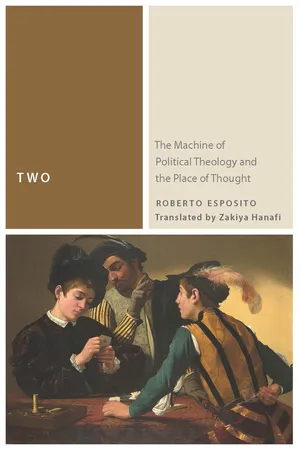
eBook - ePub
Two
The Machine of Political Theology and the Place of Thought
- 248 pages
- English
- ePUB (mobile friendly)
- Available on iOS & Android
eBook - ePub
About this book
Information
Publisher
Fordham University PressYear
2015Print ISBN
9780823267620
9780823267613
eBook ISBN
9780823267637
Topic
FilosofiaSubtopic
Storia mondiale1
MACHINATION
Why begin a book on political theology with Martin Heidegger? Why bring into the discussion one of the few thinkers of the twentieth century who never explicitly used the concept and who intentionally stayed on its sidelines? The basic reason for my choice lies precisely in this eccentricity. To arrive at the core of such an elusive category, we need to place ourselves outside it.1 This is exactly where the difficulty of our investigation lies—not in having to delve into a lexicon that we have already long possessed, but rather, in having to get outside it, by removing ourselves from its enveloping hold. Indeed, the entire linguistic tissue that innervates our conceptual categories is deeply imbued with a political-theological undertone—expressed in a secularized form, of course, but this makes it even harder to decipher. Even the secularization paradigm itself is shot through with it, which only demonstrates the persistence of political-theological language during the age of its supposed disappearance. Thus, contrary to what one may think, the secularization paradigm does not allow a critical perspective on political theology to be opened up. On the contrary, on more than one occasion the secularization paradigm has prevented its most hidden-away meaning from being understood. The fact that almost all twentieth-century thinkers used the secularization paradigm as their entrance key into the political-theological compound has something to do with the blind spot where they all ultimately arrived. The tool that they used was the least suitable one to shed light on the connection between theology and politics—because the tool is inevitably part of the connection. Continuing to advance the secularization paradigm did nothing to make its predominant effect recognizable—which is to say, the intrinsically contradictory effect of obscuring what it promises to illuminate.
This is exactly what Heidegger maintained, in no uncertain terms: “In most decisive respects,” he observes in his essay on European nihilism, “such talk of ‘secularization’ is a thoughtless deception.”2 He thus dismissed, with surprising curtness, a concept considered by twentieth-century thought to be central not only to the interpretation of political theology but to all modern history as well.3 But even more noteworthy is the fact that he did not dissociate himself from the secularization paradigm because of its homologating effect on the specificity of the Modern. On the contrary, Heidegger stresses the relation that tethers the modern age to Christianity. The two conceptual worlds refer to each another in a connection that cannot be pulled apart, because it is inherent to both: “This history of modern mankind … was mediately prepared by Christian man, who was oriented toward the certitude of salvation. Thus one can interpret certain phenomena of the modern age as ‘secularization’ of Christianity.”4 It is true that while Christian man seeks salvation of the soul, modern man aims at ensuring his earthly destiny. And yet, although they oppose each other, both are driven by a need for “assurance” that makes their attitudes complementary. Certainly, the modern individual replaces the need for otherworldly salvation with worldly salvation, but “the nature of such a transformation implies that the transformation often pursues its course within the very ‘language’ and representations of what is left behind by the transformation.”5
However, up until this time, the reason for Heidegger’s drastic rejection of the secularization paradigm still remains unclear. Although the Christian and the modern worlds are different, and even opposed in their conceptual syntax, the two remain within one and the same horizon, defined by their opposing relationship. Only at a certain point, immediately after announcing his rejection, does Heidegger bring his strongest argument into play. Talk of secularization is inadequate because “a world toward which and in which one is made worldly already belongs to ‘secularization’ and ‘becoming worldly.’ ”6 What draws Heidegger’s critical attention about the concepts of secularization (Säkularisierung) and mundanization (Verweltlichung) is the fact that both presuppose the ideas of saeculum and “world” but without having developed them. In the absence of any preliminary examination of these terms, the use of categories that derive from them not only remains illegitimate, but it also makes them vulnerable to a reversal that deforms their meaning. What condemns the secularization theory to ineffectualness is not so much its hermeneutic outcome as its dependence on something for which it is unable to account. To say that Christianity engenders the modern world, or that the modern world arose out of Christianity, does not help unless one first grasps the metaphysical context that characterizes them both. What does secularization entail? What does the concept of secularization imply, without revealing it? Or, better yet, what does secularization keep concealed, even though what it hides objectively arises out of it?
To answer these questions we must pass from Heidegger’s Nietzsche to his Contributions to Philosophy (Beiträge zur Philosophie), specifically to section 2, on “The Resonating,” in which he seemingly changes his view with respect to his previous observations. The concept now being deconstructed is “disenchantment” (Entzauberung) which, at least in Max Weber’s categorial apparatus, has a role similar to the one played by the concept of mundanization or “becoming-worldly”: “We are used to calling the era of ‘civilization’ the one that has dispelled all bewitchery, and this dispelling seems more probably—indeed uniquely—connected to complete unquestionableness. Yet it is just the reverse. We merely need to know where the bewitchery comes from.”7 To grasp the significance of mundanization we must examine the idea of the world; in the same way, to understand disenchantment in depth, which is to say, in its beginnings, we need to go back to the logically presupposed concept of enchantment. But more than a first cause, enchantment is in its turn the product of something even earlier, from which the entire chain of meanings is generated, as if from a preoriginary structure. Heidegger gives this the enigmatic name of “machination” (Machenschaft), which already appeared in the conclusion to the essay on nihilism. It would appear that his intention in referring to this term was to radically shift the internal relations of the paradigm of secularization. In any case, what is rejected is the idea of a linear, consecutive process that leads from enchantment to disenchantment—or that slips seamlessly from the theological into the political sphere. To understand their relationship, the concept of secularization is inadequate and even misleading because it tends to fall along the same shifting line of lexicons and regimes that should instead be viewed as antinomically intertwined. Like the relationship between Christianity and modernity, the connection between theology and politics is formed in a metaphysical space that determines the meaning of both.
But the reference to “machination” contains something more—even beyond the author’s own intentions, perhaps—that allows us to take a step forward in our investigation into the workings of the political-theological dispositif. To begin with, it must be noted that the first role of machination is to hide what it produces. Instead of referring to “disenchantment,” machination actually has more to with an opposite effect of “enchantment” (Bezauberung) or “bewitchery.” Enchantment, Heidegger maintains, comes from “the unbridled dominance of machination. When machination attains ultimate dominance, when it pervades everything, then there are no more circumstances whereby the bewitchery can be sensed explicitly and resisted.”8 This is the crucial passage in his argument. The fact that machination “bewitches” means not only that it produces enchantment, but at the same time it conceals the original link that unites enchantment to disenchantment, tying them together in a metaphysical bond. Like every demythologization in relation to myth, the supposed disenchantment does not free us from the enchantment of machination; on the contrary, it remains part of it, like a surface reaction that reinforces what it is intended to oppose. But, then, if the interweaving of enchantment and disenchantment is the effect of machination, how are we to interpret it? What is hidden away in its false bottom? And, above all, how is it connected to the dispositif of political theology?
Let us begin by saying that although Heidegger refers to machination as a “distorted essence,”9 its definition is stripped of any judgmental tone. Rather, the concept is traced back to a pure procedure—which, as we said, is precisely one of strengthening a phenomenon through its apparent opposite. What specifically characterizes machination more than any other quality is the reinforcing effect of an entity through the production of its opposite. The three “laws” that qualify it appear to be associated with this function. To begin with, in the transition from the Middle Ages to the modern age, the more machination develops, the more it conceals itself—in the first period behind the categories of ordo and analogia entis, and in the second behind scientific objectivity. Furthermore, “the more decisively machination conceals itself in this way, all the more does it press toward the predominance of that which seems completely opposed to its essence and yet is of its essence, i.e. toward lived experience.”10 Finally, as soon as lived experience presents itself as the criterion for the measure of truth, machination becomes unrecognizable. The two poles around which Heidegger’s position appears to be fixed are those of artifice and lived experience, assumed in the concealing effect that each produces on the reality of the other. This, in turn, is the outcome as well as the cause of a false comparability, to which the philosopher gives the name “fettering”: “What does machination mean? That which is released to its own fettering. What are the fetters? The schema of thorough and calculable explainability, whereby everything draws equally close together to everything else and becomes completely foreign to itself.”11 Not only does machination conceal itself by wrapping itself up in the false appearance of its opposite, it introduces an element of foreignness into its object that separates it from itself while making it similar to its opposite.
From this perspective, without mixing up heterogeneous terminologies, in this procedure of concealing and separating we can observe how machination has something in common with what Michel Foucault later intended by the concept of “dispositif”—also etymologically linked, moreover, to Ge-Stell, which in Heidegger’s work is flanked with the term Machenschaft. If we keep in mind the three laws we have just recalled, the similarity with Foucauldian dispositifs is even more marked. Like Heidegger’s machination, Foucault’s dispositifs never completely declare their function, concealing their real effect behind apparently opposing aims. They, too, affect our lived experience in a way that separates it from itself, fettering it to its opposite. Moreover, Heidegger himself had connected machination to the formation of “apparatuses” which, like Foucault’s dispositifs, influence our behavior in a way whose meaning eludes us. He refers to them with regard to a science that must be followed up “all the way to the apparatuses and institutions … which necessarily belong to its machinational essence.”12 In short, the common characteristic of Heideggerian machination and Foucauldian dispositifs is the production of something designed to subjugate existence by separating it from itself. This is the precise root of the technological dominance that places subjects in the web of an order that they cannot escape, precisely because it is the web that makes them what they are. As Heidegger notes elsewhere, if we analyze the dispositifs of radio and film, the technician who installs the equipment as much as the spectator or listener “remains confined even if he still thinks he is entirely free to turn the device on and off.”13
Without forcing the logic of a text that is resistant to any undue semantic slippage, let us try to string together the different steps of our analysis. Nothing Heidegger says directly concerns the concept of political theology. However, he situates himself in relation to it precisely to the extent that he dismisses the paradigm of secularization, categorized as the inverse of political theology. The secularization paradigm is misleading because it presupposes what it should explain, obscuring the metaphysical ground that unites the Christian conception and modern thought in the same horizon. This ground is traced back by Heidegger to the concept of machination, the main result of which is to conceal what it reveals in the figure of its opposite—so as to separate it from itself in a sort of mirror-image splitting that tends to make one the warped reflection of the other.
The antinomic relation of unity and separation is central to Hegel’s philosophy of history, which fully inscribes them in the paradigm of secularization. In this sense, one can well say that Hegel is the first, and greatest, political-theological thinker of modernity. With him, the category of political theology extends its scope beyond the regional or methodological to the global and ontological. As the locus of the incarnation of Spirit, the entire course of history has a political-theological substance, even if it is only with the advent of Christianity that it becomes aware of this. The difference between these two levels of consciousness provides the paradigmatic key to Hegel’s method. What precedes Christianity is at the same time inside and outside its horizon—it is the negative through which Christianity makes itself history, by including even that which it would otherwise exclude. Of course, Hegel does not express himself in these terms, but this is the outcome that objectively results from his text. One might say that Hegel simultaneously reveals and conceals this logic. He reveals it in its origin and in its internal passages. He conceals it in its final result, when he absorbs separation within unity, with no remainders. This double effect—of revelation and concealment—arises from the use of the secularization paradigm (Säkularisierung), although Hegel prefers the term “mundanization” (Verweltlichung). Like all the secularization theorists who followed after him, the effect of the political-theological dispositif is mixed up with the objective process that expresses it, in an extraordinary inversion between consequence and presupposition. That which is presupposed—the unification of difference—appears to be the intended consequence of the process. The difficulty, but also the strength, of Hegel’s work lies in the continuous oscillation between absolute transparency and maximum opacity. It is as if the story that he tells—which up to a certain point discerns the political-theological mechanism in all its antinomies—became an integral part of the mechanism, thereby hiding the very dynamic that is being revealed. In short, as in Heidegger’s machination, the evidence of the object is removed from view by the same perspective that makes it visible.
At the heart of this extraordinary metaphysical device lies the connection between universalism and exclusion: not in the weak sense that something always stays outside the framework, but in the more powerful sense that every universal is the product and, at the same time, the inclusive capture of an excluded part. The category of the West as set out by Hegel refers to a partiality that is virtually coextensive with the whole. Its dominant part tends to overlap over the whole, expelling or marginalizing the other. Without the opposing relation with its contrary, the concept of the West would be meaningless. But this opposition is simply the first step in a process destined to phagocytize what it otherwise expels. To understand the functioning of this singular dialectical process, we must not lose sight of the simultaneity of the two steps—division and unification: each one is both the instrument and the consequence of the other. Separating itself from what it is not, the West tends to include the separated part within itself, like a past whose importance is denied but which is necessary for its development. This perspective clarifies the meaning of the political-theological dispositif as it is put into action by Hegel. The Christian West is the horizon that is capable of incorporating inside itself—in a subordinate form—the portion of the world from which it has separated itself. This is the phenomenon that he describes, extending it to the entire course of history, in terms of appropriating the foreign: Persia is appropriated by Greece, Greece by Rome, and the Latin civilization by Germanicism. By appropriating what is initially other, the latter remains at the same time included and excluded: included because it is incorporated into the new body; but excluded because it is deprived of its content, which is no longer usable as such. From the beginning, argues Hegel, a people with a precondition “has a double factor within itself: on the one hand, it proceeds from itself, on the other hand, from something alien, a foreign stimulus; and its maturation consists in bringing this doubling into unity, into unification. For a people has to digest the foreign element and expel what remains alien.”14
What characterizes the political-theological scenario outlined by Hegel is the disjunctive connection of the One and the Two. The history of the world originates from a nonhistory, which characterizes a large part of the “Oriental World,” simultaneously internal and external...
Table of contents
- Cover
- Half Title
- Series Announcement Page
- Title Page
- Copyright
- Contents
- Half Title
- Introduction
- 1. Machination
- 2. The Dispositif of the Person
- 3. The Place of Thought
- Notes
- Index
- Series Page
Trusted by 375,005 students
Access to over 1.5 million titles for a fair monthly price.
Study more efficiently using our study tools.
Frequently asked questions
Yes, you can cancel anytime from the Subscription tab in your account settings on the Perlego website. Your subscription will stay active until the end of your current billing period. Learn how to cancel your subscription
No, books cannot be downloaded as external files, such as PDFs, for use outside of Perlego. However, you can download books within the Perlego app for offline reading on mobile or tablet. Learn how to download books offline
Perlego offers two plans: Essential and Complete
- Essential is ideal for learners and professionals who enjoy exploring a wide range of subjects. Access the Essential Library with 800,000+ trusted titles and best-sellers across business, personal growth, and the humanities. Includes unlimited reading time and Standard Read Aloud voice.
- Complete: Perfect for advanced learners and researchers needing full, unrestricted access. Unlock 1.5M+ books across hundreds of subjects, including academic and specialized titles. The Complete Plan also includes advanced features like Premium Read Aloud and Research Assistant.
We are an online textbook subscription service, where you can get access to an entire online library for less than the price of a single book per month. With over 1.5 million books across 990+ topics, we’ve got you covered! Learn about our mission
Look out for the read-aloud symbol on your next book to see if you can listen to it. The read-aloud tool reads text aloud for you, highlighting the text as it is being read. You can pause it, speed it up and slow it down. Learn more about Read Aloud
Yes! You can use the Perlego app on both iOS and Android devices to read anytime, anywhere — even offline. Perfect for commutes or when you’re on the go.
Please note we cannot support devices running on iOS 13 and Android 7 or earlier. Learn more about using the app
Please note we cannot support devices running on iOS 13 and Android 7 or earlier. Learn more about using the app
Yes, you can access Two by Roberto Esposito, Zakiya Hanafi in PDF and/or ePUB format, as well as other popular books in Filosofia & Storia mondiale. We have over 1.5 million books available in our catalogue for you to explore.