We hope—even as we doubt—that the environmental crisis can be controlled. Public awareness of our species' self-destructiveness as material beings in a material world is growing—but so is the destructiveness. The practical interventions needed for saving and restoring the earth will require a collective shift of such magnitude as to take on a spiritual and religious intensity.
This transformation has in part already begun. Traditions of ecological theology and ecologically aware religious practice have been preparing the way for decades. Yet these traditions still remain marginal to society, academy, and church.
With a fresh, transdisciplinary approach, Ecospirit probes the possibility of a green shift radical enough to permeate the ancient roots of our sensibility and the social sources of our practice. From new language for imagining the earth as a living ground to current constructions of nature in theology, science, and philosophy; from environmentalism's questioning of postmodern thought to a garden of green doctrines, rituals, and liturgies for contemporary religion, these original essays explore and expand our sense of how to proceed in the face of an ecological crisis that demands new thinking and acting. In the midst of planetary crisis, they activate
imagination, humor, ritual, and hope.
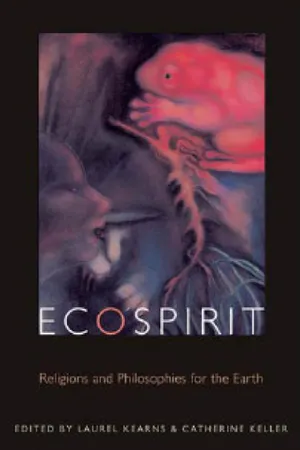
eBook - ePub
Ecospirit
Religions and Philosophies for the Earth
- 544 pages
- English
- ePUB (mobile friendly)
- Available on iOS & Android
eBook - ePub
Ecospirit
Religions and Philosophies for the Earth
About this book
Information
Publisher
Fordham University PressYear
2009Print ISBN
9780823227464
9780823227457
eBook ISBN
9780823227471
NOTES
PREFACE | LAUREL KEARNS AND CATHERINE KELLER
1. The term “tipping point” was originally coined in the early 1960s by Morton Grodzins to name “white flight,” the dramatic point when white families would move out en masse of a gradually integrating neighborhood. (Morton Grodzins, The Metropolitan Area As a Racial Problem [Pittsburg: University of Pittsburg Press, 1958]). It has been lately popularized and merged with the “butterfly effect” of chaos theory.
2. Ross Gelbspan, The Boiling Point (New York: Basic, 2004).
3. This echoes the title of Jay McDaniel’s book With Roots and Wings: Christianity in an Age of Ecology and Dialogue (Maryknoll, N.Y.: Orbis, 1995).
4. http://www.wakeuplaughing.com
5. As impressively collected, for example, in the Harvard World Religion and Ecology volumes, coordinated by Mary Evelyn Tucker and John Grim of the Forum on Religion and Ecology. More information is available at http://www.religionandecology.org, which features a full listing of the titles published in the Harvard Series.
6. Further information about David Wood’s art project is available at http://www.vanderbilt.edu/chronopod/. See also Heather Elkins and David Wood, “The Firm Ground for Hope: A Ritual for Planting Humans and Trees,” in the present volume.
INTRODUCTION | CATHERINE KELLER AND LAUREL KEARNS
1. There is good news on many campuses as the concept of sustainable or green campuses and education has spread. Many colleges and universities have built LEED-certified green buildings, worked to reduce their CO2 emissions, and electricity consumption, switched to producing or purchasing some of their power from alternative sources, and examined their production of waste and sources of food.
2. It is worth noting that as academic leaders in the field, such as Rosemary Radford Ruether, Sallie McFague, John B. Cobb Jr., Larry Rasmussen, Mary Evelyn Tucker, and John Grim have retired or left to continue their work elsewhere, they have not been replaced by scholars whose focus is as ecological. Many of the organizations established in the 1990s or before to work on faith-based environmental activism are struggling to support their staff and find enough funding.
3. There is a wide array of religious organizations working on environmental issues. See the Web sites of the National Religious Partnership for the Environment (www.nrpe.org) and its constituent members. See also the Forum on Religion and Ecology (www.religionandecology.org), the Web of Creation (www.webofcreation.org) and the Interfaith Climate Change Network (www.protectingcreation.org) for links to many other organizations. See also Laurel Kearns, “Cooking the Truth: Faith, Science, the Market, and Global Warming,” in the present volume, for a more detailed discussion of religious environmental organizations.
4. The Earth Charter: Values and Principles for a Sustainable Future. For copies of the brochure or information on the initiative, consult Earth Charter Web site, www.earthcharter.org.
5. Bruno Latour, Politics of Nature: How to Bring the Sciences into Democracy, trans. Catherine Porter (Cambridge, Mass.: Harvard University Press, 2004).
6. See David Wood, “Specters of Derrida: On the Way to Econstruction,” in the present volume; see also his discussion of Derrida on Marx, “The Eleventh Plague: Environmental Destruction,” in The Step Back: Ethics and Politics after Deconstruction (Albany: State University of New York Press, 2005).
7. Michael Shellenberger and Ted Nordhaus, “The Death of Environmentalism? Global Warming Politics in a Post-environmental World,” Social Policy 35, no. 3 (2005): 19–31.
8. John B. Cobb Jr. and Herman Daly, For the Common Good: Redirecting the Economy toward Community, the Environment and a Sustainable Future (Boston: Beacon, 1994).
9. This, for example, is the charge levied against William Cronon and colleagues in UnCommon Ground: Rethinking the Human Place in Nature (New York: Norton, 1996), a work itself stemming from a conference on the dilemma of naïve realism in popular ecological discourse vis-à-vis the antirealism of strong constructivism. In addition to Cronon’s volume, the authors in the volume Reinventing Nature: Responses to Postmodern Deconstruction, published contemporaneously, explore the resonances of constructivism and nature (Michael E. Soule and Gary Lease, eds . Reinventing Nature: Responses to Postmodern Deconstruction [Washington, D.C.: Island Press, 1995]).
10. Bruno Latour, Pandora’s Hope: Essays on the Reality of Science Studies (Cambridge, Mass.: Harvard University Press, 1999), 21; the book is dedicated not coincidentally to Donna Haraway and her cyborgs, among others.
11. “There is nothing outside of the text [there is no outside-text; il n’ya pas de hors-texte].” The translator is at pains to prevent the inevitable misreading. Jacques Derrida, Of Grammatology, trans. Gyatri Chakravorty Spivak (Balti-more: Johns Hopkins University Press, 1976[1974]), 158.
12. Derrida has been at pains to counter the misunderstanding of his “pas de hors texte”: “I never cease to be surprised by critics who see my work as a declaration that there is nothing beyond language” (as quoted in John D. Caputo, The Prayers and Tears of Jacques Derrida: Religion Without Religion [Indianapolis: Indiana University Press, 1997], 16–17).
13. Derrida, Of Grammatology, 9.
14. Indeed, it has queer affinities with the science studies approach of Donna Haraway. The latter’s constructivism, rooted in biology, may remain coy with regard to the ecological crisis, but stands with environmentalism against the corporate control of life and the presumptions of the science establishment it funds. Donna Haraway, ModestWitnessFeminism @Second _Millennium.FemaleMan©_Meets_OncoMouse™ : Feminism and TechnoScience (New York and London: Routledge, 1997).
15. It, of course, depends on how material life is conceived, as much liberation theology and others concerned about the poor focus on certain material conditions à la Marx, as purely anthropocentric.
16. Latour, Politics of Nature.
17. Leonardo Boff, Cry of the Earth, Cry of the Poor (Maryknoll, N.Y.: Orbis, 1997); Ivone Gebara, Longing for Running Water: Ecofeminism and Liberation. trans. David Molineaux (Minneapolis, Minn.: Augsburg Fortress, 1999); Karen Baker-Fletcher, Sisters of Dust, Sisters of Spirit: Womanist Wordings on God and Creation (Minneapolis, Minn.: Augsburg Fortress, 1998).
18. Larry Rasmussen, Earth Ethics, Earth Community (Maryknoll, N.Y.: Orbis, 1998); James Cone, “Whose Earth Is It Anyway?” in The Emergence of a Black Theology of Liberation, 1968–1998 (Boston: Beacon, 2000), 136–45; Sallie McFague, Super, Natural Christians: How We Should Love Nature (Minneapolis, Minn.: Augsberg Fortress, 1997).
19. John B. Cobb Jr and Herman E. Daly, For the Common Good: Redirecting the Economy Toward Community, the Environment, and a Sustainable Future (Boston: Beacon, 1994); John B. Cobb Jr., The Earthist Challenge to Economism: A Theological Critique of the World Bank (New York: Palgrave Macmillan, 1998); John B. Cobb Jr., Sustaining the Common Good: A Christian Perspective on the Global Economy (Cleveland: Pilgrim, 1995).
20. In this collection, Keller, McDaniel, Spencer, Baker-Fletcher, Lee, McDaniel, Higgins, Gorman, and Muraca are among those who in their own work develop the process theological heritage.
21. Latour, Politics of N...
Table of contents
- Cover Page
- Title Page
- Copyright Page
- CONTENTS
- Preface
- Introduction: Grounding Theory—Earth in Religion and Philosophy
- ECOGROUNDS: LANGUAGE, MATRIX, PRACTICE
- ECONATURES: SCIENCE, FAITH, PHILOSOPHY
- ECONSTRUCTIONS: THEORY AND THEOLOGY
- ECODOCTRINES: SPIRIT, CREATION, ATONEMENT, ESCHATON
- ECOSPACES: DESECRATION, SACRALITY, PLACE
- ECOHOPES: ENACTMENTS, POETICS, LITURGICS
- Notes
- Contributors
Trusted by 375,005 students
Access to over 1.5 million titles for a fair monthly price.
Study more efficiently using our study tools.
Frequently asked questions
Yes, you can cancel anytime from the Subscription tab in your account settings on the Perlego website. Your subscription will stay active until the end of your current billing period. Learn how to cancel your subscription
No, books cannot be downloaded as external files, such as PDFs, for use outside of Perlego. However, you can download books within the Perlego app for offline reading on mobile or tablet. Learn how to download books offline
We are an online textbook subscription service, where you can get access to an entire online library for less than the price of a single book per month. With over 1.5 million books across 990+ topics, we’ve got you covered! Learn about our mission
Look out for the read-aloud symbol on your next book to see if you can listen to it. The read-aloud tool reads text aloud for you, highlighting the text as it is being read. You can pause it, speed it up and slow it down. Learn more about Read Aloud
Yes! You can use the Perlego app on both iOS and Android devices to read anytime, anywhere — even offline. Perfect for commutes or when you’re on the go.
Please note we cannot support devices running on iOS 13 and Android 7 or earlier. Learn more about using the app
Please note we cannot support devices running on iOS 13 and Android 7 or earlier. Learn more about using the app
Yes, you can access Ecospirit by Laurel Kearns, Catherine Keller, Laurel Kearns,Catherine Keller in PDF and/or ePUB format, as well as other popular books in Biological Sciences & Environmental Science. We have over 1.5 million books available in our catalogue for you to explore.