In Ghost-Watching American Modernity, María del Pilar Blanco revisits nineteenth- and twentieth-century texts from Spanish America and the United States to ask how different landscapes are represented as haunted sites. Moving from foundational fictions to Westerns, Blanco explores the diverse ways in which ghosts and haunting emerge across the American hemisphere for authors who are preoccupied with evoking the experience of geographical transformations during a period of unprecedented development.
The book offers an innovative approach that seeks to understand ghosts in their local specificity, rather than as products of generic conventions or as allegories of hidden desires. Its chapters pursue formally attentive readings of texts by Domingo Sarmiento, Henry James, José Martí, W. E. B. Du Bois, Juan Rulfo, Felisberto Hernández, and Clint Eastwood. In an intervention that will reconfigure the critical uses of spectrality for scholars in U.S./Latin American Studies, narrative theory, and comparative literature, Blanco advances ghost-watching as a method for rediscovering haunting on its own terms.
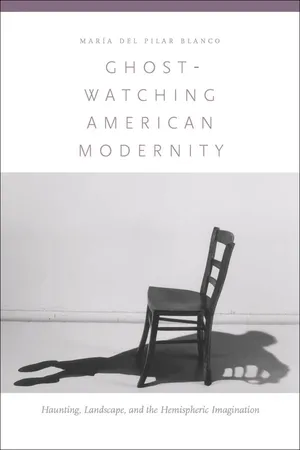
eBook - ePub
Ghost-Watching American Modernity
Haunting, Landscape, and the Hemispheric Imagination
- 234 pages
- English
- ePUB (mobile friendly)
- Available on iOS & Android
eBook - ePub
Ghost-Watching American Modernity
Haunting, Landscape, and the Hemispheric Imagination
About this book
Information
1
Unsolving Hemispheric Mystery
In this chapter, I explore the impasse between the haunting of art and the art of haunting, its critical history and implications. I am particularly interested in seeing how genre—the delineation of artistic production into historical, ideological, and formal classifications—has come to haunt haunting. Given my interest in accounting for the links between haunting, landscape, and a hemispheric American aesthetic and critical imagination, a substantial part of this chapter focuses on how ghosts have been explained according to the logic of certain genres or subgenres. These genres and subgenres have in turn been employed to describe certain national and geographic conditions. More specifically, as we will see throughout this chapter, they have even been described as the preferred aesthetic conditions of particular regions within the Americas. This first act of ghost-watching thus involves an observation of the critical-literary spaces that harbor haunting presences, so that we can begin asking whether and how these critical landscapes have done justice to their appearance in literature and film.
Haunting is, without a doubt, enmeshed in the telling and retelling of mystery; the moment the verb is uttered as well as the moment a ghost comes on the scene, things have become strange and more than likely uncomfortable. Invariably, the stories of haunting signal a limit to our comprehension, or they supplant our understanding of reality with what Philip Weinstein calls “the loom” of another, and unforeseen, history.1 Immediately we try to make sense of ghosts, to impose reason on the unreasonable, in order to restore a sense of “life” as we know it. We call these apparitions “supernatural,” “fantastic,” “marvelous,” and we attempt to order them, so as to furnish that space that has been breached between the “realistic” and the artful. Before engaging in readings of specific instances where narrative presents us with a haunting, we must look at the complicated intersections of the telling and explaining of mystery (and haunting), as well as the ways in which these have been categorized. This will lead to an exploration of how these intersections have often become entangled in an impasse between history and creativity that necessarily will take us to an analysis of how we can begin to ask a different set of questions to address this sphere of the unbelievable and mysterious.
In her essay “Some Aspects of the Grotesque in Southern Fiction” (1960), Flannery O’Connor makes a distinction between the writer of reality (the one who writes about how natural, social, and economic forces shape lives) and the writer of mystery, whom she qualifies as the “writer who believes that our life is and will remain essentially mysterious”; the writer of mystery “looks upon us as beings existing in a created order to whose laws we freely respond,” so that “what he sees on the surface will be of interest to him only as he can go through it into an experience of mystery itself” (816). She adds, about this writer of mystery: “His kind of fiction will always be pushing its own limits outward toward the limits of mystery, because for this kind of writer, the meaning of a story does not begin except at a depth where the adequate motivation and the adequate psychology and the various determinations have been exhausted.” This writer writes about what “we don’t understand” (816).
O’Connor explains that these two kinds of writers coexist (the “naturalist” and the writer of mystery), but there is a different affect for the writer who can no longer base himself on an idea of scientific truth or a psychological explanation that can rid the mind of an impenetrable question. As she argues, explanations of what is realistic, or close to what is easily perceptible, and what is mysterious, have been reaching points of exhaustion for a while. One only needs to look to writers such as Edgar Allan Poe and Nathaniel Hawthorne, who announce the limitations of reality in their stories and sketches early on in the nineteenth century. The word “adequate,” which O’Connor uses in this passage to refer to the psychology that has been becoming more and more ineffectual for the mystery writer, is particularly interesting to me. I want to spin it into a different, yet parallel, direction. What is an “adequate” character or an “adequate” situation to write about in a story? Once you have reached the limits of what is “adequate,” what situations and characters would you write about? On a large scale, what I am trying to address in this book is the question of the adequacy of ghosts in literary works that cut across received period boundaries between roughly 1850 and 1970. If a ghost is inserted in a story, novel, or essay, what is the author trying to achieve? Is s/he trying to produce a sense of fear, or an atmosphere where human existence is out of control, and there is no way to define what is alive and what is not? O’Connor, in her description of a “Christ-haunted” U.S. South, writes that ghosts “cast strange shadows” on literature: “It is interesting that as belief in the divinity of Christ decreases, there seems to be a preoccupation with Christ-figures in our fiction. What is pushed to the back of the mind makes its way forward somehow. Ghosts can be very fierce and instructive.”2 Later in the chapter, I discuss the negotiation of this Catholic faith and the belief in ghosts in literature, but my preliminary focus centers on O’Connor’s idea of the “strangeness” of ghosts. O’Connor does not write fantastic or supernatural stories; her fiction uses the “concrete” by “the way of distortion” (“Grotesque,” 816). She is, however, writing about a regional literature confronting history, a literature that often creates a distance between a writer and her/his audience, because the former will infuse life with something “wild” or freakish, although the latter has become a “tired” reader who “demands the redemptive act, that demands that what falls at least be offered the chance to be restored” (820). What O’Connor proposes is a literature that has no promise of restoration, because the history and space of the U.S. South, at the moment when she is writing, does not allow for this. The ghost-figure of Christ and the South in general are thus aligned in O’Connor’s thesis of mystery, casting a shadow of strangeness and the unexplainable. If these figures are strange, then it means they are unsettling, and in being so they unsettle or shake the norms of what is possible in the act of writing.
How can we describe what happens in such a literature? The writer of mystery might begin describing something that appears to be an everyday experience, and then, when s/he finds that the description has reached an insurmountable limit, the decision is made that something else needs to happen. In this context, the writer might begin with a straight description of the setting or landscape and the characters, all looking much like those found in a “realistic” novel, but then there is a shift to the unexplainable.3 The characters might be put in an unprecedented situation, and they will react to it in perhaps even more unexplainable ways. In the case of Flannery O’Connor’s fiction, Hazel Motes (the suffering hero of Wise Blood, her 1952 novel) will wrap his torso in barbed wire to be “clean” of sin, to which his landlady will reply that, “it’s not normal. It’s like one of them gory stories, it’s something that people have quit doing.…There’s no reason for it.” But, as Hazel replies, that problem and that torture nevertheless exist and have become visible. He replies, “They ain’t quit doing it as long as I’m doing it” (224).
If we continue to think alongside O’Connor, writing about mystery is not just about writing whatever ugliness might be lurking underneath the surface of life; it is also about our apprehension of things that just happen, appear, and are, and that we must react to even if we lack guidance. The landlady’s reaction to Hazel is representative of literary ghost sightings. She fights the idea of Hazel’s mysterious and inscrutable sacrifice with a call to normalcy, but this does not prevent the tortured man from still existing in the room in her boardinghouse. As readers reading ghosts, we are all landladies, amazed that this incredible task has fallen on us, of figuring out just what to do with a wild situation that has spun out of control within the worlds that we thought we had made “normal.”
As someone writing about the use of ghosts and questioning their usefulness in narrative, I have wrestled with the overflow of terminology that surrounds this scholarship of the unbelievable. Many of these terms—among which allegory, the uncanny, and the repressed are key nomenclatures—run into and at times uncomfortably struggle within considerations of genre, especially since many critics have made ghosts the exclusive property of a magical realist school in a Latin American and Caribbean context and the gothic school in the U.S. literary canon. (In film and literature, ghosts are also staples in the horror genre, which owes a lot to the gothic genre in its form, but which we must also consider in the context of a now multinational culture and industry of the “scary”). It would appear that ghosts haunt genre theory and genre haunts ghosts. For this reason, I would like to explore some of the problems surrounding these appropriations of the ghostly theme in order to propose a limit to classifications—or perhaps a disappropriation—of what seems to me to be a much more complex figure that should resist set lodging in any particular company. This will also lead me to a consideration of what it is that makes ghosts the subject of an anxiety of placement, especially in cultures where they are so pervasive, and where the word “haunting” has achieved the currency of a quotidian term used unquestioningly to point to the elusive or the immaterial, though without adequate scrutiny as to what that semantic pointing might formally or ethically entail. As we continue to domesticate the ghost (and haunting) in our everyday experiences, are we also trying to domesticate it by baptizing it into genre? Are we perhaps operating under the same anxieties as the landlady in Wise Blood in our own experience of literature, casting off certain strange occurrences that have no place anywhere else into the realms of “them gory stories”?
Disrupting, then, our assumption about literary poetics just as it disturbs the epistemologies of human perception, haunting poses questions as to what is accomplished by associating it with specific classifications or genres. In very crude terms, we must ask what classification into a specific genre accomplishes. How does a critical work that pronounces that a certain novel can become a bedfellow for a group of other novels move a discipline forward? Certainly genre studies help us understand and discover connections (be they transthematic, transnational, or transhistoric), origins, and genealogies, but what if these lines become forced into and susceptible to historically unanchored prescriptions? Despite a pervasive need to facilitate readers’ conversations that reflect on the unsolitariness of texts as a way to expand an understanding of literature that transcends borders, what happens when this is done for the sake of an ungrounded and at times irresponsible universalization of the themes put forth by a single and specific work or author? I am not proposing that genre studies have become ridden with a rigor mortis beyond avail; what I do want to put into question are the ways in which critics engage in scholarship where genre becomes a conclusion and classification their only mission. In order to approach these questions from a range of perspectives, I look closely at the scholarship surrounding the study of magical realism in the field of Latin American literary studies in order to gauge the compatibility of different analytic motivations and preoccupations that inform our discernment of genre.
Faith in the Strange
Since its induction into the Latin American canon of defining terms with Alejo Carpentier’s famous prologue to his 1949 novel El reino de este mundo (Kingdom of This World),4 the marvelous real [“lo real maravilloso”] has avowed a (Latin) American exceptionality. When Carpentier explains why the marvelous belongs so prominently to “our” America, he justifies it in terms of an intersection of mythology with race, history, ontology, and to the (we suppose both topographic and literary) “virginity” of the landscape: “Y es que, por la virginidad del paisaje, por la formación, por la ontología, por la presencia fáustica del indio y del negro, por la revelación que constituyó su reciente descubrimiento, por los fecundos mestizajes que propició, América está muy lejos de haber agotado su caudal de mitologías” [“Because of the virginity of the land, our upbringing, our ontology, the Faustian presence of the Indian and the black man, the revelation constituted by its recent discovery, its fecund racial mixing, America is far from using up its wealth of mythologies”].5 Carpentier’s signature use of the baroque sentence manages to include nearly all aspects of the American condition in what is ultimately an invitation to write new stories about the continent. Throughout the essay, the author points out the absence of an “exhaustion” of mythologies, as well as the American condition of not having yet “finished establishing…a retelling of cosmogonies” (133–34). Roberto González Echevarría reads this as symptomatic of a renewed mundonovista movement, which “with greater or lesser militancy and with the combined effort of figures with varying ideologies set out to define Latin America on its own terms and which actively endeavored to recover its past.”6
Carpentier’s vision is in many ways similar to Flannery O’Connor’s interpretation of an exhaustion of psychology that can impel a fiction of mystery. Carpentier sees a continent that can provide enough mysteries to propel a new (yet unwritten) literature that homes in on the untrammeled mythologies of the Latin American and Caribbean context. Both O’Connor and Carpentier signal a representational limit where the psychological is not viable and where another, multivalent dimension is in turn beckoned. In fact, Carpentier’s proposal in this essay is at many turns a rebuttal of the surrealist proposal of a literature that aims at representing the bewildering machinations of the human psyche. Carpentier accuses surrealist literature of being “a literary scheme” [“una artimaña literaria”] riddled with boring “well-known formulas” [“fórmulas consabidas”]. Wendy Faris and Lois Parkinson Zamora, in their introduction to Carpentier’s essay in their volume on magical realism,7 see these criticisms of the surrealist aesthetic as a denunciation of the conscription of the marvelous to the format of a manifesto. Quite paradoxically, however, Carpentier’s essay itself very much resembles a manifesto with its politics of exclusivity that claim a total state of “the marvelous” throughout America. “¿Pero qué es la historia de América toda sino una crónica de lo real maravilloso?” [“What is the history of America if not a chronicle of the marvelous real?”] is his final persuasively rhetorical question.8 The difference between this and Breton’s statement lies in that, although the author of the Surrealist Manifesto proposed an introspective, self-reflexive cartography of the psyche, Carpentier’s is an invitation to a representational discovery and colonization of a past history and a “virginal” landscape—an analysis that is extroverted and looking outside of the limits of the individual.
Another element that both Flannery O’Connor and Alejo Carpentier share in their respective explorations of the literature of bewilderment and strangeness is the functional importance of faith.9 Though referring to entirely different applications of metaphysical systems, both writers see faith as a starting point for perception—a perception that will allow for represented situations to be seen in an altogether different light. In “The Fiction Writer and His Country,” O’Connor writes of the privileged status of the Christian writer whose “belief in Christian dogma” secures a “respect for mystery.”10 Furthermore, in one of her letters from 1955, O’Connor writes that “a higher paradox confounds emotion as well as reason and there are long periods in the lives of all of us, and of the saints, when the truth as revealed by faith is hideous, emotionally disturbing, downright repulsive.”11 Thus, for O’Connor, reading and writing with a perspective of faith can have a disfiguring—though not disengaged from realistic—effect on a reality that is otherwise perceived disinterestedly (we recall her consideration, in her essay on the grotesque, of the “adequate psychology” that has been exhausted). Carpentier’s “marvelous real” is there for anyone who can see it, but this “sensation” [sensación] can be accomplished only through a prefigured faith, which at one point he describes as being potentially “terrible” (132). The marvelous requires a “heightened spirit” [“una exaltación del espíritu”] that is capable of driving perception to a limit [“un estado límite”]. González Echevarría refers to this pronouncement as a Spenglerian “moment of faith” that precedes the “moment of reflexivity” evidenced in the European arts in the early twentieth century. (By the same token, I should add, it reflects Carpentier’s indebtedness to the writings of Guillermo de Torre, who was one of the founders of ultraísmo in Spain. De Torre’s groundbreaking Literaturas europeas de vanguardia (1925) proposed a revitalized definition of cosmopolitanism in the face of failed internationalism after the First World War.)12 The idea of a sophisticated sense of faith to reassess the Americas raises a number questions: Who participates in this faith that Carpentier describes? In what ways could this privileged perception be transmitted and to whom? Is it a perspective that is best translated in a writing of reality or in fiction?
Stephanie Merrim, in her essay exploring the location and “intonation” of a wonder at the beginning of literary utterance that inevitably leads us into a difficult questioning of the histories of the American Souths, compares Carpentier’s and O’Connor’s uses of faith as ways to “predicate southern literature on the miracle that stands at the etymological root of the marvel (admirare).”13 Merrim identifies a difference in gradation to this presupposed faculty: She qualifies O’Connor’s vision as less “apocalyptic” than Carpentier’s imperative belief in “the miracle.” Merrim does not quite explain what she means in her use of the word “apocalyptic” and is perhaps distinguishing between these two authors in terms of levels of resignation to the world: Whereas in O’Connor faith is a privileged perspective of the individual that arrives gradually with experience of the world, Carpentier imposes on his reader an urgency to see...
Table of contents
- Title Page
- Copyright Page
- Contents
- Acknowledgments
- Introduction
- 1 / Unsolving Hemispheric Mystery
- 2 / Desert Mournings
- 3 / Urban Indiscretions
- 4 / Transnational Shadows
- Epilogue
- Notes
- Bibliography
Trusted by 375,005 students
Access to over 1.5 million titles for a fair monthly price.
Study more efficiently using our study tools.
Frequently asked questions
Yes, you can cancel anytime from the Subscription tab in your account settings on the Perlego website. Your subscription will stay active until the end of your current billing period. Learn how to cancel your subscription
No, books cannot be downloaded as external files, such as PDFs, for use outside of Perlego. However, you can download books within the Perlego app for offline reading on mobile or tablet. Learn how to download books offline
Perlego offers two plans: Essential and Complete
- Essential is ideal for learners and professionals who enjoy exploring a wide range of subjects. Access the Essential Library with 800,000+ trusted titles and best-sellers across business, personal growth, and the humanities. Includes unlimited reading time and Standard Read Aloud voice.
- Complete: Perfect for advanced learners and researchers needing full, unrestricted access. Unlock 1.5M+ books across hundreds of subjects, including academic and specialized titles. The Complete Plan also includes advanced features like Premium Read Aloud and Research Assistant.
We are an online textbook subscription service, where you can get access to an entire online library for less than the price of a single book per month. With over 1.5 million books across 990+ topics, we’ve got you covered! Learn about our mission
Look out for the read-aloud symbol on your next book to see if you can listen to it. The read-aloud tool reads text aloud for you, highlighting the text as it is being read. You can pause it, speed it up and slow it down. Learn more about Read Aloud
Yes! You can use the Perlego app on both iOS and Android devices to read anytime, anywhere — even offline. Perfect for commutes or when you’re on the go.
Please note we cannot support devices running on iOS 13 and Android 7 or earlier. Learn more about using the app
Please note we cannot support devices running on iOS 13 and Android 7 or earlier. Learn more about using the app
Yes, you can access Ghost-Watching American Modernity by María del Pilar Blanco in PDF and/or ePUB format, as well as other popular books in Literature & North American Literary Criticism. We have over 1.5 million books available in our catalogue for you to explore.