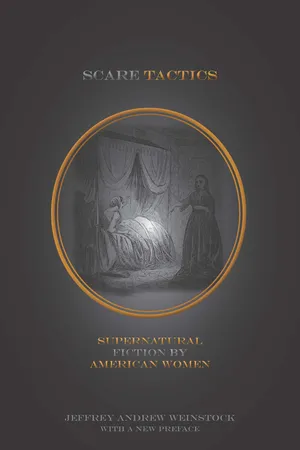
Scare Tactics identifies an important but overlooked tradition of supernatural writing by American women. Jeffrey Weinstock analyzes this tradition as an essentially feminist attempt to imagine alternatives to a world of limited possibilities. In the process, he recovers the lives and works of authors who were important during their lifetimes and in the development of the American literary tradition, but who are not recognized today for their contributions.
Between the end of the Civil War and roughly 1930, hundreds of uncanny tales were published by women in the periodical press and in books. These include stories by familiar figures such as Edith Wharton, Harriet Beecher Stowe, and Charlotte Perkins Gilman, as well as by authors almost wholly unknown to twenty-first-century readers, such as Josephine Dodge Bacon, Alice Brown, Emma Frances Dawson, and Harriet Prescott Spofford. Focusing on this tradition of female writing offers a corrective to the prevailing belief within American literary scholarship that the uncanny tale, exemplified by the literary productions of Irving, Poe, and Hawthorne, was displaced after the Civil War by literary realism.
Beyond the simple existence of an unacknowledged tradition of uncanny literature by women, Scare Tactics makes a strong case that this body of literature should be read as a specifically feminist literary tradition. Especially intriguing, Weinstock demonstrates, is that women authors repeatedly used Gothic conventions to express discontentment with circumscribed roles for women creating types of political intervention connected to the broader sphere of women's rights activism.
Paying attention to these overlooked authors helps us better understand not only the literary marketplace of their time, but also more familiar American Gothicists from Edgar Allan Poe to Shirley Jackson to Stephen King.
eBook - ePub
Scare Tactics
Supernatural Fiction by American Women, With a new Preface
- 240 pages
- English
- ePUB (mobile friendly)
- Available on iOS & Android
eBook - ePub
About this book
Information
Publisher
Fordham University PressYear
2009Print ISBN
9780823271887
9780823229857
eBook ISBN
9780823229871
1. The Ghost in the Parlor: Harriet Prescott Spofford, Harriet Beecher Stowe, Anna M. Hoyt, and Edith Wharton
Murder, incest, bigamy, suicide, child abuse, rape, and revenge from beyond the grave—the American version of the Female Gothic trades in the sensational, uncanny, and grotesque and foregrounds the forms of violence to which women were subject in patriarchal culture as fully as its British counterpart. One wouldn’t know it, however, based on the minimal attention it has received from contemporary scholars. Indeed, the body of literature on the Female Gothic, with its overwhelming emphasis on Radcliffe, Shelley, and the Brontës, might lead one to believe that only British women participated in this tradition—at least until late into the twentieth century.1 One of the primary purposes of this study therefore is to foreground the fact that the United States has its own tradition of the Female Gothic that needs to be acknowledged—a tradition in which American women, like their British counterparts, employed conventions of the Gothic to communicate their discontentment with the restricted opportunities available to them and distress over their disempowerment at the hands of men.
This chapter is explicitly about violence. It deals with stories about women, children, and even animals that are confined, murdered, and abused by fathers, husbands, and presumed protectors—and about restless spirits that mutely testify to these transgressions. In Harriet Prescott Spofford’s first novel, Sir Rohan’s Ghost (1860), as well as in short supernatural fiction by Harriet Beecher Stowe, Anna M. Hoyt, and Edith Wharton, Gothic conventions are used as a form of cultural critique. In each of the ghostly tales to be discussed, specific supernatural manifestations symbolize more generally the ways in which women and disempowered others in nineteenth-and early-twentieth-century American culture were subject to varying forms of control and abuse. The ghost in the parlor, so to speak, functions in these works as a thinly veiled metaphor for the living woman “ghosted” by a culture that refuses to recognize women as active agents in control of their own destinies and which socially and legally sanctions misogyny.
In this chapter, as elsewhere in this study, I divide my attention between well-established authors (in this case, Stowe and Wharton) and lesser-known or virtually unknown figures (Spofford and Hoyt). I do so for three reasons: first, to establish that these concerns about the roles of women in American culture were shared by a range of female authors; second, to reread familiar authors in light of the broader context of supernatural fiction by American women; and third, to direct attention to authors and works that I feel have been unjustly neglected. The stories addressed here arc from Spofford’s pre–Civil War, British Gothic–inspired tale of a haunted English nobleman who abuses women and pays the price to Wharton’s proto-Modernist World War I–era story-within-a-story about a French nobleman who terrorizes his wife and pays the price. The “through line” that links these stories is anxiety over the control men exercise over women. In each tale, women are subjected to varying forms of violence and have no recourse—at least to the living—to redress the situation. Only the dead possess the uncanny potency to confront and remedy these crimes. And, as the chapter progresses, the scope of the critique broadens. Whereas Spofford and Stowe focus specifically on the plight of women, Hoyt includes children, and Wharton, most damningly of all, extends the analysis to animals—which has the ultimate effect of conflating women and animals as less than men and therefore subject to confinement and abuse.
Nowhere to Turn: Harriet Prescott Spofford’s Sir Rohan’s Ghost
I begin my analysis here with Harriet Prescott Spofford’s first novel, Sir Rohan’s Ghost (1860), because it so clearly demonstrates the ways in which American female authors were influenced by and revised the British Female Gothic tradition. This fascinating work, through a fusion of both sensationalist and classical themes, exemplifies the preoccupation of Female Gothicists with the ways in which men exert control over women. This work—the only novel to be included within this study and one of the earliest works to be considered overall—also can be viewed, however, as a transition of sorts from the novel form to the short story and from an emphasis on the terror of the unknown, associated with Gothic works by male writers, to the terror of the known, in which what frightens women the most is not the supernatural, but the dangers of everyday life attendant on being a woman in a male-dominated culture.2
Thanks in large measure to the publication in 1989 of a collection of Harriet Prescott Spofford’s short fiction entitled The Amber Gods and Other Stories, Spofford’s star, after having been in eclipse for some eighty years, is starting to shine brightly again.3 In a publishing career that lasted from the mid-1850s until 1921 (almost the entire span covered by this study), Spofford produced hundreds of stories, poems, essays, children’s books, travel books, and novels. In the 1860s, following the inclusion of several of her stories in the Atlantic Monthly,4 the publication of her first novel, Sir Rohan’s Ghost (1860), and the publication of a collection of short fiction entitled The Amber Gods and Other Stories (1863), Spofford was one of the most popular women writers in America and was perceived to be one of the most promising authors of Romantic fiction in the United States.5 Although Spofford never quite realized her potential and tarnished her own critical reputation by rapidly publishing works of uneven quality, her best work, in Alfred Bendixen’s estimation, “represents not only the final flowering of the romantic impulse in nineteenth-century New England, but also the most significant female counterpart to the essentially male tradition of American romantic fiction” (“Amber Gods” xi).6 For the purposes of this study, it is also important to note that, increasingly during the second half of the nineteenth century and the first decades of the twentieth, Spofford, who was originally championed by literary entrepreneur and eventual editor of the Atlantic Thomas Wentworth Higginson, was part of and exercised influence over a community of Boston-based female writers, including Elizabeth Stuart Phelps Ward, Rose Terry Cooke (who included a glowing appraisal of Spofford in Our Famous Women [1884]), and Alice Brown—all of whom produced their own supernatural tales and will be discussed in Chapter 5.7
Spofford’s first novel, Sir Rohan’s Ghost, was published in 1860 and was both widely read and praised.8 The story itself is an intriguing mix of sensationalist themes clearly indebted both to the British Female Gothic tradition of Ann Radcliffe, Sophia Lee, and Charlotte Dacre, as well as to the Male Gothic tradition of Matthew “Monk” Lewis, Horace Walpole, and Charles Maturin. The story also can be seen as borrowing from classical sources, including Greek and Shakespearian tragedy—notably the story of Oedipus (Sir Rohan unknowingly pursues an incestuous relationship with his daughter) and Macbeth (Sir Rohan’s ghost, to a certain extent, is the projection of his guilty mind). The tale, which is set in England, concerns a reclusive nobleman, Sir Rohan, who for the past twenty years has been haunted by a female ghost: “A ghost that, sleeping or waking, never left him, a ghost whose long hair coiled round and stifled the fair creations of his dreams, and whose white garments swept leprously into his sunshine” (11). Sir Rohan’s gloom is lifted and his ghost quieted when he is visited by his old friend, St. Denys, and the latter’s young, beautiful ward, Miriam. Predictably, Sir Rohan falls in love with Miriam, who reciprocates his affection, and Sir Rohan appears to be on the verge of matrimonial bliss and a new life free from the torments of his apparition when the presumed villain of the story, Marc Arundel, reveals that Miriam is in fact Sir Rohan’s own natural child—the product of his affair with an alleged gypsy woman whom he refused to marry and whom he may even have tried to murder! In the final pages of the narrative, the reader learns that this cast-off gypsy woman is in fact buried on Sir Rohan’s estate, that it has been her ghost that has been haunting him, and that Sir Rohan’s desire for Miriam is in fact incestuous. As the ghost reemerges in a blaze of triumph upon the revelation of this information, the stunned Sir Rohan drops dead and the story ends.
What is initially most interesting about Sir Rohan’s Ghost is the fact that it begins with a male protagonist who is already haunted. In the very first paragraph of the novel, Sir Rohan is introduced simultaneously with his ghost. After being told that “there is a ghost in all aristocratic families” (11), the reader is told flatly, “Sir Rohan had a Ghost” (11). The rest of the brief first chapter then goes on to describe this ghost and the ways in which Sir Rohan attempted in the past, but failed, to evade this apparition. Neither throwing himself into battle nor submerging himself in social “dissipation” were effective measures to ward off the specter. As a result, Sir Rohan, in the face of this persistent, inescapable haunting, has cut himself off from all social interactions and secreted himself within his country estate. Only in painting does he find some measure of respite from the fury of his supernatural tormentor.9
Curiously, the precise nature of the apparition itself is left in question. Only in the first chapter is some consideration of its ontological status entertained. The omniscient narrator asks, “Was Sir Rohan hypochondriac? Was his Ghost but the indigestion of numerous rich dinners? Was it some unwhisperable remorse that clothed him, still living, in a pall? Or was it any restless honor that glamoured ceaselessly across his straining sight?” (15). The earliest readers of Sir Rohan’s Ghost gravitated toward the “unwhisperable remorse” option. James Russell Lowell, in his February 1860 review of the novel in the Atlantic Monthly, pronounces Sir Rohan to be possessed by his “diseased memory” (253), and the April 1860 review in the North American Review concurs, asserting the ghost to be the product of the “workings of [the novel’s] prime hero’s horror-stricken conscience” (576). This assessment of the nature of Sir Rohan’s ghost is complicated, however, by the facts that the ghost begins to materialize for Miriam while she dozes in Sir Rohan’s conservatory (134–35), that the servants in Sir Rohan’s household claim to have seen fairy lights dancing over the spot that is revealed to be the grave of the woman wronged by Sir Rohan (303–4), and that the initial antagonist, Marc Arundel, reports that, as he investigated the mysteries surrounding Sir Rohan’s past, he “felt as if some one were directing [him]; the right thing turned up at the right time, so that not a moment was lost, and [he] almost could swear that [he had] been assisted by some extraordinary and inexplicable agency” (339).
Ultimately, the story isn’t concerned with the precise nature of Sir Rohan’s apparition, which indeed seems to be a combination of “diseased memory” and external supernatural agency.10 Following the initial consideration of the nature of Sir Rohan’s ghost in the first chapter of the novel, the presence of the ghost is simply accepted within the narrative by both the narrator and Sir Rohan as a given, as a sort of foregone conclusion. The result of this is that the emphasis within the narrative falls not on the nature of the ghost, but on its effect on Sir Rohan. While the reader does wonder why Sir Rohan is being haunted, the narrative attempts to manipulate the reader into sympathizing with friendless, tormented Sir Rohan as he develops his relationship with the young ingénue, Miriam.
This sense of the haunting as a fait accompli and the forced identification with the character who turns out to be the villain is perhaps what is most original about Spofford’s appropriation and revision of the standard Gothic novel. The narrative has all the hallmarks of the conventional Gothic: an underlying story of a woman held captive and victimized, a ghost, a spooky portrait, hallucinatory visions, a missing mother, descents into dark places (including a wine cellar and a mine), ascensions to towers, ancient ruins, a curse, even a literal skeleton in a closet! Yet, by withholding certain crucial information about Sir Rohan’s past, Spofford interestingly reconceives the conventional plot by putting the reader into the position of identifying and sympathizing with the villain. The story presents what might be considered as the haunted afterlife of the reformed rake. The reader knows that Sir Rohan was involved in some tragedy but perceives him to be basically kind-hearted and generous—and, it is important to note, incapable of any act of real violence or sadism. He is so dejected and seemingly so virtuous that, in the absence of specific information about his past, the reader is led to regret his haunting and hope for a happy ending in which he marries Miriam and escapes his sorrowful past.
This positive appraisal of Sir Rohan’s character is assisted by the juxtaposition of Sir Rohan with the ostensible villain of the story, Marc Arundel. At the start of the story, St. Denys and his adopted daughter, Miriam, arrive at Sir Rohan’s estate attempting to escape from the undesired solicitations of the smarmy Arundel. Not only does the reader quickly come to understand that Arundel is only interested in Miriam for the inheritance she will acquire upon the death of St. Denys, but the unscrupulous Arundel actually appears to make an unsuccessful attempt on St. Denys’s life; cajoles Sir Rohan’s aged and faithful servant, Redruth, into getting drunk so as to pry information about Sir Rohan’s life out of him; and seems to be working together with gypsies to extort money from Sir Rohan. When the unscrupulous Arundel starts digging into Sir Rohan’s past, the reader, repelled by Arundel’s deviousness, hopes either that his investigations will be unsuccessful or will confirm the impression developed over the vast majority of the novel that Sir Rohan is innocent of any significant crime. The text clearly contrasts the heroic Sir Rohan with the villainous Arundel.
The reader, however, is mislead by Spofford. In the final 15 pages of this 350-page novel, Arundel reveals that, years ago, Sir Rohan entered into a romantic relationship with an elegant young woman, alleged to have been descended from gypsies, whom he carried off, unwed, to his “residence in the North” (341). There he kept her isolated from the world until his passion for her faded and the young woman herself began to fail. While walking alongside a river, the woman revealed to Sir Rohan that she was pregnant by him and, Arundel recounts, “Harsh words followed,—a blow, perhaps,—I will not say,—for whether fallen, or dashed aside, in a moment more she was sweeping down the tide, with a small penknife, that [Sir Rohan] always carried, fixed in her bosom” (348). The woman was fished out of the river and survived only long enough to give birth to the child ultimately adopted by St. Denys and named Miriam.
Spofford’s devious novel turns out to contain a conventional Female Gothic plot masked by an unusual point of view, the withholding of information, and a temporal shift in which the tragic act occurred prior to the start of the novel itself. Taken together, these elements tend to make the reader complicit with Sir Rohan in hoping for the consummation of what turns out to be an incestuous relationship. Indeed, all the reader’s expectations are overturned in the final pages of the narrative: Sir Rohan’s crimes are revealed to be greater than ever expected; Miriam is exposed as his illegitimate daughter; and Sir Rohan’s haunting seems to be wholly warranted. As a result of these revelations, his status as hero must be reevaluated entirely and the ramifications of this reassessment of Sir Rohan are significant: what is ultimately revealed by the story is that there is no hero. Sir Rohan, with whom the reader has been asked to sympathize and who is presented as the hero, turns out to be the conventional Gothic villain—one who seduced, imprisoned, and ultimately killed (or at least participated in the demise of) the initial object of his lust. Marc Arundel, while he does expose Sir Rohan’s shameful past, thereby preventing the incestuous marriage, remains a self-serving and unscrupulous cad (who we learn in an aside subsequently gets into legal trouble and is forced to leave England). And St. Denys, Miriam’s father, is shown to be wholly naïve and ineffectual at preventing the final tragedy.11
In some respects, this conclusion, in which the story is stripped of its apparent hero and Miriam is shown to have no true protector, must be seen as an even more forceful critique of the disempowerment of women in patriarchal culture than the typical Female Gothic tale. Miriam’s initial choice was between the man who, unbeknownst to her, seduced, abused, and who, intentionally or not, is connected to the death of her mother, and another who has no true regard for her and only covets her inheritance money. At the end of the story, only Arundel remains as suitor and her adopted father has been shown insufficient at protecting her. In an elaboration on the conventional Female Gothic, Miriam is subject to the predations of guilty and unscrupulous males, with no true protector in sight.12
The reader’s sense of Miriam’s plight is accentuated by his or her own sense of betrayal. In the final pages of the novel, the reader’s position vis-à-vis the narrative shifts from sympathizing with Sir Rohan to identifying with the startled and betrayed Miriam because the reader, too, has been seduced by Sir Rohan’s façade of victimization and betrayed by the revelation of his true villainy. By allowing the reader and the heroine to discover the black heart of the villain simultaneously, Spofford revises the typical virtue-undersiege plot of both the conventional Gothic and sentimental novel in which the reader knows more than the naïve heroine. The tragic irony of the conclusion enacts the duplicity of the typical rakish villain as the reader realizes that he or she has been mistaken and manipulated all along.
In the end, Spofford’s ghost story is one that revises the familiar Gothic plot of incestuous desire and supernatural revenge in interesting ways, but it culminates with the same realization: that the biggest threats to women in patriarchal culture lie closest to home—in fathers, lovers, and husbands. The rhetoric of haunting in this text ultimately becomes the vehicle for the revelation of Sir Rohan’s disgraceful past. While his past does catch up with him—the presumably reformed rake is unable to conquer the ghost of his earlier sins—the ghost’s revenge is accomplished only at the expense of the well-being of her daughter. Miriam is saved from an incestuous relationship but left with the realization that all the men in her life are false or ineffective.13
Ghost or Prisoner—Is There a Difference? Harriet Beecher Stowe’s “The Ghost in the Cap’n Brown House”
The imprisonment and abuse of women and the inability or unwillingness of men to protect them that is at the heart of Spofford’s Sir Rohan’s Ghost is also the central theme of Harriet Beecher Stowe’s ghostly short story “The Ghost in the Cap’n Brown House,” included in her 1872 collection of stories entitled Sam Lawson’s Oldtown Fireside Stories. Unlike Spofford, Stowe never faded from cultural consciousness. The publication in 1852 of her Uncle Tom’s Cabin, one of the country’s first best sellers, made Stowe an immediate celebrity whose name has become synonymous with sentimental literature. Stowe, however, in works such as The Mayflower: Or, Sketches of Scenes and Characters Among the Descendents of the Pilgrims (1843), The Minister’s Wooing (1859), The Pearl of Orr’s Island (1862), Oldtown Folks (1869), and Sam Lawson, also pioneered the development of what Donovan calls “local color realism” (50) in a body of literature centered around New England village life.
Interestingly, several of the stories told in The Pearl of Orr’s Island and Sam Lawson’s Oldtown Fireside Stories feature supernatural elements.14 Rather than being derived from the British Gothic, Stowe’s supernaturalism instead arguably reflects the influence of the American Spiritualist movement and Stowe’s own lifelong interest in the possibility of communicating with the dead.15 Spiritualism, which achieved great popularity in the United States in the 1850s and then again in the 1870s, pre...
Table of contents
- Cover Page
- Title Page
- Copyright Page
- Contents
- Acknowledgements
- Introduction: The Unacknowledged Tradition
- 1. The Ghost in the Parlor: Harriet Prescott Spofford, Harriet Beecher Stowe, Anna M. Hoyt, and Edith Wharton
- 2. Queer Haunting Spaces: Madeline Yale Wynne and Elia Wilkinson Peattie
- 3. Ghosts of Progress: Alice Cary, Mary Noailles Murfree, Mary Austin, and Edith Wharton
- 4. Familial Ghosts: Louise Stockton, Olivia Howard Dunbar, Edith Wharton, Josephine Daskam Bacon, Elia Wilkinson Peattie, Georgia Wood Pangborn, and Mary E. Wilkins Freeman
- 5. Ghosts of Desire: Rose Terry Cooke, Alice Brown, Elizabeth Stuart Phelps Ward, and Helen Hull
- 6. Ghostly Returns: Charlotte Perkins Gilman, Gertrude Atherton, and Josephine Daskam Bacon
- Coda The Decline of the American Female Gothic
- Works Cited
- Index
- Footnotes
Trusted by 375,005 students
Access to over 1.5 million titles for a fair monthly price.
Study more efficiently using our study tools.
Frequently asked questions
Yes, you can cancel anytime from the Subscription tab in your account settings on the Perlego website. Your subscription will stay active until the end of your current billing period. Learn how to cancel your subscription
No, books cannot be downloaded as external files, such as PDFs, for use outside of Perlego. However, you can download books within the Perlego app for offline reading on mobile or tablet. Learn how to download books offline
Perlego offers two plans: Essential and Complete
- Essential is ideal for learners and professionals who enjoy exploring a wide range of subjects. Access the Essential Library with 800,000+ trusted titles and best-sellers across business, personal growth, and the humanities. Includes unlimited reading time and Standard Read Aloud voice.
- Complete: Perfect for advanced learners and researchers needing full, unrestricted access. Unlock 1.5M+ books across hundreds of subjects, including academic and specialized titles. The Complete Plan also includes advanced features like Premium Read Aloud and Research Assistant.
We are an online textbook subscription service, where you can get access to an entire online library for less than the price of a single book per month. With over 1.5 million books across 990+ topics, we’ve got you covered! Learn about our mission
Look out for the read-aloud symbol on your next book to see if you can listen to it. The read-aloud tool reads text aloud for you, highlighting the text as it is being read. You can pause it, speed it up and slow it down. Learn more about Read Aloud
Yes! You can use the Perlego app on both iOS and Android devices to read anytime, anywhere — even offline. Perfect for commutes or when you’re on the go.
Please note we cannot support devices running on iOS 13 and Android 7 or earlier. Learn more about using the app
Please note we cannot support devices running on iOS 13 and Android 7 or earlier. Learn more about using the app
Yes, you can access Scare Tactics by Jeffrey Andrew Weinstock in PDF and/or ePUB format, as well as other popular books in Literature & Feminist Literary Criticism. We have over 1.5 million books available in our catalogue for you to explore.