- 184 pages
- English
- ePUB (mobile friendly)
- Available on iOS & Android
eBook - ePub
About this book
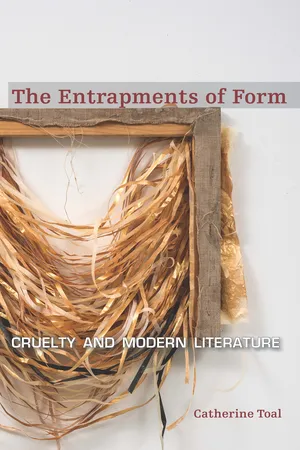
Arguing that cruelty acquires a new meaning in modernity, The Entrapments of Form follows its evolution through exchanges between French and American literature over the contradictions of Enlightenment (slavery, genocide, libertine aristocratic privilege). Catherine Toal traces Edgar Allan Poe's influence on the Sadean legacy, Melville's fictional dramatization of Tocqueville, and Henry James's response to the aesthetic of his French contemporaries, including Flaubert. The result is not simply a work that provides close readings of key literary texts of the nineteenth century—Benito Cereno, The Turn of the Screw, Les Chants de Maldoror—but one that shows how in this era cruelty develops a specific narrative structure, one that is confirmed by the manner of its negation in twentieth-century philosophy. The final chapters address this shift: the postwar French reception of Sade and the relationship between American cultural theory and the rhetoric of the so-called war on terror.
Information
Publisher
Modern Language InitiativeYear
2016Print ISBN
9780823269358
9780823269341
eBook ISBN
9780823269365
1. The Forms of the Perverse
Nineteenth-century American literature presents a strange case at its origin: Edgar Allan Poe, fated to a terrific posthumous career in France, and only recovered for serious Anglophone study once aesthetic appraisal and canon-formation ceased to be paramount scholarly tasks.1 Well known is the story of Poe’s immediate legacy in his homeland: the grave left without a tombstone for twenty years; the series of damning or ambivalent judgments. Whitman confessed to a long period of “distaste” for Poe’s work. T. S. Eliot condemned his “slipshod” and “puerile” creations. Henry James relegated enthusiasm for Poe to “a decidedly primitive state of reflection.”2 Yet it is never noted that the progress of Poe’s impact in France reveals no less of an incongruity between evaluation and tenacious significance. Evidence suggests mainly the influence of Poe’s poetry and philosophy of composition on the symbolists, but only his stories (except for “The Raven”) were translated by the writer responsible for his infiltration into French culture, Baudelaire.3 Further peculiarities appear here: Mallarmé translated Poe’s poetry into prose; “Eureka,” the most anomalous Poe text, an abstract narrative, was of greatest importance for Valéry.4
Critics tend to rely on the assumption of a powerful personal identification as the genesis of Poe’s French influence.5 What is often overlooked is the broader intertwining influence of American literature on French literature in the forging of literary modernity. Régis Messac’s Le ‘Detective Novel’ et l’influence de la pensée scientifique charts the pathway from Brockden Brown’s Wieland and Cooper’s wildernesses through Poe’s stories to the Paris of Balzac and Lautréamont.6 The mark left by Messac’s study on Walter Benjamin’s Passagen-Werk suggests that the fundamental shape of literary modernity is inconceivable without the transatlantic shift Baudelaire’s translations mediate.7 This present chapter is not another study of those translations, but rather a proposal for how their misreadings and gaps illuminate the precise nature of Poe’s narrative patterns, and their wider relationship to the mediation of the colonial project in US literature. I also examine here how continuing engagement with Poe’s work in the later nineteenth century contributed decisively to the revision, within nineteenth-century French literature, of one of its primary reference points—the libertine aesthetic of the Marquis de Sade, with its expounding of “cruelty”—thereby shaping the character of French prose poetry.
The unevenness of Baudelaire’s engagement with Poe makes it difficult to identify with accuracy the point of greatest compelling interest raised for him by the American writer’s work. But one consistent element is indeed present. Even in his earliest essay on Poe, largely plagiarized from other sources,8 Baudelaire declares his fascination with “l’esprit de PERVERSITÉ” (the spirit of perversity).9 Quoting extensively from the disquisition in “The Black Cat” on this phenomenon (from Isabel Meunier’s translation) in the only original section of the essay, Baudelaire also alludes to it in the revised version “Edgar Poe, sa Vie et ses Œuvres” (1856), where he admires the meticulousness of Poe’s analysis of this tendency: “qui flotte autour de l’homme nerveux et le conduit à mal” (that hovers about the nervous man and leads him to evil).10 “Notes nouvelles sur Edgar Poe” (1857) reaches the zenith of such admiration, extolling Poe’s “imperturbable affirmation” (resolute affirmation) of “la méchanceté naturelle” (natural evil), or later, of “la perversité primordiale de l’homme” (the primordial perversity of man).11
Baudelaire’s “perversité” is clearly not Poe’s “perverseness.” The former is shot through with the following influences: Sade, Maistre, suspicion of Rousseau. Poe’s perverse is formulated with a degree of lightness (as the contrast between his “imp” and Baudelaire’s “démon” already indicates). For Poe, it seems to be more important that the phenomenon achieve a certain kind of negation, rather than that it stipulate positive depravity: perversity is the actualization of what should not be, acting “for the reason that we should not”—going against the teleology of the productive, the healthful, the norm.12
Even more striking than the ways in which Baudelaire interprets and translates the meaning of Poe’s “perverse” is the assimilation of form to content in the treatment of those stories of Poe’s that theorize the category. Both “The Black Cat” and “The Imp of the Perverse” culminate in murder. Each story, however, distracts from and seems to figure this outcome as ancillary. “Imp” does so through its prefatory range of “silly” or less serious examples of perverseness (the narrative itself, a long circumlocution, constitutes one). “The Black Cat” does so by displacing lethal aggression toward the narrator’s wife onto a relation with a household pet. Baudelaire fuses the plot-result of “Imp of the Perverse”—in which the narrator condemns himself by compulsive confession of his crime—with one of its opening speculative claims: “l’impossibilité de trouver un motif raisonable suffisant pour certaines actions mauvaises et périlleuses, pourrait nous conduire à les considérer comme le résultat des suggestions du Diable, si l’expérience et l’histoire ne nous enseignaient pas que Dieu en tire souvent l’établissement de l’ordre et le châtiment des coquins;—après s’être servi des mêmes coquins comme de complices!” (The impossibility of finding a reasonable motive for certain bad and perilous actions might lead us to consider them the result of the Devil’s promptings, if experience and history had not taught us that God sometimes derives from them the establishment of order and the punishment of reprobates;—having made use of these same reprobates as accomplices!).13 Poe’s own statement is more noncommittal: “We might, indeed, deem this perverseness a direct instigation of the Arch-Fiend, were it not occasionally known to operate in furtherance of good.”14 Similarly, in Baudelaire’s intended dramatization of “The Black Cat” (“L’Ivrogne”), the protagonist consciously wishes to do away with his wife and is straightforwardly propelled to the deed by drunkenness.15
Of course, there is an element in Poe’s “perverse” that justifies—or inspires—the darker shading Baudelaire gives it. The very duplicity of the stories, their representation of murder as incidental to their own unfolding, creates a violence that is meaningless, laconic, and enjoyed as such. For instance, “The Black Cat” narrator’s summary disposal of his spouse: “I . . . buried the axe in her brain”; “she fell dead upon the spot without a groan.”16 All Poe’s narratives of the perverse present an elaborate prefatory or pretextual apparatus that makes possible the precipitation of mindless, trivialized, and banal corporeal destruction. The most obvious example is “The Murders in the Rue Morgue,” where the complexity of ratiocination, the deductions of the detective, are antithetical to the brutality of the acts perpetrated by the unthinking, nonhuman culprit.
American literature contemporaneous with Poe shares this “perverse” form, generating murderous violence for which narratives disavow or alienate responsibility. Recognition of this subterranean scheme resolves continual debates concerning the ideologically pugnacious racism, or, on a contrary view, the multifaceted critical potential, of formative American literature.17 The mechanism of the “perverse” constitutes an acknowledgment of the devastation—only now receiving adequate historical accounting—wreaked on the indigenous populations of the American colonies.18 At the same time, it achieves a sense of exoneration, befitting the negligible role played by individual protagonists in vaster historical processes, but also actively seeking an escape from guilt. Lastly, it marks an enjoyment that both betrays the existence of such guilt and expresses an illegitimate accession to the benefits of colonial incursion and its extraordinary depredations. With this structure, the “perverse” also contradicts the traditional mythopoeic understanding of American literature as the concatenation of colonial experience, its progressive development from first encounters with the “wilderness” to full-fledged postlapserian allegory.19 The “perverse” shows literary forms at odds with themselves—invested in their own dissolution, as much as taking tentative steps toward a putative national cultural consolidation.
While American literature betrays an integral affinity with Poe’s “perverse,” Baudelaire’s translations of Poe reveal the pressure of a tension between his initial understanding of the “perverse” and its actual patterning in Poe’s texts. In the Petits poèmes en prose Baudelaire finally creates forms that enact the ambiguities and duplicities of the American perverse. The full implications of this achievement are disclosed by a poet who receives the imprint of both Poe and Baudelaire’s influence. Lautréamont’s Les Chants de Maldoror adapts perversity’s denial of its own teleology to create a poetic rhetoric that feigns lack of awareness of the murderous acts lurking within its own narrative unfolding. In his last essay on French literature, written to Max Horkheimer in 1940, Walter Benjamin argued that the species of violence figured by Maldoror amounted to a kind of dreamwork of “Hitlerism.”20 Benjamin’s remark prompts investigation of the labyrinthine nineteenth-century journey of the “perverse,” a form that has always distorted the boundary between aesthetics and politics, producing strange refractions of external catastrophe.
Perversity to Cruelty
Baudelaire’s translations show numerous points at which the tension between his interpretation of Poe’s “perverse” and the latter’s actual form, as well as the possibility of future reinterpretation, are evident. “The Murders in the Rue Morgue,” which does not contain an explicit theorization of perversity, shows the fundamental nature of its importance as a pattern in Poe’s work. The structure of the plot is organized around the fulfillment of what should “not” be the case. Dupin, the detective protagonist, sleeps by day and wakes by night; the witnesses of the murder testify that the perpetrator was a foreigner, but do not know which language he spoke, only that it was “not” their own.21 Linguistic constraints compel Baudelaire to diminish negative emphasis, for instance with respect to the perverse aim of the detective’s investigations: “all apparent impossibilities must be proved to be not such in reality”; “il fallait démontrer que l’impossibilité n’était qu’apparente.”22
Most strikingly, Baudelaire cannot translate the negative formulation that expresses Dupin’s judgment of the police inspector because, running counter to the language of the text itself (as the murderer’s “speech” does to that of its auditors), it is in French in the original. A quotation from Rousseau’s La Nouvelle Héloïse, the phrase was, in that novel, a statement about philosophers.23 Dupin uses it to depict the police inspector as a witless bungler of perversity, who seeks to “explain” (rather than bring into existence) what is “not,” and to “deny” rather than thwart, what is: “de nier ce qui est, et d’expliquer ce qui n’est pas” (to deny what is, and to explain what is not). 24 Baudelaire cites the phrase in “Notes nouvelles sur Edgar Poe” to condemn the proponents of socialism.25 Although this usage seems again to convert Poe’s perverse into a theological doctrine opposed to mid-nineteenth-century pieties, the reiteration of the untranslatable phrase attests to a preoccupation with something elusive in the motif. Also, Baudelaire effectively turns the phrase against Rousseau himself, since he considers “Jean-Jacques” the hapless progenitor of Fourierist utopianism. Such a deployment of the quotation would not be possible without Poe’s citation (perhaps it even contains an anticipation of a link between utopianism and a police state), and it represents a formal operation of perversity, rather than the mere transposition of a meaning.
An obstacle of French/Anglo-American (cultural as well as linguistic) translation also causes Baudelaire to omit a parenthetical remark on the word “affaire”: “[The word ‘affaire’ has not yet, in France, that levity of import which it conveys with us.]”26 Apparently trivial, this phrase in fact sums up the negating triviality of the case itself, which contains a similar dramatic, objectifying violence to that represented in “The Black Cat.” Rather than focusing on the horrifically dismembered female victims, the story transfers its attention to the sailor who is the owner of the orangutan who killed them. The narrator tells this character’s story as if it were his own, provoking the ratiocinating Dupin’s entire empathy: “I pitied him from the bottom of my heart.”27 In other words, “The Murders in the Rue Morgue” presents a similar dynamic to “The Black Cat” and “Imp of the Perverse,” centered on a protagonist (or subject, in the broader sense) who is the vehicle of a violence for which he appears not fully responsible, a violence that generates casualties consigned to a disposability, a merely corporeal fate, that he manages to escape.
Poe’s longer narratives, Arthur Gordon Pym and The Unparalleled Adventure of One Hans Pfaall, disclose the primacy, for the perverse, of these casually accumulated corpses. Both journeys appear to follow an ambitious arc (Baudelaire comments on the ludicrous seriousness with which Poe presents Pfaall’s extraterrestrial quest),28 yet are resolutely circular. The College of Astronomy of Rotterdam is “not a whit better, nor greater, nor wiser” for Pfaall’s research, while the moon-dwellers he meets are no less unsympathetic than the earthlings he left behind.29 Arthur Gordon Pym famously encounters the specter of “whiteness” at the world’s south, as if meeting in the end a mere projection of the identity of himself and his fellows.30 What does remain progressive throughout each narrative is the accumulation of collateral victims that succumb to the vicissitudes of the voyages: the creditors mangled and burnt by Pfaall’s balloon takeoff; the innumerable shipmates and comrades dispatched by Pym’s misfortunes. Pym is noteworthy for dispensing also with the main protagonist, though not through death within the action—...
Table of contents
- Contents
- Introduction: The “Strange and Familiar Word”
- 1. The Forms of the Perverse
- 2. “Some Things Which Could Never Have Happened”
- 3. Murder and “Point of View”
- 4. The Marquis de Sade in the Twentieth Century
- 5. American Cruelty
- Acknowledgments
- Notes
- Index
Trusted by 375,005 students
Access to over 1.5 million titles for a fair monthly price.
Study more efficiently using our study tools.
Frequently asked questions
Yes, you can cancel anytime from the Subscription tab in your account settings on the Perlego website. Your subscription will stay active until the end of your current billing period. Learn how to cancel your subscription
No, books cannot be downloaded as external files, such as PDFs, for use outside of Perlego. However, you can download books within the Perlego app for offline reading on mobile or tablet. Learn how to download books offline
Perlego offers two plans: Essential and Complete
- Essential is ideal for learners and professionals who enjoy exploring a wide range of subjects. Access the Essential Library with 800,000+ trusted titles and best-sellers across business, personal growth, and the humanities. Includes unlimited reading time and Standard Read Aloud voice.
- Complete: Perfect for advanced learners and researchers needing full, unrestricted access. Unlock 1.5M+ books across hundreds of subjects, including academic and specialized titles. The Complete Plan also includes advanced features like Premium Read Aloud and Research Assistant.
We are an online textbook subscription service, where you can get access to an entire online library for less than the price of a single book per month. With over 1.5 million books across 990+ topics, we’ve got you covered! Learn about our mission
Look out for the read-aloud symbol on your next book to see if you can listen to it. The read-aloud tool reads text aloud for you, highlighting the text as it is being read. You can pause it, speed it up and slow it down. Learn more about Read Aloud
Yes! You can use the Perlego app on both iOS and Android devices to read anytime, anywhere — even offline. Perfect for commutes or when you’re on the go.
Please note we cannot support devices running on iOS 13 and Android 7 or earlier. Learn more about using the app
Please note we cannot support devices running on iOS 13 and Android 7 or earlier. Learn more about using the app
Yes, you can access The Entrapments of Form by Catherine Toal in PDF and/or ePUB format, as well as other popular books in Literature & Modern Literary Criticism. We have over 1.5 million books available in our catalogue for you to explore.