Over the past decade, Jeffrey J. Williams has been one of the most perceptive observers of contemporary literary and cultural studies. He has also been a shrewd analyst of the state of American higher education. How to Be an Intellectual brings together noted and new essays and exemplifies Williams's effort to bring criticism to a wider public
How to Be an Intellectual profiles a number of critics, drawing on a unique series of interviews that give an inside look at their work and careers. The book often looks at critical thought from surprising angles, examining, for instance, the history of modern American criticism in terms of its keywords as they morphed from sound to rigorous to smart. It also puts in plain language the political travesty of higher education policies that produce student debt, which, as Williams demonstrates, all too readily follow the model of colonial indenture, not just as a metaphor but in actual point of fact.
How to Be an Intellectual tells a story of intellectual life since the culture wars. Shedding academic obscurity and calling for a better critical writing, it reflects on what makes the critic and intellectual—the accidents of careers, the trends in thought, the institutions that shape us, and politics. It also includes personal views of living and working with books.
eBook - ePub
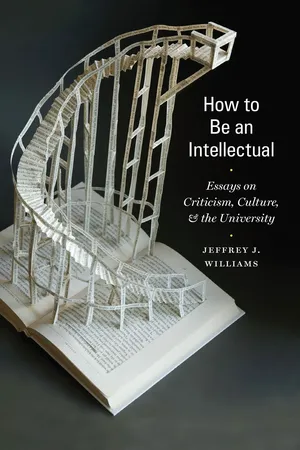
How to Be an Intellectual
Essays on Criticism, Culture, and the University
- 232 pages
- English
- ePUB (mobile friendly)
- Available on iOS & Android
eBook - ePub
About this book
Information
Publisher
Fordham University PressYear
2014Print ISBN
9780823263813
9780823263806
eBook ISBN
9780823263820
PART ONE
The Politics of Criticism
Criticism in our time seems subject to frequent change. This section looks at some of the turns in contemporary criticism, such as the rise and fall of literary theory, the institutionalization of cultural studies, the resurrection of the public intellectual, and the embrace of quantitative methods. One question that runs through it is the political relevance, or irrelevance, of culture.
Sometimes the history of criticism is framed as a kind of relay race, with a topic handed from one runner to the next (the focus on the sign, for instance, passed from Saussure to Lévi-Strauss to Derrida to Butler). It is a history without history. In contrast, I focus especially on the institutional conditions of criticism, the material circumstances within which it is embedded and that make it possible, permitting certain work to be done or not done and inflecting its form. Since the 1940s, that history has had a lot to do with higher education, first with the aims of general education and more recently with the protocols of advanced research.
To examine that history, in several essays I look at some of the peripheral objects and vehicles of criticism, for instance the theory journal. Such entities usually recede to the mute background, like an Amazon.com box irrelevant to the book inside, but they shape criticism in their own distinctive ways. A great deal has been written about “the little magazine,” but almost nothing on this newer, albeit more academic, genre. Or I look at the path of modern criticism through its keywords of approbation, shifting over the past century from “soundness” to “rigor” to the current “smart.”
I begin with a longer essay that I originally wrote for Dissent comparing Richard Rorty and Andrew Ross. The pragmatist philosopher and the avatar of cultural studies might seem strange bedfellows, but their 1991 debate in Dissent foregrounds the question of the politics of criticism, illustrating the culture wars then and now. My take is that it also encapsulates the difference between intellectual generations, and the concept of generations helps us understand contemporary criticism and, more generally, academic culture. Generations are fuzzy around the edges, but they provide a way to locate critics and intellectuals historically, formed not as singular geniuses but as part of their historical cohorts.
Rorty’s original essay was called “Intellectuals in Politics” and he has rather strict advice for what intellectuals should do (hence the title of my essay). Throughout this book, the intellectuals I talk about hail primarily from my disciplinary neck of the woods, literary and cultural studies. But for Rorty and in common usage, “critic” is often interchangeable with “intellectual,” particularly with the critic who reaches outside his or her academic corner to take up the charge of politics.
ONE
How to Be an Intellectual: Rorty v. Ross
In the fall of 1991, Richard Rorty published an essay in Dissent magazine called “Intellectuals in Politics.” It was not a profile of model figures but something of a jeremiad, castigating intellectuals in order to bring them back to their proper purpose. It upbraided American intellectuals for their disconnection from politics, standing by while the rich ripped off the poor, especially in the wake of the savings and loan crisis and recession of 1990–91. Rorty indicted two groups in particular: journalists and literature professors. Of journalists he charged that they failed the tradition of Lincoln Steffens by not properly educating the electorate. Of literature professors he charged that they failed to “remind voters of their ideals” and had given up on ordinary politics; instead they were intent on internecine pursuits like “advanced literary theory.”
Such charges were not entirely new, but Rorty went an extra step and named names. In the larger media sphere, he cited a Newsweek editor, Larry Martz, but it was his accusation in the academic sphere that he himself inhabited that drew blood, or at least some attention. He took to task a young Princeton professor, Andrew Ross, finding him guilty of celebrating popular culture indiscriminately, embracing postmodern theory rather than the concrete conditions of those downtrodden, and switching “attention from electoral to cultural politics” or real to academic politics. This switch, in Rorty’s eyes, was characteristic of the “contemporary academic left” and “represents attitudes that are widespread in American literature departments.”
The Spring 1992 issue of Dissent carried a response from Ross and a rejoinder by Rorty. Ross pointed out the relevance of culture to politics (cultural factors like gender and race help “explain how structures of wealth and power are maintained and reproduced from day to day”) and noted Rorty’s skewed depiction of his work (about his representing literary theory, he remarked “I am not Rorty’s man”). Rorty conceded that culture does have some import, but observed that the exchange demonstrated a “fairly sharp generational difference.” His side represented the Old Left and people like “Lionel Trilling, John Dewey, Paul Goodman, Sidney Hook, and Daniel Bell”—in other words, the New York Intellectuals, and what Rorty took as the traditional readership of Dissent. A key difference with the newer generation was its position on the Cold War, which older intellectuals thought was a good war, whereas younger ones did not. Rorty’s reply helped explain some of his animus: Ross’s 1989 book No Respect: Intellectuals and Popular Culture had taken the New York Intellectuals down a peg, criticizing their ignoring a range of cultural injustices as well as their cheering along the Cold War imperium.
The early 1990s were of course the height of the culture wars, and the exchange played out the Left version of them, split along the trench lines of traditional versus cultural or identity politics. I return to it now, though, not to resuscitate those quarrels, but to look at Rorty and Ross and their respective careers. The exchange, like most such exchanges, probably served to entrench each side rather than persuade the other, but it also brought to center stage two of the more prominent humanities intellectuals in the United States of the last two decades. What models of the intellectual do they each present? While one might debate the merits of cultural politics, Rorty was accurate in observing that he and Ross represented different intellectual generations, a difference that has become clearer in the interim.
Given his passing in 2007, it is fitting to take stock of Rorty’s career and how he fashioned himself, moving from an academic philosopher to public intellectual. It is also a good point to consider Andrew Ross’s career since he was only starting out in 1991 but has subsequently built a sizeable body of work. Especially over the last decade, Ross has become a kind of social reporter. To put it more contentiously, if Rorty was throwing stones, what kind of house did he live in? And has Ross borne out or absolved himself of Rorty’s charges?

By the early 1990s, Richard Rorty was widely regarded as the leading philosopher in the United States. Ironically a good part of his reputation derived from his walking away from philosophy, or at least the mainstream of philosophy departments in the postwar era. The dominant current was analytic philosophy, focused on technical issues, largely of language, and fields like formal logic, rather than large existential questions or the history of philosophy, as those in the discipline strove for the precision of a science. Doing graduate work and taking his first academic job in the 1950s, Rorty earned a reputation in analytic philosophy with articles elucidating distinctions like the mind-body problem. Though he had yet to publish a monograph, he cemented his reputation with an influential anthology, The Linguistic Turn: Recent Essays in Philosophical Method (1967). But through the 1970s he underwent a metamorphosis, investigating Continental figures like Nietzsche, Heidegger, and Derrida, who were not considered seriously in the analytic tradition, and returning to the American pragmatists, especially John Dewey, who were considered quaint or outmoded. His 1979 Philosophy and the Mirror of Nature announced Rorty’s pragmatist turn, arguing that philosophy had been misguided in creating a theory of mind based on reflection. That assumed a metaphysical foundation: there was a core Truth that philosophy attempted to divine. For Rorty, it should instead present useful “redescriptions.” Philosophy was not systematic but a conversation, and its value not that it might reveal Truth but that it might be edifying.
Seeing philosophy this way prompted two things. Rorty became more of a historicist, reworking the conversation of philosophy, and he found a renewed value in literature. In place of philosophy providing Truth, literature provided inspiration. His historical perspective prompted a steady stream of essays looking at figures from both Anglo-American and Continental philosophy, many of them gathered in Consequences of Pragmatism: Essays, 1972–1980 (1982) and the four volumes of his Philosophical Papers (1991–2007). His gravitation toward literature culminated in his 1989 book Contingency, Irony, and Solidarity, which argued for the power of narrative over logic to deal with problems like human suffering, and found models in writers like George Orwell.
Contingency, Irony, and Solidarity was also Rorty’s bid to become more of a public figure, commenting on our common lot. As Neil Gross shows in his biographical study Richard Rorty: The Making of an American Philosopher (2008), Rorty deliberately set out to refashion himself from the late 1970s on. His move in 1982 from Princeton, where he was a mainstay of the philosophy department, to the University of Virginia as an at-large professor of the humanities symbolized his evolution. By the late 1980s and through the 1990s, he embraced a role as a public intellectual, with pieces in the London Review of Books, the New York Times, and Dissent. He also published Achieving Our Country (1998), praising American democracy and urging intellectuals to take more pride in their country, and a collection of his more public essays, Philosophy and Social Hope (1999), in a Penguin paperback. The philosopher was reborn.
Rorty’s writings on politics have a refreshingly straightforward stance and plainspoken style, boiling down an issue to its basic terms, like the rich “ripping us off” in “Intellectuals in Politics.” They also, in their pragmatist habit, do not hold out a utopia for which to strive or an absolute case from which to measure; rather, they give examples that one can use or from which to draw inspiration. Rorty typically held out the better hope of American democracy, which led to one of his most controversial statements in the late 1990s, when he scolded American intellectuals for not being patriotic in a Times op-ed piece (reprinted in Achieving Our Country). Part of his argument followed from Contingency, Irony, and Solidarity: It is less useful to appeal to broad if not metaphysical categories like “the human.” Rather, it is more persuasive to argue that Americans should not suffer hunger, for instance, than that humans shouldn’t suffer hunger. But he also excoriated American intellectuals for their lack of patriotism. It is hard to separate this latter view from the American exceptionalism that gave credence to our subsequent wars.
In some ways Rorty became a man of letters and, though he debunked the special status of philosophy, he asserted a distinctive status for criticism. He gives it this estimable genealogy in “Professionalized Philosophy and Transcendentalist Culture” (collected in Consequences of Pragmatism): “Beginning in the days of Goethe and Macauley and Carlyle and Emerson, a kind of writing has developed which is neither the evaluation of the relative merits of literary productions, nor intellectual history, nor moral philosophy, nor epistemology, nor social prophecy, but all these things mingled into a new genre. This genre is often still called ‘literary criticism.’” That is why he singled out literature professors in particular in “Intellectuals in Politics,” rather than philosophy or sociology or political science professors. They had a special obligation, conferred by this tradition, to provide moral perspective on and imaginative vision of politics.
To this genealogy Rorty added, nearer to our time, the “New York intellectuals,” and he maintained a high regard for figures like Lionel Trilling and Irving Howe, whose criticism balanced among literary, moral, and political reflection. His choice of the New York intellectuals was something of a return, since his parents had been involved in Left circles in New York, his father, James Rorty, a founding editor of New Masses and involved in Communist Party and Trotskyist politics in the early 1930s. (His father was also a poet, which might explain some of Rorty’s residual regard for literature, as he suggested in an essay in Poetry Magazine before he died.) Rorty had walked away from this heritage while building his academic career, but his later eschewal of philosophy was a kind of prodigal return.
Rorty’s connection to the New York intellectuals explains some of the heightened charge of “Intellectuals in Politics.” He typically argued in a matter-of-fact, unruffled tone (in person, his signature gesture was the shrug), but part of his crossness, I would speculate, was because Ross’s book No Respect hit close to home. In the last chapter, Ross criticizes the New York intellectuals for their disconnection from popular concerns, citing James Rorty among a group of better-known names. The contest, then, was not only over the importance of culture but over who controlled the legacy of the New York intellectuals.
In “Intellectuals in Politics” Rorty identifies with the Old Left, or those who cut their political teeth in the 1930s and had a palpable sense of how the rich rip off the poor, but he himself, born in the 1930s and whisked to college in 1946 at the age of fifteen, was very much an academic product, and his authority came not from his political work or experience but his academic work and standing. Though he went against the grain of philosophy, he was in many ways typical of his academic generation, one buoyed on the rich waters of the postwar university. After attending the University of Chicago (B.A., 1950; M.A., 1952), he went to Yale for his Ph.D. (1958). Other than a brief ellipsis in the military in 1957–58 (he was assigned to the Signal Corps and evidently bored), he was on the academic fast track, teaching and earning tenure at Princeton. (Gross cites several letters from Rorty’s parents commenting on his absorption in his academic career.) He was typical of his generation, too, insofar as he attained academic reputation and position on relatively few publications, and no monograph before Philosophy and the Mirror to Nature.
The postwar years produced a new cohort of intellectuals. They were not like the earlier and scrappier generation of New York Intellectuals, who argued in the legendary lunchroom of City College, often held a variety of jobs in journalism and elsewhere before landing in academe, and traveled the fraught path of Left politics of the 1930s. Rather, they benefited from what I have called the welfare state university, when there was relatively opulent funding for research as well as tuition, they were often trained at elite universities, and they adopted the pro-American liberalism of the 1950s without the tendrils of a communist past. They were fast-tracked into a booming academic world. It is often remarked that the Sixties generation revolutionized academe, but it was actually an earlier generation that first reaped the benefits of enhanced intellectual leisure and created most of the new discourse and terms of criticism, theory, and philosophy.
Rorty’s generation was the one that created “advanced literary theory.” For instance, many of its leading members, such as Harold Bloom, Fredric Jameson, and Stanley Fish, were born in the 1930s and whisked through academe in similar ways. Rorty probably had more influence on those who did “advanced literary theory” than on those in his home discipline, philosophy, and by the 1980s was taken as an exemplar of postmodern theory in his debunking of “foundational” concepts. Thus, in “Intellectuals in Politics,” it was odd that Rorty, himself subject to many attacks on his postmodern or relativist position, would throw a similar kind of paint on someone else, with whom, on paper, he would otherwise be allied. (In his reply, he notes that he and Ross would likely vote the same on many issues.)
Along with the culture wars, the 1990s also saw the celebration of the figure of the public intellectual. What was usually meant by it, though, was not someone like Irving Howe or Michael Harrington, whose statements arose from a long engagement in political work, but an academic who made a foray to the public sphere, and in my view that is the weakness of the model Rorty represents. Rorty attained his public position primarily from his academic work and was not notably involved in party politics, as, say, those who built DSA (Democratic Socialists of America), or as Howe was involved in various enterprises, including the founding of Dissent, and he did not write on class or politics before the late 1980s. (The recent work of Walter Benn Michaels exhibits a similar tendency. Like Rorty, Michaels has attacked the focus on cultural or identity politics at the expense of class, but his argument did not arise from his connection to any actual political group; rather, it is literally an academic argument, over terminology and perceived academic trends, rather than an argument for actual policy or a report of what the working class experience.) Though Rorty castigated the “academic left,” he was a creature of it, and he imagined his audience as something called “the academic left.” And though he eschewed the top-down nature of foundational thinking, Rorty’s rhetoric in “Intellectual Politics” is top-down. The genre of “Intellectuals in Politics” is that of the bully pulpit, leading by upbraiding rather than example.
The strength of Rorty’s model is his incisive clarity. In a late essay he remarks that the customary distinction between analytic and Continental philosophy is the wrong one; it should be between analytic and conversational philosophy, or between “scholasticism…controversies that have no interest to anyone outside the philosophical profession,” and that which builds a new vocabulary “to make us happier, freer, and more flexible.” Reduction is often derided in contemporary criticism and complication praised, but Rorty’s gift was his ability to reduce complicated issues...
Table of contents
- Cover
- Half title
- Title
- Copyright
- Contents
- Acknowledgments
- Introduction
- Part 1: The Politics of Criticism
- Part 2: Profiles in Criticism
- Part 3: The Predicament of The University
- Part 4: The Personal and The Critical
Trusted by 375,005 students
Access to over 1.5 million titles for a fair monthly price.
Study more efficiently using our study tools.
Frequently asked questions
Yes, you can cancel anytime from the Subscription tab in your account settings on the Perlego website. Your subscription will stay active until the end of your current billing period. Learn how to cancel your subscription
No, books cannot be downloaded as external files, such as PDFs, for use outside of Perlego. However, you can download books within the Perlego app for offline reading on mobile or tablet. Learn how to download books offline
Perlego offers two plans: Essential and Complete
- Essential is ideal for learners and professionals who enjoy exploring a wide range of subjects. Access the Essential Library with 800,000+ trusted titles and best-sellers across business, personal growth, and the humanities. Includes unlimited reading time and Standard Read Aloud voice.
- Complete: Perfect for advanced learners and researchers needing full, unrestricted access. Unlock 1.5M+ books across hundreds of subjects, including academic and specialized titles. The Complete Plan also includes advanced features like Premium Read Aloud and Research Assistant.
We are an online textbook subscription service, where you can get access to an entire online library for less than the price of a single book per month. With over 1.5 million books across 990+ topics, we’ve got you covered! Learn about our mission
Look out for the read-aloud symbol on your next book to see if you can listen to it. The read-aloud tool reads text aloud for you, highlighting the text as it is being read. You can pause it, speed it up and slow it down. Learn more about Read Aloud
Yes! You can use the Perlego app on both iOS and Android devices to read anytime, anywhere — even offline. Perfect for commutes or when you’re on the go.
Please note we cannot support devices running on iOS 13 and Android 7 or earlier. Learn more about using the app
Please note we cannot support devices running on iOS 13 and Android 7 or earlier. Learn more about using the app
Yes, you can access How to Be an Intellectual by Jeffrey J. Williams in PDF and/or ePUB format, as well as other popular books in Literature & Education Theory & Practice. We have over 1.5 million books available in our catalogue for you to explore.