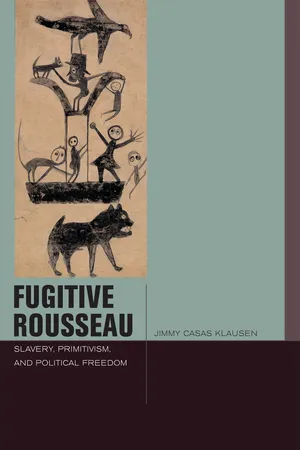
Critics have claimed that Jean-Jacques Rousseau was a primitivist uncritically preoccupied with "noble savages" and that he remained oblivious to the African slave trade. Fugitive Rousseau presents the emancipatory possibilities of Rousseau's thought and argues that a fresh, "fugitive" perspective on political freedom is bound up with Rousseau's treatments of primitivism and slavery.
Rather than trace Rousseau's arguments primarily to the social contract tradition of Hobbes and Locke, Fugitive Rousseau places Rousseau squarely in two imperial contexts: European empire in his contemporary Atlantic world and Roman imperial philosophy. Anyone who aims to understand the implications of Rousseau's famous sentence "Man is born free, and everywhere he is in chains" or wants to know how Rousseauian arguments can support a radical democratic politics of diversity, discontinuity, and exodus will find Fugitive Rousseau indispensable.
- 356 pages
- English
- ePUB (mobile friendly)
- Available on iOS & Android
eBook - ePub
About this book
Information
Publisher
Fordham University PressYear
2014Print ISBN
9780823267477
9780823257294
eBook ISBN
9780823257317
Topic
PhilosophySubtopic
Political PhilosophyII
Freedom?
3
Cosmopolitanism
You do not tear from place to place and unsettle yourself with one move after another. Restlessness of that sort is symptomatic of a sick mind.
—SENECA, Epistulae Morales ad Lucilium II
Being able to depart for where we will is the prototypical gesture of being free, as limitation of freedom of movement has from time immemorial been the precondition for enslavement.
—HANNAH ARENDT, “On Humanity in Dark Times: Thoughts about Lessing”
In the world through which I travel, I am endlessly creating myself.
—FRANTZ FANON, Black Skin, White Masks
During the long eighteenth century, from circa 1648 until about 1789, when revolution and Continental war disrupted travel and mobility, the Grand Tour typified the education of the young men of privileged classes, at first the aristocracy and later the “professional middle classes” or the “bourgeois propiétaires.”1 Or, as not every young man with the wherewithal for the three-year circuit cared to endure the physical rigors of early modern transit, it would be more accurate to say that if the Grand Tour did not typify the education of aristocrats, gentlemen, and the elite bourgeoisie, at least it represented an educational ideal for those who would be the bearers of high culture after the Renaissance. Furthermore, as an ideal, the Grand Tour was only “putatively” educational, as one scholar notes,2 for it could take on primarily professional or pleasure-seeking dimensions in serving as an internship of sorts for diplomatic service or, for those prodigal sons of Europe, a drawn-out libertine adventure. Indeed, the subentries for “Voyage” in the Encyclopédie alert us to other uses and usages of travel: mercenary or commercial, marine, legal—not to mention missionary, martial, and colonial.3 Nonetheless, travel took pride of place in humanists’ vision of education as a lifelong philosophical affair. Paraphrasing Francis Bacon (though without attribution), Louis le Chavalier de Jaucourt puts it thus in the Encyclopédie’s longest subentry for “Voyage”: “Today travels in the civilized states of Europe . . . are in the judgment of enlightened persons, one of the most important parts of the education in youth, and a part of the experiences of older people.”4 This humanistic judgment of importance is not only a contemporary one, however. For de Jaucourt launches the entry with a gesture to its Classical value, as well: “the great men of antiquity judged that there be no better school for life than that of travels. . . .”5 Invoking the authority of antiquity, de Jaucourt’s entry implicitly recalls the philosophical tradition of cosmopolitanism: edifying travels (perhaps especially the Grand Tour) would produce not citizens of this or that particular locale but instead citizens of the world. Thus, if the many faces of travel became also the many masks of cosmopolitanism, then correcting travel with a proper normative vision of the relation between self and world might rescue cosmopolitanism from its twin dangers, selfishness and self-sacrifice: either autonomy metamorphoses into hyperrational egocentrism, or civil society immobilizes and enslaves sensitive selves via worldly attachments.
The advent of social contract theory alters this cosmopolitan ideal. With social contract theory, travel ceases to be solely a labor of self-cultivation and cultural refinement understood in a universalizing humanist frame: for any political obligation worthy of the name demands specific knowledge, not only of one’s rights and duties within one’s natal polity, but also of the diversity of other political arrangements and possibilities abroad (cf. É 302–5; OC IV.617–23). Travel ceases to be crucial strictly for producing the well-formed man and becomes indispensible for educing the well-informed (male) citizen of a specified polity.6 Certainly, John Locke makes informed consent to a particular polity a crucial aspect of his Second Treatise of Government. The Second Treatise would lead one to believe that a future political subject can only attain the status of “informed” by having traveled to other places for knowledge of alternative constitutions, and yet there is no explicit theorization of travels as political education in the Treatise. Inversely and symmetrically, in Some Thoughts Concerning Education, Locke pursues the topic of travel as educationally informing, but does not discuss it in political terms of obligation or consent. In Locke’s writings the two ideals of travel remain separate. It is not until Rousseau’s Émile, or On Education that the Lockean educational travels and political obligation get sutured together.7
In what follows I examine the tensions within and final breakdown of Rousseau’s cosmopolitan project in Émile via its consideration of travel. Rousseau inherits and must transform a prior ideology of travel because, while travels make him anxious, he nonetheless concedes their value. Travels imperil the traveler’s virtue, but they are necessary as a mobile arena for virtue’s embodied performance and confirmation. One backstory for Rousseau’s simultaneous anxiety about and commitment to travel lies in the tension within the understanding of virtue as practical moral goodness in Émile. Specifically, Rousseau comes to the conclusion that virtue is nothing without its risk—risks such as travels provide. The moral assumptions behind negative education and its scientific support derive from Rousseau’s borrowing of Stoic and Epicurean moral problematics and, separate but related, his unique version of sensationalist psychology. It is here that we begin to see Rousseau’s inability to sustain his declared commitment to travels and practically risked virtue. Rousseau’s cognizance of the fragility of virtue makes sense of his tendency to prejudge intercultural encounters in terms of conquest—the conquest by vice of all that is pure.
However, this Rousseauian tendency reveals the conclusive disjuncture between travel and negative education and the political effects of committing to the latter and not the former. Because travel animates and encapsulates Rousseau’s worst fears about the corrosive and corrupting effects of modern society, he must torture it into a virtuous conformity with his vision of natural purity. To stave off the vicious effects of travels, he alters travel’s conditions of possibility, but, altering such conditions, he thereby makes travel impossible according to its conventional terms and thus thwarts the intention of travel as education for a political subject who will root cosmopolitanism in nativism. Travel in both the humanistic Grand Tour and Lockean social contract traditions is intended to complete one’s education (as a liberal cosmopolitan humanist or as a consenting citizen of a localizable polity), yet, because of the perilous status of travel in Émile, negative education must already have made travel morally feasible. That is, Rousseau turns the relationship between travel and education on its head: travels do not crown and complete education; rather, negative education must have been completed before travels take place. However, the very ends that drive Rousseauian negative education (essential goodness, purity) contradict the means to their achievement (namely, the risks of sin and corruption). For if negative education’s intended purity can never reach completion without continually risking the possibility of corruption, as Rousseau well acknowledges, then purity is effectively never itself complete and must always require but never abide the supplementary risk of impurity. The effect of this contradiction is double: negative education proves at last unachievable, and all travels occurring under its aegis are nullified by having been domesticated. Rousseau’s failed endeavor to paper over the mutual opposition between the preservationist aim of negative education and the always possible aimlessness of travel demonstrates again the simultaneity of his essentialist commitment to purity and his awareness that if pure ends are at all possible, then they can exist only by dint of impure means. In the impasse between virtuous but interminable education and vicious but necessary travels and between the Scylla of egocentrism and the Charybdis of worldly self-obliteration the goal of autonomy—and ultimately the possibilities of theory and critique—get lost. Hence, in the end I argue that Émile’s Barbary captivity in the sequel to Émile does not contradict but rather confirms that the negative educational project does not build an autonomous but rather a morally enchained Émile.
TRAVEL: POLITICAL PROMISE / MORAL PROBLEM
After inuring the pupil Émile’s physic, after instilling self-possession in him for his social and moral relations, after a neo-Hellenistic education that would locate virtue and happiness nowhere but in that bit of nature within him, the tutor Jean-Jacques ignores his own earlier reservations that a “harmony” between nature and society’s claims is “impossible” and that, “[f]orced to combat nature or the social institutions, one must choose between making a man or a citizen, for one cannot make both at the same time” (É 39; OC IV.248). In “On Travels,”8 the final section of Émile, which would seem to culminate Émile’s education, Jean-Jacques attempts to bridge this gap between making a man and making a citizen, and Rousseau (i.e., the author)9 does so by bridging the Lockean gap between humanism and contractarian obligation:
Now that Émile has considered himself in his physical relations with other beings and in his moral relations with other men, it remains for him to consider himself in his civil relations with his fellow citizens [ses concitoyens]. To do that, he must begin by studying the nature of government in general, the diverse forms of government, and finally the particular government under which he was born, so that he may find out whether it suits him to live there. For by a right nothing can abrogate, when each man attains his majority and becomes his own master, he also becomes master of renouncing the contract that connects him with the community by leaving the country [pays] in which that community is established. It is only by staying there after attaining the age of reason that he is considered to have tacitly confirmed the commitment his ancestors made. He acquires the right of renouncing his fatherland [sa patrie] just as he acquires the right of renouncing his father’s estate [la succession de son pére]. Furthermore, since place of birth is a gift of nature, one yields one’s own place of birth in making this renunciation. According to rigorous standards of right, each man remains free at his own risk in whatever place he is born unless he voluntarily subjects himself to the laws in order to acquire the right to be protected by them. (É 455–56; OC IV.833)
Having presumably secured Émile’s status as morally well-formed man, the tutor now attends to the consequent project of educing a citizen from this man. And in the rest of this passage, Rousseau condenses and simplifies the Second Treatise’s basic doctrine of original nonsubjection and the theory of tacit consent and correlative obligation built upon it.10 Where Locke declares that children are born subjects to no polity (§118), Rousseau likewise insists that each “remains free” in his place of birth. Both theorists elaborate a right of exit from this radically negative freedom, whose most unambiguous exercise would entail the alienation of one’s patrimonial estate. Rousseau, following Locke’s articulation of tacit consent, allows for the possibility that this child, upon reaching majority, might remain in the natal polity and thus will have “tacitly confirmed” a political obligation that need bear no more than an accidental (or, in Rousseau’s language, dative) relation to place of birth. Finally, Rousseau, again inspired by Locke, mentions a more robust form of obligation: voluntary subjection—that is, express consent.
What is remarkable in this passage is not merely that it appears in an educational treatise rather than Of the Social Contract or that a near-equivalent for it is lacking in the latter. (Rousseau does admit apologetically in a footnote a few pages later that he is reiterating points from the latter, published nearly concurrently with Émile [É 462n; OC IV.842n].) Rather, most remarkable are Rousseau’s explicit assertion of an imperative to study government and governments for purposes of informed consent to a particular regime and that this assertion occurs in the context of a discussion of travels whereby travels become constitutive of political citizenship—whereby routes become constitutive of contractual roots.11 Although the exit option and the theoretical separation of tacit from express consent in the Second Treatise at least implicitly suggest the necessary contribution that political education about “the nature of government in general” and “the diverse forms of government” would make for informed consent, and although the Second Treatise teems with references to travel and mobility, Locke is never so explicit about the interrelation of travel, political education, and civic decision as is Rousseau in this passage from Émile. Education is a necessary condition for proper civic choice and informed political obligation; yet the means by which such political education is attained, viz., travels, remains largely untheorized in the Lockean social contract.
And yet the project of informing consent by way of travels is crucially different from the classical tradition of a political theoría. In scholars’ recent reconstructions of the term’s usages in Classical Greece (fifth and fourth centuries B.C.E.), theoría (Ɵϵωρια) and a related family of terms were associated with a number of more or less religious meanings: a type of festival; a spectator at such a festival; a sacred delegation to a sanctuary, often officially representing a Greek polis; the travels of such a delegation; an official or delegation sent from a city-state to other city-states to announce a festival; and sacred sightseeing more generally. Although perhaps ordinarily invoked for religious contexts, the term also wandered beyond such contexts. In perhaps paradigmatic examples of such extensions of usage, theoroi in Plato’s Laws refers to the emissaries sent off by the polis to gain knowledge of other constitutions, and Herodotus uses a verbal form in the Histories to designate the travels of the barbaros Anacharsis around Greece in search of comparative knowledge of the nomoi of different peoples. More broadly, then, theoría invokes two dominant ideas—sometimes together, sometimes separately: travel or pilgrimage; insight or wondrous vision.12 In the tradition of political theory as received from ancient Greece, these meanings become combined and partly secularized so that political theory refers to real or metaphorical travels for purposes of gaining comparative insight into political matters.13
However, emphasizing too much the cognitivist and secularist sense of insight neglects the ritual-moral and embodied aspects of travel.14 As we shall see, Rousseau’s sensationalist psychology makes him very much aware that travels are far more than simply cognitive: they involve not only learning in the head but also moral formation in the body. The story of Anacharsis’s travels—or rather their violent end—might educate us here about perceived threats of travel and theoría. Anacharsis was killed by his brother King Caduidas (or Saulius) upon resettling among the Scythians after his travels in the Greek world. Something more than an intrafraternal monarchic consolidation was at stake in this murder. The insight Anacharsis gained from travel was not simply cabineted in his head but enacted in his moral practice: Herodotus has it that Anacharsis performed foreign religious rites, while Diogenes Laertius mentions a general enthusiasm for things Greek,15 but whatever the case, Caduidas (Saulius) perceived something intimately threatening about the distinctive strangeness Anacharsis now embodied. Although Herodotus’s philhellenic judgment has it that the king was xenophobic and nativist,16 a Scythian perspective suggests that it was not the fact of foreignness per se that was troubling, but rather anticipated local effects on a nomadic people of Anacharsis’s specifically urbane foreign habits.
Against a liberal-rationalist reading of Émile, wherein ideas are acceded to, rejected, or manipulated inside the cabinet of the head, and whereby political allegiance and loyalty are thus decided intellectually,17 “On Travels” as culmination of Rousseau’s negative educational project so desperately wants to signal that travels are risky because they make moral and cultural impressions on travelers’ bodies. In addition to forming bodies, though, travel taken as a norm already marks an ideological split within a cultural formation. Thus “having an idea” to travel, for example, is already a cultural practice produced by a discursive formation that would designate cognitive and corporeal moments separately—first autonomous decision, then execution or abstention—that is, rather than a recognition that much geographic movement or immobilization is not autonomous (for example, as in the transatlantic slave trade), or that travel can be a reflexive habitus of bodies (for example, among nomadic peoples). Ideas formed about or by travel are no...
Table of contents
- Cover
- Series Page
- Title Page
- Copyright
- Dedication
- Contents
- List of Illustrations
- List of Abbreviations
- Acknowledgments
- Epigraph
- Introduction
- I. Slavery
- II. Freedom?
- Afterword
- Notes
- Index
- Series List
Trusted by 375,005 students
Access to over 1.5 million titles for a fair monthly price.
Study more efficiently using our study tools.
Frequently asked questions
Yes, you can cancel anytime from the Subscription tab in your account settings on the Perlego website. Your subscription will stay active until the end of your current billing period. Learn how to cancel your subscription
No, books cannot be downloaded as external files, such as PDFs, for use outside of Perlego. However, you can download books within the Perlego app for offline reading on mobile or tablet. Learn how to download books offline
Perlego offers two plans: Essential and Complete
- Essential is ideal for learners and professionals who enjoy exploring a wide range of subjects. Access the Essential Library with 800,000+ trusted titles and best-sellers across business, personal growth, and the humanities. Includes unlimited reading time and Standard Read Aloud voice.
- Complete: Perfect for advanced learners and researchers needing full, unrestricted access. Unlock 1.5M+ books across hundreds of subjects, including academic and specialized titles. The Complete Plan also includes advanced features like Premium Read Aloud and Research Assistant.
We are an online textbook subscription service, where you can get access to an entire online library for less than the price of a single book per month. With over 1.5 million books across 990+ topics, we’ve got you covered! Learn about our mission
Look out for the read-aloud symbol on your next book to see if you can listen to it. The read-aloud tool reads text aloud for you, highlighting the text as it is being read. You can pause it, speed it up and slow it down. Learn more about Read Aloud
Yes! You can use the Perlego app on both iOS and Android devices to read anytime, anywhere — even offline. Perfect for commutes or when you’re on the go.
Please note we cannot support devices running on iOS 13 and Android 7 or earlier. Learn more about using the app
Please note we cannot support devices running on iOS 13 and Android 7 or earlier. Learn more about using the app
Yes, you can access Fugitive Rousseau by Jimmy Casas Klausen in PDF and/or ePUB format, as well as other popular books in Philosophy & Political Philosophy. We have over 1.5 million books available in our catalogue for you to explore.