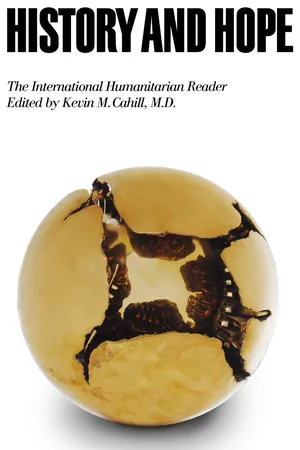
History and Hope: The International Humanitarian Reader provides a better understanding—both within and outside academia—of the multifaceted demands posed by humanitarian assistance programs. The Reader is a compilation of the most important chapters in the twelve-volume International Humanitarian Affairs book series published by Fordham University Press. Each selected chapter has been edited and updated.In addition, the series editor, Kevin M. Cahill, M.D., has written, among other chapters, an introductory essay explaining the academic evolution of the discipline of humanitarian assistance. It focuses on the "Fordham Experience": its Institute of International Humanitarian Affairs (IIHA) has developed practical programs for training fieldworkers, especially those dealing with complex emergencies following conflicts and man-made or
natural disasters.
eBook - ePub
History and Hope
The International Humanitarian Reader
- 464 pages
- English
- ePUB (mobile friendly)
- Available on iOS & Android
eBook - ePub
About this book
Trusted by 375,005 students
Access to over 1.5 million titles for a fair monthly price.
Study more efficiently using our study tools.
Information
Publisher
Fordham University PressYear
2013Print ISBN
9780823251971
9780823251964
eBook ISBN
9780823260751
PART I
History
History and Hope opens, appropriately, with an essay on the modern history of humanitarian action, and a chapter detailing the ethical and legal foundations of the discipline. Both cite the dangers that recent trends, particularly the “war on terror,” pose to hard won, almost universally accepted, positions assuring the independence of international humanitarian assistance.
One of the books in the series, Technology for Humanitarian Action, was considered innovative and advanced when published in 2005. But, as already noted, nothing changes faster than the science of modern technology. Each chapter in that book was introduced by a vignette describing the reality faced by a humanitarian fieldworker. Two vignettes introduce a more current contribution by the head of the United Nations Office for the Coordination of Humanitarian Affairs emphasizing the importance of technology as we struggle to provide assistance in complex emergencies.
Humanitarian Action in the Twenty-First Century: The Danger of a Setback
Humanitarian action as envisaged by Henry Dunant, the founder of the Red Cross Movement, is both simple—it is based on the natural human tendency to respect a fellow human—and original—Dunant wished to apply that common sense principle in systematic fashion, even in war.
A fleeting glance at the past will help us appreciate what was original about humanitarian action as conceived by Dunant, why it goes beyond good intentions or mere charity. Until September 11, 2001, there was no reason to believe that the international community would be tempted by a simplistic view of the world to roll back the concept of humanitarian action that was born with the Red Cross. I do not wish to indulge in facile anachronisms, but will retrace the development of humanitarian idea and action and highlight the challenges as well as the risks of the twenty-first century for humanitarian action.
Ancient Greece (Fifth Century BCE)
War had limits for only some members of humanity. The extent to which the Greeks humanized war can only be understood in the light of their society’s division into city-states, competition between which was natural and gave rise to regular conflicts in an attempt to establish which was the best. Fighting between cities of the same culture and the same religion was governed by unwritten rules (agraphoi nomoi). The city that lost was always at a disadvantage, but the victor had to respect limits to its conduct with regard to captives. Those rules were not a form of international law, however, as they applied only between Greek city-states, whereas there was no limit to the acts of violence that could be carried out against the enemy in wars between Greeks and barbarians (non-Greeks).
Ancient Greece therefore witnessed the first, very partial endeavor to use rules of law to regulate certain conflicts between Greek city-states. Whether or not those unwritten rules applied depended not on one’s condition as a human being, but on one’s membership in Greek civilization.
Religion and Respect for Human Beings
On the one hand, all the world’s great religions (primitive religions, Judaism, Christianity,1 Islam, the religions of the Far East) recommend that their followers treat other human beings with respect; on the other hand, each religion is linked to a people, to a culture (or is imposed on others as a culture), and the notion of universality is therefore absent. In addition, violence is often a part of religious behavior, carried out to defend a god or a truth. In any event, it makes sense for every religion to consider itself the best, otherwise why believe? In most past and present conflicts, religious communities have identified with one of the parties to the conflict. The conflicts in the Balkans have provided ample proof of this, but the same thing has happened in the eastern Democratic Republic of the Congo, in Sri Lanka, and in many other countries in conflict. It was therefore not religions that originated and promoted the founding ideas of humanitarian law, neither in the distant past nor in modern times.
Christianity since the Middle Ages: Love, Compassion, Charity
Since the Middle Ages and until the twenty-first century, the notions of love, compassion, and charity, and the activities based on them, evolved principally along two lines:
1. One tradition used love, compassion and charity to fight the established powers. In the face of the self-assigned privileges of the rich and powerful, men such as Francis of Assisi (twelfth century), Joachim de Flore (fourteenth century), and, later, Giordano Bruno (sixteenth century) branded those notions as weapons in defense of the poor and the underprivileged. In some cases, their struggles ended in social and political revolt.
2. In another tradition, represented chiefly by the institutional church, those notions were applied only in respect of the faithful who followed the right path. In that case, nothing took precedence over the established order; charity toward the poor was a means of maintaining that order and a requirement for salvation, but had no intrinsic value. It can even be said that this tradition substituted charity for justice. Charity was the pretext for not dispensing the justice that could undermine the power of the rich and mighty. This tradition’s purpose was to maintain and uphold a political and social order that was unconcerned by equal rights and used charity to contain any hint of rebellion on the part of the lower classes. In that context, the idea of universal humanitarianism had no scope to develop.
The dichotomy between the two traditions prevailed throughout Western Christian culture until the nineteenth century and constituted the political leitmotif of that period.
The Premises of the Modern Humanitarian Idea
A Christian Exception: St. Vincent de Paul
In the seventeenth century, St. Vincent de Paul adopted a systematic approach to poverty in France, with a view to its eradication. To that end, he established two structures, or religious orders: the Daughters of Charity and the Lazarists. St. Vincent de Paul’s approach was original in that it tackled poverty as a social phenomenon and established structures to remedy it.
Unfortunately, the system was appropriated by Louis XIV, or more specifically his wife, Maria Teresa of Austria. St. Vincent de Paul’s humanitarian endeavor was turned into “internment houses” run by the police, spelling a sad end to a pioneering humanitarian effort and protecting the hierarchical order of the time.
The Concept of “Humanity”
During that period—between the seventeenth and nineteenth centuries—Europe awakened to the revolutionary idea of a human being as an individual (Descartes, Spinoza, Kant, Marx, etc.). Whereas Christian charity as it had evolved in Western societies was compatible with social inequality, the modern concept of “humanity” considered every man and woman as equally “human.” Without a doubt, the philosophical development of the concept of humans as individuals fostered the sociological advent of the demand that all men and women be treated equal, and hence the idea that any person, no matter what his social status, was entitled to respect without discrimination.
The First “Humanitarian” Operations (Late Eighteenth to Early Nineteenth Centuries)
1793: relief operation for French aristocrats forced to flee Santo Domingo during a slave uprising;
1812: earthquake in Caracas: the United States organized assistance by boat;
1821: aid for the Greeks (only) during their war against the Turks
Humanitarian action in time of war initially took the form of medical services provided by the armed forces for their troops. Those who pioneered such services were Ambroise Pare (sixteenth century) and Baron Larrey (1766–1842).
The eighteenth century saw the conclusion of the first agreements between combatants for the reciprocal use of hospitals.
1743: Battle of Bethingen—agreement between the Marshall of Noailles (France) and Lord Sain (England)
1759: Seven Years War—agreement between General de Barail and Henry Seymour Conway
Henry Dunant and Solferino
The Battle of Solferino in the Italian War of Unification (1859) marked a decisive moment in the modern concept of humanitarianism, thanks first to Henry Dunant and, subsequently, to the Red Cross in general and the International Committee of the Red Cross (ICRC) in particular. Dunant and the Committee of Five “invented” the principles that underpin humanitarian action to this day. They are based on three fundamental ideas:
The basic idea: A universal space, that of the victim, that respects the neutrality of the victims of war. Henceforth, aid would not be limited to one’s own wounded but would be extended to all the victims. As Henry Dunant wrote in A Memory of Solferino: “The women of Castiglione, seeing that I made no distinction between nationalities, followed my example, showing the same kindness to all these men whose origins were so different, and all of whom were foreigners to them. ‘Tutti fratelli,’ they repeated feelingly” (ICRC, 1986).
The second original idea: Those helping the victims must be part of the same space, the space of humanity. Humanitarian agents help all the victims as members of one humanity. To give effect to this idea, an independent organization, untainted by any military or political commitment, was founded; it was the voice of humanity in the midst of armed conflict. It soon came to be called the Red Cross.
The third original idea: At a time when all man’s laws apparently ceased to exist when fighting broke out, Henry Dunant created a space for a contract. Certain laws could be applied universally even in the heat of battle. International humanitarian law was born. In 1865, the States signed the Geneva Convention for the protection of the war wounded, an international treaty that defined a legal space for humanitarian aid.
Thus, Henry Dunant and the Red Cross laid the foundations of contemporary humanitarian action, which seeks to treat enemies hors de combat as equals in humanity.
Contemporary Periods of Humanitarian Action
World War I
Previously a legal and moral authority, the ICRC—and the entire Red Cross—had now to start taking action. The First World War was different from wars of the nineteenth century in that it was total. It involved countries, economies, and populations on an unprecedented scale. The Red Cross was obliged to demonstrate that the principles and rules laid down in the law of war were applicable.
The ICRC went from being a moral and legal authority to an operational organization. Its main fields of action were prisoners of war, repatriations, and tracing activities. Forty-one delegates visited fifty-four prisoner-of-war camps. They repatriated a total of 700,000 prisoners; 1,200 volunteers worked at the International Prisoners-of-War Agency in Basel, restoring ties between prisoners and their families. Two million parcels were sent to prisoners.
In 1917, the ICRC was awarded the Nobel Peace Prize.
The Period between the Two World Wars
The first problem was practical in nature: What was to be done with the enormous infrastructure set up during the First World War? The fight against tuberculosis was one of the operations undertaken during this period. A Red Cross poster proclaimed: “Beat the Germans, beat tuberculosis.”
There then arose a political problem, for after the First World War, pacifism became a force to be reckoned with (President Wilson, Treaty of Versailles, the League of Nations, the Kellogg-Briand Pact). War was to be outlawed.
In order to deal with these two problems, the Red Cross organized itself into two international institutions. At the instigation of the President of the American Red Cross, the League of Red Cross Societies was established; it would be responsible for peacetime activities. The ICRC would specialize in wartime operations, and in humanitarian law and its dissemination.
During the same period, the Save the Children Fund (1919) and the precursor of a High Commission for Refugees (1921) were also established. Both organizations would deal with peacetime issues arising from war.
World War II
For the Red Cross, and in particular the ICRC, this war was marked by the questions and issues posed by totalitarian regimes (Bolshevism, Nazism).
Those regimes manipulated humanitarian aid for their own purposes. In 1921, for example, the USSR had demanded total control of the humanitarian assistance provided to the famine-stricken popula...
Table of contents
- Cover Page
- Title Page
- Copyright Page
- Dedication
- Contents
- Foreword
- List of Acronyms and Abbreviations
- Acknowledgments
- Introduction
- Part I. History
- Part II. Principles/Values
- Part III. Evolving Norms
- Part IV. Actors
- Part V. Operational
- Part VI. Exit Strategies
- Part VII. Epilogue
- Appendix: the IIHA Resource Library
- Notes
- List of Contributors
- The Center for International Humanitarian Cooperation and the Institute of International Humanitarian Affairs
- Index
Frequently asked questions
Yes, you can cancel anytime from the Subscription tab in your account settings on the Perlego website. Your subscription will stay active until the end of your current billing period. Learn how to cancel your subscription
No, books cannot be downloaded as external files, such as PDFs, for use outside of Perlego. However, you can download books within the Perlego app for offline reading on mobile or tablet. Learn how to download books offline
Perlego offers two plans: Essential and Complete
- Essential is ideal for learners and professionals who enjoy exploring a wide range of subjects. Access the Essential Library with 800,000+ trusted titles and best-sellers across business, personal growth, and the humanities. Includes unlimited reading time and Standard Read Aloud voice.
- Complete: Perfect for advanced learners and researchers needing full, unrestricted access. Unlock 1.5M+ books across hundreds of subjects, including academic and specialized titles. The Complete Plan also includes advanced features like Premium Read Aloud and Research Assistant.
We are an online textbook subscription service, where you can get access to an entire online library for less than the price of a single book per month. With over 1.5 million books across 990+ topics, we’ve got you covered! Learn about our mission
Look out for the read-aloud symbol on your next book to see if you can listen to it. The read-aloud tool reads text aloud for you, highlighting the text as it is being read. You can pause it, speed it up and slow it down. Learn more about Read Aloud
Yes! You can use the Perlego app on both iOS and Android devices to read anytime, anywhere — even offline. Perfect for commutes or when you’re on the go.
Please note we cannot support devices running on iOS 13 and Android 7 or earlier. Learn more about using the app
Please note we cannot support devices running on iOS 13 and Android 7 or earlier. Learn more about using the app
Yes, you can access History and Hope by Kevin M. Cahill, Kevin M. Cahill, M.D. in PDF and/or ePUB format, as well as other popular books in Social Sciences & Educational Policy. We have over 1.5 million books available in our catalogue for you to explore.