Access to a broad range of different political views and cultural expressions is often regarded as a self-evident value in both theoretical and political debates on media and democracy. Pluralism is commonly accepted as a guiding principle of media policy in addressing media concentration, the role of public service media, or more recently such questions as how to respond to search engines, social networking sites, and citizen media. However, opinions on the meaning and nature of media pluralism as a concept vary widely, and definitions of it can easily be adjusted to suit different political purposes.
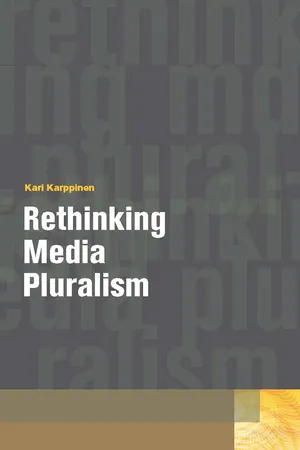
Rethinking Media Pluralism contends that the notions of media pluralism and diversity have been reduced to empty catchphrases or conflated with consumer choice and market competition. In this narrow logic, key questions about social and political values, democracy, and citizenship are left unexamined. In this provocative new book, Kari Karppinen argues that media pluralism needs to be rescued from its depoliticized uses and re-imagined more broadly as a normative value that refers to the distribution of communicative power in the public sphere. Instead of something that could simply be measured through the number of media outlets available, media pluralism should be understood in terms of its ability to challenge inequalities and create a more democratic public sphere.
- 256 pages
- English
- ePUB (mobile friendly)
- Available on iOS & Android
eBook - ePub
Rethinking Media Pluralism
About this book
Information
Publisher
Fordham University PressYear
2013Print ISBN
9780823245130
9780823245123
eBook ISBN
9780823245147
PART I
Theorizing Pluralism and the Public Sphere
The following three chapters address the assumptions underlying the debate on media pluralism from the perspective of contemporary political philosophy and democratic theory. Beyond the general consensus that the public sphere requires a broad range of voices, the exact meaning and implications of pluralism as a normative principle remain controversial and arguably undertheorized in both media studies and political theory. While much of the debate on media pluralism as a policy goal or as an object of empirical measurement takes it for granted that pluralism is important for democracy, there is less agreement on why and how: What is the purpose of media pluralism? What are its problems and limits? And what norms or theoretical models should we use to conceptualize and justify it?
In line with the approach outlined in the introduction, the idea here is that it is relevant to engage with democratic theory, not only in order to highlight the gap between the ideals and the reality but also to question the normative assumptions and arguments made in contemporary academic and political debates.
The following chapters draw on discussions within the fields of both political philosophy and media studies. In particular, I will deconstruct the standard assumptions and readings of different theories of democracy adopted in media studies. My goal is thus to challenge the theoretical models and metaphors such as the marketplace of ideas and the public sphere that are commonly invoked in media policy and to question their established interpretations.
Taking some distance from the attractiveness of pluralism as a common sense principle, the following chapters highlight some of the differences among political theories, all of which, on the surface, appear to advocate a pluralistic public sphere as a central value. Chapter 1 distinguishes three different models of democracy and the public sphere, and analyzes their implications for conceptualizing media pluralism. Chapter 2 problematizes the implications of the revival of pluralism in contemporary social and political theory and raises some questions about the ambiguities and problems associated with its application in media studies. Finally, Chapter 3 synthesizes some of the arguments and discusses their implications for critical media studies and for a rethinking of the notion of media pluralism.
CHAPTER 1
Three Models of Democratic Pluralism
Although much of the confusion surrounding the notion of pluralism in media studies stems from its different uses in different contexts, there is also an inherent element of ambiguity within the concept of pluralism itself. As is the case with most isms that carry significant political implications, pluralism is an essentially contested concept that is subject to endless arguments about its interpretation and implications.
It is questionable then whether it is possible to mount any general defense of pluralism, because pluralism itself is so plural; it exists in several versions that can be incompatible with one another. Rather than as a specific ideology or a school of thought, McLennan (1995) argues that pluralism is best conceived as a general intellectual orientation whose specific manifestations would be expected to change depending on the context.
Even in the field of political theory, however, the concept of pluralism has several meanings. It may stand for the empirical claim that different people hold different values, or for the normative view that such plurality is desirable. As a consequence, classic liberal philosophers, empirical political scientists, and contemporary theorists of radical difference and identity politics have all employed pluralism as a political value, yet they all emphasize different aspects and have diverging views on how best to realize the notion.
In this chapter, I will illustrate different ways of conceptualizing pluralism as a democratic value by distinguishing three traditions or categories of democratic theory, all of which have to varying degrees also influenced academic and political debates on media and democracy. My aim is not to categorize different models of democracy as such, but rather to deconstruct some of the most commonly used normative frameworks used in media studies and to rethink their implications especially from the point of view of how they conceptualize pluralism as a value in public communication.1
My discussion is structured by examining three different approaches that build on critiques of the other approaches. All have been used to justify different conceptions of the role of media in a democracy, and they espouse a different version of pluralism.
Liberal pluralism. Contemporary media politics and the debate on media pluralism in particular are still largely grounded in the basic values of political liberalism, such as individual freedom, personal development, dispersion of power and self-government. However, the legacy of many liberal political theorists for media politics is controversial and contested. One of the best examples is the metaphor of “the free marketplace of ideas,” which today is one of the dominant models for conceptualizing the value of pluralism and diversity in the media. Although associated with many classical liberal theorists, it has been argued that the metaphor probably reflects more the contemporary ideological belief that market behavior paradigmatically represents freedom. Below, I will demonstrate the controversial legacy of liberal political theory by focusing on the idea of the marketplace of ideas and its problematic association with the ideas of J. S. Mill and other liberal political theorists.
Deliberative democracy. While the liberal discourse of the marketplace of ideas is still powerful in policy rhetoric, much of the discussion in academic debates on media and democracy leans on the framework of deliberative democracy and the concept of the public sphere, which some claim is now the quintessential “God-term” in scholarly debates over media and democracy (Gitlin 1998, 168). One of the central ideas of deliberative democracy is the attempt to reconcile disagreements and the fact of pluralism through the idea of a rational-critical public sphere and discursive formation of public opinion. However, there is tension between the framework of deliberative democracy and its pluralist critics, who argue that the emphasis on rational deliberation and consensus ignores unequal relations of power, the depth of social pluralism, and fundamental value differences. For these reasons, the deliberative approach, often associated with Jürgen Habermas’s work (1989, 1996, 2006) is increasingly read in media studies as a defense of an outdated and overtly pessimistic ideal which has little practical relevance in contemporary societies.
Radical pluralism. Finally, as an alternative to the former two, more established models, I discuss the recent radical-pluralist theories of democracy and their critiques of both deliberative democracy and traditional liberal pluralism. Radical-pluralist or agonistic theories of democracy here refer to theories in which the public sphere is conceived as a site for political struggle and conflict, and not only as a site for the formation of common will or consensus (Connolly 1991; Connolly 1995; Connolly 2005; Honig 1993; Mouffe 1993; Mouffe 2000; Mouffe 2005). While many of these theorists have recently gained prominence in political philosophy, in the field of media studies their perspectives have been used more as oppositional discourses to criticize the biases and flaws in the existing normative frameworks. This has raised doubts over whether they have anything worthwhile to contribute to more concrete or institutional questions. The implications and potential significance of the radical-pluralist approach for media studies and media policy are discussed here mainly by reference to the political philosophy of Chantal Mouffe. Mouffe’s radical democratic pluralism provides a fundamental critique of the deliberative approach to the public sphere and democracy, and this critique has significant consequences for current debates on media and democracy. Perhaps more importantly, however, I argue that her approach provides an equally strong critique of naïve pluralism that celebrates all multiplicity and diversity, without paying attention to the continued centrality of the questions of power and exclusion in the public sphere.
Each of the three approaches outlined above offers a distinct conceptual framework for understanding media pluralism: for liberal pluralists it is the marketplace of ideas and individual choice; for deliberative democrats pluralism is a means to improve the epistemic quality of public deliberation and discursive reconciliation of disagreement; and finally, radical pluralists criticize both for unnecessary idealizations and instead focus on the continuous contestation of power relations and hegemonic structures.
LIBERAL PLURALISM AND THE FREE MARKETPLACE OF IDEAS
In political science, the term pluralism is often still associated with a mid-twentieth century strand of liberal political science that drew attention to the existence of multiple centers of power and conceived democracy as the self-regulation of society through competition among groups over power and social privileges (Dahl 1956; see also Marcil-Lacoste 1992, 129; McLennan 1995, 35). As a central normative principle of liberal democracy, however, pluralism has a much longer history. Premised on the impossibility of unambiguously establishing truth, right or good, especially in social and political affairs, pluralism has been widely celebrated as the cornerstone of the liberal conception of democracy. Although liberalism can certainly mean many things, it can be argued that the general affirmation of individual freedom and pluralism over any collective substantive idea of the common good is central to all those different meanings.
Most conceptions of pluralism share the basic assumption that values or conceptions of the good cannot be reduced to any single hierarchy. The epistemological foundation of pluralism therefore consists in opposition to monism and the view that diversity is a social good that prevents the dominance of one particular idea (Smith 2006, 21–22). Value pluralism, as discussed by philosophers such as Isaiah Berlin (1969, 167–69), maintains that there are no single right answers to questions of value. Similarly, John Rawls (1996, xviii) famously argued that political liberalism begins with the recognition that disagreement and conflict between “incompatible yet reasonable” moral doctrines is an enduring feature of contemporary societies and an ineradicable element of their political institutions. More recently, the inescapable plurality of reasonable arguments and its consequences for moral philosophy have also been extensively discussed by Amartya Sen (2010).
From a liberal perspective, in contrast to more community-centered or unitary views of society, pluralism, variety, and conflict between differing views are commonly seen as fruitful and as being a necessary condition for human progress. Antagonism is seen as mediating progress, and the clash of divergent opinions and interests, in the realm of argument and in economic competition, as well as struggles in the political domain, can be seen as inherently positive (Bobbio 1990, 21–24).
One of the most famous and influential arguments for the social desirability of disagreement and diversity and their contribution to intellectual and social progress was made by philosopher John Stuart Mill, whose On Liberty discusses freedom of thought and discussion as essentially an argument about the importance of disagreement in a democratic political culture. In short, Mill argues that first, any opinion that is being suppressed may possibly be true; secondly, in practice most beliefs are neither wholly true nor wholly false, so only by allowing for the expression of contrary opinions can the whole truth be uncovered; and third, even if the opinion is false, it is only through full and frequent discussion that it can be rationally rejected and prevented from becoming a dogma (Mill 1948, 15–40). Therefore, the only effective way to deal with erroneous or dangerous ideas is to refute them, not to suppress them.
In keeping with the general opposition to monism, pluralism also implies that political power should be dispersed and not be allowed to accumulate in the hands of the few. These principles, which are broadly accepted as the basis of liberal democracy, also form the essence of media pluralism as a normative value. Their interpretation, however, is constantly contested in theories of media and democracy.
The strength of liberal pluralism derives from the intuitive normative appeal of its basic principles, and in this sense the ideas of philosophers such as Mill, Berlin, and Rawls still provide an eloquent rationale for thinking about media pluralism as a political value. The dispersion of power and the critique of any monistic ideas of truth remain key justifications in political philosophy with which to defend freedom of speech and its close association with the principle of media pluralism. The purpose here is not to argue that the salience of these principles as such has diminished. In fact, many of the theories that are discussed below can be placed within the liberal tradition, even when there is polemic against some of its interpretations.2 The interpretation of the abstract principle of pluralism, and its implications and differing emphases within the liberal tradition, however, continue to be intensely contested in both political philosophy and politics. More often than not, this is also the case when the principle is applied to theorize the role of the media as modern social and political institutions.
Perhaps most influentially, the implications of the liberal tradition for thinking about media and democracy have been guided by the classic Four Theories of the Press, which presents the “Libertarian theory of the press” as a development of the philosophical principles found in the writings of philosophers such as John Milton, Thomas Jefferson and J. S. Mill (Siebert, Peterson, and Schramm 1963). The metaphor of the free marketplace of ideas, which in Four Theories is explicitly assigned to Mill, leads to the assumption that the mass media operate under the guiding principle of free enterprise and that all media compete in an open market, where their success depends on the public which it seeks to serve (ibid., 52).
Four Theories thus clearly establishes the articulation between diversity of ideas and the idea of “free competition in the market place of information, opinion, and entertainment.” Although the authors acknowledge that the ideal of free markets can never completely reflect reality, there remains a clear commitment to the idea that “the less government becomes involved the better” (ibid., 53). Even though it discusses many of the shortcomings of free markets and introduces the “social responsibility theory” as its alternative, this articulation carries some fundamental normative implications. The conception of “the marketplace of ideas,” in particular, has arguably strengthened an implicit rational choice ontology and the economic vocabulary of consumer choice and competition in discussions on media pluralism.
Subsequently, the liberalism of Mill and other early advocates of free speech has often been interpreted in a way where pluralism, variety, and choice are seen as the opposite of state oppression or paternalism, as constructing a narrative of media history as a continuum from public regulation and censorship towards ever increasing freedom for both producers and consumers of the media (see Curran 2002, 4–8). According to Nicholas Garnham (2000, 168), the liberal-pluralist approach has consequently taken a narrow view on the relationship between media and politics, describing it as one between media that were supposedly free because they were market-based and the institutions of representative party democracy.
Critical theorists, in turn, have criticized conventional liberal pluralism for its strategic avoidance of political economy and the unequal opportunities open to different social actors (see McClure 1992, 118). The problem in applying liberal theories of the free press to contemporary conditions lies in their assumption that political power is the main external threat to individuals who are otherwise naturally capable of expressing their opinions (Keane 1991, 36–38). This “free information-flow” paradigm views the media themselves as free and as neutral conduits of information, and fails to represent the ways in which information and opinions are embedded in communicative practices and the structure of the media which set agendas, and constrain possible choices and thereby shape public debates. Consequently, liberal pluralist perspectives ignore the questions of unequal cultural and economic power that arise from cultural production itself. As Keane (1991, 89) argues, liberal models of the media have developed a “fetish of market competition,” which ignores the forms in which communication markets themselves restrict pluralism and freedom of the media. In this sense, the liberal discourse of market competition and choice has largely failed to provide a compelling model on which to base any critical understanding of media pluralism.
This is not to say that all proponents of market doctrines would assume well-functioning media markets without acknowledging any market failures or needs for regulation, or even that choice and competition could not be regarded as valuable objectives as such. Issues related to asymmetries of power also arise in the market-consumer context, and it remains important to acknowledge that often media consumers simply still do not have much choice. Instead, the point is to question whether the marketplace is the only proper metaphor for conceptualizing the value of broader political objectives such as media pluralism.
Reflecting the dominance of this discourse, media policy discourses (especially in the United States but to a lesser extent in Europe as well) commonly conceptualize the need for plurality of opinion through the metaphor of the marketplace of ideas (for the genealogy of the concept, see Gordon 1997; Peters 2004). While the articulation of freedom and pluralism with the market has been influential, a number of critics have argued that the whole notion rests on implausible theoretical underpinnings (Baker 2007; Goodman 2004; Ingber 1984). By analogizing democratic discourse to market exchange, the model is all about competitive markets that can supply consumers with what they want. As such, it depends upon the prior existence of private, autonomous individual subjects who know their interests and who make rational choices in the marketplace. Furthermore, in assuming that each individual has equal access to the marketplace and that the marketplace itself is only a neutral mediator, the model is blind to the unequal relations of power (within media corporations and between those corporations and individual citizens) and the differences between groups and individuals in getting their voices heard. In short, it ignores that the media are not exempt from broader relations of power in society, as some social actors have more cultural, social, and economic resources than others to access the media. The model also ignores that the media themselves are structurally biased, as market-based media themselves privilege certain voices and prejudice against voices that are critical of consumer capitalism, for instance.
Consequently, the cla...
Table of contents
- Cover
- Title Page
- Copyright
- Contents
- Acknowledgments
- Introduction
- PART I. THEORIZING PLURALISM AND THE PUBLIC SPHERE
- PART II. THE POLITICS OF MEDIA PLURALISM
- Conclusion
- Reference List
- Index
Trusted by 375,005 students
Access to over 1.5 million titles for a fair monthly price.
Study more efficiently using our study tools.
Frequently asked questions
Yes, you can cancel anytime from the Subscription tab in your account settings on the Perlego website. Your subscription will stay active until the end of your current billing period. Learn how to cancel your subscription
No, books cannot be downloaded as external files, such as PDFs, for use outside of Perlego. However, you can download books within the Perlego app for offline reading on mobile or tablet. Learn how to download books offline
Perlego offers two plans: Essential and Complete
- Essential is ideal for learners and professionals who enjoy exploring a wide range of subjects. Access the Essential Library with 800,000+ trusted titles and best-sellers across business, personal growth, and the humanities. Includes unlimited reading time and Standard Read Aloud voice.
- Complete: Perfect for advanced learners and researchers needing full, unrestricted access. Unlock 1.5M+ books across hundreds of subjects, including academic and specialized titles. The Complete Plan also includes advanced features like Premium Read Aloud and Research Assistant.
We are an online textbook subscription service, where you can get access to an entire online library for less than the price of a single book per month. With over 1.5 million books across 990+ topics, we’ve got you covered! Learn about our mission
Look out for the read-aloud symbol on your next book to see if you can listen to it. The read-aloud tool reads text aloud for you, highlighting the text as it is being read. You can pause it, speed it up and slow it down. Learn more about Read Aloud
Yes! You can use the Perlego app on both iOS and Android devices to read anytime, anywhere — even offline. Perfect for commutes or when you’re on the go.
Please note we cannot support devices running on iOS 13 and Android 7 or earlier. Learn more about using the app
Please note we cannot support devices running on iOS 13 and Android 7 or earlier. Learn more about using the app
Yes, you can access Rethinking Media Pluralism by Kari Karppinen in PDF and/or ePUB format, as well as other popular books in Social Sciences & Public Policy. We have over 1.5 million books available in our catalogue for you to explore.