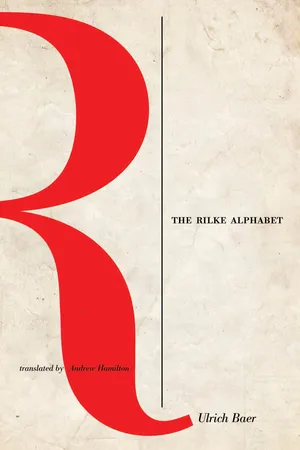
The Rilke Alphabet
eBook - ePub

The Rilke Alphabet

  1. 264 pages
  2. English
  3. ePUB (mobile friendly)
  4. Available on iOS & Android
eBook - ePub

The Rilke Alphabet

About this book

The enduring power of Rainer Maria Rilke's poetry rests with his claim that all we need for a better life on earth is already given to us, in the here and now. In twenty-six engaging and accessible essays, Ulrich Baer's The Rilke Alphabet examines this promise by one of the greatest poets in any tradition that even the smallest
overlooked word may unlock life's mysteries to us.

Fueled by an unebbing passion and indeed love for Rilke's poetry, Baer examines twenty-six words that are not only unexpected but also problematic, controversial, and even scandalous in Rilke's work. In twenty-six mesmerizing essays that eschew jargon and teutonic learnedness for the pleasures and risks of unflinchingly engaging with a great artist's genius, Baer sheds new light on Rilke's politics, his creative process, and his deepest and enduring thoughts about life, art, politics, sexuality, love, and death.

The Rilke Alphabet shows how Rilke's work provides an uncannily apt guide to life even in our vexingly postmodern condition. Whether it is a love letter to frogs, a problematic brief infatuation with Mussolini, a sustained reflection on the Buddha, the evasion of the influence of powerful precursors, or the unambiguous assertion that freedom must be lived in order to be known, Rilke's writings pull us deeply into life.

Baer's decades-long engagement with Rilke as a scholar, translator, and editor of Rilke's writings allows him to reveal unique aspects of Rilke's work. The Rilke Alphabet will surprise and delight Rilke fans, intrigue newcomers to his work, and deepen every reader's sense of the power of poetry to penetrate the mysteries and confusions of our world.

Frequently asked questions

Yes, you can cancel anytime from the Subscription tab in your account settings on the Perlego website. Your subscription will stay active until the end of your current billing period. Learn how to cancel your subscription.
At the moment all of our mobile-responsive ePub books are available to download via the app. Most of our PDFs are also available to download and we're working on making the final remaining ones downloadable now. Learn more here.
Perlego offers two plans: Essential and Complete
  • Essential is ideal for learners and professionals who enjoy exploring a wide range of subjects. Access the Essential Library with 800,000+ trusted titles and best-sellers across business, personal growth, and the humanities. Includes unlimited reading time and Standard Read Aloud voice.
  • Complete: Perfect for advanced learners and researchers needing full, unrestricted access. Unlock 1.4M+ books across hundreds of subjects, including academic and specialized titles. The Complete Plan also includes advanced features like Premium Read Aloud and Research Assistant.
Both plans are available with monthly, semester, or annual billing cycles.
We are an online textbook subscription service, where you can get access to an entire online library for less than the price of a single book per month. With over 1 million books across 1000+ topics, we’ve got you covered! Learn more here.
Look out for the read-aloud symbol on your next book to see if you can listen to it. The read-aloud tool reads text aloud for you, highlighting the text as it is being read. You can pause it, speed it up and slow it down. Learn more here.
Yes! You can use the Perlego app on both iOS or Android devices to read anytime, anywhere — even offline. Perfect for commutes or when you’re on the go.
Please note we cannot support devices running on iOS 13 and Android 7 or earlier. Learn more about using the app.
Yes, you can access The Rilke Alphabet by Ulrich Baer, Andrew Hamilton in PDF and/or ePUB format, as well as other popular books in Literature & Literary Essays. We have over one million books available in our catalogue for you to explore.

Information

NOTES

PREFACE: “THE WHOLE DICTATION OF EXISTENCE”

1. ALT 1:454.
2. ALT 1:454.
3. Musil, “Rede zur Rilke-Feier,” 75. Cited in Baer, “The Perfection of Poetry,” 171–89.
4. De Man, Allegories of Reading, 56.
5. Musil, “Rede zur Rilke-Feier,” 70.
6. See Rainer Maria Rilke, Letters on Life, ed. and trans. Ulrich Baer (New York: Random House, 2008).
7. Rainer Maria Rilke, The Notebook of Malte Laurids Brigge, 53.

A FOR ASHANTI

1. “The Modern Lyric” (speech given in Prague on March 5, 1898), in SW 5:388.
2. Peter Altenberg, The Ashantee, trans. Katherina von Hammerstein (Riverside: Ariadne Press, 2007).
3. Ralph Freedman, “Das Stunden-Buch and Das Buch der Bilder: Harbingers of Rilke’s Maturity,” in Erika A. Metzger and Michael M. Metzger (eds.), A Companion to the Works of Rainer Maria Rilke (Rochester, NY: Camden House, 2004), 125.
4. Letter to Clara Rilke, October 19, 1907, in GB 2:433.
5. BOI, 69.
6. “Die Aschanti,” in SW 1:394–95.
7. Heidegger, Elucidations of Hölderlin’s Poetry, 118.
8. “The Ashanti,” in BOI, 69.
9. Letter to Clara Rilke, October, 19, 1907, in GB 2:433.
10. “The Ashanti,” in BOI, 69.
11. “Die Aschanti,” in SW 1:395.
12. Ibid.
13. Altenberg, Ashantee, 24.
14. BOI, 69.
15. De Man, Allegories of Reading, 45.
16. Ibid., 47.
17. VOC, 63.
18. De Man, Allegories of Reading, 56.
19. Letter to Clara Rilke, March 8, 1907, in GB 2:279–90 (trans. Baer).
20. “Turning-Point,” in AAP, 127.

B FOR BUDDHA

1. SW 6:1467.
2. Bahr, Die Bücher zum wirklichen Leben, 2.
3. Ibid., responses by Camill Hoffmann and Richard Schaukall (6, 14).
4. SW 6:1020–21.
5. MLB, 39.
6. Ibid., 43
7. Ibid.
8. Ibid., 42.
9. SW 6:1021–22.
10. Letter to Richard Schaukal, August 2, 1904, quoted in KA 4:983.
11. MLB, 198.
12. “Requiem for Wolf Graf von Kalckreuth,” in JBL, 210; Benn, Sämtliche Werke 1, 654.
13. Letter to Baladine Klossowska, December 16, 1920, NAL 2:100–101.
14. Celan, Der Meridian, 156.
15. “Archaic Torso of Apollo,” in AAP, 61.
16. SW 1:317.
17. Wallis, Dhammapada, xiii.
18. ALT 1:25.
19. Das Testament, 23.
20. Neumann, Die Reden Gotamo Buddhos.
21. The citations from Mann, Hesse, Shaw, and Hofmannsthal are found in Neumann, Die Reden Gotamo Buddhos.
22. Cited in Neumann, Die Reden Gotamo Buddhos.
23. Letter to Clara Rilke, September 8, 1908, in ALT 1:252.
24. Ibid., 248 et seq.
25. Later, after the First World War, Rilke’s rejection of Buddhist teaching takes a decidedly anti-...

Table of contents

  1. Cover Page
  2. Title Page
  3. Copyright Page
  4. Contents
  5. Abbreviations
  6. Preface: “The Whole Dictation of Existence”
  7. Acknowledgments
  8. a   for Ashanti
  9. b   for Buddha
  10. c   for Circle
  11. d   for Destiny Disrupted
  12. e   for Entrails
  13. f   for Frogs
  14. g   for God
  15. h   for Hair
  16. i   for Inca
  17. j   for Jew Boy
  18. k   for Kafka and King Lear
  19. l   for Larean
  20. m   for Mussolini
  21. n   for Nature
  22. o   for O
  23. p   for Proletarian
  24. q   for Quatsch
  25. r   for Rose
  26. s   for Stampa
  27. t   for Tower
  28. u   for Un-
  29. v   for Vagabond, or Being Outside
  30. w   for Worm
  31. x   for Xaver
  32. y   for Y
  33. z   for Zero
  34. Notes
  35. Works Cited
  36. Index