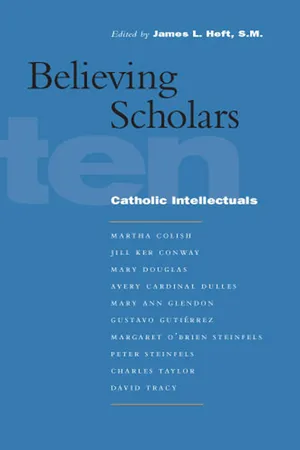
How do Catholic intellectuals draw on faith in their work? And how does their work as scholars influence their lives as people of faith?
For more than a generation, the University of Dayton has invited a prominent Catholic intellectual to present the annual Marianist Award Lecture on the general theme of the encounter of faith and profession. Over the years, the lectures have become central to the Catholic conversation about church, culture, and society.
In this book, ten leading figures explore the connections in their own lives between the private realms of faith and their public calling as teachers, scholars, and intellectuals.
This last decade of Marianist Lectures brings together theologians and philosophers, historians, anthropologists, academic scholars, and lay intellectuals and critics.
Here are Avery Cardinal Dulles, S.J., on the tensions between faith and theology in his career; Jill Ker Conway on the spiritual dimensions of memory and personal narrative; Mary Ann Glendon on the roots of human rights in Catholic social teaching; Mary Douglas on the fruitful dialogue between religion and anthropology in her own life; Peter Steinfels on what it really means to be a "liberal Catholic"; and Margaret O'Brien Steinfels on the complicated history of women in today's church. From Charles Taylor and David Tracy on the fractured relationship between Catholicism and modernity to Gustavo Gutiérrez on the enduring call of the poor and Marcia Colish on the historic links between the church and intellectual freedom, these essays track a decade of provocative, illuminating, and essential thought.
James L. Heft, S.M., is President and Founding Director of the Institute for Advanced Catholic Studies and University Professor of Faith and Culture and Chancellor, University of Dayton. He has edited Beyond Violence: Religious Sources for Social Transformation in Judaism, Christianity, and Islam (Fordham).
- 204 pages
- English
- ePUB (mobile friendly)
- Available on iOS & Android
eBook - ePub
About this book
Information
Publisher
Fordham University PressYear
2009Print ISBN
9780823225262
9780823225255
eBook ISBN
9780823225279
Topic
Theology & ReligionSubtopic
Christian DenominationsCHAPTER 1
A Catholic Modernity?
CHARLES TAYLOR
I want to say first how deeply honored I am to have been chosen as this year’s recipient of the Marianist Award. I am very grateful to the University of Dayton, not only for their recognition of my work, but also for this chance to raise today with you some issues which have been at the center of my concern for decades. They have been reflected in my philosophical work, but not in the same form as I raise them this afternoon, because of the nature of philosophical discourse (as I see it, anyway), which has to try to persuade honest thinkers of any and all metaphysical or theological commitments. I am very glad of the chance to open out with you some of the questions which surround the notion of a catholic modernity.
I
My title could have been reversed; I could have called this talk: “a modern catholicism?” But such is the force of this adjective “modern” in our culture, that one might immediately get the sense that the object of my search was a new, better, higher catholicism, meant to replace all those outmoded varieties which clutter up our past. But to search for this would be to chase a chimera, a monster that cannot exist in the nature of things.
Cannot exist because of what “Catholicism” means, at least to me. So I’ll start saying a word about that. “Go ye and teach all nations.” How to understand this injunction? The easy way, the one in which it has all too often been taken, has been to take the global worldview of us who are Christians, and strive to make over other nations and cultures to fit it. But this violates one of the basic demands of Catholicism. I want to take the original word katholou in two related senses, comprising both universality and wholeness; one might say: universality through wholeness.
Redemption happens through Incarnation, the weaving of God’s life into human lives. But these human lives are different, plural, irreducible to each other. Redemption-Incarnation brings reconciliation, a kind of oneness. But this is the oneness of diverse beings who come to see that they cannot attain wholeness alone, that their complementarity is essential, rather than of beings who come to accept that they are ultimately identical. Or perhaps we might put it: complementarity and identity will both be part of our ultimate oneness. Our great historical temptation has been to forget the complementarity, to go straight for the sameness, making as many people as possible into “good catholics”—and in the process failing of catholicity.
Failing of catholicity, because failing wholeness: unity bought at the price of suppressing something of the diversity in the humanity that God created; unity of the part masquerading as the whole. Universality without wholeness, and so not true catholicism.
This unity-across-difference, as against unity-through-identity, seems the only one possible for us, not only because of the diversity among humans, starting with the difference between men and women, and ramifying outward. It’s not just that the human material, with which God’s life is to be interwoven, imposes this formula, as a kind of second-best solution to sameness. Nor is it just because any unity between humans and God would have to be one across (immense) difference. But it seems that the life of God itself, understood as trinitarian, is already a oneness of this kind. Human diversity is part of the way in which we are made in the image of God.
So a Catholic principle, if I can put it in this perhaps over-rigid way, is: no widening of the faith without an increase in the variety of devotions and spiritualities and liturgical forms and responses to Incarnation. This is a demand which we in the Catholic Church have often failed to respect, but which we have also often tried to live up to—I’m thinking, for instance, of the great Jesuit missions in China and India at the beginning of the modern era.
The advantage of us moderns is that, living in the wake of so many varied forms of Christian life, we have this vast field of spiritualities already there before us with which to compensate for our own narrowness, to remind us of all that we need to complement our own partiality, on our road to wholeness. Which is why I’m chary of the possible resonance of “a modern catholicism” with the potential echoes of triumphalism and self-sufficiency residing in the adjective (added to those which have often enough resided in the noun)!
The point is not to be a “modern catholic,” if by this we (perhaps semiconsciously and surreptitiously) begin to see ourselves as the ultimate “compleat catholics,” summing up and going beyond our less advantaged ancestors1 (a powerful connotation which hangs over the word “modern” in much contemporary use). The point rather is, taking our modern civilization for another of those great cultural forms which have come and gone in human history, to see what it means to be a Christian here, to find our authentic voice in the eventual catholic chorus; to try to do for our time and place what Mateo Ricci was striving to do four centuries ago in China.
I realize how strange, even outlandish, it seems to take Mateo Ricci and the great Jesuit experiment in China as our model here. It seems impossible to take this kind of stance toward our time; and that for two opposite reasons. First, we are too close to it. This is still, in many respects, a Christian civilization; at least, it is a society with many churchgoers. How can we start from the outsider’s standpoint which was inevitably Ricci’s?
But immediately as we say this, we are reminded of all those facets of modern thought and culture which strive to define Christian faith as the other, as what needs to be overcome and set firmly in the past, if Enlightenment, liberalism, humanism is to flourish. With this in mind, it’s not hard to feel an outsider. But just for this reason, the Ricci project can seem totally inappropriate. He faced another civilization, one built largely in ignorance of the Judeo-Christian revelation; so the question could arise how to adapt this latter to these new addressees. But to see modernity under its non-Christian aspect is generally to see it as anti-Christian, as deliberately excluding the Christian kerygma. And how can you adapt your message to its negation?
So the Ricci project in relation to our own time looks strange for two seemingly incompatible reasons. On one hand, we feel already at home here, in this civilization which has issued from Christendom, so what do we need to strive further to understand? On the other hand, whatever is foreign to Christianity seems to involve a rejection of it, so how can we envisage accommodating? Put in other terms, the Ricci project involves the difficult task of making new discriminations: what in the culture represents a valid human difference, and what is incompatible with Christian faith? The celebrated debate about the Chinese rites turned on this issue. But it seems that for modernity, things are already neatly sorted out: whatever is in continuity with our past is legitimate Christian culture, and the novel, secularist twist to things is simply incompatible. No further enquiry seems necessary.
Now I think that this double reaction, which we are easily tempted to go along with, is quite wrong. The view I’d like to defend, if I can put it in a nutshell, is that in modern, secularist culture there are mingled together both authentic developments of the Gospel, of an Incarnational mode of life, and also a closing off to God which negates the Gospel. The notion is that modern culture, in breaking with the structures and beliefs of Christendom, also carried certain facets of Christian life further than they ever were taken, or could have been taken within Christendom. In relation to the earlier forms of Christian culture, we have to face the humbling realization that the breakout was a necessary condition of the development.
For instance, modern liberal political culture is characterized by an affirmation of universal human rights—to life, freedom, citizenship, self-realization—which are seen as radically unconditional. That is, they are not dependent on such things as gender, cultural belonging, civilizational development, or religious allegiance, which always limited them in the past. As long as we were living within the terms of “Christendom,” that is, of a civilization where the structures, institutions, and culture were all supposed to reflect the Christian nature of the society (even in the nondenominational form in which this was understood in the early United States), we could never have attained this radical unconditionality. It is difficult for a “Christian” society, in this sense, to accept full equality of rights for atheists, or people of a quite alien religion, or those who violate what seems to be the Christian moral code (e.g., homosexuals).
This is not because having Christian faith as such makes you narrow or intolerant, as many militant unbelievers say. We have our share of bigots and zealots, to be sure, but we are far from alone in this. The record of certain forms of militant atheism in this century is far from reassuring. No, the impossibility I was arguing for doesn’t lie in Christian faith itself, but in the project of Christendom: the attempt to marry the faith with a form of culture and a mode of society. There is something noble in the attempt; indeed, it is inspired by the very logic of Incarnation I mentioned above, whereby it strives to be interwoven more and more in human life. But as a project to be realized in history, it is ultimately doomed to frustration; it even threatens to turn into its opposite.
That’s because human society in history inevitably involves coercion (as political society, at least, but also in other ways); it involves the pressure of conformity; it involves inescapably some confiscation of the highest ideals for narrow interests; and a host of other imperfections. There can never be a total fusion of the faith and any particular society; and the attempt to achieve it is dangerous for the faith. Something of this kind has been recognized from the beginning of Christianity in the distinction between church and state. The various constructions of Christendom since then could be seen unkindly as attempts post-Constantine to bring Christianity closer to the other, prevalent forms of religion, where the sacred was bound up with and supported the political order. A lot more can be said for the project of Christendom than this unfavorable judgment allows. But nevertheless, this project at its best sails very close to the wind, and is in constant danger of turning into a parodic denial of itself.
Thus to say that the fullness of rights culture couldn’t have come about under Christendom is not to point to a special weakness of Christian faith. Indeed, the attempt to put some secular philosophy in the place of the faith—Jacobinism, Marxism—has scarcely led to better results (and in some cases, spectacularly worse). This culture has flourished where the casing of Christendom has been broken open, and where no other single philosophy has taken its place, but the public sphere has remained the locus of competing ultimate visions.
I also make no assumption that modern rights culture is perfectly all right as it is. On the contrary, it has lots of problems. I hope to come to some of these later. But for all its drawbacks, it has produced something quite remarkable: the attempt to call political power to book against a yardstick of fundamental human requirements, universally applied. As John Paul II has amply testified, it is impossible for the Christian conscience not to be moved by this.
This example illustrates the thesis I’m trying to argue here. Somewhere along the line of the last centuries the Christian faith was attacked from within Christendom and dethroned. In some cases, gradually dethroned, without being frontally attacked (largely in Protestant countries); but this displacement also often meant sidelining, rendering the faith irrelevant to great segments of modern life. In other cases, the confrontation was bitter, even violent; the dethroning followed long and vigorous attack (e.g., in France, in Spain, that is, largely in Catholic countries). In neither case is the development particularly comforting for Christian faith. And yet, we have to agree that it was this process which made possible what we now recognize as a great advance in the practical penetration of the Gospel in human life.
Where does this leave us? Well, it’s a humbling experience. But also a liberating one. The humbling side: we are reminded by our more aggressive secularist colleagues: “It’s lucky that the show is no longer being run by you card-carrying Christians, or we’d be back with the Inquisition.” The liberating side comes when we recognize the truth in this (however exaggerated the formulation), and draw the appropriate conclusions. This kind of freedom, so much the fruit of the Gospel, we have only when nobody (that is, no particular outlook) is running the show. So a vote of thanks to Voltaire and others for (not necessarily wittingly) showing us this, and allowing us to live the Gospel in a purer way, free of that continual and often bloody forcing of conscience which was the sin and blight of all those “Christian” centuries. The Gospel was always meant to stand out, unencumbered by arms. We have now been able to return a little closer to this ideal—with a little help from our enemies.
Does acknowledging our debt mean that we have to fall silent? Not at all. This freedom, which is prized by so many different people for different reasons, also has its Christian meaning. It is, for instance, the freedom to come to God on one’s own; or otherwise put, moved only by the Holy Spirit, whose barely audible voice will often be heard better when the loudspeakers of armed authority are silent.
That is true, but it may well be that Christians will feel reticent about articulating this meaning, lest they be seen as trying to take over again, by giving the (authoritative) meaning. But here they may be doing a disservice to this freedom. And this for a reason which they are far from being alone in seeing, but which they are often more likely to discern than their secularist compatriots.
The very fact that freedom has been well served by a situation in which no view is in charge, that it has therefore gained from the relative weakening of Christianity, and from the absence of any other strong, transcendental outlook, can seem to accredit the view that human life is better off without transcendental vision altogether. The development of modern freedom is then identified with the rise of an exclusive humanism, that is, one based exclusively on a notion of human flourishing, which recognizes no valid aim beyond this. The strong sense which continually arises that there is something more, that human life aims beyond itself, is stamped as an illusion; and judged to be a dangerous illusion, since the peaceful coexistence of people in freedom has already been identified as the fruit of waning transcendental visions.
To a Christian, this outlook seems stifling. Do we really have to pay this price to enjoy modern freedom? A kind of spiritual lobotomy? Well, no one can deny that religion generates dangerous passions. But that is far from being the whole story. Exclusive humanism also carries great dangers, which remain very underexplored in modern thought.
II
I want to look at two of these here. In doing so, I will be offering my own interpretation of modern life and sensibilities. All this is very much open to contestation. But we urgently need new perspectives in this domain, as it were, Ricci-readings of modernity.
The first danger that threatens an exclusive humanism, which wipes out the transcendent beyond life, is that it provokes as reaction an immanent negation of life. Let me try to explain this a little better.
I have been speaking of the transcendent as being “beyond life.” In doing this, I am trying to get at something which is essential not only in Christianity, but in a number of other faiths, for instance, in Buddhism. A fundamental idea enters these faiths in very different forms, an idea which one might try to grasp in the claim that life isn’t the whole story.
There is one way to take this expression, which is as meaning something like: life goes on after death; there is a continuation; our life doesn’t totally end in our deaths. I don’t mean to deny what is affirmed on this reading, but I want to take the expression here in a somewhat different (though undoubtedly related) sense.
What I mean is something more like: the point of things isn’t exhausted by life, the fullness of life, even the goodness of life. This is not meant to be just a repudiation of egoism, the idea that the fullness of my life (and perhaps those of people I love) should be my concern. Let us agree with John Stuart Mill that a full life must involve striving for the benefit of humankind. Then acknowledging the transcendent means seeing a point beyond that.
One form of this is the insight that we can find in suffering and death not merely negation, the undoing of fullness and life, but also a place to affirm something which matters beyond life, on which life itself originally draws. The last clause seems to bring us back into the focus on life. It may be readily understandable even within the purview of an exclusive humanism how one could accept suffering and death in order to give life to others. On a certain view, that too has been part of the fullness of life. Acknowledging the transcendent involves something more. What matters beyond life doesn’t matter just because it sustains life; otherwise it wouldn’t be “beyond life” in the meaning of the act. (For Christians, God wills human flourishing, but “thy will be done” doesn’t reduce to “let human beings flourish.”)
This is the way of putting it which goes most against the grain of contemporary Western civilization. There are other ways of framing it. One which goes back to the very beginning of Christianity is a redefinition of the term “life” to incorporate what I’m calling “beyond life”: for instance, the NewTestament evocations of “eternal life,” and John 10:10.
Or we could put it in a third way: acknowledging the transcendent means being called to a change of identity. Buddhism gives us an obvious reason to talk this way. The change here is quite radical, from self to “no-self” (anatta). But Christian faith can be seen in the same terms: as calling for a radical decentering of the self, in relation with God. (“Thy will be done.”) In the language of Abbé Henri Bremond in his magnificent study of French seventeenth-century spiritualities,2 we can speak of “theocentrism.” This way of putting it brings out a similar point to my first way, since most conceptions of a flourishing life assume a stable identity, the self for whom flourishing can be defined.
So acknowledging the transcendent means aiming beyond life, or opening yourself to a change in identity. But if you do this, where do you stand to human flourishing? There is much division, confusion, uncertainty about this. Historic religions have in fact combined concern for flourishing and transcendence in their normal practice. It has even been the rule that the supreme achievements of those who went beyond life have served to nourish the fullness of life of those who remain on this side of the barrier. Thus prayers at the tombs of martyrs brought long life, health, and a whole host of good things for the Christian faithful. Something of the same is true for the tombs of certain saints in Muslim lands; while in Theravada Buddhism, for example, the dedication of monks is turned, through blessings, amulets, etc., to all the ordinary purposes of flourishing among the laity.
Over against this, there have recurrently been “reformers” in all religions who have considered this symbiotic, complementary relation between renunciation and flourishing to be a travesty. They insist on returning religion to its “purity,” and posit the goals of renunciation on their own, as goals for everyone, and disintricated from the pursuit of flourishing. Some are even moved to denigrate the latter pursuit altogether, to declare it unimportant, or an obstacle to sanctity.
But this extreme stance runs athwart a very central thrust in some ...
Table of contents
- Cover Page
- Title Page
- Copyright Page
- Contents
- Preface and Acknowledgments
- Introduction Catholic Intellectuals: No Ivory Tower
- 1. A Catholic Modernity?
- 2. The Poor and the Third Millennium
- 3. Forms of Divine Disclosure
- 4. Memoirs and Meaning
- 5. Catholic and Intellectual: Conjunction or Disjunction?
- 6. Catholicism and Human Rights
- 7. A Feeling for Hierarchy
- 8. My Life as a “Woman”: Editing the World
- 9. Liberal Catholicism Reexamined
- 10. The Faith of a Theologian
- Notes
- Contributors
- Index
Trusted by 375,005 students
Access to over 1.5 million titles for a fair monthly price.
Study more efficiently using our study tools.
Frequently asked questions
Yes, you can cancel anytime from the Subscription tab in your account settings on the Perlego website. Your subscription will stay active until the end of your current billing period. Learn how to cancel your subscription
No, books cannot be downloaded as external files, such as PDFs, for use outside of Perlego. However, you can download books within the Perlego app for offline reading on mobile or tablet. Learn how to download books offline
Perlego offers two plans: Essential and Complete
- Essential is ideal for learners and professionals who enjoy exploring a wide range of subjects. Access the Essential Library with 800,000+ trusted titles and best-sellers across business, personal growth, and the humanities. Includes unlimited reading time and Standard Read Aloud voice.
- Complete: Perfect for advanced learners and researchers needing full, unrestricted access. Unlock 1.5M+ books across hundreds of subjects, including academic and specialized titles. The Complete Plan also includes advanced features like Premium Read Aloud and Research Assistant.
We are an online textbook subscription service, where you can get access to an entire online library for less than the price of a single book per month. With over 1.5 million books across 990+ topics, we’ve got you covered! Learn about our mission
Look out for the read-aloud symbol on your next book to see if you can listen to it. The read-aloud tool reads text aloud for you, highlighting the text as it is being read. You can pause it, speed it up and slow it down. Learn more about Read Aloud
Yes! You can use the Perlego app on both iOS and Android devices to read anytime, anywhere — even offline. Perfect for commutes or when you’re on the go.
Please note we cannot support devices running on iOS 13 and Android 7 or earlier. Learn more about using the app
Please note we cannot support devices running on iOS 13 and Android 7 or earlier. Learn more about using the app
Yes, you can access Believing Scholars by James L. Heft, James L. Heft, S.M. in PDF and/or ePUB format, as well as other popular books in Theology & Religion & Christian Denominations. We have over 1.5 million books available in our catalogue for you to explore.