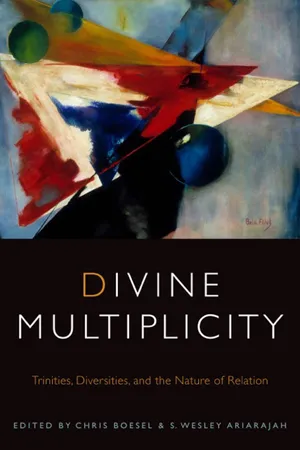
The essays in this volume ask if and how trinitarian and pluralist discourses can enter into fruitful conversation with one another. Can trinitarian conceptions of divine multiplicity open the Christian tradition to more creative and affirming visions of creaturely identities, difference, and relationality—including the specific difference of religious plurality? Where might the triadic patterning evident in the Christian theological tradition have always exceeded the boundaries of Christian thought and experience? Can this help us to inhabit other religious traditions' conceptions of divine and/or creaturely reality?
The volume also interrogates the possibilities of various discourses on pluralism by putting them in a concrete pluralist context and asking to what extent pluralist discourse can collect within itself a convergent diversity of orthodox, heterodox, postcolonial, process, poststructuralist, liberationist, and feminist sensibilities while avoiding irruptions of conflict, competition, or the logic of mutual exclusion.
eBook - ePub
Divine Multiplicity
Trinities, Diversities, and the Nature of Relation
- 364 pages
- English
- ePUB (mobile friendly)
- Available on iOS & Android
eBook - ePub
Divine Multiplicity
Trinities, Diversities, and the Nature of Relation
About this book
Information
Publisher
Fordham University PressYear
2013Print ISBN
9780823253968
9780823253951
eBook ISBN
9780823253975
Topic
Theology & ReligionSubtopic
Comparative ReligionNOTES
THE GOD WHO IS (NOT) ONE: OF ELEPHANTS, BLIND MEN, AND DISAPPEARING TIGERS | PHILIP CLAYTON
1. Stephen Prothero, God Is Not One: The Eight Rival Religions That Run the World—and Why Their Differences Matter (San Francisco: HarperOne, 2010).
2. For an excellent summary, see Paul O. Ingram, The Modern Buddhist-Christian Dialogue: Two Universalistic Religions in Transformation (Lewiston, Maine: E. Mellen Press, 1988).
3. John Hick, An Interpretation of Religion (New Haven: Yale University Press, 1989).
4. See www.ClaremontLincoln.org.
5. Catherine Keller and Laurel Schneider, eds., Polydoxy: Theology of Multiplicity and Relation (New York: Routledge, 2011).
6. I made the epistemic case in a previous essay for the Drew series. See Philip Clayton, “The Infinite Found in Human Form: Intertwinings of Cosmology and Incarnation,” in Apophatic Bodies: Negative Theology, Incarnation, and Relationality, ed. Chris Boesel and Catherine Keller (New York: Fordham University Press, 2010).
7. J. Wentzel van Huyssteen, Essays in Postfoundationalist Theology (Grand Rapids, Mich.: W. B. Eerdmans, 1997).
8. John Rawls, A Theory of Justice, 2nd ed. (Cambridge, Mass.: Harvard University Press, 1999); idem, Political Liberalism (New York: Columbia University Press, 1996); idem, Justice as Fairness: A Restatement (Cambridge, Mass.: Harvard University Press, 2001).
9. Among innumerable publications see esp. Jürgen Habermas, The Theory of Communicative Action, trans. Thomas McCarthy, 2 vols. (Boston: Beacon Press, 1984–87).
10. The debate on coherence theories in Anglo-American philosophy goes back to W. V. O. Quine and J. S. Ullian, The Web of Belief (New York: Random House, 1970). Key works include Laurence BonJour, The Structure of Empirical Knowledge (Cambridge, Mass.: Harvard University Press, 1985), and Keith Lehrer, Theory of Knowledge, 2nd ed. (Boulder: Routledge, 2000).
11. See, e.g., Donna Haraway, “Situated Knowledges: The Science Question in Feminism and the Privilege of Partial Perspectives,” Feminist Studies 14, no. 3 (1988): 575–99; Luce Irigaray, To Be Two, trans. Monique M. Rhodes and Marco F. Cocito-Monoc (New York: Routledge, 2001); idem, The Irigaray Reader, ed. Margaret Whitford (Cambridge, Mass.: Basil Blackwell, 1991).
12. Robert Brandom’s appropriation of Hegel has been a notable exception; see Robert Brandom, Making It Explicit: Reasoning, Representing, and Discursive Commitment (Cambridge, Mass.: Harvard University Press, 1994); idem, Between Saying and Doing: Towards an Analytic Pragmatism (Oxford: Oxford University Press, 2008). When analytic philosophers move in this direction, one usually finds contemporary Continental philosophy or feminist theory among the causes. For a great example in the analytic tradition, see Karen Warren, Ecofeminist Philosophy: A Western Perspective on What It Is and Why It Matters (Lanham, Md.: Rowman and Littlefield, 2000).
13. See Richard Rorty, Philosophy and the Mirror of Nature (Princeton: Princeton University Press, 1979); John R. Searle, The Construction of Social Reality (New York: Free Press, 1995).
14. Philippa Foot, Virtues and Vices and Other Essays in Moral Philosophy (Oxford: Clarendon Press; New York: Oxford University Press, 2002); Martha C. Nussbaum, The Fragility of Goodness: Luck and Ethics in Greek Tragedy and Philosophy (Cambridge: Cambridge University Press, 1986).
15. See Franz Rosenzweig, The Star of Redemption, trans. of the 2nd ed. [1930] by William W. Hallo (Notre Dame, Ind.: Notre Dame Press, 1985); Gershom Scholem, Major Trends in Jewish Mysticism (New York: Schocken Books, 1995); and (more controversially) Martin Buber, e.g., Martin Buber, Tales of the Hasidim, 2 vols., trans. Olga Marx (New York: Schocken Books, 1991).
16. See Emil L. Fackenheim, To Mend the World: Foundations of Post-Holocaust Jewish Thought (Bloomington: Indiana University Press, 1994). In particular, the Kabbalistic narrative of bringing together the divine sparks from the En Soph through human community, observance, and the quest for justice combined metaphysical narrative with the distinctives of Jewish observance in a way that is paradigmatic of the type of work I am defending.
17. It’s not that the simple solutions are wrong; narratives can express ethical and political commitments and ideals, and thus encourage powerful prophetic action within society.
18. Marjorie Suchocki, God, Christ, Church: A Practical Guide to Process Theology (New York: Crossroad, 1989), 33.
19. Philip Clayton and Steven Knapp, The Predicament of Belief: Science, Philosophy, Faith (Oxford: Oxford University Press, 2011).
20. See Jürgen Moltmann, The Crucified God: The Cross of Christ as the Foundation and Criticism of Christian Theology, trans. R. A. Wilson and John Bowden (New York: Harper and Row, 1974), esp. chap. 6.
21. I happily acknowledge the leadership of John Thatamanil in this project. Not only has John made the case in The Immanent Divine: God, Creation, and the Human Predicament (Minneapolis: Fortress Press, 2006), but he has also brought it home effectively in numerous lectures, blogs, and videos.
22. http://www.iucnredlist.org/news/following-flex, accessed May 14, 2012.
23. Visit http://www.greenmuze.com/animals/wild/2058-wild-tigers-disappearing.html, accessed May 14, 2012. Or just google “disappearing tigers.”
GOD’S VITALITY: CREATIVE TENSION AND THE ABYSS OF DIFFÉRANCE WITHIN THE DIVINE LIFE | ERIC TROZZO
1. Notable figures within this group would include Mark Heim and David Ray Griffin, and Laurel Schneider. While there are clearly differences between the proposals and projects of these theologians, they share an interest in the role of multiplicity within divinity.
2. See John Hoffmeyer’s essay in this volume, “Multiplicity and Christocentric Theology.”
3. Lewis S. Ford, “The Appropriation of Dynamics and Form for Tillich’s God,” Harvard Theological Review 68 no. 1 (1975): 37.
4. Paul Tillich, Systematic Theology, vol. 1 (Chicago: University of Chicago Press, 1951), 179. Tillich distinguishes between me on (relative or potential nonbeing) and ouk on (absolute nonbeing). Me on is the dynamic potentiality of that which does not exist but might and so could burst into the realm of being, whereas ouk on is the absolute not existing that stops all being.
5. Ibid.
6. Ibid., 41.
7. Ibid., 156.
8. I am specifically referring to Tillich’s understanding of the Spirit offered up in this passage of the first volume of his Systematic Theology. He deals with the Spirit in other ways in other places, notably the third volume of the Systematic Theology, that lie outside what can be addressed within the current discussion.
9. Tillich, Systematic Theology, 1:156.
10. Ibid., 247.
11. Paul Tillich, The Interpretation of History, http://www.religion-online.org/showbook.asp?title=377, 1:1b.
12. Tillich, Systematic Theology, 1:242.
13. Ford, “Dynamics and Form,” 42.
14. Tillich, Systematic Theology, 1:246.
15. John J. Thatamanil, The Immanent Divine: God, Creation, and the Human Predicament (Minneapolis: Fortress Press, 2006), 144.
16. Ibid., 146.
17. Tillich, Systematic Theology, 1:243.
18. Ford, “Dynamics and Form,” 46.
19. Daniel J. Peterson, “Jacob Boehme and Paul Tillich: A Reassessment of the Mystical Philosopher and Systematic Theologian,” Religious Studies 42, no. 2 (2006): 231.
20. Here I have in mind not just the ideas coming from Boehme and Tillich but also Richard Kearney’s more recent ...
Table of contents
- Cover
- Series Page
- Title Page
- Copyright
- Contents
- Acknowledgments
- Introduction: The Whence and the Whither of “Divine Multiplicity”
- Philosophical Explorations: Divinity, Diversity, Depth
- Interreligious Explorations: Religious Diversity and Divine Multiplicity
- Theo-Anthropological Explorations: Queer God, Strange Creatures, Storied Spirit
- Doctrinal Explorations: Trinity, Christology, and the Quality of Relation
- Notes
- List of Contributors
- Transdisciplinary Theological Colloquia
Trusted by 375,005 students
Access to over 1.5 million titles for a fair monthly price.
Study more efficiently using our study tools.
Frequently asked questions
Yes, you can cancel anytime from the Subscription tab in your account settings on the Perlego website. Your subscription will stay active until the end of your current billing period. Learn how to cancel your subscription
No, books cannot be downloaded as external files, such as PDFs, for use outside of Perlego. However, you can download books within the Perlego app for offline reading on mobile or tablet. Learn how to download books offline
Perlego offers two plans: Essential and Complete
- Essential is ideal for learners and professionals who enjoy exploring a wide range of subjects. Access the Essential Library with 800,000+ trusted titles and best-sellers across business, personal growth, and the humanities. Includes unlimited reading time and Standard Read Aloud voice.
- Complete: Perfect for advanced learners and researchers needing full, unrestricted access. Unlock 1.5M+ books across hundreds of subjects, including academic and specialized titles. The Complete Plan also includes advanced features like Premium Read Aloud and Research Assistant.
We are an online textbook subscription service, where you can get access to an entire online library for less than the price of a single book per month. With over 1.5 million books across 990+ topics, we’ve got you covered! Learn about our mission
Look out for the read-aloud symbol on your next book to see if you can listen to it. The read-aloud tool reads text aloud for you, highlighting the text as it is being read. You can pause it, speed it up and slow it down. Learn more about Read Aloud
Yes! You can use the Perlego app on both iOS and Android devices to read anytime, anywhere — even offline. Perfect for commutes or when you’re on the go.
Please note we cannot support devices running on iOS 13 and Android 7 or earlier. Learn more about using the app
Please note we cannot support devices running on iOS 13 and Android 7 or earlier. Learn more about using the app
Yes, you can access Divine Multiplicity by Chris Boesel, S. Wesley Ariarajah, Chris Boesel,S. Wesley Ariarajah in PDF and/or ePUB format, as well as other popular books in Theology & Religion & Comparative Religion. We have over 1.5 million books available in our catalogue for you to explore.