In the current age where democratic and egalitarian ideals have preeminence, Eastern Orthodox Christianity, among other hierarchically organized religious traditions, faces the challenging questions: "Why is hierarchy maintained as the model of organizing the church, and what are the theological justifications for its persistence?" These questions are especially significant for historically and contemporarily understanding how Orthodox Christians negotiate their spiritual ideals with the challenges of their social and ecclesiastical realities.
To critically address these questions, this book offers four case studies of historically disparate Byzantine theologians from the sixth to the fourteenth-centuries—Dionysius the Areopagite, Maximus the Confessor, Niketas Stethatos, and Nicholas Cabasilas—who significantly reflect on the relationship between spiritual authority, power, and hierarchy in theoretical, liturgical, and practical contexts. Although Dionysius the Areopagite has been the subject of much scholarly interest in recent years, the applied theological legacy of his development of "hierarchy" in the Christian East has not before been explored.
Relying on a common Dionysian heritage, these Byzantine authors are brought into a common dialogue to reveal a tradition of constructing authentic ecclesiastical hierarchy as foremost that which communicates divinity.
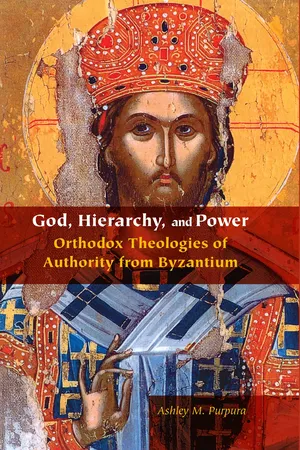
eBook - ePub
God, Hierarchy, and Power
Orthodox Theologies of Authority from Byzantium
- 240 pages
- English
- ePUB (mobile friendly)
- Available on iOS & Android
eBook - ePub
About this book
Information
CHAPTER
1
DIONYSIUS THE AREOPAGITE’S DIVINIZING HIERARCHY
Dionysius the Areopagite is widely acknowledged as the terminological and theological founder of “hierarchy” as a Christian concept.1 Scholars agree that “hierarchy” is one of Dionysius’s most significant and enduring contributions, but the modern interpretation and evaluation of this contribution varies considerably.2 Charles Stang, for example, characterizes Dionysian hierarchy as “a providential ordering of beings … who can claim no analogy, no relative likeness to God,” suggesting a limitation in the hierarchy’s ability to communicate divinity. In comparison, Paul Rorem defines Dionysius’s hierarchy as “enabling the imitation of God,” which expresses a potentiality. Ysabel de Andia, on the other hand, defines hierarchy as “imitation of the High Priest in dispensing the divine light,” so that hierarchy appears as a fact of already accomplished divine communication.3 Moreover, among contemporary scholars, a unified relationship between hierarchy and power at the practical and theological levels appears only as a peripheral consideration. Alexander Golitzin is a notable exception with his theological interpretation that “a hierarchy is … a community, a single corporate organism bound together by the exercise of a loving and mutual providence whose origins and enabling power come directly from God,” which suggests more applied extensions of hierarchy through an emphasis on community relationships.4 Outside of the study of the Areopagite’s writings specifically, often hierarchy is severed from its robust theological attributions and interpretations. Consequently, Dionysius’s lending of “hierarchy” to Christian theology appears in modern scholarship to be primarily of terminological significance.5 Andrew Louth persuasively claims that although the authenticity of the Corpus Dionysiacum was initially contested in the sixth century, the term “hierarchy” immediately resonated throughout Christendom with enduring acceptance. For many, both in antiquity and modernity, hierarchy signifies the organizational and clerical administrative structure of the church.6 Although this is one meaning of hierarchy for Dionysius—based on the church being the living Body of Christ and priests bringing about the communication of the Body of Christ—hierarchy is more than just an administrative organization. Dionysius founds hierarchy more ideologically and practically around communicating divine power to this world and transforming earthly powers by it. Accordingly, Dionysian hierarchy is often critiqued by scholars for being too idealized for practical application, or if applied, for resulting in a type of infallible or “magical” clericalism.7 In its modern application, Dionysius’s own theological rendering of hierarchy appears nearly inconsequential beyond the Corpus Dionysiacum, compared to the use of the hierarchic term itself. As I will detail in the following chapters, however, this truncating of the significance of “hierarchy” does not accurately reflect its Orthodox theological development.8
In contrast to the trend of distancing the oft-perceived problematic theology of Dionysian hierarchy from the term, there is a way to read the paradoxical theology of divine power as determinative of hierarchical content. Dionysius develops ecclesiastical hierarchy precisely as a fixed signifier for the flexible means by which humans communicate God in the world. Consequently, the concept of ecclesiastical hierarchy is flexible in the composition of its human content, yet fixed in the immovable divine reality it signifies. Hierarchy for Dionysius is the means of divinization and the divinizing activity itself. Ecclesiastical hierarchy, if read in this light, is foremost determined by divinizing activity, realized in sacramental ritual, and the very means by which practical issues perceived as challenges to church order can be overcome while maintaining the ultimate necessity and goodness of hierarchy as a means of participating in divine power. Therefore, ecclesiastical hierarchy is most fruitfully and consistently read in the Corpus Dionysiacum as a signifier for a dynamic divinizing reality. As we shall see in subsequent discussions of later Byzantine authors, the conception of hierarchy as that which divinizes pervades discussions of church legitimacy even where the term is absent—suggesting a persisting Dionysian hierarchic theological legacy.
Central to understanding Dionysius’s vision and negotiation of hierarchy are the historical and pseudonymic contexts in which the Corpus Dionysiacum was composed. There is no certainty about the author of the Corpus Dionysiacum’s precise provenance or dates, but the individual who wrote as Dionysius the Areopagite was likely a late fifth- or early sixth-century Syrian monk.9 Dionysius’s writings show the influence of Antiochian liturgical practices and familiarity with the liturgical customs of Constantinople.10 The difficulty of determining the historical situation of the Corpus Dionysiacum from its content is augmented by the fact that modern scholars have no access to its original Greek text.11 Moreover, the ambiguous historical situation of the author of the Corpus Dionysiacum is compounded by the texts’ historically and scholarly contested ideology. In its early and late Byzantine receptions (as well as modern scholarship), the Corpus Dionysiacum received a wide range of (and often contradictory) interpretations, and has been used to justify arguments from opposing sides of theological debates. For example, Dionysius is used as an authoritative source to argue both sides of the sixth-century christological controversies and the fourteenth-century hesychast controversy.12
In modern scholarship, the ideology and “orthodoxy” of the Areopagite is similarly contested. John Meyendorff identifies Dionysius as needing christological corrective, Jaroslav Pelikan describes Dionysius as proposing a type of “crypto-Origenism” in the Christian tradition, and Rosemary Arthur makes a compelling case that Dionysius actually held miaphysite beliefs. Others emphasize the Corpus Dionysiacum’s appropriation of Neoplatonism, with claims that Dionysius offers a false usurpation of philosophy or that through his pseudonym he tries to sneak Neoplatonic ideals into Christian theology.13 Despite this diversity of opinion on how to situate the Areopagite historically and theologically, the centrality of hierarchy as an original and significant contribution is uncontested.14
In addition to his historical context, Dionysius’s choice of pseudonym prompts the reader to imaginatively contextualize the Corpus Dionysiacum within the apostolic age. According to Acts 17:34, Dionysius was among those who converted after Paul’s sermon at the Areopagus in Athens (Acts 17:19–32). By adopting this pseudonym, Dionysius situates himself as equal to the apostles, which according to the Corpus Dionysiacum is the highest hierarchic rank in “our” (ecclesiastical) hierarchy.15 Stang suggests that Dionysius chooses this pseudonym as an ascetic practice in apophatic “unknowing” to solicit the divine presence. Other scholars propose the pseudonym is a cunning attempt to cloak the Neoplatonic content of the Corpus Dionysiacum with an apostolically endorsed Christian veneer.16 While Stang retrieves the intentionality of the pseudonym in a more positive light than many of his predecessors, in a way that appreciates pseudonymous writing as an ascetic enterprise, he does not fully extend the implications of this ascetic move to the realm of hierarchy in terms of spiritual authority and the production of power in a divinely imitative way.17 Specifically, the question remains, why would the likely monastic author of the Corpus Dionysiacum assume the pseudonym of a first-century apostolic bishop only to write about a hierarchic vision in which stepping beyond one’s hierarchic rank (e.g., that of monk) and rebuking those above (e.g., priests and bishops) is explicitly rejected?18 Taking his pseudonym into consideration as part of his hierarchic idealization, realization, and negotiation paints a fuller picture of hierarchy as the active communication of the divine image rather than as a fixed image itself. Within the hierarchic construction of power Dionysius posits, the pseudonym can be read as a tool of divine communication, which renders Dionysius empowered through giving up of the self rather than (but not exclusive of!) merely subverting temporal and ecclesiastical order. Although historically contextualizing Dionysius’s writings and person is only possible to a limited and hypothetical degree, it is still sufficient to conclude that the Corpus Dionysiacum’s hierarchic discourse developed in historical and imagined (in the case of the pseudonym) times of proliferating ecclesiastical and monastic offices alongside internal power struggles for legitimacy.19
Hierarchy in Theory
Dionysius constructs hierarchy as that which communicates divinity to humanity and that by which humanity communes in divinity. Hierarchy is a direct result of the outpouring of the triune Godhead, or divine “thearchy,” and the mediation of divine power in the world.20 Dionysius founds his notion of hierarchy as that which divinizes. Consequently, the activities of divinizing and manifesting recognizable divine likeness determines who and what is properly named hierarchy. Prioritizing the divinely communicative function of ecclesiastical hierarchy as determinative of its content unifies the diverse ways Dionysius employs and describes ecclesiastical hierarchy. Hierarchy is fixed in that it is ultimately a divine reality and the means by which that reality is made manifest. On the other hand, it is necessarily in constant adaptation to authentically communicate the perfect divinity through imperfect humanity. Moreover, hierarchy in its structure and application uniquely mediates divine power and reflects it as paradoxical self-giving and service. It is this participative outpouring unto others that empowers each rank of the hierarchy authentically to function as an icon of God.21 This interpretation of hierarchy is highlighted by Dionysius’s ritual contextualization, allows him to successfully maneuver otherwise hierarchically nullifying situations, and (as I will argue in subsequent chapters) is the most significant aspect of hierarchy for the interpretation and negotiation of power by several later Byzantine authors.
Dionysius defines hierarchy several times throughout the Corpus Dionysiacum with different formulations. These various definitions, however, are united by the foundational characteristic that hierarchy’s activity—the act of divinizing—is determinative of all its other components. Several of Dionysius’s most direct (and oft-cited) definitions of hierarchy include: an “inspired, divine, and divinely worked understanding, activity, and perfection,” “arrangement of the sacred realities,” a “gift to ensure the salvation and divinization of every being endowed with reason and intelligence,” “a sacred order, a state of understanding and an activity approximating as closely as possible to the divine,” and “forever looking directly at the comeliness of God.”22 Dionysius unites these seemingly diverse formulations by emphasizing hierarchy as the means of communicating and realizing divine power among humanity.23 The hierarchy as divinizing activity is simultaneously an order, an arrangement, an understanding, a divine vision, and perfection. It is a means of divine empowerment through divine similitude. For Dionysius, becoming God-like through participation occurs in a way that is like God. Essentially, Dionysius figures the ascent of humans to God, as well as God’s condescension to humanity, as orderly, arranged, and transfigurative.24 Nowhere does Dionysius express the ideal of hierarchy as merely the clerical and administrative ranks of the earthly institutional church (although in as much as these ranks bring about divinization they are included in this hierarchic ideal). The ecclesiastical hierarchy as Dionysius constructs it includes a triple triad of sacraments, ordained ranks, and laity.25 Hierarchy functioning at each of these levels is most basically that which brings divinity and humanity into communion.
Dionysius reflects the underlying characterization of hierarchy as that which divinizes by paralleling the image of the hierarchy with the image of God. Although which “orthodoxy” Dionysius actually holds is unclear, Dionysius reflects on the Trinity in developing hierarchy as divinely reflective by envisioning it as triadic groupings.26 Hierarchy in its active and triadic structures is thus consistent with both Dionysius’s Christian and Neoplatonic contexts.27 While the Neoplatonic trinity is undoubtedly influential on the Corpus Dionysiacum, the Christian divine Trinitarian model is more so. As Valentina Izmirlieva observes, Dionysius’s model of hierarchy is “distinctly non-hierarchical,” because it creates humanity in the likeness of the Trinitarian God who is free of any ontological hierarchical distinctions such as those found between the One, the Mind, and the Soul in Neoplatonism.28 Based on the divine model employed by Dionysius, hierarchy is indeed strictly ordered but also constituted by complete equality. The order of the hierarchy is based in and ordered by the divine Logos and therefore the human hierarchy in its authentic form conveys this divine likeness and internal divine presence.29 The definitions of hierarchy and the triadic structure through which Dionysius describes and explains hierarchy thus reflect and realize the divine image. Dionysius’s hierarchy manifests a divinely reflective equalizing unity and stratified diversity based on Trinitarian referents.30
The divine image is also communicated in hierarchical likeness by Dionysius’s construction of hierarchy as activity. Reflecting Christian and Neoplatonic influences, Dionysius conceives of God most properly as activity, as “being,” or more precisely “beyond being.”31 God being “beyond being” implies not only that hierarchy is determined by its activity—participating in God’s activity in the world—but also reflects a certain Dionysian apophatic mediation of participation in the God who is “beyond being.” An individual’s hierarchic participation as determined by divinizing activity thus reflects and participates in the God who cannot be named in terms of static attributes, but nevertheless “Is.” The individual functioning in his or her particular rank correctly is one that manifests divinizing activity through voluntary self-emptying in relation to others, not a set of humanly established and cataphatically named attributes. Again, the self-emptying activity of divine communication within the hierarchy is reflective of divine condescension, as Dionysius explains, “because of his (God’s) love for humanity he has deigned to come down to us and that, like a fire, has made one with himself all those capable of being divinized.”32 The activity of divine love is communicating divinity to others throu...
Table of contents
- Cover
- Half Title
- Series Announcement Page
- Title Page
- Copyright
- Contents
- Half Title
- Introduction: Challenge of Hierarchy for Orthodoxy
- 1. Dionysius the Areopagite’s Divinizing Hierarchy
- 2. Maximus the Confessor and Christological Realization
- 3. Niketas Stethatos’s Hierarchic Re-Imaging
- 4. Nicholas Cabasilas and Embodied Authority
- 5. Thearchical Power in Theory and Practice
- Conclusion
- Notes
- Index
- Series Page
Trusted by 375,005 students
Access to over 1.5 million titles for a fair monthly price.
Study more efficiently using our study tools.
Frequently asked questions
Yes, you can cancel anytime from the Subscription tab in your account settings on the Perlego website. Your subscription will stay active until the end of your current billing period. Learn how to cancel your subscription
No, books cannot be downloaded as external files, such as PDFs, for use outside of Perlego. However, you can download books within the Perlego app for offline reading on mobile or tablet. Learn how to download books offline
Perlego offers two plans: Essential and Complete
- Essential is ideal for learners and professionals who enjoy exploring a wide range of subjects. Access the Essential Library with 800,000+ trusted titles and best-sellers across business, personal growth, and the humanities. Includes unlimited reading time and Standard Read Aloud voice.
- Complete: Perfect for advanced learners and researchers needing full, unrestricted access. Unlock 1.5M+ books across hundreds of subjects, including academic and specialized titles. The Complete Plan also includes advanced features like Premium Read Aloud and Research Assistant.
We are an online textbook subscription service, where you can get access to an entire online library for less than the price of a single book per month. With over 1.5 million books across 990+ topics, we’ve got you covered! Learn about our mission
Look out for the read-aloud symbol on your next book to see if you can listen to it. The read-aloud tool reads text aloud for you, highlighting the text as it is being read. You can pause it, speed it up and slow it down. Learn more about Read Aloud
Yes! You can use the Perlego app on both iOS and Android devices to read anytime, anywhere — even offline. Perfect for commutes or when you’re on the go.
Please note we cannot support devices running on iOS 13 and Android 7 or earlier. Learn more about using the app
Please note we cannot support devices running on iOS 13 and Android 7 or earlier. Learn more about using the app
Yes, you can access God, Hierarchy, and Power by Ashley M. Purpura in PDF and/or ePUB format, as well as other popular books in History & Eastern European History. We have over 1.5 million books available in our catalogue for you to explore.