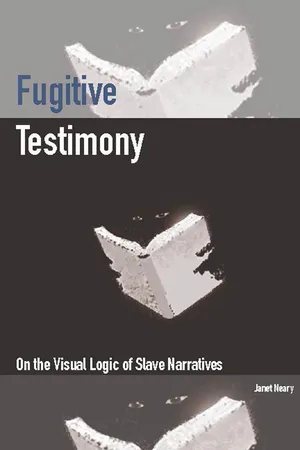
Fugitive Testimony traces the long arc of the African American slave narrative from the eighteenth century to the present in order to rethink the epistemological limits of the form and to theorize the complicated interplay between the visual and the literary throughout its history. Gathering an archive of ante- and postbellum literary slave narratives as well as contemporary visual art, Janet Neary brings visual and performance theory to bear on the genre's central problematic: that the ex-slave narrator must be both object and subject of his or her own testimony.
Taking works by current-day visual artists, including Glenn Ligon, Kara Walker, and Ellen Driscoll, Neary employs their representational strategies to decode the visual work performed in nineteenth-century literary narratives by Elizabeth Keckley, Solomon Northup, William Craft, Henry Box Brown, and others. She focuses on the textual visuality of these narratives to illustrate how their authors use the logic of the slave narrative against itself as a way to undermine the epistemology of the genre and to offer a model of visuality as intersubjective recognition rather than objective division.
- 232 pages
- English
- ePUB (mobile friendly)
- Available on iOS & Android
eBook - ePub
About this book
Information
Publisher
Fordham University PressYear
2016Print ISBN
9780823272907
9780823272891
eBook ISBN
9780823272914
Table of contents
- Cover
- Title Page
- Copyright
- Dedication
- Contents
- Epigraph
- Introduction: Representational Static
- 1. Sight Unseen: Contemporary Visual Slave Narratives
- 2. Behind the Scenes and Inside Out: Elizabeth Keckly’s Use of the Slave Narrative Form
- 3. Optical Allusions: Textual Visuality in Running a Thousand Miles for Freedom
- 4. “The Shadow of the Cloud”: Racial Speculation and Cultural Vision in Solomon Northup’s Twelve Years a Slave
- 5. Gestures Against Movements: Henry Box Brown and Economies of Narrative Performance
- Epilogue. Racial Violence, Racial Capitalism, and Reading Revolution: Harriet Jacobs, John Jones, Kerry James Marshall, and Kyle Baker
- Acknowledgments
- Notes
- Index
Trusted by 375,005 students
Access to over 1.5 million titles for a fair monthly price.
Study more efficiently using our study tools.
Frequently asked questions
Yes, you can cancel anytime from the Subscription tab in your account settings on the Perlego website. Your subscription will stay active until the end of your current billing period. Learn how to cancel your subscription
No, books cannot be downloaded as external files, such as PDFs, for use outside of Perlego. However, you can download books within the Perlego app for offline reading on mobile or tablet. Learn how to download books offline
Perlego offers two plans: Essential and Complete
- Essential is ideal for learners and professionals who enjoy exploring a wide range of subjects. Access the Essential Library with 800,000+ trusted titles and best-sellers across business, personal growth, and the humanities. Includes unlimited reading time and Standard Read Aloud voice.
- Complete: Perfect for advanced learners and researchers needing full, unrestricted access. Unlock 1.5M+ books across hundreds of subjects, including academic and specialized titles. The Complete Plan also includes advanced features like Premium Read Aloud and Research Assistant.
We are an online textbook subscription service, where you can get access to an entire online library for less than the price of a single book per month. With over 1.5 million books across 990+ topics, we’ve got you covered! Learn about our mission
Look out for the read-aloud symbol on your next book to see if you can listen to it. The read-aloud tool reads text aloud for you, highlighting the text as it is being read. You can pause it, speed it up and slow it down. Learn more about Read Aloud
Yes! You can use the Perlego app on both iOS and Android devices to read anytime, anywhere — even offline. Perfect for commutes or when you’re on the go.
Please note we cannot support devices running on iOS 13 and Android 7 or earlier. Learn more about using the app
Please note we cannot support devices running on iOS 13 and Android 7 or earlier. Learn more about using the app
Yes, you can access Fugitive Testimony by Janet Neary in PDF and/or ePUB format, as well as other popular books in Social Sciences & North American Literary Criticism. We have over 1.5 million books available in our catalogue for you to explore.