eBook - ePub
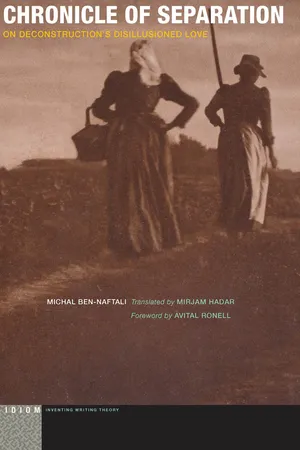
Chronicle of Separation
On Deconstruction’s Disillusioned Love
- 232 pages
- English
- ePUB (mobile friendly)
- Available on iOS & Android
eBook - ePub
About this book
A unique feminist approach to the legacy of Jacques Derrida, Chronicle of Separation is a disparate yet beautifully interwoven series of distinct readings, genres, and themes, offering a powerful reflection of love in—and as—deconstruction. Looking especially at relationships between women, Ben-Naftali provides a wide-ranging investigation of interpersonal relationships: the love of a teacher, the anxiety-ridden bond between a mother and daughter as manifested in anorexia, passion between two women, love after separation and in mourning, the tension between one's self and the internalized other. Traversing each of these investigations, Chronicle of Separation takes up Derrida's Memoires for Paul de Man and The Post Card, Lillian Hellman's famed friendship with a woman named Julia, and adaptations of the biblical Book of Ruth. Above all, it is a treatise on the love of theory in the name of poetry, a passionate book on love and friendship.
Trusted by 375,005 students
Access to over 1.5 million titles for a fair monthly price.
Study more efficiently using our study tools.
Information
Publisher
Fordham University PressYear
2015Print ISBN
9780823265800
9780823265794
eBook ISBN
9780823265817
Copyright © 2015 Fordham University Press
All rights reserved. No part of this publication may be reproduced, stored in a retrieval system, or transmitted in any form or by any means—electronic, mechanical, photocopy, recording, or any other—except for brief quotations in printed reviews, without the prior permission of the publisher.
Fordham University Press has no responsibility for the persistence or accuracy of URLs for external or third-party Internet websites referred to in this publication and does not guarantee that any content on such websites is, or will remain, accurate or appropriate.
Fordham University Press also publishes its books in a variety of electronic formats. Some content that appears in print may not be available in electronic books.
Visit us online at www.fordhampress.com.
Library of Congress Cataloging-in-Publication Data
Ben-Naftali, Michal.
[Kronikah shel peredah. English]
Chronicle of separation : on deconstruction’s disillusioned love / Michal Ben-Naftali ; translated by Mirjam Hadar.
pages cm. — (Idiom: inventing writing theory)
Includes bibliographical references and index.
ISBN 978-0-8232-6579-4 (hardback) — ISBN 978-0-8232-6580-0 (paper)
1. Deconstruction. 2. Interpersonal relations. 3. Gender identity.
4. Anorexia nervosa. I. Title.
4. Anorexia nervosa. I. Title.
B809.6.B4613 2015
149'.97—dc23
2014033583
Printed in the United States of America
17 16 15 5 4 3 2 1
First edition
CONTENTS
Foreword: Friendship, Unauthorized by Avital Ronell
Preface
1 From Absolute Love to the Politics of Friendship
2 Let’s Show Our (Post) Cards
3 Julia
4 “And She Did Eat and Was Sufficed and Left”: Deconstruction as an Anorexic Perspective
5 The Book of Ruth
Epilogue
Notes
Bibliography
Index
FOREWORD:
FRIENDSHIP, UNAUTHORIZED
AVITAL RONELL
FRIENDSHIP, UNAUTHORIZED
AVITAL RONELL
I have wanted to get a close-up, to confirm an incomparable alliance. Maybe show up for her, if only as a measure of the postal logic to which her writing bears witness. I could enact the stalls of arrival, tracking the uncharted convergence of a destiny and its destination. Show up without properly manifesting, develop an itinerary that stays depropriative—at once steady in its nearness and prudently off range. Philippe Lacoue-Labarthe has taught us to think in terms of depropriation, which entails a form of rigorous hesitation when assuming responsibility for the work or thought of another, an ally or ancestor, or unknown straggler of writing. I would be capable, I tell myself, of refraining from putting stakes down as one does when claiming a territory. To the extent that I am at all “capable”—willed-to-power on any level of existence, able to accompany and say and squeak, like my cousin Josefine, Queen of the Mausvolk. But that’s another story of certifiable kinship, another depropriating route; I shall desist from exploring my literary roots to follow a different cut of destination. Postal logic indicates that we might not make it, that some other form of address, inadvertent and remote, might overtake the travel plan that I had in mind. Nonetheless, I wanted to show up for her, take the call by accompanying her writing, at least part of the way. Not sure what in fact propelled me, I would do my best, “faire mon impossible,” as I sometimes tell myself. But why, in this instance and to this address?
1
Maybe we were meant to be friends. Yet, so much militated against such an extravagance: the hypothesis that we were meant to be friends. Language, philosophical habits and markers, existentially pitched checkpoints were stacked against us. On what basis could I possibly befriend Michal B.—according to what ledger of determinations, approved contingencies, contractual loopholes, or transferential coordinates? The blocked passage to friendship remains a dilemma for those constituted, if only in passing, as women. The restrictive covenant is a rigorous part of the order of things. When you’re a girl, friendship doesn’t just happen; you have to be willing to go against all sorts of grains and traditionally set restrictions, the blowback of cynical postulations. Still, no flex of muscled lucidity will help you make the grade as friend, for the situation is not a matter of some accidental lockout. Our metaphysical heritage has rigorously demanded the embargo on the female clasp of friendship.
Despite revolutionary breakthrough stances or carefully attended displacements, one still remains tethered to a grating heritage that defines, oppresses, structures, feeds, regulates, or plumps any attempt at reconfigured personhood, setting up the rules and regs, metaphysically speaking, that make politically-tinged aspects of relatedness an affair of men. Metaphysics, our homeroom language and shared existential springboard, puts a ban on friendship among women. The stakes are undoubtedly high, for the motif of friendship ensures the modeling of all sorts of vital ethical and political dispositions, grounding our sense of justice. As Derrida has argued, friendship serves as the blueprint for political and amorous cleaves. Women, for the most part, have been assigned to the historical sidelines, even though they prove adept at traumatically intrusive break-ins and manage to achieve a modicum of social rewrites. One thinks of Antigone, of Kleist’s feminine figurines that shoot out counter-memory to block historical narratives of entitlement; one continues to be struck by the howls of one-woman–lone-warrior types like Valerie Solanas; one continues to stress over the seething deflations of Ingeborg Bachmann and the ongoing peel-down of Sylvia Plath. (I have more names in mind; I love enumeration and memorializing remembrance—I can go overboard with my lists, but this is not the place.)
So. How to get around this embarrassment and still make some sort of legitimate outreach program primed on the protocols of friendship stick? My share of Penis-neid is wrapped up in withheld friendship, an attachment or disposition, an inclination of being-in-the-world declared off-limits to women. Of course male designees yammer staggeringly, from Aristotle to our day, about the nearly impossible attainment of friendship, but that plaint operates on an entirely other level and register of constraint and taboo.
Maybe I was called up by a different politics of friendship, a different grid or writing practice that pulls one close to another’s distress. I search out the skies daily for smoke signals, often discreet and sophisticated or technologically upgraded. I am always on the lookout for signaling systems, no matter how remote or deferred, no matter how misdirected or suddenly they appear on my desk. I am not the only one waiting anxiously at the ready to sign for a designated—or stray—envoi. I for my part may be the warp of a defective GPS, for I cannot imagine that my function as address has been taken all that seriously. Still, things, no matter how deflected or dead letter boxed, do have a way of showing up at my door or on my desk (the door is law for Celan, the desk for Kafka: these are not contingent architectural motifs). I have little to offer, and less that I can do. At most, I can provide a reading. But is that so derisory? For so many of the luminous writers that command my moves and immobility, reading sets the stage for friendship’s sweep, for the amicable rejoinder, establishing the levers that pull in another Dasein.
I first heard of Michal Ben-Naftali from Marguerite Derrida one afternoon in Ris-Orangis, when we were hanging out and Jacques was taking lunch in Paris with his Hebrew translator. Since that initiatory encounter—a rumor, a discreet shadow enfolded in the Aufgabe from which Walter Benjamin whipped us (well, me) into a hysterical frenzy—I have been following Ben-Naftali’s trajectory, wondering, among other things and destinations, about the vectors defining our intellectual kinship and the conditions of an a priori fellowship, quietly staging the “sight unseen” kind of embrace that I was prepared to offer. Or, digging out of a paleonymic rut, let us say that I probed the premises for establishing a relationality, whether gendered or not, maybe even scouring our shared traditions in search of solid amity, a kind of grrlship, since “fellowship” sounds peculiar, if not altogether void. In any case, I have felt, from day one, responsible to and for Michal Ben-Naftali. Lately, though, the gentle disposition has turned into a streak of fearfulness, for I have become anxious about initializing her important text, upsetting its carefully laid tracks and ecosystems with my inescapable trip-ups prompted by the historical panic attacks that make language hard to come by, self-undermining and capable of upturning the most serene trajectories of thought. Already in the early paragraphs I flail about for a bolstering idiom, a way to designate “fellowship” among, let us say, women—or more crunched still, among women authors, philosophers in the feminine, and the stock of conceptual incompatibilities bequeathed to Michal and me. The inevitable slip-up, the stammer and stall, is not entirely my fault when I try to give expression to an inclination on my part to befriend Michal Ben-Naftali.
You already know that, on the whole, philosophy squeezes out friendship among women, even merely so-called and difficultly coded women. I am on repetition compulsion; but this bears repeating, calling out, obsessing with, lamenting. There’s simply no call for friendship among women in the metaphysical dialup—at most, grrls were accorded some provisional and retaliatory alliances, identificatory contrivances, or other busts in the consolidation of Mitsein. For Hegel, woman not only famously stood as the irony of the community, but she figured also as its enemy. Still, friendship can host adversity; friendship among enemies was not accommodated, however, as a particular style or option in philosophical rosters—at least not before the alliance of Montaigne and Nietzsche was closed, or before Werner Herzog’s boundary-breaking film, Mein bester Feind (My Best Enemy) or the notion of “frenemy” was coined relatively recently.
We know from other well-documented philosophical tendencies that friendship can spin easily enough into enmity, or even that enmity is the intensification of friendship, as when Blake writes, “Be my enemy for friendship’s sake.” I don’t think that Hegel, who was in it to win it, was dialectically angling for the capture of powerful affect, for raising the stakes of friendship by turning women into standout enemies, though. When you scroll down the philosophical corridor of determinations, becoming ...
Table of contents
- CONTENTS
Frequently asked questions
Yes, you can cancel anytime from the Subscription tab in your account settings on the Perlego website. Your subscription will stay active until the end of your current billing period. Learn how to cancel your subscription
No, books cannot be downloaded as external files, such as PDFs, for use outside of Perlego. However, you can download books within the Perlego app for offline reading on mobile or tablet. Learn how to download books offline
Perlego offers two plans: Essential and Complete
- Essential is ideal for learners and professionals who enjoy exploring a wide range of subjects. Access the Essential Library with 800,000+ trusted titles and best-sellers across business, personal growth, and the humanities. Includes unlimited reading time and Standard Read Aloud voice.
- Complete: Perfect for advanced learners and researchers needing full, unrestricted access. Unlock 1.5M+ books across hundreds of subjects, including academic and specialized titles. The Complete Plan also includes advanced features like Premium Read Aloud and Research Assistant.
We are an online textbook subscription service, where you can get access to an entire online library for less than the price of a single book per month. With over 1.5 million books across 990+ topics, we’ve got you covered! Learn about our mission
Look out for the read-aloud symbol on your next book to see if you can listen to it. The read-aloud tool reads text aloud for you, highlighting the text as it is being read. You can pause it, speed it up and slow it down. Learn more about Read Aloud
Yes! You can use the Perlego app on both iOS and Android devices to read anytime, anywhere — even offline. Perfect for commutes or when you’re on the go.
Please note we cannot support devices running on iOS 13 and Android 7 or earlier. Learn more about using the app
Please note we cannot support devices running on iOS 13 and Android 7 or earlier. Learn more about using the app
Yes, you can access Chronicle of Separation by Michal Ben-Naftali, Mirjam Hadar in PDF and/or ePUB format, as well as other popular books in Literature & Literary Criticism for Comparative Literature. We have over 1.5 million books available in our catalogue for you to explore.