In recent years, a number of books in the field of literacy research have addressed the experiences of literacy users or the multiple processes of learning literacy skills in a rapidly changing technological environment. In contrast to these studies, this book addresses the subjects of literacy. In other words, it is about how literacy workers are subjected to the relations between new forms of labor and the concept of human capital as a dominant economic structure in the United States. It is about how literacies become forms of value producing labor in everyday life both within and beyond the workplace itself.
As Evan Watkins shows, apprehending the meaning of literacy work requires an understanding of how literacies have changed in relation to not only technology but also to labor, capital, and economics. The emergence of new literacies has produced considerable debate over basic definitions as well as the complexities of gain and loss. At the same time, the visibility of these debates between advocates of old versus new literacies has obscured the development of more fundamental changes. Most significantly, Watkins argues, it is no longer possible to represent human capital solely as the kind of long-term resource that Gary Becker and other neoclassical economists have defined. Like corporate inventory and business management practices, human capital—labor—now also appears in a "just-in-time" form, as if a power of action on the occasion rather than a capital asset in reserve.
Just-in-time human capital valorizes the expansion of choice, but it depends absolutely on the invisible literacy work consigned to the peripheries of concentrated human capital. In an economy wherein peoples' attention begins to eclipse information as a primary commodity, a small number of choices appear with an immensely magnified intensity while most others disappear entirely. As Literacy Work in the Reign of Human Capital deftly illustrates, the concentration of human labor in the digital age reinforces and extends a class division of winners on the inside of technological innovation and losers everywhere else.
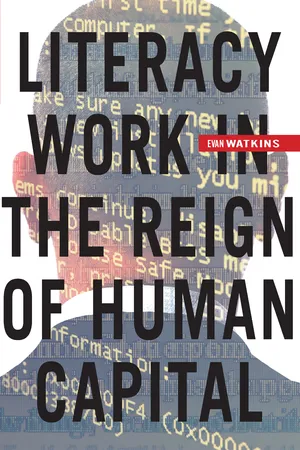
- 184 pages
- English
- ePUB (mobile friendly)
- Available on iOS & Android
eBook - ePub
Literacy Work in the Reign of Human Capital
About this book
Information
Publisher
Fordham University PressYear
2015Print ISBN
9780823264230
9780823264223
eBook ISBN
9780823264247
CHAPTER 1
Capitalizing on Autonomy
Gary Becker had available a number of sources for the concept of human capital developed in his 1964 book of that title, but one particularly powerful originary formulation occurs in none other than Adam Smith. In The Wealth of Nations Smith identifies, as one kind of fixed capital, “the acquired and useful abilities of all the inhabitants or members of the society,” noting that “[t]he acquisition of such talents, by the maintenance of the acquirer during his education, study, or apprenticeship, always costs a real expence, which is a capital fixed and realized, as it were, in his person” (358). In this passage Smith lays down a basic principle that over two centuries later Becker will reaffirm in Human Capital: that what “distinguishes human from other kinds of capital is that, by definition, the former is embedded or embodied in the person investing” (112).
Smith’s elaboration of his basic point, however, will raise some considerable concern among his later commentators: “The improved dexterity of a workman may be considered in the same light as a machine or instrument of trade which facilitates and abridges labour, and which, though it costs a certain expence, repays that expence with profit” (Wealth of Nations, 358). That is, a worker’s skills are a form of capital just like “a machine or instrument of trade,” only in this case they are “fixed and realized, as it were, in his person.” The editors of the Bantam Classic edition of The Wealth of Nations, echoing a long-familiar critique, remark that the difficulty is that Smith had used almost the same comparison earlier as a justification for why certain workers should receive higher wages for the work they do: “A man educated at the expence of much labour and time to any of those employments which require extraordinary dexterity and skill, may be compared to one of those expensive machines. The work which he learns to perform, it must be expected, over and above the usual wages of common labour, will replace to him the whole expence of his education, with at least the ordinary profits of an equally valuable capital” (141).
Neoclassical economists may well be scandalized at what looks to be some confusion on Smith’s part between a labor market exchange of wages for the actual work the laborer performs, albeit more highly skilled work than most, and a capital asset one might acquire and then embody in one’s own person as human capital. I am not entirely sure it would be confusing to Smith, however, since in both passages he is clearly talking about a worker. In the later passage no less than the earlier, Smith seems primarily concerned with fair recompense for the worker who has taken the individual trouble to acquire something that will also be of value to society as a whole when exercised. In the passage I quoted above from Becker’s Human Capital, the key word instead is “investing.” Although Smith mentions “dexterity” as well as “skill,” the significant difference is not really a matter of manual worker versus brain worker, as often implied in media representations of human capital in contrast to what was required of industrial laborers. Smith’s human capital agent is a laborer whom Smith feels should recover the expenses of acquiring new and valuable skills she or he uses in the work. Becker’s agent is imagined as if already an individual capitalist entrepreneur, a minicapitalist rather than a worker.
Smith is often lauded by later economists for his near-throwaway line about an “invisible hand” guiding the market to just conclusions, but the passages quoted above suggest some skepticism about whether market forces would actually ensure fairness with regard to the distribution of rewards for the effort of acquiring human capital. For Becker, in contrast, the individual who chooses to invest in a human capital asset can expect only the kinds of risks and rewards that exist for any other market player. She or he should be expected to bear the consequences of investment decisions. At the same time, Becker evidences a far more considerable faith in market workings than Smith. Ultimately it can be expected that human capital investors will get what they deserve in relation to the assets they bring to the marketplace. If inequalities exist, they are attributable to different skill sets and greater or lesser motivation to acquire human capital resources. Becker has argued strongly that human capital yields immense economic and social benefits as well as individual rewards. Nevertheless, in contrast to Smith’s worries about fairness to a worker whose skills benefit society as well as the individual, the point is not at issue in Becker’s basic definition.
Literacy is not usually foregrounded in Becker’s argument, but his model can accommodate relatively traditional definitions of literacy quite easily. In considering family influences on childhood investment, for example, Becker argues that while “human capital takes many forms, including skills and abilities, personality, appearance, reputation, and appropriate credentials, we further simplify by assuming that it is homogeneous and the same ‘stuff’ in different families” (Human Capital, 262). Before the emergence of New Literacy Studies, most definitions of literacy assumed that it should be considered as indeed “the same stuff” no matter where it appeared, a kind of culturally autonomous set of skills in principle available to anyone willing to do the necessary work to acquire them. Few might have doubted that literacy skills were relatively more available to certain children than to others given variations in childhood living conditions, but in principle again the substance of the acquisition was the same whether the skills were acquired with relative ease or considerable hardship.
Background counts in Becker’s thinking about the complexities of human capital “stuff,” but the idea of individual choices made by rational investors remains the central theme: “The approach presented here, however, offers an explanation that is not only consistent with economic analysis but actually relies on one of its fundamental tenets, namely, that the amount invested is a function of the rate of return expected” (100). He may not be imagining everyone actually calculating demand curves, time units, and so on in advance, but the implication is that the closer one comes to performing such calculations and being guided by them, the better the investment return is likely to be. Likewise, the better the calculations parents make in investing, for example, in their children’s education, the more likely it will be that the children will become rich in human capital assets as they mature.
New Literacy Studies, however, aimed a powerful critique at the ideological implications of “same stuff” definitions of literacy. Brian Street argued in Literacy in Theory and Practice that dominant definitions of literacy both reflected and disguised a specific set of conditions. For those growing up in different conditions altogether from those silently assumed, these skills were often unavailable, and in any case clearly functioned very differently from the social practices in other communities. In Literacy in American Lives Deborah Brandt recognized that New Literacy Studies set out not only to democratize the means of access to literacy as more traditionally defined, but also, as Street’s argument suggests, to alter definitions in order to recognize multiple forms of literacy embedded within specific ensembles of social practices. Thus in her account literacy invites “broader connotations” than Becker’s concept of human capital, in ways “that will take on resonance as this study unfolds” (6).
Since Gary Becker’s mid-twentieth-century formulation, however, human capital has also taken on “broader connotations” that can escape some of the limitations of Becker’s model of rational investment. I suggested in my introduction that for my purposes, Yochai Benkler’s concept of human communicative capacity in The Wealth of Networks offers a particularly useful avenue for exploring the expansion of the basic idea. Benkler’s definition of human communicative capacity not only seems more broad-based than Becker’s concept of human capital, but also more compatible with Brandt’s far-reaching account of literacy. Like human capital in Becker’s definition, human communicative capacity is embodied in the person, but it involves all “the creativity, experience, and cultural awareness necessary to take from the universe of existing information and cultural resources and turn them into new insights, symbols, or representations meaningful to others with whom we converse. Given the zero cost of existing information and the declining cost of communication and processing, human capacity becomes the primary scarce resource in the networked information economy” (Wealth of Networks,52).
Benkler’s emphasis on communication practices and representations shapes his definition more immediately toward literacy issues, especially recent research into digital literacies, multimodal users, and the affordances of different technologies in networking situations. As the last sentence in the passage above indicates, he recognizes direct connections to the economy, but in what seem to be very different terms than Becker’s rational understanding of human capital investment in relation to the market. Rather than viewing human communicative capacity as an asset that, like Becker’s human capital, benefits for-profit enterprises competing in the marketplace, Benkler imagines the fullest expression of this capacity as developing within the emergent conditions of commons-based peer production. Perhaps not surprisingly given the title of his book, The Wealth of Networks, Benkler’s argument owes something to Adam Smith, including Smith’s concern for a kind of fundamental fairness in economic relations. Unlike Gary Becker, who anticipates that the market will ultimately adjudicate just rewards in relation to human capital skills and abilities, Benkler sees the for-profit marketplace as controlled from the top down. Those at the top have every incentive to discourage diversity and individual autonomy and to waste no time at all on the process of creating conditions to ensure workplace fairness. As a primary resource for commons-based peer production, human communicative capacity becomes a primary factor in the process of transforming such an existing market economy.
Given Benkler’s challenge to for-profit markets, it seems difficult to imagine how human communicative capacity might then be identified as a capital asset. The allusion to Smith in his title, however, suggests that the key might be to connect his argument more closely to Smith’s interest in production and how it is organized, rather than to Becker’s focus on the market. Like Smith’s, Benkler’s vision of any kind of long-term balance and fairness in economic relations rests on faith in the hard work and ability of those engaged in production tasks—which is where Smith’s concept of acquired abilities as capital fixed in the person of the acquirer comes into its own, in contrast to Becker’s tightly closed rational marketplace of investors following marketplace laws. Perhaps even more than Smith, Benkler values the autonomy of all the individuals involved in production, while also recognizing the social value of human communicative capacity. In short, a return to Smith’s concept of human capital at work in production provides a basis for understanding human communicative capacity as functioning as a human capital asset—that is, as a primary economic resource embodied in a person. Unlike more modern versions and in common with Smith’s concept, Benkler is interested in how such human resources can transform economic production to everyone’s benefit.
As a more expansive resource than seems possible within the limitations of Becker’s single-focus rationalism, Benkler’s human communicative capacity promises a direction that is also more congruent with a literacy-studies account of emergent literacies. His concept suggests how multiple literacies might flourish in the midst of complex economic relations, while also highlighting the importance of diversity and individual autonomy. Indeed, he argues forcefully that for all its advantages over for-profit enterprise, commons-based peer production driven by human communicative capacity is only a means to the end of maximizing autonomy for each individual. His argument thus seems much more immediately in line with the democratizing imperatives of recent literacy studies and the claims for necessary educational reforms. If perhaps paradoxically, Benkler’s debt to Smith allows him to define and elaborate a capacious and flexible set of concepts that are more suggestive in thinking about new literacies and economic value than what Becker has to offer.
Smith was well aware, however, of how the efficiency of production that he admired so much could result at the same time in the most stultifying working conditions for many of those in the factories. Nor was he under any illusion that those working conditions were simply an unfortunate persistence from the past that might soon become obsolete as production became even more efficient. Those conditions were created by the very same changes that made the greatly expanded production possible. Benkler in contrast finds little to worry about in a networked future, if the constraints on individual autonomy surviving from the past can finally be eased. That is, the problems he foresees are all assigned to the unfortunate persistence of past practices rather than to a recognition like Smith’s of how current conditions might simultaneously produce new limitations on any kind of democratic fairness. As all too often in literacy studies as well, it is the divide between old and new that occupies his attention.
In his zeal for maximizing individual autonomy, Benkler installs in the middle of his map for economic transformation an assumption that is also a core component of the literacy myth. For all that the name and the practices he describes would seem to identify a collective enterprise, commons-based peer production is finally all about enhancing the experiences of the autonomous individual. In my conclusion below I will argue that far from serving the democratizing of production that Benkler imagines, the principles of individual autonomy that he values so highly have become central to the transformation of Becker’s concept of human capital into what I call just-in-time human capital. In the following chapter I describe some of the many differences between just-in-time principles and more familiar concepts of human capital, but in one significant respect at least just-in-time behaves very similarly. Like any other form of human capital, just-in-time human capital is in the business of constituting economic subjects. As a result, the practices Benkler hopes will democratize commons-based peer production for everyone instead re-create a familiar capital class division—not because Benkler’s fundamental principle of individual autonomy has been ignored, but because it hasn’t. Just-in-time human capital is built on individual autonomy in order to ensure that the ghost of Adam Smith and the dream of labor fairness might be left entirely behind.
Gary Becker understood that human capital is a produced rather than a natural resource, but Benkler is far from clear about the origins of human communicative capacity. Unlike Deborah Brandt, who is willing to think by analogy of literacy as if it were a “natural resource” given the current conditions of an information economy, Benkler often seems to take the natural resource idea quite literally. Human communicative capacity is “something each of us innately has, though in divergent quanta and qualities” (Wealth of Networks, 52). Yet it also involves “creativity,” “experience,” and “cultural awareness” (52), not characteristics typically recognized as innate. What is clear is that in common with both Smith’s and Becker’s definitions of human capital, Benkler understands human communicative capacity as embodied in the person of the individual. But while Smith is uncomfortably aware of how efficient modern production can create difficult working conditions for some individuals while enhancing the lives of others, Benkler remains insistent that commons-based peer production is finally all about maximizing individual autonomy for everyone.
In his initial definition Benkler emphasizes a “practical” understanding of individual autonomy as a power of action in specific circumstances, unlike “formal” definitions of autonomy that fail to take into account the way in which individuals actually must live their lives: “Formal conceptions of autonomy are committed to assuming that all people have the capacity for autonomous choice, and do not go further in attempting to measure the degree of freedom people actually exercise in the world in which they are in fact constrained by circumstances, both natural and human” (140). Practically speaking, you can know you have greater autonomy if and when your power of action increases in relation to those circumstances, lesser when circumstances impose more constraints that close down your range of choices and your ability to act on them. In the terms of Benkler’s favorite metaphor, individual autonomy means the possibility for each person to author her or his own story “within the constraints of context” (141). Thus constraining conditions are the crucial sector of necessary change. When an individual becomes “an object of manipulation” (141), a pawn in someone else’s story, those conditions must be removed.
Benkler’s most direct examples of avoidable constraints typically involve Hollywood-based forms of entertainment and corporate-owned mass media generally. In a commonsense way, network television in his example may seem a popular medium with millions and millions of viewers. In fact, however, the costs are so enormous that very few people can participate as active producers. Everyone else is excluded, constrained to the position of consumer only. One result is that the profit incentives of network television, rather than encouraging diversity, privilege those cultural products least likely to offend anybody among their consumer base: “For our purposes here, it is enough to note that this model shows how advertiser-supported media tend to program lowest-common-denominator programs, intended to ‘capture the eyeballs’ of the largest possible number of viewers. These media do not seek to identify what viewers intensely want to watch, but tend to clear programs that are tolerable enough to viewers so that they do not switch off their television” (165). Subsequently, as consumers we learn our stories from someone else, rather than authoring them ourselves. Because the range of available stories is so very limited, most of what we learn is very similar to what everyone else learns.
Although his arguments occasionally sound like a cliché about mass media consumption conjured up by the Frankfurt School term culture industry, Benkler is not claiming that consumers are all inevitably duped or manipulated by ideologically suspect interests. Manipulation is always possible with a Hollywood, top-down model, but not necessarily toward any ideological end. Nor are consumers necessarily passive. If in limited terms, the process of listening to and trying on the stories one receives can nevertheless engage active attention and interest. The basic problem for Benkler is simply the market organization of a culture industry around profits in a way that requires massive production costs. With such an organization, the best will in the world would have no particular incentive to take the kind of risks that might encourage more diverse offerings beyond a set of common-denominator parameters. Meanwhile, little is possible by way of effective challenge from the consumer end precisely because individual consumers are so dramatically separated from production. You can talk back to the TV all you want, and it never really matters. What minimal individual autonomy you possess can only be exercised within a tiny circle.
Everything can change, however, with the emergence of networked, commons-based information production organized in nonmarket ways. In a story that Benkler has by no means authored alone, he notes that technological innovation and change have put a relatively cheap and available means of producing and sharing information in the hands of billions of people worldwide. Nobody has to talk back to the TV, alone, any more. At the same time, Benkler is careful to emphasize that technology cannot guarantee a different future. His “practical” logic focuses on how to maximize individual autonomy by challenging constraining conditions whenever possible. The idea is that imaginatively taking full advantage of recent technologies offers a much better opportunity for positive social change to overcome constraints than relying on political choices based on forms of social and cultural organization inherited from a very different past and which no longer work very well in the present.
Recent technologies can be especially useful as instruments to help undo the tightly circumscribed ho...
Table of contents
- Cover
- Half Title
- Title Page
- Copyright
- Dedication
- Contents
- Acknowledgments
- Half Title
- Introduction: Literacy and Human Capital
- 1. Capitalizing on Autonomy
- 2. Arrivals and Departures: Just in the Nick of Time
- 3. Star Power
- 4. Capital Divisions and Literacy Work
- Works Cited
- Index
Trusted by 375,005 students
Access to over 1.5 million titles for a fair monthly price.
Study more efficiently using our study tools.
Frequently asked questions
Yes, you can cancel anytime from the Subscription tab in your account settings on the Perlego website. Your subscription will stay active until the end of your current billing period. Learn how to cancel your subscription
No, books cannot be downloaded as external files, such as PDFs, for use outside of Perlego. However, you can download books within the Perlego app for offline reading on mobile or tablet. Learn how to download books offline
Perlego offers two plans: Essential and Complete
- Essential is ideal for learners and professionals who enjoy exploring a wide range of subjects. Access the Essential Library with 800,000+ trusted titles and best-sellers across business, personal growth, and the humanities. Includes unlimited reading time and Standard Read Aloud voice.
- Complete: Perfect for advanced learners and researchers needing full, unrestricted access. Unlock 1.5M+ books across hundreds of subjects, including academic and specialized titles. The Complete Plan also includes advanced features like Premium Read Aloud and Research Assistant.
We are an online textbook subscription service, where you can get access to an entire online library for less than the price of a single book per month. With over 1.5 million books across 990+ topics, we’ve got you covered! Learn about our mission
Look out for the read-aloud symbol on your next book to see if you can listen to it. The read-aloud tool reads text aloud for you, highlighting the text as it is being read. You can pause it, speed it up and slow it down. Learn more about Read Aloud
Yes! You can use the Perlego app on both iOS and Android devices to read anytime, anywhere — even offline. Perfect for commutes or when you’re on the go.
Please note we cannot support devices running on iOS 13 and Android 7 or earlier. Learn more about using the app
Please note we cannot support devices running on iOS 13 and Android 7 or earlier. Learn more about using the app
Yes, you can access Literacy Work in the Reign of Human Capital by Evan Watkins in PDF and/or ePUB format, as well as other popular books in Literature & Economic Theory. We have over 1.5 million books available in our catalogue for you to explore.