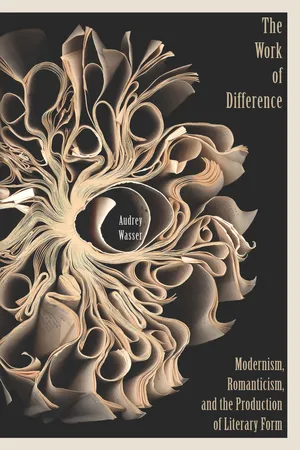
eBook - ePub
The Work of Difference
Modernism, Romanticism, and the Production of Literary Form
- 216 pages
- English
- ePUB (mobile friendly)
- Available on iOS & Android
eBook - ePub
About this book
The Work of Difference addresses a fundamental ontological question: What is literature? And at the heart of this question, it argues, is the problem of the new. How is it that new works or new forms are possible within the rule-governed orders of history, language use, or the social? How are new works in turn recognizable to already-existing institutions? Tracing the relationship between literature and the problem of newness back to a set of concerns first articulated in early German romanticism, this book goes on to mount a critique of romantic tendencies in contemporary criticism in order, ultimately, to develop an original theory of literary production. Along the way, it offers new readings of major modernist novels by Samuel Beckett, Marcel Proust, and Gertrude Stein.
Information
Publisher
Modern Language InitiativeYear
2016Print ISBN
9780823270064
9780823270057
eBook ISBN
9780823270071
Topic
PhilosophySubtopic
Literary Criticism Theory1. Form and Fragmentation
Romantic Legacies
A solution always has the truth it deserves according to the problem to which it is a response
Gilles Deleuze, Difference and Repetition
The Question of Literature
“The Double Session,” one of Jacques Derrida’s most explicit engagements with the relationship between philosophy and literature, opens with a series of quotations from texts by Plato and Mallarmé. Yet an unattributed quotation quickly follows, embedded in Derrida’s own discourse. This is the question “What is literature?,” which Derrida presents without question mark or quotation marks. Referring either to a line in Mallarmé’s Le Livre or to the two sessions of the study group where this argument was first presented, Derrida writes, “The double session . . . about which I don’t quite have the gall to say plumb straight out that it is reserved for the question what is literature, this question being henceforth properly considered a quotation already, in which the place of the what is ought to lend itself to careful scrutiny, along with the presumed authority under which one submits anything whatever, and particularly literature, to the form of its inquisition—this double session . . . will find its corner BETWEEN literature and truth” (177). Derrida doesn’t answer the question “What is literature?” in this passage, but he does delineate the question’s territory. He characterizes its threshold by a refusal of the directness that would be required to pose it outright, noting instead that the question has already been received as a citation. He observes that the question is bound up with issues of (presumed) authority and with the particular language of its posing, and that it is not without a certain relationship to truth. Tacitly, he even links literature to a notion of particularity or singularity in the phrase singulièrement la littérature. He cites the question “What is literature?” in the context of Mallarmé’s work, which, he intimates, may be asking this question without quoting it. Derrida, on the other hand, manages to quote it without asking it. In quoting or presenting it this way, in divorcing it from its immediately literal or communicative function, he returns the question to a sort of literary status.
Presenting it without deigning to ask it, Derrida draws attention to the construction of the question itself, to what may already be given in its articulation, to the implications and presuppositions that shape it and allow it to be asked. Likewise, my own argument begins at the site of this question “What is literature?” in order to examine the problems that underlie its formulation, the particular history and plane of suppositions it is made to draw upon, and the kinds of answers it makes intelligible or unintelligible.
There are several reasons the question cannot be posed directly. One is historical: quite literally, the question is a citation of the title of Jean-Paul Sartre’s landmark book Qu’est-ce que la littérature? (1948), collecting essays that appeared the previous year in Les temps modernes. As such it cannot help but recall Sartre’s well-known conceptions of “committed” writing and of the essential continuity of literature with political action. Yet Sartre was himself taking up a question that had already been developed with some sophistication in Les fleurs de Tarbes (1941) by the critic Jean Paulhan. Paulhan signaled at the time that the question of literature was a “childish question . . . childish, but which we spend our whole lives avoiding” (8). In a similar vein, Maurice Blanchot, at once taking up some of Paulhan’s concerns and expressing his own dissatisfaction with Sartre’s response to the question, observed in 1949, “It has been noted with amazement that the question ‘What is literature?’ has received only meaningless answers” (The Work of Fire 302).1
Paulhan’s and Blanchot’s dissatisfaction stemmed from a series of foreclosures they perceived in the formulation of the question itself, especially in the assumption such a formulation makes about the nature of literary language and its separability from a language of erudition and truth. The form of the question “What is literature?” is classically philosophical, while at the same time it seeks to identify that which distinguishes literature from other kinds of discourse, among them philosophy. Such a question can only be quoted, as Derrida suggests, because it is already invested in, and invested by, certain decisions about the respective natures of literature and philosophy and what it means to confront one with the other. It operates within an already-given understanding of the distinction between these two discursive fields and their supposedly different uses of language, and decides in advance the terms of their encounter.
The question “What is . . . ?” decides, among other things, that a particular version of philosophy is at stake. Just as Heidegger cautioned in Being and Time that the philosophical question “What is being?” involves a certain prior understanding of the “is” (4), so the question “What is literature?” rests on the assumption that literature is the kind of thing to which “being” can be attributed. It involves a prior understanding of what it means to define the essence of something, and of what we mean when we say that something “is.” In behaving as if an answer to the question were possible, we suggest that literature is an entity coherent enough to be demarcated and predicated outside of its instantiation in individual works (“Literature is X”), or, as Derek Attridge writes, “This question . . . asks for a statement of the essence of literature, for that which distinguishes literature from all that is not literature” (1).
“What is . . . ?,” in other words, is the paradigmatic formula of the metaphysical question of essence. It “announc[es] that which is just as it is,” Derrida writes (“Che cos’è la poesia?” 237): not only does the form of the question attribute a predicable being, essence, or presence to literature, but it also attempts to grasp this being as stable and self-identical. Furthermore, it restricts potential answers to those that are intelligible according to a certain set of philosophical presuppositions, one that understands beings as objects present for a subject, and truth as the certainty of representation.2 Yet what is obscured from the moment the question is posed in this way is the possibility of literature’s or the literary work’s having a different relationship to being, subjectivity, and truth than the one announced in this interrogation.
The question “What is literature?” implies that literature is answerable to philosophy—and we will see that this answerability has been a definitive feature of the philosophico-literary relation. Furthermore, the apparently timeless form of the question masks the confrontation between these two domains that is presupposed by the question’s formulation, as well as covers over the historical process that underlies the possibility of its being asked. For the notion that literature is an activity sufficiently distinct from philosophy that we can even speak of a confrontation between the two is the product of a fairly recent history. An examination of the changing usage of the term literature will shed some light on this history, and, what is more, it will draw our attention to a series of constitutive tensions in the concept.
A Conflicted History of the Term
Literature derives from the Latin litteratura, with the root littera, “letter,” likely a translation of the Greek grammatike, with the root gramme. Its current usage—wherein literature refers to a particular body of writing, as opposed to the realm of written culture in general—can be traced back no earlier than the 1730s in France and Germany, slightly later in England, although this modern sense of the term was not consistent until the second half of that century (Escarpit 49).3 Most scholars cite the publication of Lessing’s review Briefe die neueste Literatur betreffend (1759) and Mme de Staël’s De la littérature considérée dans ses rapports avec les institutions sociales (1800),4 where the sense of literature as an “art of writing” among the other fine arts seems to have been solidified (Escarpit 79). At the same time as the publication of Mme de Staël’s work, August Schlegel announced his Lectures on Art and Fine Literature, delivered in Berlin in 1801–2, likewise treating literature as a specific kind of fine art, as well as marking the entrance of this literary art into the university as a legitimate object of study.5
In what is perhaps the best-known lexicographical approach to the concept of literature, the French journalist and “sociologist of literature” Robert Escarpit notes that, prior to the eighteenth century, the term literature designated a realm of general erudition or knowledge of written culture, as today when we refer to a “man of letters,” and carried with it implications of belonging to an intellectual elite. By the end of the eighteenth century, the term ceased to designate a general quality of erudition or, by association, a group of erudite men, and came to refer instead to the result of an activity and to a particular object of study. Literature no longer named the intellectual quality of written material; it named a particular product. At the same time, a qualitative hierarchy subsisted, Escarpit notes, “but instead of being applied to men, it was applied to works, to the act of writing, to publication” (50, translation mine). Even in this sense of literature as something produced, however, the term continued to encompass both intellectual and aesthetic production; hierarchical judgments were accordingly founded sometimes on the value of intellect, sometimes on the value of art. The notion of literature has continued to bear these two noncoincidental aspects ever since: on the one hand an aesthetic aspect and on the other an epistemological aspect, referring sometimes to the art of writing and sometimes to a body of written, intellectual material (50). That is, embedded in the very development of the concept is an indistinction between literature’s aesthetic and epistemological dimensions, between its value as beauty and its value as knowledge.
Prior to the eighteenth century, the term poetry was used in a general sense to refer to any writing of the aesthetic sort. As the novel rose to prominence and struggled for legitimacy, the term poetry became more restricted, and literature became the more useful term for yoking together multiple genres under an umbrella designation. At the same time, it lent those genres, especially the novel, the aesthetic cachet previously reserved for what was designated by the term poetry. This turn of events suggests that, insofar as the concept of literature is a modern phenomenon, any serious attention to the question of literature must give prominent place to a consideration of the genre of the novel. For the early German romantics, the novel represented the possibility of overcoming neoclassical divisions of genre altogether. In their theorization and designation of a new concept by the name of “literature”—what Philippe Lacoue-Labarthe and Jean-Luc Nancy have described as the all-inclusive, absolute genre of Literature as such—the romantics aimed at a special kind of aesthetic universality, one open to the inherent generativity of language yet delimited and autonomous with respect to processes of history, society, and philosophy (11).
In the persistence of both terms, literature and poetry, a marked distinction also persisted between them, so that poetry, true to its etymology, could be used to designate creation par excellence, while literature, retaining its own “semantic memory,” as Escarpit aptly calls it (51), also kept its aristocratic connotation to indicate knowledgeable usage of written language—that is, technique. Finally, the older and more general concept of literature as written intellectual material, so rich at the outset, became increasingly impoverished—like a daisy shedding its petals, Escarpit suggests—as the discourses of the natural sciences, human sciences, and philosophy slowly abandoned it and became more specialized in their own right (50).6 In this narrative, literature’s distinction from philosophy appears as the result of a subtractive operation, and beholden to contingent historical forces.
The semantic memory of the term literature, in sum, has served to preserve a number of conflicting values: literature as aesthetic versus intellectual output, as process versus product, as creation versus technique. These distinctions recall disagreements in philosophical treatments of art going back as far as the ancient Greeks, which pitted art’s value as craft or know-how (techne) against its value as creative making (poiesis) akin to natural production (physis).7 And, as we will see, the distinction between techne and physis inhabited a number of hierarchical oppositions in late eighteenth- and nineteenth-century thinking about art, notably between fine art and handicraft, as well as between “free” beauty and beauty dependent on conceptual determination.8 Most significantly, this distinction became sedimented in romanticism’s elevation of poetry to the highest of the fine arts, and its simultaneous confinement of poetry to the task of speculative philosophy. Indeed, in romanticism the tensions inhabiting the concept of literature reach a certain apex.
The Moment Literature Becomes a Question
In the question “What is literature?” the putatively timeless form of the “What is . . . ?” implies that a conceptual discourse can be distinguished in its essence from the creative discourse set up as its object. But can discursive knowledge about literature be neatly distinguished from literature itself? Conversely, is an encounter with literature even possible wholly distinct from an encounter with this (supposedly philosophical) question of its own being? The lexicographical study outlined earlier is itself a discourse of erudition and truth, and a product of the very discursive division of labor it purports to describe. Beyond it lies a literary-critical discourse that has been invested, in a different way, in concepts of literature and the literary. If we cannot decide for certain whether what goes by the name literature is merely the object of knowledge and not also, in its own way, thinking, then we have to turn to a different locus of the questioning of the concept, namely to the locus of the literary-critical itself.
Derrida does not have the “militant innocence,” as he puts it in “The Double Session,” either to pose the question “What is literature?” directly or to pronounce it in the place of Mallarmé’s text—that is, to unveil this formula as the essential truth of Mallarmé’s work—because his own most consistent “place of interest” has been in the confrontation, corner, or fold between literature and truth, or literature and philosophy: two domains so mutually implicated that, as Derrida suggests elsewhere, a “literal” approach to the question would make it a “bad question or an impossible question” (Demeure 22–23). Likewise Blanchot, perhaps the most important source of Derrida’s own conception of literature, remarks that such a question either lacks seriousness or turns too easily into a prosecution of art and of art’s goals (Work of Fire 301). His dismissal of the explicit formulation of the question, as we saw, implies that the question is inadequate both to an experience of literature we possess implicitly and to a concern with itself that literature has already demonstrated. That is, Blanchot rejects the explicitly reflective, cognitive, and philosophical form of the question in order to draw attention to literature’s ability to “manifest itself from itself . . . to re-emerge as the question itself, and of itself” (Gasché, “The Felicities of Paradox” 35).
“Let us suppose that literature begins,” writes Blanchot, “at the moment when literature becomes a question” (Work of Fire 300). When he identifies the “beginning” of literature—and this trope of literature’s beginning will merit investigation later on—with the moment of its critical questioning, his claim is no less historical than metaphysical. The emergence of the concept of literature and of the literary work as we know them today coincides historically, in fact, with the most radical questioning of these concepts. That is, the notion of literature was, and in its most developed form continues to be, inseparable from a deep-seated questioning of that notion. In this sense, it is more accurate to refer to the formation of an entire literary-critical problematic than to the emergence of a single and self-identical concept of “literature.”
The problematic I have in mind is one initially elaborated by the theoretical writings of early German romanticism. Romanticism more broadly names both a historical moment and a constellation of concepts and sensibilities nearly universally credited with being perpetuated, to a greater or lesser extent, in assumptions about the nature of literature and criticism today. M. H. Abrams’s landmark work The Mirror and the Lamp opens with the claim, for example, that “the development of literary theory in the lifetime of Coleridge was to a surprising extent the making of the modern critical mind” (vii). Paul de Man has declared that “the main points around which contemporary methodological and ideological arguments circle can almost always be traced directly back to the romantic heritage,” a heritage all the more difficult to demarcate clearly because it originates in “a period of time that we have ourselves experienced” (“Wordsworth and Hölderlin” 48–49). In similarly oracular pronouncements, Blanchot declares that romanticism “inaugurates an epoch” (The Infinite Conversation 356), while Lacoue-Labarthe and Nancy, for whom Blanchot’s work is an explicit reference, call early German romanticism “our birthplace” (8), arguing that what happened in Jena over a period of only two years “opens the critical age to which we still belong” (xxii, from the original book jacket). All of these authors would claim that a romantic conception of literature is “mirrored” in or at the “root” of nearly all of our literary-critical notions today, if they were not already aware that such metaphors of reflection and generation have been well prepared by a romantic rhetoric, a rhetoric that continues to supply dominant models for thought as well as for the classification and continuity of literary history.
What emerges at this moment of early German romanticism in particular, a moment whose features I outline in more detail shortly, is nothing less than the critical question ...
Table of contents
- Cover
- Dedication
- Contents
- Introduction
- 1. Form and Fragmentation: Romantic Legacies
- 2. The Book of the World: Form and Intent in New Criticism, Revisited
- 3. Tyranny of the Possible: Blanchot
- 4. A Genesis of the New: Deleuze
- 5. From Figure to Fissure: Self-Correction in Beckett’s Molloy, Malone Dies, and The Unnamable
- 6. Hyperbole in Proust’s A la recherche du temps perdu
- 7. “How Anything Can Be Different from What It Is”: Tautology in Stein’s The Making of Americans
- Conclusion
- Appendix
- Notes
- Bibliography
- Index
- Acknowledgments
Trusted by 375,005 students
Access to over 1.5 million titles for a fair monthly price.
Study more efficiently using our study tools.
Frequently asked questions
Yes, you can cancel anytime from the Subscription tab in your account settings on the Perlego website. Your subscription will stay active until the end of your current billing period. Learn how to cancel your subscription
No, books cannot be downloaded as external files, such as PDFs, for use outside of Perlego. However, you can download books within the Perlego app for offline reading on mobile or tablet. Learn how to download books offline
Perlego offers two plans: Essential and Complete
- Essential is ideal for learners and professionals who enjoy exploring a wide range of subjects. Access the Essential Library with 800,000+ trusted titles and best-sellers across business, personal growth, and the humanities. Includes unlimited reading time and Standard Read Aloud voice.
- Complete: Perfect for advanced learners and researchers needing full, unrestricted access. Unlock 1.5M+ books across hundreds of subjects, including academic and specialized titles. The Complete Plan also includes advanced features like Premium Read Aloud and Research Assistant.
We are an online textbook subscription service, where you can get access to an entire online library for less than the price of a single book per month. With over 1.5 million books across 990+ topics, we’ve got you covered! Learn about our mission
Look out for the read-aloud symbol on your next book to see if you can listen to it. The read-aloud tool reads text aloud for you, highlighting the text as it is being read. You can pause it, speed it up and slow it down. Learn more about Read Aloud
Yes! You can use the Perlego app on both iOS and Android devices to read anytime, anywhere — even offline. Perfect for commutes or when you’re on the go.
Please note we cannot support devices running on iOS 13 and Android 7 or earlier. Learn more about using the app
Please note we cannot support devices running on iOS 13 and Android 7 or earlier. Learn more about using the app
Yes, you can access The Work of Difference by Audrey Wasser in PDF and/or ePUB format, as well as other popular books in Philosophy & Literary Criticism Theory. We have over 1.5 million books available in our catalogue for you to explore.