Streetcars "are as dead as sailing ships," said Mayor Fiorello LaGuardia in a radio speech, two days before Madison Avenue's streetcars yielded to buses. LaGuardia was determined to eliminate streetcars, demolish pre-1900 elevated lines, and unify the subway system, a goal that became reality in 1940 when the separate IRT, BMT, and IND became one giant system under full public control.
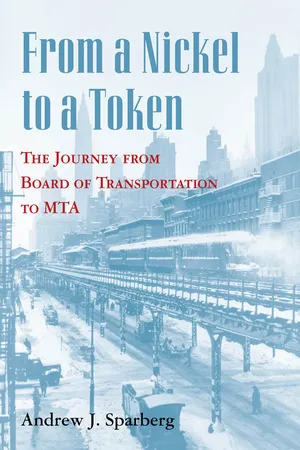
In this fascinating micro-history of New York's transit system, Andrew Sparberg examines twenty specific events between 1940 and 1968, book ended by subway unification and the MTA's creation. From a Nickel to a Token depicts a potpourri of well-remembered, partially forgotten, and totally obscure happenings drawn from the historical tapestry of New York mass transit. Sparberg deftly captures five boroughs of grit, chaos, and emotion grappling with a massive and unwieldy transit system.
During these decades, the system morphed into today's familiar network. The public sector absorbed most private surface lines operating within the five boroughs, and buses completely replaced streetcars. Elevated lines were demolished, replaced by subways or, along Manhattan's Third Avenue, not at all. Beyond the unification of the IND, IRT, and BMT, strategic track connections were built between lines to allow a more flexible and unified operation. The oldest subway routes received much needed rehabilitation. Thousands of new subway cars and buses were purchased. The sacred nickel fare barrier was broken, and by 1968 a ride cost twenty cents.
From LaGuardia to Lindsay, mayors devoted much energy to solving transit problems, keeping fares low, and appeasing voters, fellow elected officials, transit management, and labor leaders. Simultaneously, American society was experiencing tumultuous times, manifested by labor disputes, economic pressures, and civil rights protests.
Featuring many photos never before published, From a Nickel to a Token is a historical trip back in time to a multitude of important events.
eBook - ePub
From a Nickel to a Token
The Journey from Board of Transportation to MTA
- 192 pages
- English
- ePUB (mobile friendly)
- Available on iOS & Android
eBook - ePub
About this book
Trusted by 375,005 students
Access to over 1.5 million titles for a fair monthly price.
Study more efficiently using our study tools.
Information
1
1940: Unification
IRT AND BMT JOIN THE IND, CREATING ONE SUBWAY SYSTEM
Over a twelve-day period in June 1940, the City of New York purchased the two privately operated subway companies, the Brooklyn-Manhattan Transit Company (BMT) and the Interborough Rapid Transit Company (IRT). The total cost, $326 million, was financed by municipal bonds paying 3 percent interest. The two companies became the BMT and IRT Divisions, respectively, of the now-unified New York City Transit System (hence the term, “unification”), joining the Independent Subway System, owned and operated by the City of New York from its inception in 1924; the latter now became the IND division. The Board of Transportation, a city agency reporting directly to Mayor Fiorello LaGuardia, was responsible for operating and maintaining the entire system, which also included an extensive bus and streetcar system in Brooklyn that was inherited with the BMT purchase.1
The Board of Transportation will be referred to many times in this book. New York State created it in 1924 to empower the City of New York to build and operate the Independent Subway System (IND). The Board of Transportation greatly expanded in 1940 when under subway unification it added the IRT and BMT to its domain. In 1947 and 1948, when private bus operators in Staten Island, Queens, and Manhattan were bought, its stable of operations once again increased. In 1953 the Board of Transportation was abolished; its replacement was the New York City Transit Authority, still in existence today.
LaGuardia had an ambivalent attitude toward mass transit.2 He was in agreement with the Robert Moses mentality that automobiles and highways were destined to be the dominant transport modes in the future, which was consistent with his embrace of aviation. At the same time, never forgetting that he was still a politician, the mayor recognized that two-thirds of New York households did not own automobiles in 1940, and thus he did not ignore a mass transit system’s importance to the well-being of New Yorkers. He was unabashedly in favor of retaining the nickel fare, which was one of unification’s key selling points. So when unification did occur, the media considered it a positive event. The headline from the New York Times, June 14, 1940, announces the conclusion of a twenty-plus-year campaign, going back to John Hylan’s mayoralty, to create a single, unified New York subway system.

New York Times (left) February 25, 1940 and (right) June 14, 1940.
In 1940 the Board of Transportation became the largest, and one of the few, publicly owned mass transit systems in North America, comprising 250 route miles of subway and elevated lines, plus another three hundred route miles of bus and streetcar lines. The Dual Contracts agreements of 1913, which created the modern BMT and IRT subway networks, were based on a premise that the two companies’ fare revenues would create enough money to pay the interest on city bonds originally issued to build the vast new subway system between 1913 and 1931.3 The fares never came close to raising the money needed, so the city itself paid those interest charges out of tax revenues. According to the historian Clifton Hood, between 1919 and 1940 the city only received $2.1 million from the IRT’s operating revenues and nothing from the BMT. The result was that the city incurred a total accumulated deficit of $461 million over that twenty-one-year period, which was covered from general tax revenues.4
It should be noted that the BMT as a corporate entity was created in 1923. Prior to that it was known as the Brooklyn Rapid Transit Company (BRT). The name was changed to BMT when the firm emerged from a five-year period of receivership, partially because of a fatal train 1918 accident at Prospect Park that killed ninety-three people.5
Unification had been discussed since 1921, when Mayor John Hylan proposed “recapture” of some Dual Contracts routes into a single, municipally owned subway system. In 1924 a municipal system became reality when the Board of Transportation was created to build and operate the new Independent Subway System (IND), which was constructed beginning in 1925 and opened in stages between 1932 and 1940. The IND was deliberately built to be physically compatible with the BMT, so that future train routes could include parts of both the BMT and IND. Proponents of unification believed that significant economies of scale could be achieved by merging the three subway operators. Another benefit would be eliminating many costly, duplicative, and functionally obsolete nineteenth-century elevated train operations in Manhattan and Brooklyn, where newer IND and BMT subway routes paralleled the old routes. The hoped-for result would be for the system to reduce its financial problems and be less of a drain on the city treasury. The fare would remain at five cents until 1948, a political and psychological barrier that was tough to break (see Chapter 7).
An example of how the nickel fare was a hot-button issue in the late thirties and early forties can be gleaned from the classic guidebook WPA Guide to New York City, published in 1939. A chapter about the subway and elevated lines concludes with the sentences: “The five cent fare—a recurring issue in municipal politics—is not likely to be increased in the immediate or distant future. The New Yorker is extremely sensitive on this point.”6 How true, seventy-plus years later. Though the nickel by itself nowadays is essentially worthless, today’s transit fare is no less sensitive a political issue.
Whatever the case, the Board of Transportation was now faced with a number of daunting tasks. The New York Times published an article on February 25, 1940, about four months prior to the actual implementation of the unified subway system. The piece was an insightful analysis about the challenges the newly unified system would face—complex operating, labor, and financial problems. Today these issues are still very much on the front burner. Only the dollar amounts are higher because of inflation.
Operating issues were both short and long term. The former needed immediate examination because the elimination of old elevated routes required the creation of free transfers where newer IND subways replaced four old BMT and IRT elevated routes that closed immediately upon unification in June 1940. Two were BMT routes in Brooklyn along Fifth and Third Avenues (between downtown and 65th Street) and Fulton Street (between downtown and Rockaway Avenue). Two were IRT routes in Manhattan along Second Avenue north of 57th Street and along Ninth Avenue south of 155th Street. All four routes had parallel subway or elevated routes within one block and thus were a good example of the types of cost savings that unification would achieve. Interdivisional transfers were created at locations where IND subway customers had to continue trips on older elevated routes. These locations were 155th Street in Manhattan (to the IRT Polo Grounds Shuttle), 161st Street in the Bronx (to the IRT Jerome Avenue Line), Franklin Avenue in Brooklyn (to the BMT Franklin Shuttle), and Rockaway Avenue in Brooklyn (to the BMT Fulton Street Elevated). Prior to unification the only intercompany transfer was at Queensboro Plaza, where the IRT and BMT already operated a joint station. Otherwise, transfer privileges were not expanded where two or more divisions intersected; this would not occur until the 1948 fare increase.

Two views of Second Avenue El trains from Queens (Astoria or Flushing) that have just crossed the Queensboro Bridge before going south above Second Avenue to complete trips to South Ferry. The image on the left looks south from the 60th Street side of the bridge. The image on the right looks north at a southbound train that has just crossed the bridge. Note how the structure rises high over the southbound tracks from upper Manhattan. Both photos were taken in approximately 1940, when the Board of Transportation took over the IRT. This line was razed in 1942. Since then there has been no one-seat service between the IRT Flushing Line and Lower Manhattan. Source: New York Transit Museum Archives. All subsequent photos from the New York Transit Museum Archives will be identified as “NYTM” only with a specific collection included if appropriate.
Elevated Lines Explained
At this juncture a short explanation of elevated lines would be appropriate. Between 1870 and 1900 Manhattan and Brooklyn developed two separate, steam-powered elevated train systems. All were electrified in the first years of the twentieth century. The Manhattan els, which also included the Third Avenue Line in the Bronx, became an operating entity of the IRT subway through a long-term lease. The Brooklyn els became a part of the BMT’s rapid transit network, and some of its early routes were rebuilt and connected to the subways.
During the 1930s there was considerable pressure to remove many nineteenth-century elevated train routes in Brooklyn and Manhattan. Most required the use of wood-bodied equipment because the structures were never upgraded to permit operation of modern steel subway cars. The noise and blight associated with the elevateds was also blamed for low property values on the affected streets. The IND subway was built in part to replace a number of el routes. In Manhattan, the new Sixth and Eighth Avenue subways replaced IRT els on Sixth and Ninth Avenues. In Brooklyn, the Fulton Street subway replaced the BMT el on the same street, practically block by block. In 1915 one of the first Dual Contracts subways, the BMT route under Brooklyn’s Fourth Avenue, was a block from the BMT’s older Fifth–Third Avenue elevated route.
Between 1938 and 1973, all pre-1900 elevated routes in Manhattan, the Bronx, and Brooklyn were razed, with two exceptions. Those are the J and M routes in Brooklyn, which still use structures built between 1885 and 1893 for steam trains. The remaining elevated rapid transit routes in New York were built as part of the Dual Contracts subway expansions between 1915 and 1922 and are not considered elevated lines in the New York context.

Ninth Avenue El at 110th Street and Eighth Avenue, spring 1940, looking northwest. The double-decker bus is a Fifth Avenue Coach vehicle going uptown on either the #3 or #4 routes to Washington Heights. The train is traveling between Lower Manhattan and either 155th Street or Woodlawn (Bronx). Although the el has been gone for over seventy years, buses continue to serve these routes. NYTM

Second and Third Avenue El, 1940, near the South Ferry terminal at Coenties Slip. Second Avenue trains used this stretch until 1942; Third Avenue trains would use it until 1950, when it was razed. NYTM
The Second Avenue El in Manhattan south of 57th Street to Chatham Square was initially retained as it connected to tracks that crossed the Queensboro Bridge, connecting the el to the Astoria and Flushing lines in Queens. But pressure to eliminate the Second Avenue El caused this route to be closed completely on June 13, 1942. This move reduced by two tracks rapid transit linkage between Queens and Manhattan, which became an issue in the 1950s, when Queens experienced much residential growth. It also eliminated a one-seat ride between the Flushing Line and Lower Manhattan, something still not possible today. After 1942, the only remaining nineteenth-century elevated on Manhattan was on Third Avenue, and it would last only another thirteen years.
The long-term operating issues involved the need to rationalize subway routings, including constructing short links where IND subway trains could provide through service on older BMT Brooklyn elevated routes. A look at a 1940 map shows many logical routes that could be created by building links between the IND and BMT networks. Since the IND was built with the same clearances as the BMT, such links would create a more efficient subway-elevated system. Two obvious links involved IND subways in Brooklyn. In 1940 the A ...
Table of contents
- Cover
- Half Title
- Title Page
- Copyright
- Dedication
- Contents
- Preface
- Acknowledgments
- Half Title
- 1. 1940: Unification—IRT and BMT Join the IND, Creating One Subway System
- 2. 1941: A Strike and a Pioneering Labor Agreement
- 3. 1941: Dyre Avenue Subway Extension Opens
- 4. 1941–1948: Third Avenue Transit—Rails to Rubber
- 5. 1944 and 1950: Goodbye to Brooklyn Bridge Rails
- 6. 1947–1948: Private to Public Bus Operations
- 7. 1948: Goodbye to the Nickel
- 8. 1947–1956: Final Decade for Brooklyn Trolleys
- 9. 1950: Farewell, Lexington Avenue
- 10. 1953–1968: The TA, Tokens, and TWU Triumphant
- 11. 1953: Last Double-Deck Buses Operate on Fifth Avenue
- 12. 1954–1956: The BMT and IND Begin a Courtship
- 13. 1955: Sunshine Returns to Third Avenue
- 14. 1956: Fifth Avenue Coach Becomes Number One
- 15. 1957–1959: IRT West Side Improvement
- 16. 1962: Fifth Avenue Coach Suddenly Disappears
- 17. 1964: World’s Fair, Blue Subways, Stainless Steel Subways
- 18. 1966: Mike Quill’s Last Hurrah
- 19. 1967: The BMT and IND Marry Forever
- 20. 1968: The MTA Is Created and Express Buses Appear
- Bibliography
- Index
Frequently asked questions
Yes, you can cancel anytime from the Subscription tab in your account settings on the Perlego website. Your subscription will stay active until the end of your current billing period. Learn how to cancel your subscription
No, books cannot be downloaded as external files, such as PDFs, for use outside of Perlego. However, you can download books within the Perlego app for offline reading on mobile or tablet. Learn how to download books offline
Perlego offers two plans: Essential and Complete
- Essential is ideal for learners and professionals who enjoy exploring a wide range of subjects. Access the Essential Library with 800,000+ trusted titles and best-sellers across business, personal growth, and the humanities. Includes unlimited reading time and Standard Read Aloud voice.
- Complete: Perfect for advanced learners and researchers needing full, unrestricted access. Unlock 1.5M+ books across hundreds of subjects, including academic and specialized titles. The Complete Plan also includes advanced features like Premium Read Aloud and Research Assistant.
We are an online textbook subscription service, where you can get access to an entire online library for less than the price of a single book per month. With over 1.5 million books across 990+ topics, we’ve got you covered! Learn about our mission
Look out for the read-aloud symbol on your next book to see if you can listen to it. The read-aloud tool reads text aloud for you, highlighting the text as it is being read. You can pause it, speed it up and slow it down. Learn more about Read Aloud
Yes! You can use the Perlego app on both iOS and Android devices to read anytime, anywhere — even offline. Perfect for commutes or when you’re on the go.
Please note we cannot support devices running on iOS 13 and Android 7 or earlier. Learn more about using the app
Please note we cannot support devices running on iOS 13 and Android 7 or earlier. Learn more about using the app
Yes, you can access From a Nickel to a Token by Andrew J. Sparberg in PDF and/or ePUB format, as well as other popular books in Technology & Engineering & North American History. We have over 1.5 million books available in our catalogue for you to explore.