Faith and reason, especially in Roman Catholic thought, are less contradictory today than ever. But does the supposed opposition even make sense to begin with? One can lose faith, but surely not because one gains in reason. Some, in fact, lose faith when reason is not able to make sense of the experiences of our lives. We very quickly realize that reason does not understand everything. Immense areas remain incomprehensible and irrational, which we abandon to belief and opinion.
Soon we definitively renounce thinking what that has been excluded from the realm of the thinkable. Ideological nightmares arise from this slumber of reason. Thus, the separation between faith and reason, too quickly taken as self-evident and even natural, is born from a lack of rationality, an easy capitulatin of reason before what is supposedly unthinkable. Rather than lose faith through excessive rationality, we often lose rationality because faith is too quickly excluded from the realm that it claims to open, that of revelation. We lose reason by losing faith.
Examining such topics as the role of the intellectual in the church, the rationality of faith, the infinite worth and incomprehensibility of the human, the phenomenality of the sacraments, and the phenomenological nature of miracles and of revelation more broadly, this book spans the range of Marion's thought on Christianity. Throughout he stresses that faith has its own rationality, structured according to the logic of the gift that calls forth a response of love and devotion through kenotic abandon.
eBook - ePub
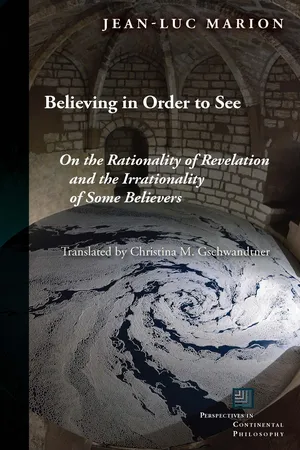
Believing in Order to See
On the Rationality of Revelation and the Irrationality of Some Believers
- 192 pages
- English
- ePUB (mobile friendly)
- Available on iOS & Android
eBook - ePub
Believing in Order to See
On the Rationality of Revelation and the Irrationality of Some Believers
About this book
Information
Publisher
Fordham University PressYear
2017Print ISBN
9780823275854
9780823275847
eBook ISBN
9780823275861
Topic
Theology & ReligionSubtopic
Christian TheologyPART I
Reason and Faith Together
1
Faith and Reason
Faith and reason, believing or knowing, believing without certainty or knowing through definite science—what opposition seems more obvious? And if one adds that it is “modern science” facing Christian faith, then the dichotomy imposes itself beyond dispute, ready for all the weekly reports, for all the prefabricated debates and ideological arguments. Yet we should be on our guard against what is assumed to be so obvious here, for by a strange reversal in this commonplace dispute the argument from authority is today definitely found on the side of “science,” which has become the object of the most unwavering faith for its devotees, whereas on the other side, “believers” guard the prerogative of doubt, of a critical sense, and an attitude of research (admittedly at times involuntarily). Actually, nothing is more fragile than this opposition, as the best philosophers of science have demonstrated. The first task of a merely honest and informed mind would be to show how artificial this opposition is, for faith has its reasons and scientific reason has its beliefs.
Christian Faith as Rationality
To begin with, Christians themselves should be the first to realize that their faith cannot and must not in any way do without reason; nor should they pride themselves on doing without it. Believing without reason actually amounts to scorning Him in whom we claim to believe. This is so, first, because as Saint Peter underlines, we must be “ready to make a defense (apologia) to anyone who demands an accounting (logon) for the hope that is in” us (1 Pet. 3:15). Believing without knowing how or what to believe does not increase faith but leads it astray, maybe even ridicules it. The point of “giving an account” here actually is not to quarrel with the interlocutor face to face, as in an ideological battle, but to do justice to Him in whom we say we believe, in Him and in his high reason. For the believer will have to “give an accounting (apodidonai logon) to him who stands ready to judge the living and the dead” (1 Pet. 4:5). We will have to answer to Christ for what we will have answered humans on his behalf and “for every careless word you utter, you will have to give an account (apodōsousin peri autou logon) on the day of judgment” (Matt. 12:36). What we will have said of Christ before humans, Christ will say of us before the Father.
This immediately raises another question: Why does God expect us to speak of Him with arguments, reasons, and rationality? Does God not know better than all of us that we can neither comprehend him nor even reason correctly about him, without taking into account our fear of those who do not accept him? Yet if God is God, he knows all that and more; thus if he asks us to speak with reason, without doubt he has good reasons for asking it of us. What do we know about these reasons? We know at least this: The Christian religion announces the death and resurrection of a human being who was and thus still is God. This man Jesus Christ is called the Logos, the Word and hence Reason. Even the paradox of his crucifixion, which contradicts “the wisdom of the world,” remains a logos, “the logos of the Cross,” which opposes a different sophia to the wisdom of the world, namely the “wisdom of God” (1 Cor. 1:18–25). When Saint Paul debates the Athenians on the Areopagus, it is in the name of the logos of Him who rightfully bears the name of Logos. And when he announces the foolishness of the Cross against the secular culture of the Corinthians, he still speaks according to a logos, because he speaks in the name of the Logos and according to the Logos. Even and especially when someone faithful to Christ confronts the rationality of the world, he or she confronts it with the reasons and for the love of wisdom. To witness can designate making an argument as much as giving one’s life, to philosophize as much as to suffer martyrdom. Thus the first Christian to lay claim to the title of “philosopher,” Justin, the Palestinian from Nablus who in the second century discussed so dispassionately with the Jew Trypho, was also a martyr, which is why he bears the admirable title of “philosopher and martyr.” And the final giant among the Greek Fathers (also the most difficult), Maximus the Confessor, who in the seventh century brought to a close the brilliant christological and trinitarian synthesis begun by the council of Chalcedon, likewise suffered martyrdom: in order to silence his arguments, one had to cut out his tongue. Concepts can also bear witness.
The announcement of the Word come to reveal God in his humanity to humanity unfolds a new and superior reason, which can only be unfolded with reasons. The logos is not optional for Christians, because He from whom they take their name bears the title of Logos. For better or for worse, they had to take up again the knowledge of the Greeks, their logos, and hence their philosophy and their sciences (as also later the Roman law). Besides, as Saint Augustine firmly underlines, Christianity from the outset refuses to be compared with the ancient religions (the theologia civilis or the theologia fabulosa), agreeing only to a connection with the theologia naturalis, the pursuit of a rational knowledge of the divine via the study of celestial motions. And, facing the theological cosmology of the ancients, Augustine claims for his Christian faith the credentials of a true knowledge of the divinity as the only correct sense of the term theologia, which was pagan in origin and thus suspect. Because it is a matter of truth, “it is with the philosophers that the comparison must be made (cum philosophis est habenda conlatio).” Faith thus appears first of all as a matter of philosophy, which seems strange to us but obvious to him, because, he concludes, “the true philosopher will be a lover of God (verus philosophus est amator Dei).”1 Of course the ultimate destiny of philosophy, the science of being that later became “metaphysics,” will render its identification with the science of God impossible (although under the formulation of philosophia christiana it would endure at least until Erasmus). Yet one thing will not disappear: Christian theology’s duty to rationality. At times it has even fulfilled this duty too well, at the risk of reducing the revealed Word to a system of concepts. Yet this duty has nevertheless permitted the development of a theo-logy, a knowledge about God through reasons coming from God. We take this accomplishment as self-evident, but all things considered, it is achieved as such only in the Christian religion. Both cases confirm that faith has a duty to reason in regard to itself.
Granted, one might object, but the issue is not faith’s duty to reason in regard to itself, but rather faith’s rationality in regard to reason itself, the type of reason that is displayed in the sciences. And how could one avoid thinking of several conflicts that have marked history, from Galileo to Darwin, to stick only with the most legendary cases?
This way of putting the question calls forth three remarks. First, the most obvious: No conflict could have broken out between some science or other and some decision or other of the Church’s ordinary magisterium, if both had not been situated on a single shared ground, precisely that of reason. To the point that one must sometimes wonder whether this ground was really shared, whether the encounter was even legitimate. Did the magisterium have to defend a particular cosmology against a different one—and anyway is that really what happened? Did Galileo really have to contest the rules for the interpretation of the Scriptures—and did he do so with full awareness? Contemporary history and philosophy of science have made us much more prudent in regard to these questions than our predecessors were, and one can reasonably assume that the two camps themselves were lacking epistemological prudence.
A second comment follows from this: the history of Christian faith is remarkable less for its omissions than for its often decisive contributions to the birth and growth of the sciences, even if we restrict ourselves to the collection and transmission of ancient texts, the foundation of the universities, the emergence of the “arts” in these universities as independent from theology, the impetus given in the schools to mathematics, astronomy and physics, and so forth. Precisely because Christian faith first owed rationality to itself, it could not keep it for itself but expanded it into the world and human society.
Finally, even the conflicts or at least tensions that today oppose the magisterium of the Catholic Church to certain developments in biology and the neurosciences have their rational stake: how is one to reconcile freedom in regard to conception with the humanity of what has been conceived, how determine the humanity of a biological life, how recognize the end of a human life, how safeguard the identity of the individual against the threat of its reproduction? Without a doubt, these questions are vexing and will continue to be divisive. Yet who could disregard them and reduce them to irrationalism? To the contrary, they rather require us to complicate the models and the currently accepted technical protocols in order to reach a rationality that would be more sophisticated, more flexible, hence higher.
What Reason Thinks and What It Does Not Think
A higher reason—what does that mean? If we understand this as asking the rationality of the contemporary sciences to manage thinking the divinity, it is an absolutely unacceptable demand. Unacceptable first in regard to the sciences, which never claim (at least one would reasonably hope so today) to know the world absolutely or to understand its potentially divine dimension. Then in regard to faith, because God’s transcendence would thus be insulted due to the fact that He is known only by not being known: for “man reaches the highest point of his knowledge about God when he knows that he knows him not, inasmuch as he knows that that which is God transcends whatsoever he conceives of him—illud quod Deus est, omne ipsum quod de eo intelligimus, excedere.”2
But could we think this higher reason in a different sense, one that is more precise and rigorous? Perhaps by listening to one of Nietzsche’s rather enigmatic remarks: “You say ‘I’ and are proud of this word. But greater is that in which you do not wish to have faith—your flesh and its great reason (dein Leib und seine grosse Vernunft): that does not say ‘I,’ but does ‘I.’ ”3 This strange formulation raises two questions. What is meant by “the flesh”? And how is it partially connected to a “great reason”?
Flesh does not mean the body that is perceived or rather sensed as it is extended in the space of the world; instead it means this other and unique body—mine—that alone senses the bodies of the world. My flesh senses the bodies that, themselves, do not sense. It can do so by virtue of another privilege: it only senses everything else by sensing itself sensing. But how could this flesh possibly surpass the “I” and its reason?
In order to understand this, one must consider what the “I” knows, the ego that makes modern metaphysics so “proud.” It knows with certainty, because it retains from an experience only what it can keep of it and anticipate there, abandoning everything else as unknowable. Descartes identifies what offers such a grasp to reason as order and measure; today we would say models and parameters. Yet only phenomena of extension, of quantity and hence of exteriority offer such material to certain knowledge. We call “objects” the kinds of phenomena, for which intuition responds in advance to the expectations of the concept without overflowing it. To each science there hence corresponds a method of constitution and of production of objects. And modern rationality unfolds by ceaselessly enlarging the number and the range of such objects. Not only does it constitute them intellectually and realize them experimentally, but it produces and reproduces them technically, in such a way that a new world of technical objects has sprung up before our increasingly less surprised eyes. This new world covers up and replaces the ancient world of things more and more. This change has defined the common rationality of our reason and is extended to nature, whose “masters and possessors” we become.4
This success and uninterrupted process (for each scientific crisis becomes the opportunity for a new technological leap) nevertheless leaves us puzzled or even anxious. For we rather suspect that the world is calculated only via far away objects, only from afar and in the remote region where objects face us, precisely as the objectives of our aim. We really know objects as we produce them—at a distance. Yet because we also live among them, we sense them and in this way we inevitably feel ourselves first of all. And this felt immediacy, precisely the flesh, concerns what is the closest, whereas the rationality of objects concerns what is the furthest away. Just as in the immediacy of feeling we experience ourselves without distance, so the distant knowledge of objects no longer helps us at all: we do not stand opposite ourselves, but sense what we are and are what we sense in the closest, namely pain and pleasure, death and birth, hunger and thirst, sleep and fatigue, but also hatred and love, communion and division, justice and violence. From this, from what is closest, we know very clearly that the common rationality of objects knows nothing and is of no help.
In this sense, Heidegger could legitimately say that “science does not think.” He should only have added that it has claimed this as its privilege: science does not think, it measures and orders in the form of modeling, of parameter and of objectification. Technology produces what is understood in this way and vice versa. In contrast, only the flesh reaches nonobjective phenomena, those where an excess of intuition saturates the limits of the concept already known and always foreseen—for example, it reaches the event that occurs unpredictably despite its supposed impossibility, the idol that fascinates the gaze by dazzling it, the flesh of this other who eroticizes mine through his flesh, the face of every other who commands my respect and asks me to spare his or her life. No one can claim to be ignorant about such phenomena and, even so, no one can conceive them according to the rationality of objects. In front of these phenomena, I cannot simply say “I,” constitute them, foresee them, and hold them at a distance from me. To the contrary, these very phenomena saturated with intuition make me and unmake me. The flesh exposes me to what the “I” cannot constitute as an object. It surpasses my objectifying rationality. It really does point to a “greater reason.”
Who can exercise such “great reason” today? That is a fair question, except that one should rather ask: Who has to exercise it and cannot do without it? Response: Everyone for whom the humanity of humans, the naturalness of nature, the justice of the city and the truth of knowledge still remain absolute requirements. That is to say, everyone, or at least everyone who believes these things still to be possible. Or more exactly that part of each of us that still wants to believe in them. For on top of the first difficulty (objectivity), we must confront a second one that is linked to it but is much more severe: nihilism. One often claims that it would be enough to round off the science of objects with a supposed “soul supplement.” This is a simplistic illusion, because what one understood under the term “soul” has precisely been rendered inaccessible by objectivity: henceforth, what we can no longer know as a certain and hence remote object can only be thought as a “value.” Yet in these times of nihilism, the highest values are being devalued. It serves no point to “defend” the vanished soul any more than it does the supposed values, for that amounts to recognizing the intrinsic weakness of what it is a matter of defending or attacking; as a value, it is completely dependent on whoever evaluates or devalues it. In every case, nihilism brings out its black sun by insinuating this disarming question into each of us: “What’s the use?” What is the point of the humanity of humans, the naturalness of nature, the justice of the city and the truth of knowledge? Why not rather their opposites, the dehumanization of humans for improving humanity, the systematic bleeding of nature in order to develop the economy, injustice so as to render society more efficient, the absolute empire of information-distraction in order to escape the constraints of the true? These counterpossibilities are no longer fantasy or prediction, because the ideologies that have dominated history since the beginning of the last ...
Table of contents
- Cover
- Half Title
- Series Announcement Page
- Title Page
- Copyright
- Dedication
- Contents
- Preface
- Translator’s Note
- Half Title
- Part I: Reason and Faith Together
- Part II: Who Speaks About It?
- Part III: What Is Possible and What Shows Itself
- Part IV: Recognition
- Notes
- Index
- Series Page
Trusted by 375,005 students
Access to over 1.5 million titles for a fair monthly price.
Study more efficiently using our study tools.
Frequently asked questions
Yes, you can cancel anytime from the Subscription tab in your account settings on the Perlego website. Your subscription will stay active until the end of your current billing period. Learn how to cancel your subscription
No, books cannot be downloaded as external files, such as PDFs, for use outside of Perlego. However, you can download books within the Perlego app for offline reading on mobile or tablet. Learn how to download books offline
Perlego offers two plans: Essential and Complete
- Essential is ideal for learners and professionals who enjoy exploring a wide range of subjects. Access the Essential Library with 800,000+ trusted titles and best-sellers across business, personal growth, and the humanities. Includes unlimited reading time and Standard Read Aloud voice.
- Complete: Perfect for advanced learners and researchers needing full, unrestricted access. Unlock 1.5M+ books across hundreds of subjects, including academic and specialized titles. The Complete Plan also includes advanced features like Premium Read Aloud and Research Assistant.
We are an online textbook subscription service, where you can get access to an entire online library for less than the price of a single book per month. With over 1.5 million books across 990+ topics, we’ve got you covered! Learn about our mission
Look out for the read-aloud symbol on your next book to see if you can listen to it. The read-aloud tool reads text aloud for you, highlighting the text as it is being read. You can pause it, speed it up and slow it down. Learn more about Read Aloud
Yes! You can use the Perlego app on both iOS and Android devices to read anytime, anywhere — even offline. Perfect for commutes or when you’re on the go.
Please note we cannot support devices running on iOS 13 and Android 7 or earlier. Learn more about using the app
Please note we cannot support devices running on iOS 13 and Android 7 or earlier. Learn more about using the app
Yes, you can access Believing in Order to See by Jean-Luc Marion, Christina M. Gschwandtner in PDF and/or ePUB format, as well as other popular books in Theology & Religion & Christian Theology. We have over 1.5 million books available in our catalogue for you to explore.