Ph.D. students from 14 European countries, Israel, Turkey and Venezuela in addition to supervisors and lecturers from 11 countries including Israel and USA worked for one week to understand each other with the goal of improving and sharpening features of their respective theoretical backgrounds, research questions, and design and methodological demands. The projects presented reflect a multitude of topics and goals of research in science education in Europe as well as the variety and elaboration of theoretical frameworks used and a remarkable level of methodological expertise. The following topics are included: Teachers' thinking and beliefs and teachers' actions in the classroom, the interaction between specific programs of science museums and teachers' and classes' plans for engagement with them, teaching, learning and understanding of new subject matter for science classes, different interaction processes in the classroom, discourse analysis, decision making processes in science classes and the use of models in chemistry lessons and last but not least specific characters and the function of text when learning physics by means of computer-based multimedia. All science subjects including earth science are involved in these articles and the level of analysed e
eBook - ePub
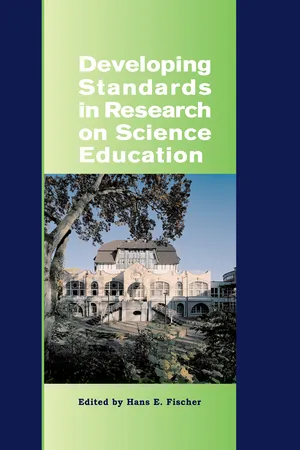
Developing Standards in Research on Science Education
The ESERA Summer School 2004
- English
- ePUB (mobile friendly)
- Available on iOS & Android
eBook - ePub
About this book
Information
Table of contents
- Cover
- Half Title
- Title
- Copyright
- Table of Contents
- Preface
- Staff members
- Towards science education research that is relevant for improving practice: The model of educational reconstruction
- Exploring a case study to discover issues relevant to the use and misuse of statistics
- Interviews in science education research
- Qualitative Video-Analysis Applied to Classroom Studies – A First-Steps Workshop
- Teachers’ conceptions of, and obstacles to, sex education in Portuguese primary schools
- A study of students’ learning processes on a new quantum physics course for preservice and inservice teachers
- Public understanding of genetics: The role of school science in preparing citizens for participating in a democratic society
- Different ways of explanation: Descriptive/empirical vs. explanatory/theoretical 69
- Computer assisted hands-on laboratories activities: Design, development and evaluation of instructional software for science teachers education
- How students use empirical evidence to draw conclusions
- Science instruction with the use of information communication technologies – Suggestions and applications of quantum approaches
- The design of a remote experiment for high school students
- Discourse Analysis in University Physics Class. Implications for Improvement of Educational Practice
- Assessing characteristics of teacher and student actions during instructional talks in primary science classrooms by means of video-analysis
- The process of teachers’ planning and implementation of school visits to science and technology museums
- Investigating students’ and teachers’ reactions to a curriculum on the evolution of a chemical system
- Engaging Explainers in design-based research to support student science enquiry 139
- Modern physics and how to get there: teaching and learning quantum physics in secondary school – outline of a research project
- Acquisition and encouragement of decision making processes in science classes 155
- Young people's perspectives on genetics, identity and society using film and discussion 165
- Learning with simulations and their effect on problem solving in the domain of physics 171
- Designing and evaluating a research-based teaching-learning sequence on the moment of force
- Meaningful learning of models and modelling in chemistry education by adapting authentic practices
- Textcoherence and self-explanation in learning physics with multimedia
- A Multimodal analysis of physics explanations
- Upper secondary students’ views of the Nature of Science: The influence of activities at a research centre
- Approaching conceptual change in the teaching and learning of mechanical and solar energy with 6th grade primary school children in Greece
- Process orientated learning in small groups in chemistry education
- Systems thinking in ecology education: Modelling ecosystems
- Realizing integrated science instruction at the upper secondary level – The chances and challenges of assessment from the teachers’ perspective
- Author index
Trusted by 375,005 students
Access to over 1.5 million titles for a fair monthly price.
Study more efficiently using our study tools.
Frequently asked questions
Yes, you can cancel anytime from the Subscription tab in your account settings on the Perlego website. Your subscription will stay active until the end of your current billing period. Learn how to cancel your subscription
No, books cannot be downloaded as external files, such as PDFs, for use outside of Perlego. However, you can download books within the Perlego app for offline reading on mobile or tablet. Learn how to download books offline
Perlego offers two plans: Essential and Complete
- Essential is ideal for learners and professionals who enjoy exploring a wide range of subjects. Access the Essential Library with 800,000+ trusted titles and best-sellers across business, personal growth, and the humanities. Includes unlimited reading time and Standard Read Aloud voice.
- Complete: Perfect for advanced learners and researchers needing full, unrestricted access. Unlock 1.5M+ books across hundreds of subjects, including academic and specialized titles. The Complete Plan also includes advanced features like Premium Read Aloud and Research Assistant.
We are an online textbook subscription service, where you can get access to an entire online library for less than the price of a single book per month. With over 1.5 million books across 990+ topics, we’ve got you covered! Learn about our mission
Look out for the read-aloud symbol on your next book to see if you can listen to it. The read-aloud tool reads text aloud for you, highlighting the text as it is being read. You can pause it, speed it up and slow it down. Learn more about Read Aloud
Yes! You can use the Perlego app on both iOS and Android devices to read anytime, anywhere — even offline. Perfect for commutes or when you’re on the go.
Please note we cannot support devices running on iOS 13 and Android 7 or earlier. Learn more about using the app
Please note we cannot support devices running on iOS 13 and Android 7 or earlier. Learn more about using the app
Yes, you can access Developing Standards in Research on Science Education by Fischer Hans E in PDF and/or ePUB format, as well as other popular books in Education & Government & Business. We have over 1.5 million books available in our catalogue for you to explore.