- 156 pages
- English
- ePUB (mobile friendly)
- Available on iOS & Android
eBook - ePub
About this book
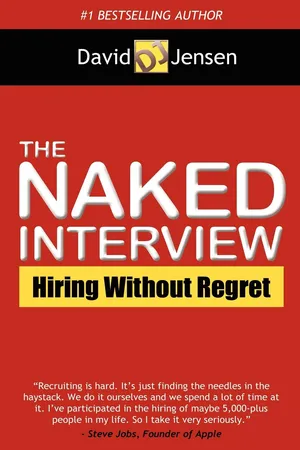
David Jensen is an author, speaker, consultant and Founder of The Hiring Academy. He addresses what has proven to be the most critical success or failure point of any business of any size: hiring the right personnel. Jensen's purpose is to help business owners find and hire the right people so that they can pull back from their business and yet continue expanding. Surveyed business owners, executives, and Human Resource personnel unanimously HATED the process of hiring! Jensen aims to help fill that important void with simple guidelines. He is going to give you real stories, actual examples, basic rules, sample questions, and invaluable solutions.
Information
Section III
INTERVIEWING

“Manners and professionalism are
paramount as the company representative
placed in the role of hiring.”
paramount as the company representative
placed in the role of hiring.”
Six

The Interview
Determine if the candidate possesses the necessary knowledge for the job.
Hiring is easily likened to getting married and interviewing is much like dating. It can be difficult to find “the one.” You don’t want to jump right into bed with the first person you meet or at least don’t want to marry that individual after the first date.
The point here is that appearances up front may not always be genuine. It would best suit you to become familiar with the individual first and figuratively meet the parents, too. People may bring baggage to a relationship, for better or worse. You might have to compromise on some points or let it be known up front that you won’t concede.
This impression begins from the moment a candidate arrives. In fact, I have a friend who heads an attorneys’ office specializing in employment law and litigation for employers. The candidates are watched on camera from the moment they walk from the parking lot, step into the elevator, and enter the reception area. My friend said people would be shocked by the mannerisms seen when someone doesn’t know he or she is being watched. Not that picking one’s nose is going to cause that candidate to lose the job but the point here is to use every moment possible to be looking for genuine character.
Specific steps are used in conducting the interview, which will follow. First, however, I want to mention “Courtesy interviews” that help avoid wasting either party’s valuable time.
Courtesy interviews and a code word add a little fun to the process and save time. In a business in which I was vice president over the human resource division, we used the code word “coffee” to provide an indication of the current candidate’s standing in an interview.
It went something like this: if a candidate arrived to interview who was obviously not a good fit for the company as a result of unprofessional appearance, attire, conduct, or presentation, the receptionist called HR and told them the interviewee had arrived, and by the way, don’t try the coffee in the kitchen; it’s cold and bitter today.
This clue alerted HR that the person currently standing in reception was now placed in the category of a “courtesy interview.” HR’s procedure then sped up significantly. Instead of handing the person an application that requires twenty minutes to complete or giving him
or her a wasted tour that exposes this candidate to the entire company, the applicant is taken straight to the interview room. There, he or she is greeted and told that the company is seeing so many candidates that the interviewer has to breeze through the preliminary consultations, so please excuse the rush.
Here one would, cut to the chase with a couple significant questions, such as the reason that applicant thinks he or she is right for the job and the qualifications that candidate brings to the table, asking if he or she has done this same job previously (which is often the easy out). “Sorry, we’re looking for more of X, Y or Z, but we’ll keep your résumé on file.” If you are uncomfortable saying no in this manner, you can always say the position has already been filled or you’re seeing several candidates in the next couple days, and if he or she doesn’t hear from you, we went in another direction. Thank you; let me show you the way out. This truncated method works effectively and saves everyone time.
The Interview Sequence
Welcome the candidate. Introduce yourself. Let the applicant know your position in the company, and that today is only the first interview. Ensure the consultation is held in a private location with a professional atmosphere. Conduct it in a conference room or office where you will be undisturbed. Keep the first interview short, preferably not longer than fifteen or twenty minutes.
In the first impression, note whether or not the candidate looks you in the eye when talking. This one never fails. If it is so uncomfortable for a candidate to look me in the eye during a conversation, especially in an interview, then I know I won’t be comfortable having that potential candidate in my organization. They may not be able to look a customer in the eye and gain their trust. It is one of those observations that has always proven true over the years.
Begin with easy social questions, such as:
Was it easy to find our office?
Would you like some water or coffee?
Then explain the way the company operates and the responsibilities of the job. Remember to take notes during the interview or directly after the candidate leaves the room. Taking notes during the interview will demonstrate genuine interest in that applicant as a prospect.
Invite the candidate to ask questions about the company and about the work he or she might be expected to do if hired. Be clear and direct in your communication. Observe whether or not the candidate’s interest increases during the interview.
Pay attention to whether or not the candidate appears motivated or enthusiastic. You want only candidates who are willing and eager to make a positive difference in the company.
Use questions that create the necessity for the candidate to think independently and answer honestly, rather than use some rote script from a book or the redundant coaching received from a personnel agency. Be creative and force that person to think out of the box.
Realize you are not looking for all of the interviewees to be cookie-cutter, rote or robotic renditions of each other. Individuality is an important characteristic for this potential applicant and should be in your search as well. You want to be able to see them for who they really are see through any phoniness.
Ask some of the following questions:
Why do you want this job?
Now that you understand a few details about this job and the responsibilities it may entail, are you more or less interested and why?
Have you previously worked or always wanted to work in this particular field?
What experience qualifies you to be the best possible candidate for this position?
What is the number-one factor that sways you one way or the other in looking for a job? Salary? Job duties? Your boss?
What ambitions do you have regarding your level of achievement in this prospective new job?
What are your career goals?
What personality traits would you prefer your boss have or not have?
Be alert to “red flags” in the candidate’s attitude. Is it superficial or is he or she really motivated to be hired? Does salary seem to be the candidate’s main concern or only motivation, or does this applicant actually reveal interest in the position? At the end of the day, does this prospective candidate seem genuinely satisfied with the conditions of the job?
These questions are relevant to selecting the most appropriate candidate.
Is the Candidate Qualified
Check the prospective candidate’s education, training, and experience closely. Review the prospect’s professional background, and for each job he or she has had, ask the applicant the reason he or she ended employment there? Let the candidate explain any possible “holes” in his or her career timeline as well.
Stay in control of the interview and pay extra attention not to let the candidate diverge from the subject. Discuss the candidate’s previous career.
Did he or she hold a job regularly or only sporadically?
Did the applicant leave the earlier employment before a replacement was found, or without making it easy for the replacement to take control of the new duties?
Be aware if the candidate is critical of his or her previous employer. This criticism is a big red flag. If this person is so unhappy with a previous employer and willing to bash that person on the spot, there is definitely unfinished business and baggage that will carry over into the new employment, not to mention this applicant’s unprofessional criticism.
Practical Knowledge
Determine if the candidate has the necessary knowledge for the job. Ask technical questions, too. You can verify their familiarity with the terminology and job-specific procedures by asking for examples of their previous products.
Listen for practical examples revealing the candidate’s competence. Be alert for dissertations that sound like things he or she “knows you want to hear.” This charade also becomes apparent when the candidate doesn’t display certainty in answering questions and providing solutions. It is also revealing if he or she gives answers that seem unnecessarily complicated as if this candidate can’t get his or her own story straight.
Has This Candidate Produced Results?
It is vital to check the candidate’s ability to achieve results. Is the prospect able to translate his or her knowledge into definite results of value? You need to know about that person’s earlier products. Then to effectively verify this, check references after the interview.
The following are some recommended questions to ask candidates:
What achievements in earlier jobs make you proud?
Tell me about projects for which you were responsible and their outcomes.
Tell me about results expected of you and the way they turned out.
How could your results be measured? What did you do to achieve these results?
What do you think is the most important attribute necessary to achieving results?
Did you work at a steady pace?
How was your productivity and efficiency compared with others?
Whom did you report to?
Can that person confirm the information you have given here?
Have you had a job in which you did not achieve good enough results? If yes, why? (The answer he or she gives on this question could be revealing. Did he or she own up to a fault? Most important, did that candidate learn a lesson from it?)
What is your former employer likely to say about you?
You can use the last one in reference checking. When you call a former supervisor, mention the candidate’s answer and gauge the former employer’s response.
Every applicant is going to give his or her best “spin” on performance at previous jobs. The following are the questions to ask yourself about each prospective candidate’s answers.
How enthusiastic does the candidate appear to be when talking about previous results?
Does he or she know the way the results were achieved?
Is the person capable of pinpointing definite previous results?
Does he or she describe the previous results in a theoretical or a practical manner?
Can those results be verified?
The Interview Is a Tug of War
During the interview, the majority of fact-finding will occur, as this will be the bas...
Table of contents
- Cover
- Title
- Copyright
- Contents
- Acknowledgements
- Introduction: My Story
- Section I Why Naked?
- Section II Deciding to Hire
- Section III Interviewing
- Section IV Selecting and Hiring
- Section V – Bonus! The Other Side of the Desk
Trusted by 375,005 students
Access to over 1.5 million titles for a fair monthly price.
Study more efficiently using our study tools.
Frequently asked questions
Yes, you can cancel anytime from the Subscription tab in your account settings on the Perlego website. Your subscription will stay active until the end of your current billing period. Learn how to cancel your subscription
No, books cannot be downloaded as external files, such as PDFs, for use outside of Perlego. However, you can download books within the Perlego app for offline reading on mobile or tablet. Learn how to download books offline
Perlego offers two plans: Essential and Complete
- Essential is ideal for learners and professionals who enjoy exploring a wide range of subjects. Access the Essential Library with 800,000+ trusted titles and best-sellers across business, personal growth, and the humanities. Includes unlimited reading time and Standard Read Aloud voice.
- Complete: Perfect for advanced learners and researchers needing full, unrestricted access. Unlock 1.5M+ books across hundreds of subjects, including academic and specialized titles. The Complete Plan also includes advanced features like Premium Read Aloud and Research Assistant.
We are an online textbook subscription service, where you can get access to an entire online library for less than the price of a single book per month. With over 1.5 million books across 990+ topics, we’ve got you covered! Learn about our mission
Look out for the read-aloud symbol on your next book to see if you can listen to it. The read-aloud tool reads text aloud for you, highlighting the text as it is being read. You can pause it, speed it up and slow it down. Learn more about Read Aloud
Yes! You can use the Perlego app on both iOS and Android devices to read anytime, anywhere — even offline. Perfect for commutes or when you’re on the go.
Please note we cannot support devices running on iOS 13 and Android 7 or earlier. Learn more about using the app
Please note we cannot support devices running on iOS 13 and Android 7 or earlier. Learn more about using the app
Yes, you can access The Naked Interview by David Jensen in PDF and/or ePUB format, as well as other popular books in Business & Business General. We have over 1.5 million books available in our catalogue for you to explore.