Information about stubborn symptoms that "helps you end the cycle of being sick and tired" (Mark Hyman, MD).
In this book, Dr. Sharon Norling provides thought-provoking evidence that challenges our traditional thinking about right and wrong choices in maintaining a healthy lifestyle.
Your Doctor Is Wrong is filled with patients' stories and life-saving information, and is documented with medical journal citations.
If you are still suffering after years of medical care and pharmaceutical drugs,
Your Doctor Is Wrong will help you to get your life on the healthy track. Read
Your Doctor Is Wrong if your symptoms of fatigue, insomnia, anxiety, depression, allergies, joint pain, lack of motivation, headaches, hormonal imbalances, or intestinal issues are just not going away.
"Based on years of medical practice, Dr. Norling has done a thorough job of going beneath the surface to uncover root causes of the many conditions that affect us today. She then describes the treatments that, unlike conventional methods that just cover over the symptoms (or produce serious side effects!) actually get results based our natural body's physiology and chemistry." —Hyla Cass, MD, author of
8 Weeks to Vibrant Health
eBook - ePub
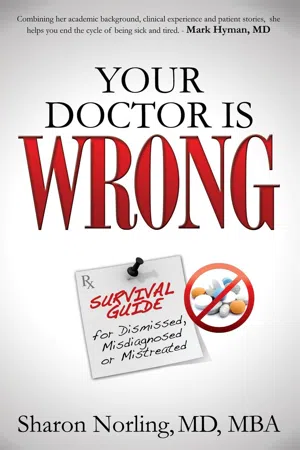
Your Doctor Is Wrong
Survival Guide for Dismissed, Misdiagnosed or Mistreated
- 200 pages
- English
- ePUB (mobile friendly)
- Available on iOS & Android
eBook - ePub
About this book
Information
Topic
MedicineChapter 1
MEDICALLY RIGHT OR WRONG?
Each year 250,000 people die due to medical errors. That is equivalent to one and a half 747 jumbo jets crashing every day.
My mother had severe stomach pains. I remember her suffering as she lay on a small sofa in the living room at night trying not to disturb her family as she cried out in pain and we tried to sleep. She went to many doctors in our small rural Minnesota town as well as seeking help in Minneapolis and the Mayo Clinic. They told her, “There is nothing wrong with you.” She was dismissed. She was misdiagnosed. They prescribed an antipsychotic medication,Thorazine. Within a year my mother died of stomach and esophageal cancer.She was 38 years old. I was 12.
Years later, my elderly father was diagnosed with colon cancer after months of a delayed diagnosis. He was healthy for his age and still had his great sense of humor. After surgery he never regained consciousness. I asked, “Why? What happened?” Even as a physician I never got an answer. “It could have been a stroke,” I was told.
I stayed with him in the ICU for days. Then I went home to get some rest. After I fell asleep the phone rang. It was his doctor. Dr. M. told me my dad had died. Of course, I felt terrible. I wasn’t there. I had left. I called my sons to ask them to be pallbearers. I dozed a little. In the early morning I called the hospital to let them know the name of the funeral home. I said, “I am calling about Stan Norling.” The nurse said, “He is doing better, his blood pressure is up and he is stable.”
The shock was unbelievable. To my horror I thought, did I dream this? I called my brother and said I had just talked to the hospital and dad was doing better. The look on his face can only be well described by my sister-in-law, Ruth Ann, who was standing next to him. The doctor had called him in the middle of the night and told him dad had died.
I drove 100 miles back to my hometown to see for myself. Dad was still alive in the ICU. His doctor left town that morning on vacation. He never ever called me or my brother back.
I suppose it goes without saying that a doctor should be able to determine if someone is dead or alive especially in the ICU.
Everyone has a story about someone they know or themselves who has been dismissed, misdiagnosed or their symptoms were just treated like the tip of the iceberg with a pharmaceutical drug.
Recent research published in the October issue 2012 of the Annals of Family Medicine show that chronic illness affects 45 percent of the US population and that 40 percent of people older than 60 years of age are now taking five or more medications. More medications are prescribed to alleviate the side effects of the already-prescribed medications.1
Pharmaceutical drugs inhibit, block or antagonize specific bio-chemical pathways. These are the very pathways that make your body work. What else do we know about pharmaceutical drugs?
- Medication errors are estimated to account for at least 7,000 deaths in the United States alone every year.2
- Over 770,000 patients are estimated to be injured because of medication errors every year.3
- The Food and Drugs Administration (FDA) in the United States says that at least 1 death occurs per day and 1.3 million people are injured each year due to medication errors.4
- Several studies point to more than 50 percent of potential and serious adverse events being associated with injectable medications.5
- One 5-year study showed that the most common types of medication errors were a wrong dose, a wrong drug or a wrong route of administration.6
- Medication errors occur in nearly 1 out of every 5 doses given to patients in the typical hospital.7
- Adverse medication events have been reported and are estimated to occur at a rate of around 5 percent for admissions and discharges from the typical hospital.8
According to the New England Journal of Medicine, medical care in the United States is uniformly mediocre. This report was one of the largest studies on health care quality in the U.S. It found that patients were found to receive proper care only 55 percent of the time. This study brought to light that no one is safe from poor quality medical care— myself included.
According to the August 14, 2013 issue of JAMA, US rankings relative to other countries got worse for:
- Death rate (from 18th to 27th)
- Years lost life (from 23rd to 28th)
- Years lived with disability (from 5th to 6th)
- Life expectancy at birth (from 20th to 27th)
- Healthy life expectancy (from 14th to 26th)
“The United States spends the most per capita on health care across all countries, lacks universal health coverage, and lags behind other high-income countries for life expectancy and many other health outcome measures.”
Americans needlessly suffer and die at the hands of the medical establishment. No one, however, had ever analyzed all the published literature dealing with injuries and deaths caused by medicine.
That changed when a group of researchers meticulously reviewed the published statistical evidence and compiled a startling fully referenced report. According to the data compiled by these researchers, the number of people having adverse reactions to prescribed drugs in the hospital is 2.2. million per year.9 The number of unnecessary antibiotics prescribed annually for viral infections is 20 million per year.10,11 The number of unnecessary medical and surgical procedures performed annually is 7.5 million per year.12 The number of people exposed to unnecessary hospitalization annually is 8.9 million per year.13
The most stunning statistic is the total number of deaths. An astounding 783,936 Americans die each year as a result of the medical care they receive. Today’s medical system is the leading cause of death and injury in the U.S. By contrast, 577,190 deaths due to cancer and about 600,000 due to heart disease have been estimated for 2012.
Halstead Holman wrote in the Journal of American Medical Association that medicine is in need of new clinical education to better manage the rising prevalence of chronic disease.
Evaluating the whole person gives us whole answers. This method is a proven treatment that has worked for so many.
Most people wouldn’t buy a car without checking consumer ratings, but they still rely largely on word of mouth to select a physician. Yet with more patients having to choose from a health plan’s list, there is a growing demand for information that is more reliable than a friend’s recommendation. It goes beyond the rudimentary details available online—a doctor’s hours, educational background and ZIP code. Remember 50 percent of all doctors graduated in the bottom half of their class.
Aging baby boomers think 60 is the new 40. But 40 is not necessarily the benchmark of mature vigor or sound health. By age 35—40 men and women will probably already be suffering from a number of silent diseases.
Given the absence of significant conventional findings, these silent diseases and mild symptoms are overlooked or dismissed. Rather than finding the root cause early and preventing the progression, mainstream medicine treats fullblown diseases that may have been festering for years. Health insurance is like car insurance—you are only entitled to make a claim after a wreck, and then it may be too late.
Once you or your loved one has a serious disease or significant unbearable symptoms, all other issues become largely irrelevant. Your concern is how quickly I can get a relief in the least toxic way.
There is a better way. This book will give the direction, the help and the hope of living a longer, healthier life.
Every day in my practice I see patients who have been suffering with chronic illness for days, months, and even years. The conventional care practice is to recommend a prescription or do a surgery. How many times have you gone to your doctor and been told what to do and not been given options? Perhaps you were told, “It is all in your head,” but you know you have symptoms. You know you are not well.
Are you are tired, anxious, depressed, can’t focus, lack motivation, experience joint pain, can’t sleep, have digestive issues and just don’t feel well? If so, there is something wrong. The right doctor can find the root cause. To be a happy and successful person, health is a must.
You may have seen many doctors and spent the time, energy, and money looking for answers. Yet, all the routine tests come back negative. You look good on paper and have been told that there is nothing wrong with you because the doctor could not find the underlying cause.
Is the life you are living worth the life you are giving up?
Today we have a wide range of tests, from basic labs to sophisticated imaging that can be done to look for the root cause of symptoms or illnesses. The power of these tests in obtaining information and saving lives has encouraged the hope of a “magic bullet” for treatment; however this model has, to a large extent, failed to produce the same success with diseases that are multi-factorial and chronic in nature.
Illness starts because of a cause, illness continues because the cause continues, and illness can only be resolved when the cause is resolved.
You must find the underlying or root cause of an illness or a symptom rather than just treating the tip of the iceberg with a pharmaceutical drug. It is more than just taking a pill or having a procedure. Medicine is more than just naming a disease. It is more than a pill for an ill. You need and deserve to live your best life.
As education is often the key to health, keeping abreast of advances in medicine is critical, if challenging—even for physicians. In the past, physicians were taught to “blame or name” a disease. Unfortunately, according to the research, most doctors practice only what they have learned in medical school and residency. There’s a huge gap between research and the way doctors practice. This is evident even in mainstream medical journals like the Journal of American Medical Association. “There is a large gap between what physicians do for patients with chronic diseases and what should be done.”14
Today, we’ve learned that there is no such thing as a single disease, but rather the root causes of an illness that create diseases. If the underlying cause of a symptom is not identified and treated, disease or illness often occurs. This explains why people are often diagnosed with multiple diseases or symptoms as they get sicker and sicker over time.
Chronic illness is in epidemic proportions. Despite the fact that the majority of the US population looks rather healthy, statistics show a different story. Nearly 1 in 2 (133 million) people have a chronic condition. This could be an illness like cancer or rheumatoid arthritis, or a condition such as arthritis, migraines or pain.15
“When the well’s dry, we know the worth of water.” —Benjamin Franklin, 1706–1790. When we are healthy we take it for granted. It’s only when we get sick we realize the importance of good health.
The World Health Organization states, “Chronic diseases are diseases of long duration and generally slow progression. Chronic diseases, such as heart disease, stroke, cancer, chronic respiratory diseases and diabetes, are by far the leading cause of mortality in the world, representing 63 percent of all deaths. Out of the 36 million people who died from chronic disease in 2008, nine million were under 60.16
Your health or lack of it is based on your genetic vulnerability, the environment, and your lifestyle. Genetic variations are important but genes are like light switches that can be turned on or off based on the lifestyle you choose to live. The variations in genes, called SNPs, are single nucleotide polymorphisms. SNP’s can be tested for a person’s ability to detoxify and for cardiovascular risk. This is important information so you can implement changes to decrease your risk of disease.
Seventy-five percent of gene expression is due to the environment or your lifestyle choices. Twenty-five percent is hardwired.
Sending you and your body parts off to multiple specialists may not be the best approach when many symptoms can be occurring that are linked to the same underlying cause such as inflammation. Maybe your doctor has mentioned that you have inflammation. In order for you to get well you need to find out the root cause of the inflammation. Treating your symptoms with an anti-inflammatory just covers the symptoms and may not be therapeutic.
Most physicians are not adequately trained to assess the underlying causes of complex, chronic disease and to apply strategies such as nutrition, diet, and exercise to both treat and prevent these illnesses in their patients. They practice more of an acute care approach; a quick diagnosis, followed by a prescription, procedure or surgery. This can be effective in management of acute medical conditions, but not necessarily the best answers for chronic c...
Table of contents
- Cover
- Title
- Copyright
- Contents
- Acknowledgments
- Introduction
- Chapter 1 Medically Right or Wrong?
- Chapter 2 Food Allergies: Discovery and Treatment
- Chapter 3 Indigestion: Right Tests Right Solutions for GERD and IBS
- Chapter 4 Hormones for Life: Health or Harm?
- Chapter 5 Sex: Women Want More
- Chapter 6 Moods: Finding the Root Cause
- Chapter 7 Dancing Partners: Hormones, Neurotransmitters, Thyroid, Adrenals
- Chapter 8 Addictions: Righting the Wrong
- Chapter 9 Heart Disease: Right Solutions
- Chapter 10 Toxins: Right Choices
- Chapter 11 The Fork in the Road: Getting it Right
- About the Author
- References
- Resources
- Bonus
Trusted by 375,005 students
Access to over 1.5 million titles for a fair monthly price.
Study more efficiently using our study tools.
Frequently asked questions
Yes, you can cancel anytime from the Subscription tab in your account settings on the Perlego website. Your subscription will stay active until the end of your current billing period. Learn how to cancel your subscription
No, books cannot be downloaded as external files, such as PDFs, for use outside of Perlego. However, you can download books within the Perlego app for offline reading on mobile or tablet. Learn how to download books offline
Perlego offers two plans: Essential and Complete
- Essential is ideal for learners and professionals who enjoy exploring a wide range of subjects. Access the Essential Library with 800,000+ trusted titles and best-sellers across business, personal growth, and the humanities. Includes unlimited reading time and Standard Read Aloud voice.
- Complete: Perfect for advanced learners and researchers needing full, unrestricted access. Unlock 1.5M+ books across hundreds of subjects, including academic and specialized titles. The Complete Plan also includes advanced features like Premium Read Aloud and Research Assistant.
We are an online textbook subscription service, where you can get access to an entire online library for less than the price of a single book per month. With over 1.5 million books across 990+ topics, we’ve got you covered! Learn about our mission
Look out for the read-aloud symbol on your next book to see if you can listen to it. The read-aloud tool reads text aloud for you, highlighting the text as it is being read. You can pause it, speed it up and slow it down. Learn more about Read Aloud
Yes! You can use the Perlego app on both iOS and Android devices to read anytime, anywhere — even offline. Perfect for commutes or when you’re on the go.
Please note we cannot support devices running on iOS 13 and Android 7 or earlier. Learn more about using the app
Please note we cannot support devices running on iOS 13 and Android 7 or earlier. Learn more about using the app
Yes, you can access Your Doctor Is Wrong by Sharon Norling in PDF and/or ePUB format, as well as other popular books in Medicine & Alternative & Complementary Medicine. We have over 1.5 million books available in our catalogue for you to explore.