How Shakespeare’s exploration of central human questions—about identity, politics, religion and right and wrong—explains his lasting power, popularity and relevance
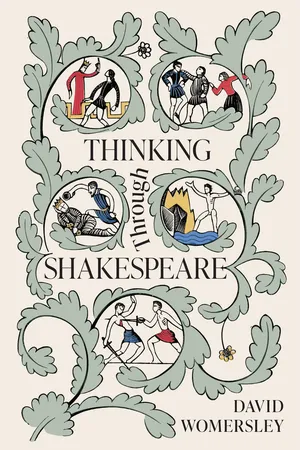
In the eighteenth century, Samuel Johnson famously argued that Shakespeare is enduringly popular because he “is above all writers, at least above all modern writers, the poet of nature; the poet that holds up to his readers a faithful mirror of manners and of life.” Johnson’s view largely prevailed until the late twentieth century, when it was challenged by a growing scepticism about the existence of a general human nature. In Thinking Through Shakespeare, eminent literary critic David Womersley pushes back against this change by exploring how Shakespeare’s plays think through—and invite us to think through—deep human questions of lasting importance.
Thinking Through Shakespeare explores four perennial human problems: personal identity, the distinction between civilization and barbarism, the relation between political power and religious authority and the tension between means and ends. It examines the history of these problems, from antiquity to today, and traces how Shakespeare engages with them in the great tragedies—Othello, Hamlet, Macbeth and King Lear—but also in his other plays. Without arguing that human nature is universal or unchanging, or that Shakespeare has some special access to timeless wisdom, the book makes the case that his drama is powerful because it serves as a forensic tool, probing rival perspectives on questions that have preoccupied many people in many societies over many centuries.
By revealing in new ways how Shakespeare’s plays are animated and driven by central human problems, and why he should again be viewed as the great poet of human nature, Thinking Through Shakespeare opens up a richer understanding and appreciation of his work.
- English
- ePUB (mobile friendly)
- Available on iOS & Android
eBook - ePub
Thinking Through Shakespeare
About this book
Information
Publisher
Princeton University PressYear
2026Print ISBN
9780691283739
9780691154107
eBook ISBN
9780691288369
Table of contents
- Cover
- Title Page
- Copyright
- Dedication
- Contents
- Acknowledgments
- Abbreviations
- Introduction: Johnson on Shakespeare
- 1. Selves and Others: Othello
- 2. Barbarism and Civilisation: Hamlet
- 3. Throne and Altar: Macbeth
- 4. Means and Ends: King Lear
- Coda: Jonson on Shakespeare
- Index
Trusted by 375,005 students
Access to over 1.5 million titles for a fair monthly price.
Study more efficiently using our study tools.
Frequently asked questions
Yes, you can cancel anytime from the Subscription tab in your account settings on the Perlego website. Your subscription will stay active until the end of your current billing period. Learn how to cancel your subscription
No, books cannot be downloaded as external files, such as PDFs, for use outside of Perlego. However, you can download books within the Perlego app for offline reading on mobile or tablet. Learn how to download books offline
Perlego offers two plans: Essential and Complete
- Essential is ideal for learners and professionals who enjoy exploring a wide range of subjects. Access the Essential Library with 800,000+ trusted titles and best-sellers across business, personal growth, and the humanities. Includes unlimited reading time and Standard Read Aloud voice.
- Complete: Perfect for advanced learners and researchers needing full, unrestricted access. Unlock 1.5M+ books across hundreds of subjects, including academic and specialized titles. The Complete Plan also includes advanced features like Premium Read Aloud and Research Assistant.
We are an online textbook subscription service, where you can get access to an entire online library for less than the price of a single book per month. With over 1.5 million books across 990+ topics, we’ve got you covered! Learn about our mission
Look out for the read-aloud symbol on your next book to see if you can listen to it. The read-aloud tool reads text aloud for you, highlighting the text as it is being read. You can pause it, speed it up and slow it down. Learn more about Read Aloud
Yes! You can use the Perlego app on both iOS and Android devices to read anytime, anywhere — even offline. Perfect for commutes or when you’re on the go.
Please note we cannot support devices running on iOS 13 and Android 7 or earlier. Learn more about using the app
Please note we cannot support devices running on iOS 13 and Android 7 or earlier. Learn more about using the app
Yes, you can access Thinking Through Shakespeare by David Womersley in PDF and/or ePUB format, as well as other popular books in Literature & Literary Criticism of Shakespeare. We have over 1.5 million books available in our catalogue for you to explore.