The thesis of the book is that in the early modern period, literature claimed precedence over the observation of nature. There were shifts through phases of temporary parity, the priority of natural sciences in the 19th century, and their critique by literature in the 20th century. These developments are presented in France and the Spanish-speaking world, while also considering Germany and England: While Montaigne, Pedro Mexía, Pérez de Oliva, Vives, and Gracián prioritize literature, Pascal contrasts the "esprit de finesse" with the "esprit de géométrie," opening a controversy that Linnaeus and Buffon continue. Enlightenment thinkers like Voltaire orient themselves toward the English model, where Locke and Hume introduce empirical sciences whose advances Rousseau critiques. In the 19th century, Balzac and Pérez Galdós engage with the natural sciences, with Zola later looking to Darwin and Comte as role models. Finally, the aporias of scientific thinking are highlighted by Ortega y Gasset, Borges, and Sábato.
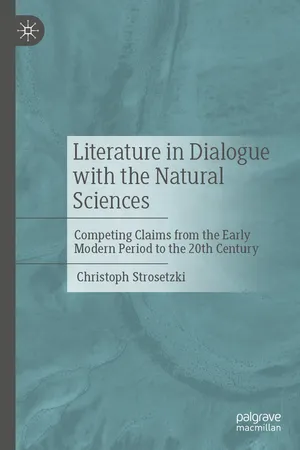
eBook - ePub
Literature in Dialogue with the Natural Sciences
Competing Claims from the Early Modern Period to the 20th Century
- English
- ePUB (mobile friendly)
- Available on iOS & Android
eBook - ePub
Literature in Dialogue with the Natural Sciences
Competing Claims from the Early Modern Period to the 20th Century
About this book
Information
Table of contents
- Literature in Dialogue with the Natural Sciences
- Prologue
- Contents
- Part I: Priority of Literature
- Part II: Unclear Priorities
- Part III: Priority of the Natural Sciences
- Part IV: Criticism of the Priority of the Natural Sciences
- References
Trusted by 375,005 students
Access to over 1.5 million titles for a fair monthly price.
Study more efficiently using our study tools.
Frequently asked questions
Yes, you can cancel anytime from the Subscription tab in your account settings on the Perlego website. Your subscription will stay active until the end of your current billing period. Learn how to cancel your subscription
No, books cannot be downloaded as external files, such as PDFs, for use outside of Perlego. However, you can download books within the Perlego app for offline reading on mobile or tablet. Learn how to download books offline
Perlego offers two plans: Essential and Complete
- Essential is ideal for learners and professionals who enjoy exploring a wide range of subjects. Access the Essential Library with 800,000+ trusted titles and best-sellers across business, personal growth, and the humanities. Includes unlimited reading time and Standard Read Aloud voice.
- Complete: Perfect for advanced learners and researchers needing full, unrestricted access. Unlock 1.5M+ books across hundreds of subjects, including academic and specialized titles. The Complete Plan also includes advanced features like Premium Read Aloud and Research Assistant.
We are an online textbook subscription service, where you can get access to an entire online library for less than the price of a single book per month. With over 1.5 million books across 990+ topics, we’ve got you covered! Learn about our mission
Look out for the read-aloud symbol on your next book to see if you can listen to it. The read-aloud tool reads text aloud for you, highlighting the text as it is being read. You can pause it, speed it up and slow it down. Learn more about Read Aloud
Yes! You can use the Perlego app on both iOS and Android devices to read anytime, anywhere — even offline. Perfect for commutes or when you’re on the go.
Please note we cannot support devices running on iOS 13 and Android 7 or earlier. Learn more about using the app
Please note we cannot support devices running on iOS 13 and Android 7 or earlier. Learn more about using the app
Yes, you can access Literature in Dialogue with the Natural Sciences by Christoph Strosetzki in PDF and/or ePUB format, as well as other popular books in Literature & Literary Criticism for Comparative Literature. We have over 1.5 million books available in our catalogue for you to explore.