The Agricultural and Horticultural Society of India was founded in 1820 by an English Baptist missionary, William Carey. He was part of a network of missionaries centred at Srirampur (Serampore), the Danish settlement close to Calcutta. This book explores the ways that missionaries included plants in their projects of proselytization to better understand the origins of this scientific society. It includes an investigation of the farms and gardens at each mission station, the missionaries’ work with indigo plantations, and different scientific projects leading up to the creation of the agricultural society. Amidst all of this, plants became an important target and sign of moral improvement, marking a sort of ‘moral frontier’ which reiterated racial hierarchies. Nevertheless, various entanglements with Bengali converts, gardeners (malis), and the elite bhadralok class also impacted the missionary vision. In the initial years of the scientific organisation, missionaries and their interlocutors upheld a romantic and hierarchical vision of agrarian society that mixed gardening with large-scale agriculture – but, an economic depression in 1833, followed shortly by William Carey’s death in 1834, ended this composite vision. The Society began to focus instead on the production of more remunerative agricultural cash crops, like sugar and cotton, over horticultural crops like vegetables and fruit trees.
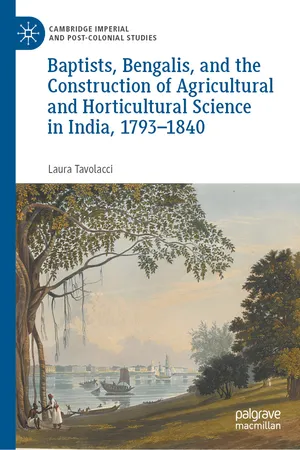
eBook - ePub
Baptists, Bengalis, and the Construction of Agricultural and Horticultural Science in India, 1793–1840
- English
- ePUB (mobile friendly)
- Available on iOS & Android
eBook - ePub
Baptists, Bengalis, and the Construction of Agricultural and Horticultural Science in India, 1793–1840
About this book
Information
Table of contents
- Cambridge Imperial and Post-Colonial Studies
- Baptists, Bengalis, and the Construction of Agricultural and Horticultural Science in India, 1793–1840
- Acknowledgments
- Notes on Spellings
- Contents
- 1. Introduction
- 2. Rectifying the Soul and Body: Gender, Class, Race, and the Fracturing of Improvement
- 3. Transplanting in the Garden of God
- 4. The Evangelical “Improvement” of Plant Sciences
- 5. Toward a Moral Agriculture: William Carey and the Founding of the Agricultural and Horticultural Society of India
- 6. Vegetable Gardens Versus Cash Crops: Science and Political Economy in the Agricultural and Horticultural Society of India, 1820–40
- 7. Where are the Plants? Morality and Science as an Elite Curriculum
- Conclusion
- Bibliography
- Index
Trusted by 375,005 students
Access to over 1.5 million titles for a fair monthly price.
Study more efficiently using our study tools.
Frequently asked questions
Yes, you can cancel anytime from the Subscription tab in your account settings on the Perlego website. Your subscription will stay active until the end of your current billing period. Learn how to cancel your subscription
No, books cannot be downloaded as external files, such as PDFs, for use outside of Perlego. However, you can download books within the Perlego app for offline reading on mobile or tablet. Learn how to download books offline
Perlego offers two plans: Essential and Complete
- Essential is ideal for learners and professionals who enjoy exploring a wide range of subjects. Access the Essential Library with 800,000+ trusted titles and best-sellers across business, personal growth, and the humanities. Includes unlimited reading time and Standard Read Aloud voice.
- Complete: Perfect for advanced learners and researchers needing full, unrestricted access. Unlock 1.5M+ books across hundreds of subjects, including academic and specialized titles. The Complete Plan also includes advanced features like Premium Read Aloud and Research Assistant.
We are an online textbook subscription service, where you can get access to an entire online library for less than the price of a single book per month. With over 1.5 million books across 990+ topics, we’ve got you covered! Learn about our mission
Look out for the read-aloud symbol on your next book to see if you can listen to it. The read-aloud tool reads text aloud for you, highlighting the text as it is being read. You can pause it, speed it up and slow it down. Learn more about Read Aloud
Yes! You can use the Perlego app on both iOS and Android devices to read anytime, anywhere — even offline. Perfect for commutes or when you’re on the go.
Please note we cannot support devices running on iOS 13 and Android 7 or earlier. Learn more about using the app
Please note we cannot support devices running on iOS 13 and Android 7 or earlier. Learn more about using the app
Yes, you can access Baptists, Bengalis, and the Construction of Agricultural and Horticultural Science in India, 1793–1840 by Laura Tavolacci in PDF and/or ePUB format, as well as other popular books in History & British History. We have over 1.5 million books available in our catalogue for you to explore.